
WANTAI BIOLOGICAL(603392)

Search documents
万泰生物(603392) - 万泰生物关于部分募集资金投资项目延期的公告
2025-12-12 10:01
证券代码:603392 证券简称:万泰生物 公告编号:2025-062 | | | 原计划拟投入 | 调 整 后 拟 投 入 募 | 截至 年 2025 | 11 | 截至 年 2025 | 11 | | --- | --- | --- | --- | --- | --- | --- | --- | | 序号 | 项目名称 | 募集资金金额 | 集资金金额(扣除 | 月30日累计投入 | | 月30日累计投入 | | | | | | 发行费用) | 金额 | | 进度(%) | | | 1 | 九价宫颈癌疫苗二期扩 产建设项目 | 110,000.00 | 106,015.57 | 65,593.92 | | 61.87 | | | 2 | 二十价肺炎球菌多糖结 合疫苗产业化项目 | 70,000.00 | 70,000.00 | 26,827.22 | | 38.32 | | | 3 | 养生堂厦门万泰诊断基 地建设项目 | 110,000.00 | 110,000.00 | 71,186.14 | | 64.71 | | | 4 | 鼻喷疫苗产业基地建设 项目 | 60,000.00 | 6,191.39 ...

万泰生物(603392) - 万泰生物关于部分募集资金投资项目结项的公告
2025-12-12 10:01
证券代码:603392 证券简称:万泰生物 公告编号:2025-063 北京万泰生物药业股份有限公司 关于部分募集资金投资项目结项的公告 本公司董事会及全体董事保证本公告内容不存在任何虚假记载、误导性 陈述或者重大遗漏,并对其内容的真实性、准确性和完整性承担法律责任。 重要内容提示: 北京万泰生物药业股份有限公司(以下简称"公司")2021年非公开发行股 票募投项目之一的"养生堂厦门万泰诊断基地建设项目"主体工程建设均已完成,并 已通过工程质量竣工验收、人防竣工验收。公司对该募投项目进行结项。 根据《上海证券交易所上市公司自律监管指引第1号——规范运作》等有关规定, 公司养生堂厦门万泰诊断基地建设项目结项事项无需提交公司董事会、股东会审议,亦 无需保荐人发表意见。 一、募集资金基本情况 经中国证券监督管理委员会《关于核准北京万泰生物药业股份有限公司非公开发 行股票的批复》(证监许可[2022]1098号)核准,公司非公开发行25,862,705股新股, 发行价格135.33元/股,募集资金总额为人民币3,499,999,867.65元,扣除与发行有关的 费用人民币39,844,153.48元,实际募集资金净额 ...
万泰生物:部分募集资金投资项目延期
2 1 Shi Ji Jing Ji Bao Dao· 2025-12-12 09:51
Core Viewpoint - The company has announced a delay in the completion of its second-phase expansion project for the nine-valent cervical cancer vaccine, pushing the expected operational date from December 2025 to December 2026 [1] Funding and Financials - The initial planned investment for the project was 1.1 billion yuan, which has been adjusted to approximately 1.060 billion yuan [1] - The funding source for this project will continue to be from non-public stock issuance [1] Project Requirements and Delays - The delay is primarily due to the need to complete processes such as process validation, comparability studies, and stability studies as required by regulatory authorities [1] - Additional registration documentation for the new production line must be submitted and approved before commercial production can commence [1] Impact on Operations - The delay is a cautious decision aimed at ensuring the quality of project construction and improving the efficiency of fund utilization [1] - There will be no changes to the implementation entity, location, or investment scale, and the use of raised funds will remain unchanged [1] - The delay is not expected to negatively impact the company's main business or financial status and is aligned with the company's long-term development strategy [1]
万泰争锋默沙东:HPV疫苗“最甜”的市场已经没了 | 海斌访谈
Di Yi Cai Jing· 2025-12-11 15:05
Core Viewpoint - The launch of Wantai Biological's nine-valent HPV vaccine in Shanghai marks the beginning of competition with Merck, which has dominated the market for seven years, raising concerns about the clarity of commercial returns for vaccine companies [1][4]. Group 1: Market Dynamics - Wantai's nine-valent HPV vaccine is priced at 499 yuan, requiring only 2 doses for women aged 9-17 and 3 doses for those aged 18-45, making it more affordable compared to Merck's vaccine [3][5]. - Merck's vaccine has seen a significant drop in monthly administration numbers in Shanghai, from 2000 to around 200, indicating a potential saturation in the market [4][6]. - The introduction of Wantai's vaccine is expected to increase vaccination rates among women, particularly those who previously found Merck's vaccine too expensive [5][6]. Group 2: Clinical and Production Insights - Wantai employs a lower-cost production method using E. coli, which allows for more stable output compared to Merck's vaccine [5]. - Wantai's vaccine has undergone five clinical trials involving approximately 11,000 Chinese women, with mostly mild adverse events reported [5]. - Merck's vaccine has a longer history of real-world data, but the introduction of Wantai's vaccine may lead to a decrease in prices for both products [5][8]. Group 3: Competitive Landscape - The HPV vaccine market in China is facing concerns of oversupply, with Merck's nine-valent vaccine experiencing a 38% year-on-year decline in batch approvals [8]. - Merck's distributor, Zhifei Biological, is under pressure to clear inventory, which may lead to price reductions [8]. - Other companies, such as Watson Bio and Ruike Bio, are also developing HPV vaccines, but their market entry timelines are uncertain, with Ruike's vaccine expected to be approved by late 2026 or early 2027 [9][10].

过去10年,顶级富豪们都怎么赚钱?
商业洞察· 2025-12-10 09:51
Core Insights - The article discusses the evolution of wealth in China over the past decade, highlighting the shift from real estate tycoons to new wealthy individuals in sectors driven by "emotional value" such as Pop Mart, Laopu Gold, and Card Game [4][6][9]. Group 1: New Wealth Creation - The top new entrants in the wealth rankings for 2025 include Xu Gaoming and Xu Dongbo from Laopu Gold with a wealth of 69.5 billion yuan, and Li Qibin and Qi Yan from Card Game with 60 billion yuan [7]. - Pop Mart's revenue and net profit have both increased by over 200% year-on-year, while Card Game's revenue is projected to exceed 10 billion yuan in 2024 with a net profit margin over 40% [7][9]. - The rise of milk tea brands has also contributed to the creation of new wealthy individuals, with brands like Guming and Bawang Tea entering the wealth rankings [9]. Group 2: Historical Context - The article contrasts the current wealth landscape with that of 2015, when high-tech internet and manufacturing sectors were the primary sources of new wealth, exemplified by DJI's founder Wang Tao and Didi's Cheng Wei [9][10]. - Many of today's successful companies were initially underestimated by major investors, who missed opportunities to invest in them before they became billion-dollar enterprises [10][12]. Group 3: Female Entrepreneurs - The article notes a significant increase in female entrepreneurs on the wealth list, with women making up 22.4% of the total, and over 70% being first-generation wealth creators [13][16]. - Notable female figures include Zong Fuli, who became the first female billionaire in 2024, and Zhong Huijuan, who, along with her daughter, became the first female billionaire from the pharmaceutical industry [16][17]. Group 4: Wealth Stability and Changes - The article outlines that five individuals have held the title of China's richest over the past decade, including Wang Jianlin, Xu Jiayin, Jack Ma, Zhang Yiming, and Zhong Shanshan [19]. - Zhong Shanshan's wealth, primarily from his companies Nongfu Spring and Wantai Biological Pharmacy, reached 530 billion yuan, making him the richest for the fourth consecutive year [19][20]. Group 5: Decline of Real Estate Tycoons - The article highlights a significant decline in the representation of real estate tycoons on the wealth list, dropping from 30% to just 10% over the past decade [28]. - Wang Jianlin and Xu Jiayin, once at the top, have faced severe financial difficulties, with Wang's company facing economic disputes and Xu's assets being frozen due to debt issues [30][31][32].



国产疫苗迎来出海爆发的前夜
Xin Lang Cai Jing· 2025-12-10 08:02
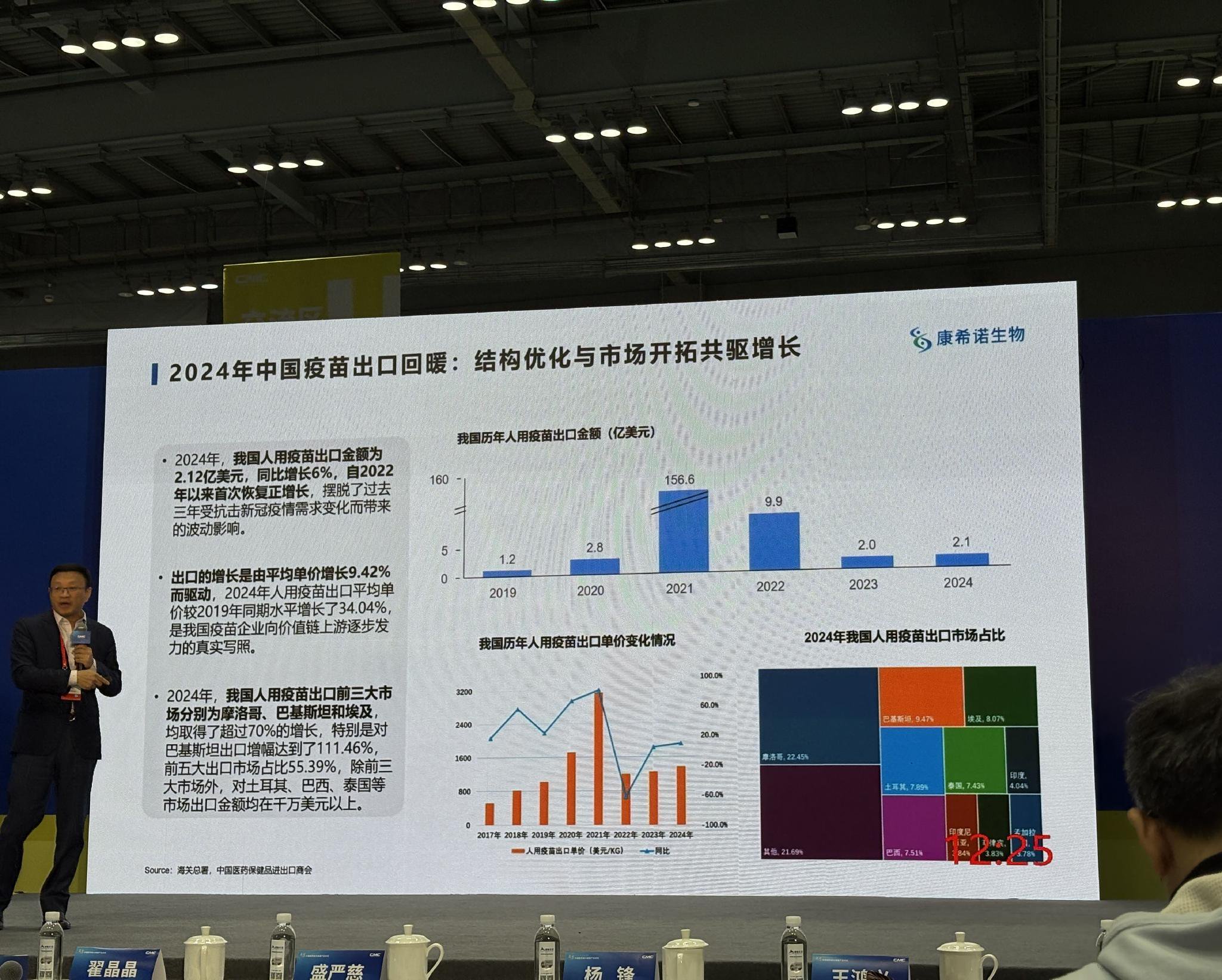
Core Viewpoint - The export of Chinese vaccines is experiencing a recovery, with significant international contracts and an upward trend in export value, driven by increased average prices and a shift towards innovative products [1][9][19]. Group 1: Export Growth and Market Dynamics - Sinovac has signed a long-term contract with the Brazilian Ministry of Health to supply approximately 60 million doses of varicella and rabies vaccines over the next decade, valued at over $700 million [1][21]. - In 2024, China's human vaccine export value is projected to reach $212 million, marking a 6% year-on-year increase and the first growth since 2022 [1]. - The average export price of Chinese human vaccines is expected to rise by 9.42% in 2024, with a 34.04% increase compared to the same period in 2019 [9]. Group 2: Product Development and Innovation - Chinese vaccine companies are expanding their product lines from basic vaccines to more competitive innovative vaccines, with a focus on higher-value categories [8]. - Various vaccines, including the 13-valent pneumococcal vaccine and quadrivalent meningococcal conjugate vaccine, are accelerating entry into international markets [10]. - The HPV vaccine from Wantai Biologics has seen a threefold increase in exports, reaching approximately 15 million doses in 2025 [12]. Group 3: Challenges and Competitive Landscape - The domestic vaccine market is under pressure, with a decline in the number of vaccine approvals from 5,343 in 2021 to 4,202 in 2024, influenced by economic downturns and reduced vaccination willingness [14]. - The competition in the vaccine development space is intense, with many companies pursuing similar vaccine types, leading to a crowded pipeline [17]. - The export strategy is also influenced by cost structures, as companies aim to lower supply costs and improve production efficiency through increased output [18]. Group 4: Strategic Opportunities and Localization - There is a structural opportunity for Chinese vaccine companies to enter markets that are underserved by multinational corporations, particularly in low- and middle-income countries [19]. - Successful international expansion requires not only product sales but also the establishment of localized systems to support long-term growth [20]. - Companies are shifting from simple export models to more integrated approaches, including local production and technology transfer agreements [20].


首款国产九价HPV疫苗正式在沪接种
Jing Ji Guan Cha Wang· 2025-12-09 12:58
Core Viewpoint - The launch of the first domestically produced nine-valent HPV vaccine in Shanghai provides a new option for cervical cancer prevention for women aged 9 to 45 [1] Group 1: Vaccine Approval and Significance - The nine-valent HPV vaccine, named "Xinkening 9," developed by Wantai Biological Pharmacy, received approval from the National Medical Products Administration in June 2025, making it the first domestically approved nine-valent HPV vaccine and the second globally [1] - Cervical cancer is one of the most common malignant tumors threatening women's health worldwide and is the only cancer that can be prevented through vaccination [1] Group 2: Vaccine Efficacy and Pricing - Research indicates that the vaccine effectively protects against infections from nine types of HPV that can lead to cervical cancer and related diseases [1] - The vaccine is priced at 499 yuan per dose, with a total cost of 998 yuan for a two-dose regimen for females aged 9-17, and 1497 yuan for a three-dose regimen for females aged 18-45 [1] Group 3: Implementation and Distribution - Shanghai has fully launched the vaccination service for the domestically produced nine-valent HPV vaccine, with the first batch of vaccines being delivered to community health service centers across the city [1]
医保商保“双目录”发布,建信中证创新药ETF(159835)所跟踪指数一度涨超1%,机构研判创新药有望获得更高利润空间
Sou Hu Cai Jing· 2025-12-09 04:50
Group 1 - The core viewpoint of the news highlights the significant increase in the success rate of national medical insurance negotiations, reaching a historical high, which is expected to encourage the development of innovative drugs in China [2] - The 2025 National Medical Insurance Drug List will add 114 new drugs, including 50 first-class innovative drugs, with an overall success rate of 88%, marking a notable increase from 76% in 2024 [1] - The new drug list will officially implement on January 1, 2026, expanding the total number of drugs covered to 3,253, enhancing coverage in key areas such as oncology, chronic diseases, mental health, rare diseases, and pediatric medications [1] Group 2 - Citic Securities believes that the successful negotiation rate for national medical insurance has reached a historical high, and the commercial insurance directory is expected to become an important growth driver, promoting the development of innovative drugs [2] - Guotai Junan Securities indicates that the recent press conference and series of discussions by the medical insurance bureau clarify future policies that support companies in "anti-involution," international expansion, and differentiated innovation, which will benefit the high-quality development of the medical device industry [2] - The China Innovation Drug ETF closely tracks the China Innovation Drug Industry Index, which selects up to 50 representative listed companies involved in innovative drug research and development to reflect the overall performance of the innovative drug industry [2]



万泰生物:公司始终高度重视投资者权益保护
Zheng Quan Ri Bao· 2025-12-08 14:15
(文章来源:证券日报) 证券日报网讯 12月8日,万泰生物在互动平台回答投资者提问时表示,公司始终高度重视投资者权益保 护,将继续严格遵守监管要求,不断完善投资者关系管理,切实维护投资者合法权益。 ...
万泰生物:今年8月公司向无国界医生组织供应了重组戊型肝炎疫苗
Zheng Quan Ri Bao· 2025-12-08 14:14
证券日报网讯 12月8日,万泰生物在互动平台回答投资者提问时表示,今年8月公司向无国界医生组织 供应了重组戊型肝炎疫苗(大肠埃希菌)。 (文章来源:证券日报) ...