
ECOVACS(603486)

Search documents
科沃斯:计提资产减值准备共计约1.37亿元
Mei Ri Jing Ji Xin Wen· 2025-08-15 11:03
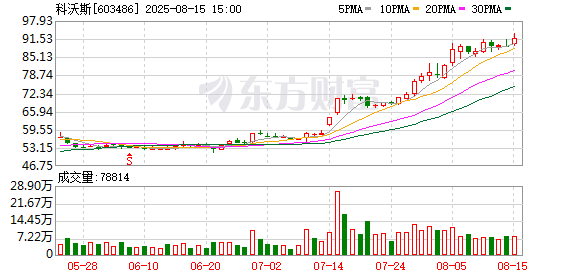
2024年1至12月份,科沃斯的营业收入构成为:家电行业占比100.0%。 (文章来源:每日经济新闻) 科沃斯(SH 603486,收盘价:91.6元)8月15日晚间发布公告称,根据《企业会计准则》及公司会计政 策、会计估计等相关规定,基于谨慎性原则,公司对截至2025年6月30日合并财务报表范围内的存货、 应收账款、其他应收款等资产出现的减值迹象进行全面的清查和分析,计提相应资产减值准备共计约 1.37亿元。本次计提各类资产减值准备约1.37亿元,减少公司2025年半年度合并报表利润总额约1.37亿 元,占2024年度经审计归属于上市公司股东净利润的16.96%。 ...


科沃斯(603486) - 关于参与设立投资基金完成基金备案的公告
2025-08-15 10:46
二、进展情况 近日,公司收到基金管理人通知,已根据《证券投资基金法》和《私募投资 基金监督管理暂行办法》等法律法规的要求,在中国证券投资基金业协会完成私 募投资基金备案手续,并取得《私募投资基金备案证明》。具体备案信息如下: 证券代码:603486 证券简称:科沃斯 公告编号:2025-063 转债代码:113633 转债简称:科沃转债 科沃斯机器人股份有限公司 关于参与设立投资基金完成基金备案的公告 本公司董事会及全体董事保证本公告内容不存在任何虚假记载、误导性陈述 或者重大遗漏,并对其内容的真实性、准确性和完整性承担法律责任。 一、基本情况 科沃斯机器人股份有限公司(以下简称"公司"或"科沃斯")公司于2025 年4月24日召开第三届董事会第二十六次会议,审议通过《关于参与设立基金暨 关联交易的议案》,为响应国家产业政策鼓励,更好地抓住人工智能、机器人、 互/物联网等行业未来发展机遇,提升公司在机器人和人工智能领域的全产业链 布局,推动技术赋能,场景落地和规模释放,助力包括具身智能等在内的新型机 器人发展和普及,促进公司生态协同,提高资金收益和创新效率等,拟参与发起 设立苏州隐峰揽秀创业投资合伙企业(有限 ...
科沃斯(603486) - 2024年度可持续发展报告
2025-08-15 10:46
公司代码: 6 0 3 4 8 6 / 公司简称:科沃斯 公司代码: 6 0 3 4 8 6 / 公 司 简 称 : 科 沃 斯 Ecovacs Sustainability Report 2024 | | aa | | --- | --- | | | 103 | | 贡献 | 107 | | | 109 | | 引表 | 115 | | | 120 | • • • • • • | • • • | | --- | | • • • • • | | • • • | | • | | --- | | • | | • | | • | | • | | • | | • | | • | | • | | • | | • | • | 公司、本公司、科沃斯、 指 科沃斯机器人股份有限公司 我们、集团 我们、集团 | | | --- | --- | | 服务机器人 | 控股千公司"科沃斯家用机器人有限公司"、"科沃斯机器人科技有限公司"、 | | | "科沃斯商用机器人有限公司"、"Ecovacs Robotics Holdings Limited"等 | | 漆ロ | 控股子公司"添可智能科技有限公司"、"添可电器有限公司"、"苏 ...
科沃斯(603486) - 关于2025年半年度募集资金存放与实际使用情况的专项报告
2025-08-15 10:46
证券代码:603486 证券简称:科沃斯 公告编号:2025-056 转债代码:113633 转债简称:科沃转债 科沃斯机器人股份有限公司关于2025 年半年度募集资金存放与实际使用情况的专项报告 本公司董事会及全体董事保证本公告内容不存在任何虚假记载、误导性陈述 或者重大遗漏,并对其内容的真实性、准确性和完整性承担法律责任。 根据中国证券监督管理委员会《上市公司募集资金监管规则》及上海证券交易 所颁布的《上海证券交易所上市公司自律监管指引第1号——规范运作》及科沃斯 机器人股份有限公司(以下简称"公司"或"本公司")《募集资金管理办法》等 相关规定,公司现将2025年半年度募集资金存放与实际使用情况专项说明如下: 一、募集资金基本情况 经中国证券监督管理委员会《关于核准科沃斯机器人股份有限公司公开发行 可转换公司债券的批复》(证监许可【2021】3493 号)的核准,公司获准向社会公 开发行面值总额 104,000 万元可转换公司债券,期限 6 年。本次发行的募集资金 总额为 1,040,000,000.00 元,扣除发行费用人民币 10,359,811.33 元(不含增值 税),实际募集资金净额为人民币 ...
科沃斯(603486) - 关于计提资产减值准备的公告
2025-08-15 10:46
转债代码:113633 转债简称:科沃转债 证券代码:603486 证券简称:科沃斯 公告编号:2025-060 科沃斯机器人股份有限公司 关于计提资产减值准备的公告 本公司董事会及全体董事保证本公告内容不存在任何虚假记载、误导性陈述 或者重大遗漏,并对其内容的真实性、准确性和完整性承担法律责任。 二、本次计提资产减值准备对公司财务状况的影响 本次计提各类资产减值准备136,692,962.86元,减少公司2025年半年度合并报 表利润总额136,692,962.86元,占2024年度经审计归属于上市公司股东净利润的 16.96%。本次计提资产减值准备事项真实反映了企业财务状况,符合《企业会计准 则》和相关政策规定,符合公司资产实际情况,能够公允地反映公司资产状况。 三、其他说明 公司本次拟计提的资产减值准备金额为公司初步测算的结果,未经会计师事务 所审计,最终以会计师事务所年度审计确认的金额为准。敬请广大投资者注意投资 风险。 特此公告。 科沃斯机器人股份有限公司董事会 2025年8月16日 1 科沃斯机器人股份有限公司(以下简称"本公司"或"公司")于2025年8月 14日召开第四届董事会第三次会议,审议 ...
科沃斯(603486) - 关于召开2025年半年度业绩说明会的公告
2025-08-15 10:46
证券代码:603486 证券简称:科沃斯 公告编号:2025-062 科沃斯机器人股份有限公司 关于召开2025年半年度业绩说明会的公告 转债代码:113633 转债简称:科沃转债 三、出席会议人员 公司副董事长David Cheng Qian先生、总经理庄建华女士、财务负责人李雁女 士、董事会秘书马建军先生、独立董事浦军先生将出席本次业绩说明会。如有特殊情 况,参加人员可能会有调整。 本公司董事会及全体董事保证本公告内容不存在任何虚假记载、误导性陈述 或者重大遗漏,并对其内容的真实性、准确性和完整性承担法律责任。 重要内容提示: 科沃斯机器人股份有限公司(以下简称"公司")已于2025年8月16日发布公司 2025年半年度报告,为使广大投资者更加全面、深入地了解公司2025年半年度经营 成果、财务状况,公司计划于2025年8月22日(星期五)下午14:00-15:00举行2025 年半年度业绩说明会,就投资者关心的问题进行交流。 一、说明会类型 本次说明会以网络纯文字互动的方式召开,公司将针对2025年半年度的经营成果 及财务指标的具体情况与投资者进行互动交流和沟通,在信息披露允许的范围内就投 资者普遍关注 ...
科沃斯(603486) - 第四届董事会第三次会议决议公告
2025-08-15 10:45
二、 董事会会议审议情况 证券代码:603486 证券简称:科沃斯 公告编号:2025-061 转债代码:113633 转债简称:科沃转债 1、审议通过《2025 年半年度报告及摘要》 本议案已经公司董事会审计委员会审议通过,并同意提交公司董事会审议。 科沃斯机器人股份有限公司 第四届董事会第三次会议决议公告 本公司董事会及全体董事保证本公告内容不存在任何虚假记载、误导性陈述或 者重大遗漏,并对其内容的真实性、准确性和完整性承担法律责任。 一、 董事会会议召开情况 2025 年 8 月 14 日,科沃斯机器人股份有限公司(以下简称"公司")第四届董 事会第三次会议在公司会议室召开。本次会议的会议通知已于 2025 年 8 月 4 日通过 书面形式发出,本次会议采用现场表决方式召开,会议应到董事 9 名,实到董事 9 名, 符合召开董事会会议的法定人数。会议由公司董事长钱东奇先生主持,公司高级管理 人员列席了会议。会议的召集、召开符合有关法律、行政法规、部门规章、规范性文 件和《公司章程》的规定,表决形成的决议合法、有效。会议审议并通过了如下议案: 科沃斯机器人股份有限公司根据《企业会计准则》《公开发行证券的公 ...
科沃斯(603486) - 2025 Q2 - 季度财报
2025-08-15 10:35
[Definitions](index=4&type=section&id=Item%201.%20Definitions) This section provides definitions of key terms used throughout the report [Company Profile and Key Financial Indicators](index=5&type=section&id=Item%202.%20Company%20Profile%20and%20Key%20Financial%20Indicators) This section provides an overview of the company's basic information and presents its key financial performance metrics [Company Information](index=5&type=section&id=Company%20Information) This chapter provides basic information about Ecovacs Robotics Co., Ltd., including its Chinese and English names, legal representative, contact details, and registered and office addresses Company Information | Item | Information | | :--- | :--- | | **Chinese Name** | Ecovacs Robotics Co.,Ltd | | **Chinese Abbreviation** | Ecovacs | | **Foreign Name** | Ecovacs Robotics Co.,Ltd | | **Legal Representative** | Zhuang Jianhua | | **Registered Address** | No. 518 Songwei Road, Wusongjiang Industrial Park, Guoxiang Street, Wuzhong District, Suzhou City | | **Office Address** | No. 18 Youxiang Road, Wuzhong District, Suzhou City | [Key Accounting Data and Financial Indicators](index=6&type=section&id=Key%20Accounting%20Data%20and%20Financial%20Indicators) In the first half of 2025, the company achieved strong performance growth, with operating revenue increasing by 24.37% and net profit attributable to the parent company surging by 60.84% Key Accounting Data (January-June 2025) | Key Accounting Data | Current Period (RMB) | Prior Period (RMB) | YoY Change (%) | | :--- | :--- | :--- | :--- | | **Operating Revenue** | 8,676,366,781.22 | 6,976,054,419.34 | 24.37 | | **Total Profit** | 1,109,597,546.46 | 664,743,364.00 | 66.92 | | **Net Profit Attributable to Parent Company Shareholders** | 979,463,201.38 | 608,975,404.11 | 60.84 | | **Net Profit Attributable to Parent Company Shareholders After Non-Recurring Items** | 860,211,944.49 | 557,364,074.88 | 54.34 | | **Net Cash Flow from Operating Activities** | 1,455,578,985.63 | 247,675,913.00 | 487.70 | | **Total Assets (Period-end)** | 16,181,698,971.02 | 15,026,057,891.69 | 7.69 | Key Financial Indicators (January-June 2025) | Key Financial Indicators | Current Period | Prior Period | YoY Change (%) | | :--- | :--- | :--- | :--- | | **Basic Earnings Per Share (RMB/share)** | 1.73 | 1.07 | 61.68 | | **Diluted Earnings Per Share (RMB/share)** | 1.71 | 1.06 | 61.32 | | **Weighted Average Return on Net Assets (%)** | 12.81 | 8.92 | Increased by 3.89 percentage points | | **Weighted Average Return on Net Assets After Non-Recurring Items (%)** | 11.25 | 8.17 | Increased by 3.08 percentage points | - During the reporting period, the company's total profit, net profit attributable to the parent, and non-recurring net profit all achieved **over 50% year-over-year growth**, primarily due to revenue increase, improved gross margin, and increased fair value change gains[23](index=23&type=chunk) - Net cash flow from operating activities significantly increased by **487.70% year-over-year**, mainly due to a higher increase in cash received from sales of goods in the current period compared to the prior period[23](index=23&type=chunk) [Management Discussion and Analysis](index=9&type=section&id=Item%203.%20Management%20Discussion%20and%20Analysis) This section provides a comprehensive analysis of the company's operational performance, financial condition, and future outlook [Industry and Main Business Overview](index=9&type=section&id=Industry%20and%20Main%20Business%20Overview%20During%20the%20Reporting%20Period) The company's household service robot and floor washer industries maintained rapid growth in the first half of 2025, driven by technological iteration and policy support [Industry Development Status](index=9&type=section&id=Industry%20Development%20Status) In the first half of 2025, both the domestic robot vacuum and floor washer markets experienced significant growth, with high brand concentration - In the first half of 2025, the domestic robot vacuum market retail sales increased by **41.1%** to **9.8 billion RMB**, with retail volume growing by **40.7%** to **3.15 million units**; the floor washing robot sub-market's online sales surged by **1,593%**, reaching a market share of **24.4%**[32](index=32&type=chunk) - In the first half of 2025, the domestic floor washer market retail sales increased by **30.3%** to **8.0 billion RMB**, with retail volume growing by **37.2%** to **3.90 million units**; the top three brands accounted for **68.7%** of online retail sales[34](index=34&type=chunk)[35](index=35&type=chunk) [Main Business](index=10&type=section&id=Main%20Business) The company operates a dual-brand strategy with Ecovacs focusing on service robots and Tineco on high-end smart home appliances, alongside OEM business and next-generation embodied robot R&D - The company has successfully established a dual-wheel driven business model with **Ecovacs** service robots and **Tineco** smart home appliances[36](index=36&type=chunk) - The **Ecovacs** brand focuses on service robot solutions, with products covering robot vacuums, window cleaning robots, air purifiers, and robotic lawn mowers[37](index=37&type=chunk) - The **Tineco** brand is positioned for high-end smart home appliances, with its core product, the Floor One series floor washer, driving rapid brand growth and becoming a new growth engine for the company[38](index=38&type=chunk) [Discussion and Analysis of Operations](index=11&type=section&id=Discussion%20and%20Analysis%20of%20Operations) In the first half of 2025, the company achieved total revenue of 8.676 billion RMB and net profit attributable to the parent of 979 million RMB, driven by innovation, cost efficiency, channel integration, and global expansion Revenue by Brand in H1 2025 | Brand/Business | Sales Revenue (billion RMB) | Share of Total Revenue (%) | | :--- | :--- | :--- | | **Ecovacs Brand Service Robots** | 48.05 | 55.39 | | **Tineco Brand High-End Smart Home Appliances** | 36.61 | 42.19 | | **Total for Two Own Brands** | 84.66 | 97.58 | - Through technological innovation and product iteration, the Ecovacs brand holds **73.1%** of the domestic online retail sales share in the floor washing robot market; Ecovacs service robot global shipments increased by **55.5%** year-over-year, and Tineco floor washer global shipments increased by **17.5%** year-over-year[41](index=41&type=chunk) - The company achieved cost reduction and efficiency improvement through design optimization and supply chain upgrades, with the overall gross margin increasing by **2.0 percentage points** year-over-year, and the Ecovacs brand gross margin rapidly increasing by **5.3 percentage points** year-over-year[42](index=42&type=chunk) - The globalization strategy continues to advance, with overseas business revenue accounting for **40.8%** of total revenue; Ecovacs brand's Q2 overseas business grew by **66.6%** year-over-year, with the European market growing by **89.2%** and the US market by **86.5%**[45](index=45&type=chunk) [Analysis of Core Competencies](index=12&type=section&id=Analysis%20of%20Core%20Competencies%20During%20the%20Reporting%20Period) The company's core competencies include substantial R&D investment leading to technological accumulation, a comprehensive global presence, and strong independent manufacturing capabilities ensuring cost control and flexibility - The company places high importance on R&D, with R&D expenditure reaching **507 million RMB** during the reporting period, a **13.8%** year-over-year increase; as of the end of the period, the company had accumulated **2,545 authorized patents**, including **713 invention patents**[46](index=46&type=chunk)[49](index=49&type=chunk) - The company continues to strategically invest in cutting-edge technologies, having submitted **152 patent applications** in areas such as robot 3D spatial understanding, multi-modal large models, and embodied intelligence, including **100 invention patents**[49](index=49&type=chunk)[50](index=50&type=chunk) - The globalization strategy has yielded significant results, with Ecovacs and Tineco brand products receiving numerous awards in overseas markets, including the German `CONNECT` 'Excellent' rating and the US `Reviewed` 'CES Innovation Award', continuously enhancing brand influence[52](index=52&type=chunk)[53](index=53&type=chunk) - The company possesses an advantage in independent production, with products largely self-produced; the integrated R&D, production, and sales model facilitates rapid response to market changes, improving overall operational efficiency and cost control capabilities[54](index=54&type=chunk) [Analysis of Key Operating Conditions](index=14&type=section&id=Analysis%20of%20Key%20Operating%20Conditions%20During%20the%20Reporting%20Period) This chapter analyzes the company's financial performance, including revenue and cost changes, significant decline in financial expenses due to exchange gains, and the impact of non-operating income from accounting method changes [Analysis of Financial Statement Item Changes](index=14&type=section&id=Analysis%20Table%20of%20Financial%20Statement%20Related%20Item%20Changes) During the reporting period, operating revenue increased by 24.37%, sales expenses rose due to new product promotion, and financial expenses significantly decreased due to exchange gains, while operating cash flow surged by 487.70% Changes in Major Financial Statement Items | Item | Current Period (RMB) | Prior Period (RMB) | Change (%) | | :--- | :--- | :--- | :--- | | **Operating Revenue** | 8,676,366,781.22 | 6,976,054,419.34 | 24.37 | | **Operating Cost** | 4,363,329,366.33 | 3,647,147,926.20 | 19.64 | | **Selling Expenses** | 2,602,280,052.25 | 1,944,485,987.01 | 33.83 | | **Financial Expenses** | -163,763,684.08 | -20,998,129.20 | Not applicable | | **R&D Expenses** | 507,403,297.76 | 445,874,143.87 | 13.80 | | **Net Cash Flow from Operating Activities** | 1,455,578,985.63 | 247,675,913.00 | 487.70 | [Explanation of Significant Changes in Non-Operating Profit](index=15&type=section&id=Explanation%20of%20Significant%20Changes%20in%20Profit%20Due%20to%20Non-Operating%20Activities) A change in accounting method for the investment in Shanghai Xengong Intelligent Technology Co., Ltd., due to loss of significant influence, resulted in a 145 million RMB increase in net profit for the first half of 2025 - Due to no longer having significant influence over associate company Shanghai Xengong Intelligent Technology Co., Ltd., the company changed its accounting method for long-term equity investment, with this change and subsequent fair value adjustments collectively increasing net profit by **144.96 million RMB** for the first half of 2025[57](index=57&type=chunk) [Analysis of Assets and Liabilities](index=15&type=section&id=Analysis%20of%20Assets%20and%20Liabilities) At the end of the reporting period, total assets increased by 7.69%, with significant changes in financial assets held for trading, other non-current financial assets, notes payable, and contract liabilities Changes in Major Balance Sheet Items | Item Name | Current Period End (RMB) | Change from Prior Year End (%) | Primary Reason | | :--- | :--- | :--- | :--- | | **Financial Assets Held for Trading** | 170,000,000.00 | 211.41 | Increase in structured deposits held at period-end | | **Receivables Financing** | 40,228,017.60 | -76.21 | Decrease in bank acceptance bills held at period-end | | **Other Non-Current Financial Assets** | 551,463,435.79 | 50.81 | Equity in Xengong Technology transferred to this item for accounting | | **Notes Payable** | 819,286,119.72 | 37.34 | Increase in bank acceptance bills payable at period-end | | **Contract Liabilities** | 466,726,331.01 | 32.03 | Increase in advance receipts for goods | [Analysis of Investment Status](index=16&type=section&id=Analysis%20of%20Investment%20Status) The company's investment activities include capital contributions to a venture capital partnership and ongoing significant non-equity investment projects for manufacturing centers and lithium-ion battery production - The company plans to contribute **130 million RMB** to Suzhou Yinfeng Lanxiu Venture Capital Partnership (Limited Partnership), with **52 million RMB** already paid in during the reporting period[63](index=63&type=chunk) - The total investment for the 'Tineco Annual Production of **12 Million Units** High-End Smart Home Appliances Manufacturing Center Project' was adjusted from **1.0 billion RMB** to **1.4 billion RMB**, with completion extended to December 2025; cumulative investment reached **473 million RMB** as of the end of the reporting period[64](index=64&type=chunk)[65](index=65&type=chunk)[66](index=66&type=chunk) - The 'Annual Production of **2 GWH** Polymer Lithium-Ion Battery Project' has completed factory construction and partial equipment procurement, with a cumulative investment of **504 million RMB** and **1 GWH** production line already in operation[67](index=67&type=chunk)[68](index=68&type=chunk) [Potential Risks](index=23&type=section&id=Potential%20Risks) The company faces various risks including macroeconomic fluctuations, raw material price volatility, intensified market competition, exchange rate fluctuations, tax policy changes, intellectual property disputes, and international trade friction - The company has identified seven major risks: macroeconomic fluctuations, raw material price volatility, market competition, exchange rate fluctuations, changes in tax policies, intellectual property disputes, and international trade risks[75](index=75&type=chunk)[76](index=76&type=chunk)[77](index=77&type=chunk)[78](index=78&type=chunk)[79](index=79&type=chunk)[80](index=80&type=chunk)[82](index=82&type=chunk) [Corporate Governance, Environment, and Society](index=27&type=section&id=Item%204.%20Corporate%20Governance%2C%20Environment%2C%20and%20Society) This section details the company's governance structure changes, environmental compliance, and social responsibility initiatives [Corporate Governance](index=27&type=section&id=Corporate%20Governance) During the reporting period, the company underwent changes in its board of directors, elected new independent directors, abolished the supervisory board, and adjusted its equity incentive plan - The company elected Pu Jun, Wu Ying, and Huang Hui as independent directors for the fourth board of directors, while also abolishing the supervisory board, with its functions now exercised by the board's audit committee[92](index=92&type=chunk) - The company adjusted its 2024 equity incentive plan, repurchasing and canceling a portion of restricted shares, and granting reserved stock options and restricted shares to incentive recipients[94](index=94&type=chunk)[95](index=95&type=chunk) [Environment and Society](index=28&type=section&id=Environment%20and%20Society) The company's subsidiary, Taiding New Energy (Zhejiang) Co., Ltd., is listed as an environmental information disclosure enterprise, and the company actively engages in educational philanthropy through dedicated funds - Subsidiary Taiding New Energy (Zhejiang) Co., Ltd. has been included in the list of enterprises required to disclose environmental information for 2025[96](index=96&type=chunk) - Through the Ecovacs Scholarship Fund and Tineco Culture and Arts Fund, the company actively fulfills its social responsibilities by donating books to schools in impoverished areas and sponsoring art activities, contributing to rural revitalization[98](index=98&type=chunk) [Significant Matters](index=30&type=section&id=Item%205.%20Significant%20Matters) This section covers the fulfillment of commitments, significant related party transactions, major contracts, and the progress of raised funds utilization [Fulfillment of Commitments](index=30&type=section&id=Fulfillment%20of%20Commitments) During the reporting period, the company, its controlling shareholder, actual controller, and directors, supervisors, and senior management strictly fulfilled all commitments made during the initial public offering and subsequent financing activities - The company, its controlling shareholder, actual controller, and directors, supervisors, and senior management, as relevant parties to commitments, have strictly fulfilled all commitments made during or continuing into the reporting period[100](index=100&type=chunk) [Significant Related Party Transactions](index=40&type=section&id=Significant%20Related%20Party%20Transactions) The company engaged in a significant related party transaction by participating in the establishment of Suzhou Yinfeng Lanxiu Venture Capital Partnership (Limited Partnership), a 500 million RMB fund, with a planned contribution of 200 million RMB - The company participated in establishing an industrial fund focused on robotics and artificial intelligence, 'Suzhou Yinfeng Lanxiu Venture Capital Partnership (Limited Partnership)', which constitutes a related party transaction; as a limited partner, the company plans to contribute **200 million RMB** from its own funds, with **52 million RMB** already paid in during the reporting period[112](index=112&type=chunk)[113](index=113&type=chunk) [Significant Contracts and Their Performance](index=42&type=section&id=Significant%20Contracts%20and%20Their%20Performance) During the reporting period, the company provided guarantees totaling up to 69.8882 million RMB for its wholly-owned subsidiaries to support their financing and operational needs, with 25.7710 million RMB actually utilized Company Guarantees for Subsidiaries | Item | Amount (million RMB) | | :--- | :--- | | **Total Guarantees Provided to Subsidiaries During Reporting Period** | 25.7710 | | **Total Guarantee Balance for Subsidiaries at Period End (B)** | 25.7710 | | **Total Guarantees (A+B)** | 25.7710 | | **Percentage of Total Guarantees to Company's Net Assets (%)** | 0.32 | [Explanation of Progress in Use of Raised Funds](index=45&type=section&id=Explanation%20of%20Progress%20in%20Use%20of%20Raised%20Funds) The company issued convertible bonds in 2021, raising approximately 1.03 billion RMB, with 81.15% utilized as of the reporting period, and two projects extended to June 2026 Use of Convertible Bond Proceeds | Item | Amount (million RMB) | | :--- | :--- | | **Net Proceeds from Fundraising** | 102,964.02 | | **Total Committed Investment** | 102,964.02 | | **Cumulative Investment as of Period End** | 83,553.58 | | **Overall Investment Progress** | 81.15% | - The fundraising project 'Multi-Smart Scene Robot Technology Innovation Project' has been completed, with all raised funds fully invested[121](index=121&type=chunk)[122](index=122&type=chunk) - The completion date for the 'Tineco Smart Home Appliances International Operations Project' and 'Ecovacs Brand Service Robot Global Digital Platform Project' has been adjusted from December 2024 to June 2026[123](index=123&type=chunk) [Share Capital Changes and Shareholder Information](index=49&type=section&id=Item%206.%20Share%20Capital%20Changes%20and%20Shareholder%20Information) This section details changes in the company's share capital and provides an overview of its shareholder structure [Share Capital Changes](index=49&type=section&id=Share%20Capital%20Changes) During the reporting period, the company's total share capital slightly increased due to convertible bond conversions, and subsequently decreased after the period due to restricted share repurchases and cancellations - During the reporting period, the company's total share capital increased by **338 shares** due to convertible bond conversions, reaching **575,295,565 shares** at period-end[131](index=131&type=chunk)[132](index=132&type=chunk) [Shareholder Information](index=50&type=section&id=Shareholder%20Information) As of the end of the reporting period, the company had 34,220 common shareholders, with the top ten shareholders' structure remaining stable and Suzhou Chuangling Smart Investment Management Co., Ltd. holding 42.00% Top Ten Shareholders' Holdings as of Period End | Shareholder Name | Number of Shares Held at Period End (shares) | Percentage (%) | | :--- | :--- | :--- | | **Suzhou Chuangling Smart Investment Management Co., Ltd.** | 241,615,609 | 42.00 | | **EVER GROUP CORPORATION LIMITED** | 70,480,000 | 12.25 | | **Suzhou Chuangxiu Investment Center (Limited Partnership)** | 59,645,808 | 10.37 | | **SKY SURE LIMITED** | 12,600,000 | 2.19 | | **Suchuang Smart (Shanghai) Enterprise Management Partnership** | 10,173,310 | 1.77 | | **Hong Kong Securities Clearing Company Limited** | 9,473,950 | 1.65 | [Bond-Related Information](index=54&type=section&id=Item%207.%20Bond-Related%20Information) This section provides details on the company's convertible corporate bonds, including issuance, conversion status, and credit ratings [Convertible Corporate Bonds](index=54&type=section&id=Convertible%20Corporate%20Bonds) The company issued 1.04 billion RMB in convertible bonds in November 2021, with a minimal conversion rate during the reporting period, and maintains a stable AA credit rating Basic Information on Ecovacs Convertible Bonds | Item | Details | | :--- | :--- | | **Bond Abbreviation** | Ecovacs Convertible Bonds | | **Bond Code** | 113633 | | **Total Issue Amount** | 1.04 billion RMB | | **Unconverted Amount (RMB)** | 1,039,574,000 | | **Unconverted Percentage (%)** | 99.9590 | | **Latest Conversion Price (RMB/share)** | 174.72 | - The company's corporate credit rating is 'AA' with a 'stable' outlook, and the 'Ecovacs Convertible Bonds' credit rating is 'AA', with no change in rating results[157](index=157&type=chunk) [Financial Report](index=58&type=section&id=Item%208.%20Financial%20Report) This section presents the company's unaudited financial statements for the first half of 2025, along with detailed notes on accounting policies and key financial items [Financial Statements](index=58&type=section&id=Financial%20Statements) This chapter includes the company's unaudited consolidated and parent company financial statements for the first half of 2025, comprising the balance sheet, income statement, cash flow statement, and statement of changes in equity - The financial statements in this semi-annual report are **unaudited**[5](index=5&type=chunk) - Consolidated and parent company balance sheets, income statements, cash flow statements, and statements of changes in equity are provided[160](index=160&type=chunk)[163](index=163&type=chunk)[166](index=166&type=chunk)[173](index=173&type=chunk)[179](index=179&type=chunk) [Notes to the Financial Statements](index=82&type=section&id=Notes%20to%20the%20Financial%20Statements) This chapter details the company's basic information, financial statement preparation basis, significant accounting policies and estimates, and provides notes on major consolidated financial statement items - The company's main business involves the R&D, design, production, and sales of various household service robots, high-end smart home appliances, and related components[196](index=196&type=chunk) - In accordance with 'Interpretation No. 18 of Accounting Standards for Business Enterprises' issued by the Ministry of Finance, the company retrospectively adjusted the accounting treatment for guarantee-type quality assurance, reclassifying related expenses from 'selling expenses' to 'operating costs'[337](index=337&type=chunk)[338](index=338&type=chunk) - The company and several subsidiaries are recognized as high-tech enterprises, enjoying a preferential corporate income tax rate of **15%**[343](index=343&type=chunk)
科沃斯(603486) - 关于2024年股票期权与限制性股票激励计划首次授予股票期权第一个行权期行权条件成就的公告
2025-08-15 10:34
| 证券代码:603486 | 证券简称:科沃斯 | 公告编号:2025-058 | | --- | --- | --- | | 转债代码:113633 | 转债简称:科沃转债 | | 科沃斯机器人股份有限公司 关于 2024 年股票期权与限制性股票激励计划 首次授予股票期权第一个行权期行权条件成就的公告 本公司董事会及全体董事保证本公告内容不存在任何虚假记载、误导性陈 述或者重大遗漏,并对其内容的真实性、准确性和完整性承担法律责任。 重要内容提示: 股权激励计划名称:2024 年股票期权与限制性股票激励计划(以下简称 "激励计划"或"本次激励计划")。 股票期权拟行权数量:首次授予部分股票期权第一个行权期行权条件成 就的激励对象共 873 人,可行权的数量为 2,961,250 份,占目前公司总股本的 0.5152%,行权股票来源为公司向激励对象定向发行的人民币 A 股普通股股票。 本次行权采用自主行权模式,本次可行权股票期权若全部行权,公司股 权分布仍具备上市条件。 科沃斯机器人股份有限公司(以下简称"公司")于 2025 年 8 月 14 日召开 了第四届董事会第三次会议,会议审议通过了《关于 2024 ...
科沃斯(603486) - 关于注销部分已授予但尚未行权的股票期权的公告
2025-08-15 10:34
证券代码:603486 证券简称:科沃斯 公告编号:2025-057 转债代码:113633 转债简称:科沃转债 3、2024 年 9 月 7 日,公司披露了《关于公司 2024 年股票期权与限制性股票激 励计划内幕信息知情人买卖公司股票情况的自查报告》。 4、2024 年 9 月 2 日至 2024 年 9 月 11 日,公司对首次授予激励对象的名单在公 司内部系统进行了公示,在公示期内,公司监事会未接到与激励计划拟激励对象有 1 关的任何异议。2024 年 9 月 12 日,公司监事会披露了《监事会关于公司 2024 年股 票期权与限制性股票激励计划首次授予部分激励对象名单的审核意见及公示情况说 明》。 科沃斯机器人股份有限公司 关于注销部分已授予但尚未行权的股票期权的公告 本公司董事会及全体董事保证本公告内容不存在任何虚假记载、误导性陈述 或者重大遗漏,并对其内容的真实性、准确性和完整性承担法律责任。 科沃斯机器人股份有限公司(以下简称"公司")于 2025 年 8 月 14 日召开第 四届董事会第三次会议,审议通过了《关于注销部分已授予但尚未行权的股票期权 的议案》,鉴于公司 2024 年股票期权与限 ...