
Kouzijiao(603589)

Search documents
口子窖净利腰斩,创上市以来最大跌幅
Shen Zhen Shang Bao· 2026-01-07 12:56
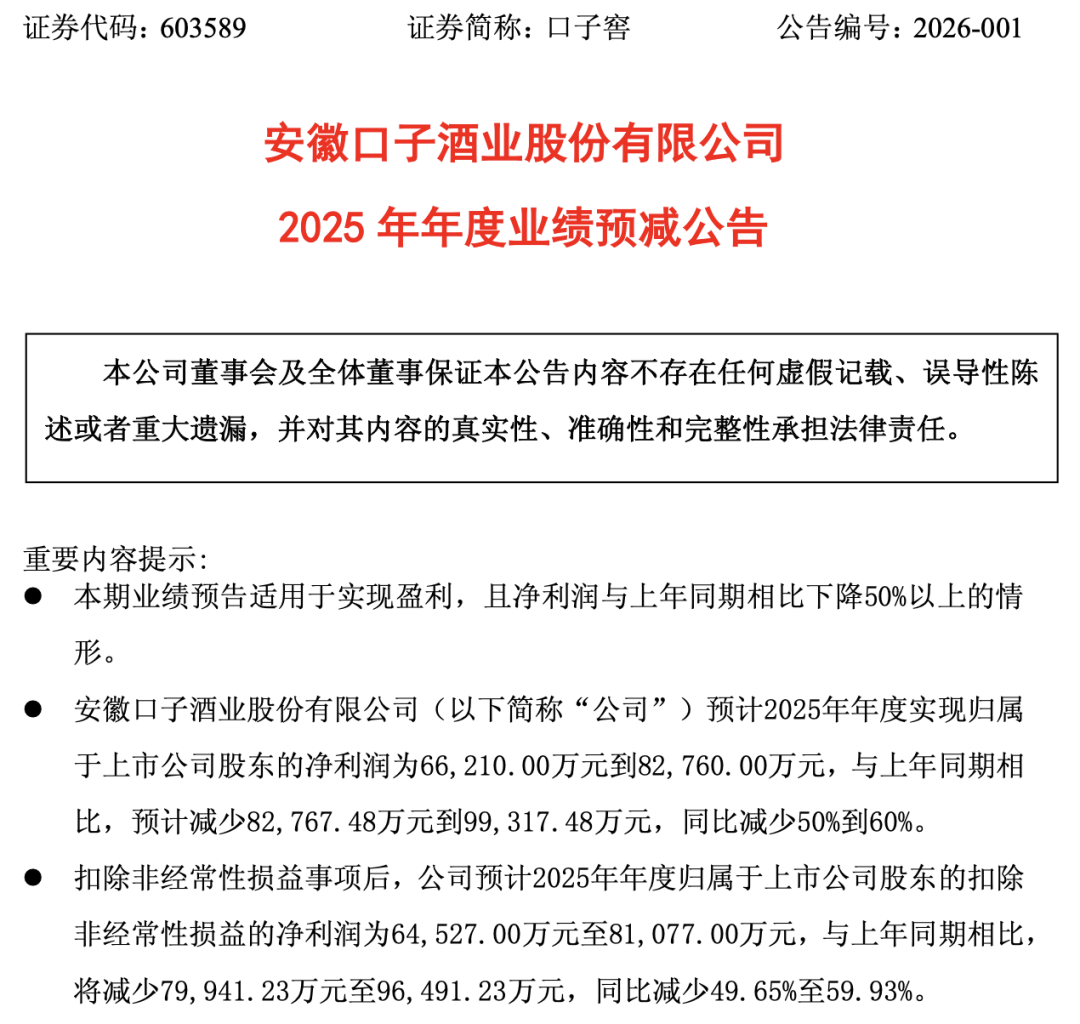
高端酒卖不动,口子窖(603589)2025年净利润预计迎来"腰斩",或是其上市以来最大的净利跌幅。 1月7日,口子窖发布2025年度业绩预告,经财务部门初步测算,预计2025年年度实现归母净利润为6.62亿元到8.28亿元,与上年同期相比,预计减少8.28 亿元到9.93亿元,同比减少50%到60%。 扣非净利润为6.45亿元至8.11亿元,与上年同期相比,将减少7.99亿元至9.65亿元,同比减少49.65%至59.93%。 对于业绩预减,口子窖的解释是,报告期内白酒行业市场分化与渠道变革加剧,叠加需求下行及政策变化影响,核心利润来源高端窖产品销量大幅下滑, 导致营业收入减少,同时为保证公司运营及市场持续投入,管理费用、销售费用下降幅度均小于营业收入下降幅度致利润总额下降幅度较大。 资料显示,口子窖是安徽省内白酒行业的龙头企业之一,公司生产的口子窖系列产品香气独特,是我国兼香型白酒的代表。公司生产和销售口子窖、老口 子、口子坊、口子酒等系列品牌产品。 记者注意到,自2020年开始,口子窖的净利呈现"涨跌互现"的波动趋势,从公司2025年业绩预告来看,50%到60%的净利跌幅,将会是口子窖上市以来最 大的净 ...


口子窖预计去年净利至少腰斩,核心利润来源高端窖产品销量大幅下滑
Xin Lang Cai Jing· 2026-01-07 12:54
Core Viewpoint - Kuaizi Jiao expects a significant decline in net profit for 2025, projecting a decrease of 50% to 60% year-on-year, primarily due to market differentiation, channel changes, and a drop in high-end product sales [1][3]. Group 1: Company Performance - Kuaizi Jiao forecasts a net profit attributable to shareholders of between 662 million to 828 million yuan for 2025, with a non-GAAP net profit of 645 million to 811 million yuan, reflecting a year-on-year decrease of 49.65% to 59.93% [1]. - For the first three quarters of 2025, Kuaizi Jiao reported revenue of 3.174 billion yuan, a decline of 27.24% year-on-year, and a net profit of 742 million yuan, down 43.39% year-on-year [2][3]. - The third quarter of 2025 saw revenue drop to 643 million yuan, a decrease of 46.23% year-on-year, with net profit plummeting to 26.97 million yuan, down 92.55% year-on-year, marking the worst quarterly performance since its listing in 2015 [2][3]. Group 2: Industry Context - The white liquor industry is currently undergoing a deep adjustment period, with a reported 13.8% year-on-year decline in industrial white liquor production in November 2025, and an 11.3% decrease in cumulative production from January to November 2025 [3]. - Kuaizi Jiao acknowledges that the industry is facing pressures from economic downturns, low consumer demand, and high inventory levels, which have become the norm [3]. Group 3: Strategic Initiatives - In response to the challenging market conditions, Kuaizi Jiao is exploring transformation paths, including the opening of its first community store, Kuaizi Jiu Fang, in Huai Bei City, Anhui Province, aimed at enhancing community consumption [3].
口子窖发预减,预计2025年度归母净利润6.62亿元到8.28亿元,同比减少50%到60%
智通财经网· 2026-01-07 11:59
Core Viewpoint - The company, Kouzi Jiao, expects a significant decline in net profit for the year 2025, projecting a range of 662 million to 828 million yuan, which represents a year-on-year decrease of 50% to 60% [2] Group 1: Financial Performance - The anticipated decline in profit is primarily attributed to market differentiation and intensified channel changes within the liquor industry, coupled with a downturn in demand and policy changes [2] - A substantial drop in sales of high-end liquor products, which are the core profit source, has led to a decrease in operating revenue [2] - Management and sales expenses have not decreased as significantly as the decline in operating revenue, resulting in a larger reduction in total profit [2]

口子窖(603589.SH)发预减,预计2025年度归母净利润6.62亿元到8.28亿元,同比减少50%到60%
智通财经网· 2026-01-07 11:55
Core Viewpoint - The company, Kouzi Jiao, expects a significant decline in net profit for the year 2025, projecting a range of 662 million to 828 million yuan, which represents a year-on-year decrease of 50% to 60% [1] Group 1: Financial Performance - The primary reason for the profit reduction is attributed to the intensified market differentiation and channel transformation within the liquor industry, coupled with declining demand and policy changes [1] - The core profit source, high-end liquor product sales, has seen a substantial drop, leading to a decrease in operating revenue [1] - To ensure ongoing operations and market investments, the decline in management and sales expenses has been less than the decrease in operating revenue, resulting in a larger decline in total profit [1]
口子窖(603589.SH):预计2025年净利润同比减少50%到60%
Ge Long Hui A P P· 2026-01-07 11:13
Core Viewpoint - The company, Kuozi Jiao (口子窖), anticipates a significant decline in net profit for the year 2025, primarily due to market differentiation in the liquor industry, changes in distribution channels, and a decrease in demand, leading to a substantial drop in sales of high-end products [1] Financial Performance - The estimated net profit attributable to shareholders for 2025 is projected to be between 662.10 million and 827.60 million yuan, representing a year-on-year decrease of 50% to 60% [1] - The net profit after deducting non-recurring gains and losses is expected to range from 645.27 million to 810.77 million yuan, reflecting a year-on-year decline of 49.65% to 59.93% [1] Market Conditions - The decline in profit is attributed to intensified market differentiation within the liquor industry, exacerbated by a downturn in demand and changes in policies [1] - The core profit source, high-end liquor product sales, has experienced a significant drop, contributing to reduced operating revenue [1] Cost Management - To ensure ongoing operations and market investments, the company has seen a decrease in management and sales expenses, although the reduction in these expenses has not kept pace with the decline in operating revenue, resulting in a larger decrease in total profit [1]
口子窖(603589) - 2025 Q4 - 年度业绩预告
2026-01-07 10:40
重要内容提示: 一、本期业绩预告情况 (一)业绩预告期间 证券代码:603589 证券简称:口子窖 公告编号:2026-001 安徽口子酒业股份有限公司 2025 年年度业绩预减公告 本公司董事会及全体董事保证本公告内容不存在任何虚假记载、误导性陈 述或者重大遗漏,并对其内容的真实性、准确性和完整性承担法律责任。 (一)利润总额:227,357.74万元。归属于母公司所有者的净利润: 165,527.48万元。归属于母公司所有者的扣除非经常性损益的净利润: 161,018.23万元。 (二)每股收益:2.76元。 三、本期业绩预减的主要原因 2025年1月1日至2025年12月31日。 (二)业绩预告情况 1、经财务部门初步测算,预计2025年年度实现归属于上市公司股东的净利 润为66,210.00万元到82,760.00万元,与上年同期相比,预计减少82,767.48万 元到99,317.48万元,同比减少50%到60%。 2、归属于上市公司股东的扣除非经常性损益的净利润为64,527.00万元至 81,077.00万元,与上年同期相比,将减少79,941.23万元至96,491.23万元,同 比减少49. ...
口子窖:2025年净利同比预降50%~60%
Mei Ri Jing Ji Xin Wen· 2026-01-07 10:38
每经AI快讯,1月7日,口子窖(603589)发布2025年度业绩预告,预计归属于上市公司股东的净利润 为6.62亿元至8.28亿元,同比减少50%到60%。扣除非经常性损益后的净利润为6.45亿元至8.11亿元,同 比减少49.65%至59.93%。报告期内,白酒行业市场分化与渠道变革加剧,叠加需求下行及政策变化影 响,核心产品高端窖酒销量大幅下滑,导致收入减少;管理费用和销售费用下降幅度小于收入降幅,利 润总额下降明显。 ...
口子窖:预计2025年净利润同比减少50%—60%
Zheng Quan Shi Bao Wang· 2026-01-07 10:34
Core Viewpoint - Kouzi Jiao (603589) expects a significant decline in net profit for the year 2025, projecting a range of 662 million to 828 million yuan, which represents a year-on-year decrease of 50% to 60% [1] Group 1: Company Performance - The anticipated profit reduction is primarily attributed to market differentiation within the liquor industry and intensified channel transformations [1] - A notable decline in sales of high-end liquor products, which are the core profit source for the company, has led to a decrease in operating revenue [1] - Management and sales expenses have not decreased as significantly as the decline in operating revenue, resulting in a larger drop in total profit [1] Group 2: Industry Context - The liquor industry is experiencing a downturn in demand, compounded by changes in policies affecting market dynamics [1]
口子窖:2025年净利同比预降50%-60%
Xin Lang Cai Jing· 2026-01-07 10:33
口子窖(603589.SH)发布2025年度业绩预告,预计归属于上市公司股东的净利润为6.62亿元至8.28亿元, 同比减少50%到60%。扣除非经常性损益后的净利润为6.45亿元至8.11亿元,同比减少49.65%至 59.93%。报告期内,白酒行业市场分化与渠道变革加剧,叠加需求下行及政策变化影响,核心产品高 端窖酒销量大幅下滑,导致收入减少;管理费用和销售费用下降幅度小于收入降幅,利润总额下降明 显。 ...
口子窖:2025年净利同比预降50%-60% 核心利润来源高端窖产品销量大幅下滑
2 1 Shi Ji Jing Ji Bao Dao· 2026-01-07 10:32
Core Viewpoint - Kouzi Jiao (603589.SH) forecasts a significant decline in net profit for the fiscal year 2025, projecting a decrease of 50% to 60% compared to the previous year, primarily due to market differentiation in the liquor industry and changes in distribution channels [1] Financial Performance - The expected net profit attributable to shareholders is estimated to be between 662 million yuan and 828 million yuan [1] - The net profit after deducting non-recurring gains and losses is projected to be between 645 million yuan and 811 million yuan, reflecting a year-on-year decrease of 49.65% to 59.93% [1] Market Conditions - The decline in profit is attributed to a significant drop in sales of high-end liquor products, which are the core profit source for the company [1] - The overall revenue is expected to decrease due to a combination of declining demand and policy changes affecting the industry [1] Cost Management - Despite the decrease in revenue, the reduction in management and sales expenses is not expected to match the decline in total revenue, leading to a larger decrease in total profit [1]