Kouzijiao(603589)

Search documents
古麒绒材1月5日获融资买入1040.52万元,融资余额9794.16万元
Xin Lang Cai Jing· 2026-01-06 01:42
Group 1 - The core point of the news is that Guqi Down Material experienced a slight increase in stock price and notable trading activity on January 5, with a financing net purchase indicating investor interest [1][2] Group 2 - On January 5, Guqi Down Material's stock rose by 0.82%, with a total transaction amount of 81.39 million yuan [1] - The financing buy amount for Guqi Down Material on the same day was 10.41 million yuan, while the financing repayment was 8.15 million yuan, resulting in a net financing purchase of 2.26 million yuan [1][2] - As of January 5, the total financing and securities lending balance for Guqi Down Material was 97.94 million yuan, accounting for 7.94% of its circulating market value [2] - The company, established on October 15, 2001, specializes in the research, production, and sales of high-specification down products, with its main revenue sources being duck down products (60.66%) and goose down products (38.61%) [2] - For the period from January to September 2025, Guqi Down Material reported an operating income of 763 million yuan, reflecting a year-on-year growth of 0.30%, and a net profit attributable to shareholders of 139 million yuan, with a year-on-year increase of 0.99% [2]

2025年第53周:酒行业周度市场观察
艾瑞咨询· 2026-01-06 00:03
Industry Environment - The liquor industry is undergoing a channel transformation, with traditional inventory strategies failing and instant retail emerging as a new opportunity. Leading companies like Moutai and Luzhou Laojiao are exploring online channels and new models such as "live streaming + instant fulfillment" [3] - The scattered liquor market is expected to grow from 80 billion yuan in 2024 to over 100 billion yuan in 2025, driven by companies like Gujing Gongjiu and Kuozi Jiao, which are targeting young consumers with experiential and diverse product offerings [5] - The competition in the liquor industry is shifting towards "value deepening," with companies focusing on product reconstruction and cultural resonance to meet the demands of younger and female consumers [6] Market Trends - The trend of low-alcohol liquor is gaining traction, with major brands like Wuliangye and Gujing Gongjiu launching new products to cater to younger consumers' preferences for lower alcohol content. The low-alcohol market is projected to reach 57 billion yuan by 2025 [7] - The white liquor market is experiencing a shift from "face consumption" to "substance consumption," with a focus on quality and experience rather than just brand prestige [9][14] - The scattered liquor market is becoming a new growth area, with brands leveraging community consumption and flexible pricing strategies to attract consumers [20][21] Sales and Marketing Strategies - Companies are increasingly focusing on enhancing bottle opening rates to address high inventory levels and declining consumption. Some brands have reported significant increases in opening rates through targeted marketing strategies [15] - The concept of "user co-creation" is emerging as a key strategy for brands to engage consumers and enhance brand loyalty, with companies like Wuliangye and Fenjiu exploring new ways to connect with their audience [16][17] - The wedding market is seeing a resurgence, with a 30% increase in wedding events in certain regions, although overall liquor consumption at these events is declining due to economic pressures [19] Brand Dynamics - Moutai is facing challenges with declining prices and inventory buildup, prompting the company to optimize its product structure and marketing strategies to attract younger consumers [12][14] - The introduction of new products and collaborations, such as the partnership between Water Well and actor Tony Leung, is aimed at enhancing brand image and connecting with consumers on an emotional level [26][34] - The rise of health-oriented products, particularly in the health liquor segment, is attracting younger female consumers, with brands like Jinjiu successfully tapping into this demographic [36] Future Outlook - The liquor industry is expected to continue evolving, with a focus on digital transformation and the integration of AI technologies to enhance operational efficiency and consumer engagement [37] - The scattered liquor market is projected to exceed 100 billion yuan, indicating a significant shift in consumer preferences towards more affordable and accessible options [20][21] - The industry is likely to see a continued emphasis on quality and value, as brands adapt to changing consumer demands and market conditions [22][29]





寒意加剧!中小酒企将加速洗牌
Qi Lu Wan Bao· 2026-01-01 16:31
Core Viewpoint - The adjustment trend in the liquor industry is becoming increasingly severe, as evidenced by the third-quarter financial reports of 20 A-share liquor companies, indicating significant declines in revenue and net profit [1] Financial Performance - The total revenue of 20 liquor companies in the third quarter reached 77.976 billion yuan, a year-on-year decline of 18.47% [1] - The net profit for these companies was 28.011 billion yuan, reflecting a year-on-year drop of 22.22%, marking a new low for this cycle [1] Industry Dynamics - The "Matthew Effect" is becoming more pronounced, with only Kweichow Moutai and Shanxi Fenjiu achieving growth in both revenue and net profit, while the performance decline of the other 18 companies has worsened compared to the second quarter [1] - Over half of the liquor companies reported a year-on-year decline in net profit, with regional companies facing particularly severe challenges [1] Regional Company Challenges - Kuozi Jiao's net profit plummeted by 92.55%, nearing a loss, while several companies like Jiu Gui Jiu and Huang Tai Jiu Ye have also fallen into losses [1] - Jinzhongzi Jiu experienced a slight revenue increase of 3.73%, but still reported a net loss, failing to reverse the industry's downturn [1] Market Trends - The industry is witnessing a dual pressure from top-tier companies and the inherent brand and channel weaknesses of regional firms, leading to a shrinking survival space [1] - The trend towards lower alcohol content and targeting younger consumers is becoming irreversible in the liquor industry, with the market for low-alcohol beverages expected to exceed 74 billion yuan by 2025, with a compound annual growth rate of 25%, significantly outpacing the overall liquor industry [1] - Both top-tier and regional liquor companies need to optimize product structures and cultivate younger customer bases to explore new growth avenues [1]


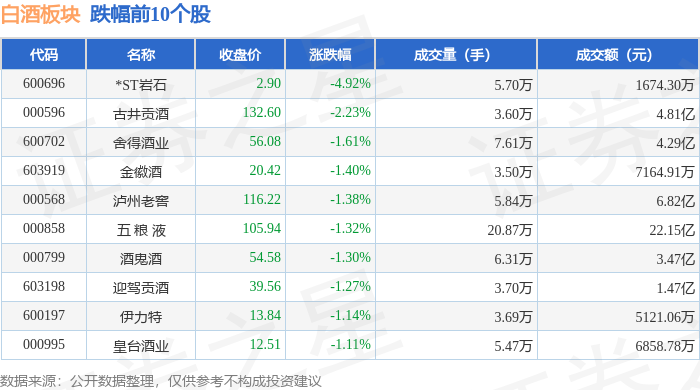
白酒板块12月31日跌1.01%,*ST岩石领跌,主力资金净流出15.73亿元
Zheng Xing Xing Ye Ri Bao· 2025-12-31 08:59
Core Viewpoint - The liquor sector experienced a decline of 1.01% on December 31, with *ST Yanshi leading the drop, while the overall market showed mixed results with the Shanghai Composite Index up by 0.09% and the Shenzhen Component Index down by 0.58% [1] Liquor Sector Performance - The closing prices and percentage changes for key liquor stocks are as follows: - *ST Yanshi: 2.90, -4.92% - Gujing Gongjiu: 132.60, -2.23% - Shede Manye: 56.08, -1.61% - Quanwei Jiu: 20.42, -1.40% - Luzhou Laojiao: 116.22, -1.38% - Wuliangye: 105.94, -1.32% - Zhisi Cha: 54.58, -1.30% - Yingjia Gongjiu: 39.56, -1.27% - Yilite: 13.84, -1.14% - Huangtai Jiuye: 12.51, -1.11% [1] Capital Flow Analysis - The liquor sector saw a net outflow of 1.573 billion yuan from main funds, while retail investors contributed a net inflow of 712 million yuan [1] - The detailed capital flow for selected stocks indicates: - Gujing Gongjiu: Main net inflow of 5.437 million yuan, retail net inflow of 2.302 million yuan - *ST Yanshi: Main net outflow of 4.866 million yuan, retail net inflow of 4.265 million yuan - Other stocks like Jinzhongzi Jiu and Kuozi Jiao experienced significant net outflows from main and retail funds [2]


观酒|“打酒铺”火了,散酒模式能成酒企的“压力出口”吗?
Nan Fang Du Shi Bao· 2025-12-29 05:37
Core Insights - The Chinese liquor industry is undergoing significant transformation in 2025, facing challenges such as high channel inventory and weak terminal sales, while also experiencing new opportunities driven by changing policies, consumer behavior, and market scenarios [2] Group 1: Industry Trends - The resurgence of "loose liquor" sales, a traditional model, has gained attention this year, with innovative pricing strategies attracting consumers [2][3] - New "liquor bars" are rapidly emerging, allowing consumers to purchase liquor by the cup, which has revitalized the loose liquor market and gained acceptance among younger consumers [3][4] - The market for loose liquor is projected to exceed 800 billion yuan in 2024 and reach a trillion yuan by 2025, indicating significant growth potential [14] Group 2: Consumer Behavior - Young consumers are particularly drawn to the novelty of purchasing premium liquor like Moutai at lower prices in these new liquor bars, leading to increased sales and curiosity [7][8] - The new liquor bars are designed to be visually appealing and cater to social media engagement, creating a "third space" for young consumers to enjoy [12] Group 3: Company Strategies - Major liquor companies are entering the liquor bar market, with brands like Gujing Gongjiu and Kuozi Jiu actively opening their own outlets to tap into community consumption [11] - Companies are leveraging the high-frequency sales model of liquor bars to alleviate inventory and cash flow pressures, especially as many face declining revenues [14] Group 4: Challenges and Concerns - Despite the excitement around new liquor bars, there are concerns regarding profitability, cost pressures, and the balance of interests with traditional distributors [15][16] - Food safety issues related to loose liquor have raised public concerns, with incidents of contamination affecting consumer trust [17]
“打酒铺”火了,散酒模式能成酒企的“压力出口”吗?
Nan Fang Du Shi Bao· 2025-12-29 05:36
Core Insights - The Chinese liquor industry is undergoing significant transformation in 2025, facing challenges such as high channel inventory and weak terminal sales, while also experiencing new opportunities driven by changing policies, consumption patterns, and scenarios [1] Group 1: Market Trends - The trend of "loose liquor" has resurfaced as a new phenomenon, with various new-style "liquor shops" emerging, allowing consumers to purchase liquor by the cup, which has gained recognition among younger consumers [2][3] - The "liquor shop" model has become popular, particularly in urban areas, with high demand observed in places like Guangzhou, where consumers are eager to try premium brands at lower prices [3][4] - The market for loose liquor is projected to exceed 800 billion yuan in 2024 and reach a trillion yuan by 2025, indicating a strong potential for growth [6] Group 2: Company Strategies - Major liquor companies are entering the "liquor shop" space, with brands like Gujing Gongjiu and Kuozi Jiu actively opening their own liquor shops to cater to community needs and alleviate inventory pressure [5][6] - The new liquor shops are designed to appeal to younger consumers, offering a social space that combines quality and affordability, thus addressing the evolving consumer preferences [6][7] Group 3: Challenges and Concerns - Despite the potential of the "liquor shop" model, there are concerns regarding profitability, cost pressures, and the balance of interests with traditional distributors [8] - Food safety issues related to loose liquor have raised public concerns, with incidents of contamination affecting consumer trust and potentially hindering the expansion of this model [9]
第七届安徽省人民政府质量奖结果揭晓
Zhong Guo Zhi Liang Xin Wen Wang· 2025-12-29 04:47
Group 1 - The Anhui Provincial Government has awarded the 7th Anhui Provincial Government Quality Award to four organizations and an individual for their outstanding contributions to quality work [2] - The awarded organizations include Anhui Wanwei High-tech Materials Co., Ltd., Baowu Group Maanshan Rail Transit Materials Technology Co., Ltd., Chery Commercial Vehicle (Anhui) Co., Ltd., and Lenovo (Hefei) Electronic Technology Co., Ltd. [2] - The nomination award was given to eight organizations and two individuals, highlighting the importance of quality management and innovation in enhancing brand competitiveness and economic development [2][3] Group 2 - The announcement emphasizes the need for recognized organizations and individuals to continue their efforts in improving quality and promoting high-quality development [3] - It encourages local entities and quality workers to learn from the awarded parties and enhance quality awareness, aligning with the spirit of the 20th National Congress of the Communist Party of China [3] - The initiative aims to support the construction of a strong quality foundation for Anhui's economic development during the 14th Five-Year Plan period and contribute to the modernization of the province [3]


2025年名酒企争相布局散酒市场,古井贡酒口子窖等试水社区打酒铺
Sou Hu Cai Jing· 2025-12-26 01:07
Core Insights - The white liquor market in 2025 is facing challenges, yet the scattered liquor business is emerging as a lucrative opportunity for major liquor companies [3][15] - The scattered liquor market is expected to grow significantly, with projections indicating a market size of approximately 800 billion yuan in 2024 and likely surpassing 1 trillion yuan in 2025 [13][15] Industry Trends - Major liquor companies are entering the scattered liquor market due to high inventory pressure and price inversion, which has made traditional sales channels less effective [15][18] - The scattered liquor business model has evolved since 2023, with new entrants like Tang San Liang and Zebra Hero targeting younger consumers through modern store designs and experiential consumption [3][12] Company Developments - Gujing Gongjiu opened its first scattered liquor store in December 2025, focusing on community sales and serving as a pilot project [4][5] - Kuaizi Jiu has opened two direct stores in 2025, combining scattered and bottled liquor sales, with prices ranging from 50 to 60 yuan per jin [6] - Anhui Hengjia Gongjiu has entered the scattered liquor market through a franchise model, with prices varying from over 10 yuan to 200 yuan per jin [6] Market Dynamics - The scattered liquor market is characterized by two main types of stores: traditional low-cost outlets and more upscale venues targeting young consumers [3][12] - The market is experiencing a shift from low-quality, low-price offerings to better value products, with an increasing number of young consumers participating [13][19] Financial Performance - In the first three quarters of 2025, 20 listed liquor companies reported a decline in revenue and net profit, with a year-on-year decrease of 5.90% and 6.93% respectively [17] - Kuaizi Jiu reported a significant drop in net profit by 43.39% year-on-year, indicating the financial pressures faced by liquor companies [17]
徽酒三国杀,决战社区“最后一公里”
阿尔法工场研究院· 2025-12-22 00:03
Core Viewpoint - The Anhui liquor industry is collectively shifting towards community-focused sales models, with companies like Kuozi Jiao, Gujing Gongjiu, and Yingjia Gongjiu opening local liquor shops to directly engage with consumers [1][10]. Group 1: Market Dynamics - The traditional sales model relied heavily on distributors, but the new "liquor shop" approach requires companies to engage directly with consumers, shifting from brand-centric to retail-centric thinking [1][2]. - The competitive landscape has changed significantly, with Kuozi Jiao's market position declining, Gujing Gongjiu leading in scale and growth, and Yingjia Gongjiu surpassing Kuozi Jiao to become the second-largest player [5][6]. Group 2: Financial Performance - In the first three quarters of 2025, Kuozi Jiao reported a revenue of 3.174 billion yuan and a net profit of 742 million yuan, reflecting year-on-year declines of 27.24% and 43.39% respectively, with a 92.55% drop in net profit for Q3 [8][12]. - Gujing Gongjiu's revenue was 16.425 billion yuan and net profit 3.96 billion yuan, down 13.87% and 16.57% year-on-year [8]. - Yingjia Gongjiu's revenue reached 4.516 billion yuan with a net profit of 1.511 billion yuan, showing declines of 18.09% and 24.67% respectively [9]. Group 3: Consumer Behavior and Market Trends - The demand for liquor has slowed, with a notable decrease in corporate group purchases and business banquets, leading to a reassessment of consumption structures towards community retail and personal consumption [16][17]. - The competition among Anhui liquor brands is shifting from scale expansion to intense competition at the retail level [18]. - The traditional year-end negotiations between liquor companies and distributors are changing, with companies adopting a more cautious approach in setting sales targets [19]. Group 4: Strategic Implications - Kuozi Jiao's move to open community liquor shops symbolizes a strategic shift to regain direct consumer engagement amid market pressures [14][20]. - The industry faces a critical challenge in transitioning from a reliance on wholesale distribution to a focus on direct sales and consumer engagement [21][22].
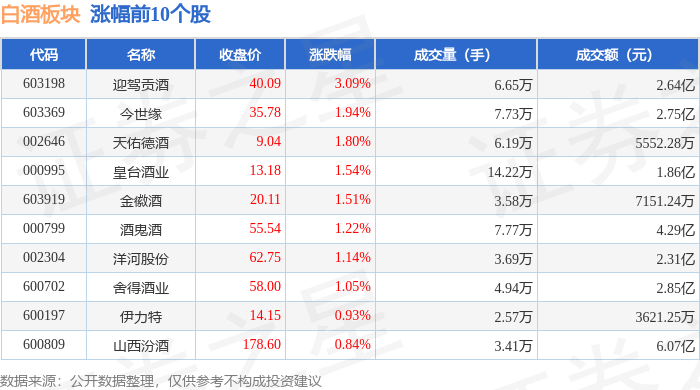
白酒板块12月19日跌0.66%,*ST岩石领跌,主力资金净流出5.64亿元
Zheng Xing Xing Ye Ri Bao· 2025-12-19 09:03
Group 1 - The liquor sector experienced a decline of 0.66% on December 19, with *ST Rock leading the drop [1] - The Shanghai Composite Index closed at 3890.45, up 0.36%, while the Shenzhen Component Index closed at 13140.22, up 0.66% [1] - Key stocks in the liquor sector showed varied performance, with Yingjia Gongjiu rising by 3.09% to a closing price of 40.09, and *ST Rock falling by 4.91% to 3.29 [2] Group 2 - The liquor sector saw a net outflow of 564 million yuan from institutional investors, while retail investors contributed a net inflow of 264 million yuan [2] - Major stocks like Wuliangye and Moutai had minimal price changes, with Wuliangye at 110.53 (up 0.09%) and Moutai at 1410.00 (up 0.21%) [2] - The liquidity dynamics showed that retail investors were more active, with significant inflows into stocks like Yingjia Gongjiu and Yanghe Co., despite overall institutional outflows [3]