Loongson Technology(688047)

Search documents
算力概念股强势,数据港等多股涨停
Ge Long Hui· 2026-01-14 05:40
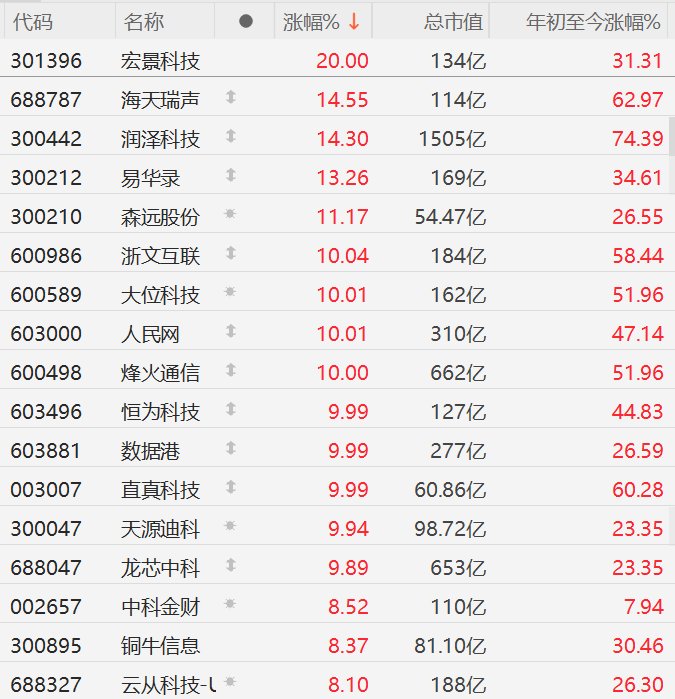
Group 1 - The A-share market saw strong performance in computing power concept stocks, with several companies hitting the daily limit up [1] - Hongjing Technology experienced a 20% increase, reaching a market capitalization of 13.4 billion [2] - Haitan Ruisheng and Runze Technology both rose over 14%, with market capitalizations of 11.4 billion and 150.5 billion respectively [2] Group 2 - Yihualu increased by over 13%, with a market cap of 16.9 billion and a year-to-date increase of 34.61% [2] - Senyuan Co. saw an increase of over 11%, with a market cap of 5.447 billion [2] - Other notable performers included Zhejiang Wenhulian, Dawi Technology, and People's Daily, each rising by around 10% [2]





英伟达六大芯片协同升级,芯片ETF(159995.SZ)上涨1.23%,海光信息上涨5.76
Sou Hu Cai Jing· 2026-01-14 02:10
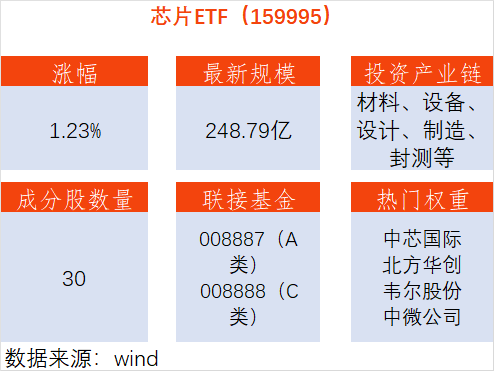
Group 1 - The A-share market saw all three major indices rise, with the Shanghai Composite Index increasing by 0.37%, driven by gains in sectors such as computers, media, and non-ferrous metals, while banks and conglomerates experienced declines [1] - The chip technology sector showed strong performance, with the Chip ETF (159995.SZ) rising by 1.23%, and notable increases in component stocks such as Haiguang Information (+5.76%), Longxin Zhongke (+5.08%), and Lanke Technology (+3.47%) [1] Group 2 - NVIDIA's founder and CEO Jensen Huang announced the launch of the Rubin platform at CES 2026, which consists of six new chips designed for building extraordinary AI supercomputers, including VeraCPU, RubinGPU, and NVLink6 switch [3] - According to Cinda Securities, the launch of the Rubin platform marks a new era in AI computing power, with a complete transformation of global computing facilities towards the "AI factory" paradigm [3] - The Rubin platform's collaborative design is expected to significantly enhance performance, with potential increases in value across multiple segments such as computing power, storage, and infrastructure investment [3] - The Chip ETF (159995) tracks the National Chip Index, comprising 30 leading companies in the A-share chip industry, including SMIC, Cambricon, and Changdian Technology [3]


龙芯中科:公司第一款GPGPU芯片9A1000已经交付流片
Zheng Quan Ri Bao Wang· 2026-01-13 14:12
Core Viewpoint - Longxin Zhongke has delivered its first GPGPU chip, the 9A1000, which is designed to support both graphics functions and inference computing capabilities for AI applications [1] Group 1 - The 9A1000 chip is aimed at supporting terminal AI computing, including applications in AIPC and unmanned devices [1] - Longxin Zhongke maintains an open attitude towards system manufacturers, encouraging them to develop various types of systems based on Longxin chips [1]
龙芯中科:公司暂无量子芯片的相关规划
Zheng Quan Ri Bao Wang· 2026-01-13 13:42
Core Viewpoint - Longxin Zhongke has no current plans for quantum chips, which are primarily used in specific fields, unlike general processors that have a wide range of applications [1] Group 1 - Longxin Zhongke responded to investor inquiries on January 13, indicating that quantum chips are not part of their current strategy [1]
龙芯中科:3C6000系列服务器在2025年6月底发布
Zheng Quan Ri Bao Wang· 2026-01-13 13:42
Core Viewpoint - Longxin Zhongke announced that the 3C6000 series servers will be released by the end of June 2025, with multiple partners developing complete products based on the 3C6000 series chips, leading to typical applications in storage, intelligent computing, and cryptography in the second half of 2025 [1] Group 1 - The 3C6000 series servers are set to launch in June 2025 [1] - Several partners are collaborating to create complete products using the 3C6000 series chips [1] - Typical applications in storage, intelligent computing, and cryptography are expected to emerge in the latter half of 2025 [1]
龙芯中科(688047.SH):暂无量子芯片的相关规划
Ge Long Hui· 2026-01-13 09:53
Group 1 - The core viewpoint of the article is that Longxin Zhongke (688047.SH) has no current plans for quantum chips, which are primarily used in specific fields, unlike general processors that have a wide range of applications [1] Group 2 - Longxin Zhongke stated that quantum chips are mainly applicable in specialized areas [1] - The company emphasizes the distinction between quantum chips and general processors in terms of their application scope [1]
存储价格继续上涨!芯片ETF(159995)跌2.89%,三安光电跌8%
Mei Ri Jing Ji Xin Wen· 2026-01-13 05:49
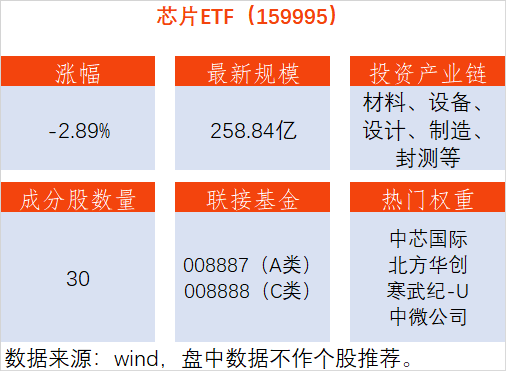
Group 1 - The A-share market experienced a collective decline on January 13, with the Shanghai Composite Index dropping by 0.55%. The biotechnology, education, and cultural media sectors showed positive performance, while aerospace and military, as well as chemical fiber sectors, faced significant declines [1] - The semiconductor sector remained sluggish, with the semiconductor ETF (159995) falling by 2.89%. Notable declines were observed in individual stocks such as Sanan Optoelectronics, which dropped by 8.10%, Loongson Technology by 7.82%, and Cambrian Technologies-U by 6.03%. However, some stocks like Zhaoyi Innovation and Chipone Technology saw increases of 2.24% and 0.55%, respectively [1] Group 2 - Global semiconductor sales are projected to grow by 29.8% year-on-year in November 2025, reaching $75.28 billion, marking 25 consecutive months of positive year-on-year growth. In China, semiconductor sales are expected to reach $20.23 billion, with a year-on-year growth of 22.9% and a quarter-on-quarter increase of 3.9% [3] - The trend of the global AI industry is shifting from model training to inference, which is expected to drive demand for high-performance chips. Domestic cloud service providers' AI computing power center construction plans will further stimulate the demand for SOC chips and other core components [3] - The semiconductor ETF (159995) tracks the National Chip Index, comprising 30 leading companies in the A-share semiconductor industry, including SMIC, Cambrian Technologies, Changdian Technology, and Northern Huachuang [3]


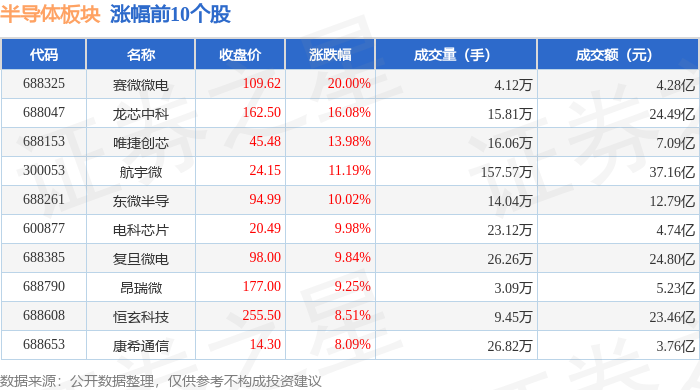
半导体板块1月12日涨1.65%,赛微微电领涨,主力资金净流出30.38亿元
Zheng Xing Xing Ye Ri Bao· 2026-01-12 09:04
Market Performance - The semiconductor sector increased by 1.65% on January 12, with Saiwei Microelectronics leading the gains [1] - The Shanghai Composite Index closed at 4165.29, up 1.09%, while the Shenzhen Component Index closed at 14366.91, up 1.75% [1] Top Gainers in Semiconductor Sector - Saiwei Microelectronics (688325) closed at 109.62, up 20.00% with a trading volume of 41,200 shares and a transaction value of 428 million [1] - Longxin Technology (688047) closed at 162.50, up 16.08% with a trading volume of 158,100 shares and a transaction value of 2.449 billion [1] - Weijie Chuangxin (688153) closed at 45.48, up 13.98% with a trading volume of 160,600 shares and a transaction value of 709 million [1] Top Losers in Semiconductor Sector - Yuanjie Technology (688498) closed at 707.00, down 5.98% with a trading volume of 50,100 shares and a transaction value of 3.584 billion [2] - Xinyuan Micro (688037) closed at 191.10, down 4.93% with a trading volume of 133,500 shares and a transaction value of 2.572 billion [2] - Helin Weina (688661) closed at 68.98, down 4.39% with a trading volume of 126,900 shares [2] Capital Flow in Semiconductor Sector - The semiconductor sector experienced a net outflow of 3.038 billion from institutional investors, while retail investors saw a net inflow of 1.517 billion [2] - The net inflow from speculative funds was 1.521 billion [2] Individual Stock Capital Flow - Zhaoyi Innovation (603986) had a net inflow of 906 million from institutional investors, while it faced a net outflow of 457 million from speculative funds [3] - North Huachuang (002371) saw a net inflow of 612 million from institutional investors, with a net outflow of 611 million from speculative funds [3] - Changchuan Technology (300604) had a net inflow of 335 million from institutional investors, while facing a net outflow of 1.054 billion from speculative funds [3]


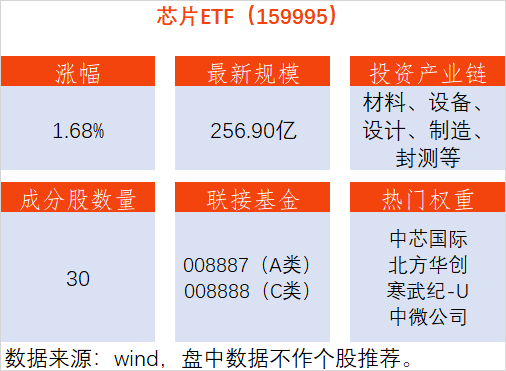
英伟达六大芯片协同升级!芯片ETF(159995)上涨1.68%,龙芯中科涨9.52%
Mei Ri Jing Ji Xin Wen· 2026-01-12 03:30
Group 1 - The A-share market showed mixed performance on January 12, with the Shanghai Composite Index rising by 0.25%, driven by gains in sectors such as internet, cultural media, and software, while motorcycle and energy equipment sectors faced declines [1] - The chip technology sector demonstrated strong fluctuations, with the chip ETF (159995) increasing by 1.68%. Notable individual stock performances included Longxin Technology rising by 9.52%, Changdian Technology by 7.09%, and Zhongwei Company by 6.77% [1] Group 2 - NVIDIA's founder and CEO Jensen Huang announced the launch of the Rubin platform at CES 2026, which consists of six new chips designed for building extraordinary AI supercomputers. These include Vera CPU, Rubin GPU, NVLink 6 switch, ConnectX-9 SuperNIC, BlueField-4 DPU, and NVIDIA Spectrum-6 Ethernet switch [3] - The Rubin platform is expected to significantly reduce training time and lower inference token costs, marking a new era in AI computing power. The collaborative design of these chips is anticipated to enhance performance and increase the value across multiple segments of the industry [3] - The chip ETF (159995) tracks the National Chip Index, comprising 30 leading companies in the A-share chip industry, including SMIC, Cambricon, Changdian Technology, and Northern Huachuang, indicating a robust investment landscape in the semiconductor sector [3]



CES2026闭幕,全球AI算力平台能力持续提升
Ping An Securities· 2026-01-12 02:18
Investment Rating - The industry investment rating is "Outperform the Market" which indicates an expected performance that exceeds the market by more than 5% over the next six months [23] Core Insights - The CES 2026 event highlighted the continuous enhancement of global AI computing power platforms, with significant advancements from major chip manufacturers like NVIDIA and AMD [3][5] - NVIDIA's Rubin platform has achieved full-scale production, while AMD introduced its Helios platform, showcasing the ongoing improvements in AI computing infrastructure that are expected to drive the global AI industry forward [6][19] - The report emphasizes the synergy between the enhancement of AI computing infrastructure and the iterative upgrades of global large models, which will foster sustained growth in the AI sector [3][19] Summary by Sections Industry News and Commentary - CES 2026 concluded on January 9, 2026, showcasing advancements in AI computing chips from companies like NVIDIA and AMD [3][6] - NVIDIA's Rubin platform is designed for building advanced AI supercomputers and is now in full production, with products expected to be available in the second half of 2026 [7] - AMD's Helios platform aims to provide significant computational power for large parameter model training, enhancing bandwidth and energy efficiency [8] Weekly Market Review - The computer industry index rose by 8.49% this week, outperforming the CSI 300 index by 5.70 percentage points [12] - As of the last trading day, the overall P/E ratio for the computer industry was 58.8 times, with 325 out of 359 A-share component stocks experiencing price increases [16] Investment Recommendations - The report suggests a strong focus on AI-related investment opportunities, particularly in AI computing and algorithms [19] - Recommended stocks in AI computing include Haiguang Information, Longxin Zhongke, and Inspur Information, while strong recommendations in AI algorithms include Hengsheng Electronics and Zhongke Chuangda [19]