Junshi Biosciences(688180)

Search documents
君实生物:尚无抗生素相关业务
Jin Rong Jie· 2025-08-04 09:37
Core Viewpoint - The company, Junshi Biosciences, currently does not engage in any antibiotic-related business and has no plans to disclose antibiotic management risks and opportunities in future reports [1] Group 1 - Investors inquired about the company's involvement in antibiotic-related business [1] - The company confirmed that it has no antibiotic-related business as of the date of the response [1] - The company expressed gratitude for the investor's interest [1]
君实生物(688180.SH):尚无抗生素相关业务
Ge Long Hui· 2025-08-04 09:32
格隆汇8月4日丨君实生物(688180.SH)在互动平台表示,截至本回复日,公司尚无抗生素相关业务。 ...
君实生物跌1.1% 9年连亏2020年上市2募资共86亿元
Zhong Guo Jing Ji Wang· 2025-08-04 09:13
中国经济网北京8月4日讯 君实生物(688180.SH)今日股价下跌,截至收盘报37.66元,跌幅1.10%。该股 目前处于破发状态。 君实生物于2020年7月15日在上交所科创板上市,发行数量为8713万股,发行价格为55.50元/股,保荐 机构、主承销商为中国国际金融股份有限公司,联席主承销商为国泰君安证券股份有限公司、海通证券 股份有限公司(2家公司现已合并为国泰海通证券股份有限公司)。 上市首日,君实生物股价最高报220.40元,此后该股一路震荡下滑。该股目前处于破发状态。 君实生物首次公开发行股票募集资金总额为48.36亿元,扣除发行费用后,募集资金净额为44.97亿元, 较原计划多17.97亿元。君实生物于2020年7月8日发布的招股说明书显示,该公司计划募集资金27.00亿 元,分别用于创新药研发项目、君实生物科技产业化临港项目、偿还银行贷款及补充流动资金。 君实生物首次公开发行股票募的发行费用为3.39亿元,其中,保荐及承销费用3.20亿元。 君实生物2022年度向特定对象发行A股股票募集资金情况为,根据中国证监会出具的《关于同意上海君 实生物医药科技股份有限公司向特定对象发行股票注册的批复》 ...
君实生物跌1.10%,成交额5.87亿元,今日主力净流入-3212.02万
Xin Lang Cai Jing· 2025-08-04 08:00
Core Viewpoint - Junshi Biosciences aims to establish itself as a global innovative pharmaceutical company with a complete industry chain capability from drug discovery to commercialization, focusing on quality and innovation [2][3]. Company Overview - Junshi Biosciences was founded on December 27, 2012, and listed on July 15, 2020. The company specializes in the research and commercialization of monoclonal antibody drugs and other therapeutic protein drugs [7]. - The main revenue sources include 84.18% from drug sales, 12.08% from technology licensing, and 3.73% from other sources [7]. Product Development - The company has developed a significant product portfolio, including the first domestically approved PD-1 monoclonal antibody, Toripalimab, which has received approval for 11 indications in mainland China and is also approved in multiple countries including the US and EU [2]. - Junshi's Tifcemalimab is the first anti-tumor BTLA monoclonal antibody to enter clinical development, with ongoing Phase III trials and several combination studies with Toripalimab [2]. Recent Collaborations - On October 27, 2023, Junshi announced collaborations with several institutions, including Peking University and the Chinese Academy of Sciences, to develop a monkeypox recombinant protein vaccine [3]. Financial Performance - For the first quarter of 2025, Junshi reported revenue of 5.01 billion yuan, a year-on-year increase of 31.46%, while the net profit attributable to shareholders was -235 million yuan, reflecting a 17.01% year-on-year growth [8]. Market Position - As of March 31, 2025, Junshi had 29,400 shareholders, with an average of 25,987 circulating shares per person, indicating a slight decrease in share distribution [8]. - The company operates within the pharmaceutical and biotechnology sector, focusing on innovative drugs and biopharmaceuticals [8].
君实生物上周获融资净买入3475.36万元,居两市第274位
Jin Rong Jie· 2025-08-03 23:40
Group 1 - The core viewpoint of the article highlights that Junshi Biosciences has seen a net financing inflow of 34.75 million yuan in the last week, ranking 274th in the market [1] - The company had a total financing purchase amount of 385 million yuan and repayment amount of 350 million yuan during the same period [1] - Junshi Biosciences operates in various sectors including biopharmaceuticals, Shanghai market, FTSE Russell, MSCI China, and innovative drugs [1] Group 2 - Over the past five days, the main capital outflow from Junshi Biosciences was 63.86 million yuan, with a decline of 1.76% in the same period [1] - In the last ten days, the total main capital outflow reached 172 million yuan, resulting in a decline of 2.66% [1] - Junshi Biosciences was established in 2012 and is primarily engaged in the pharmaceutical manufacturing industry, with a registered capital of approximately 985.69 million yuan [1]
君实生物U(688180)8月1日主力资金净流出2137.84万元
Jin Rong Jie· 2025-08-01 12:49
Group 1 - The core viewpoint of the article highlights the financial performance and market activity of Junshi Biosciences, indicating a recent decline in stock price and significant capital outflow [1][3] - As of August 1, 2025, Junshi Biosciences' stock closed at 38.08 yuan, down 0.99%, with a trading volume of 15.26 million shares and a transaction amount of 589 million yuan [1] - The latest quarterly report shows total revenue of 501 million yuan, a year-on-year increase of 31.46%, and a net profit attributable to shareholders of 234.88 million yuan, up 17.01% [1] Group 2 - The company has a current liquidity ratio of 1.398 and a quick ratio of 1.204, indicating a stable financial position [1] - Junshi Biosciences has invested in 41 companies and participated in 39 bidding projects, showcasing its active engagement in the industry [2] - The company holds 151 trademark registrations and 116 patents, along with 133 administrative licenses, reflecting its strong intellectual property portfolio [2]
独家专访君实生物总经理邹建军:深度变革、再下一城,在上海生药产业的万亿冲刺线上加速起跳|上海药圈新拐点
Di Yi Cai Jing· 2025-08-01 12:26
爆款、上市、融资、出海,这是今年中国创新药产业的四大关键词。这些动作绝非一朝一夕的博弈,而 是历经过去数年的资本"寒潮"、行业波动和周期冷暖后,自我倒逼、奋力突围、穿越周期的结果。 把镜头拉回上海。去年上海三大先导产业规模达1.8万亿元,其中生物医药产业规模超9800亿元。今 年,这一数字有望突破万亿大关。行业迎来拐点,企业何尝不是。"上海药圈新拐点"系列报道,将独家 专访三家扎根上海的上市药企掌舵人,共同讲述当全球创新药行业进入"中国时间",作为上海打造生物 医药产业高地的侧影,他们如何腾挪和突破,迎接属于自己的新拐点。 节目第三集,将走进老牌科创板上市药企——君实生物。它是第一个国产PD-1药物的拥有者,也是第 一批带着国产创新药出海的中国公司之一。它曾在三年内,实现了两款抗新冠新药的商业化,目前总市 值约400亿元。在新任总经理邹建军的掌舵之下,这家扎根上海13年的创新药企,今年能否迎来新的发 展拐点,第一财经记者将与之深度对话。 ...
医药行业周专题:国产创新药具备全球竞争力,出海正盛
Orient Securities· 2025-08-01 07:37
Investment Rating - The report maintains a positive outlook on the pharmaceutical and biotechnology industry, emphasizing the transition from "Made in China" to "Created in China" for innovative drugs [10]. Core Insights - The report highlights that domestic innovative drugs are gaining global competitiveness and are currently in the first and second stages of international expansion, primarily through licensing agreements and partnerships [10][12]. - The report identifies key areas of focus for investment, including PD-(L)1 plus, ADCs, and GLP-1 drugs, which are expected to drive future growth and business development (BD) opportunities [10][51]. Summary by Sections Section 1: Transition from "Manufacturing" to "Innovation" - The policy reforms initiated in 2015 have stimulated a shift from generic to innovative drug development in China, with significant increases in R&D investment since 2018 [19][21]. - The number of First-in-Class (FIC) drugs developed in China has risen from 9 in 2015 to 120 in 2024, indicating a substantial increase in innovation [25][26]. Section 2: Continued BD Opportunities - PD-(L)1 plus is identified as a cornerstone for next-generation cancer treatments, with significant demand and potential for new products [51]. - The report notes that ADCs are transitioning towards more differentiated targets, focusing on unmet clinical needs, with promising candidates like PD-L1, DLL3, and EGFR [51]. - The GLP-1 market is experiencing rapid growth, with a focus on multi-target, oral, combination, and long-acting formulations [51]. Section 3: Investment Recommendations - For PD-(L)1 plus, companies such as Kangfang Biotech, Shansheng Pharmaceutical, and Junshi Biosciences are recommended for investment due to their strong pipelines [5]. - In the ADC space, companies like Fuhong Hanlin and Zai Lab are highlighted for their potential in addressing unmet clinical needs [5]. - In the GLP-1 sector, firms such as Borui Pharmaceutical and Zai Lab are noted for their promising developments [5].


君实生物股价连续3天下跌累计跌幅7.12%,嘉实基金旗下3只基金合计持47.54万股,浮亏损失138.8万元
Xin Lang Cai Jing· 2025-08-01 07:12
8月1日,君实生物跌0.99%,截至发稿,报38.08元/股,成交5.89亿元,换手率1.99%,总市值390.96亿 元。君实生物股价已经连续3天下跌,区间累计跌幅7.12%。 资料显示,上海君实生物医药科技股份有限公司位于上海市浦东新区平家桥路100弄6号7幢16层,香港铜 锣湾希慎道33号利园1期19楼1918室,成立日期2012年12月27日,上市日期2020年7月15日,公司主营业 务涉及单克隆抗体药物和其他治疗型蛋白药物的研发与产业化,单克隆抗体药物研发的技术服务与技术 转让等。主营业务收入构成为:药品销售84.18%,技术许可及特许权使用收入12.08%,其他(补 充)3.73%。 从基金十大重仓股角度 来源:新浪基金∞工作室 风险提示:市场有风险,投资需谨慎。本文为AI大模型自动发布,任何在本文出现的信息(包括但不 限于个股、评论、预测、图表、指标、理论、任何形式的表述等)均只作为参考,不构成个人投资建 议。 基金名称基金代码基金经理持股数量(股)占流通股比例(%)占基金净值比(%)持股数量变动(股)嘉实上证 科创板生物医药ETF588700王紫菡2498300.03264.15-242422 ...
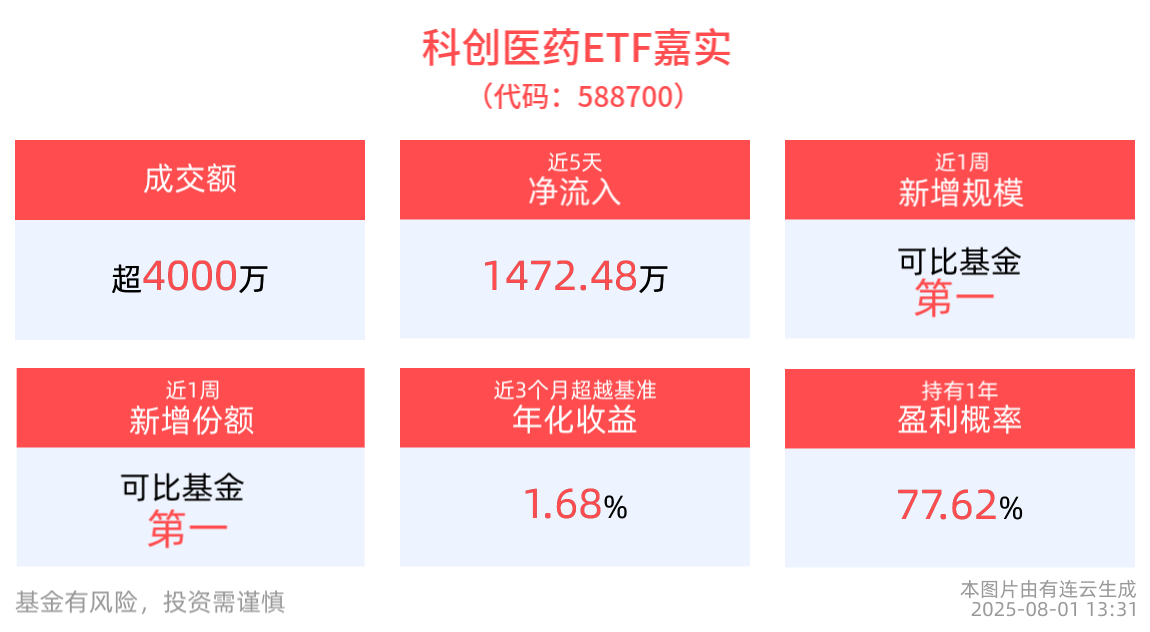
“新上市药品首发价格机制”首次公开,科创医药ETF嘉实(588700)盘中交投活跃,近1周新增规模同类居首!
Sou Hu Cai Jing· 2025-08-01 06:04
Group 1 - The core viewpoint highlights the active trading and significant growth of the Science and Technology Innovation (Sci-Tech) Pharmaceutical ETF managed by Harvest, with a turnover rate of 21.72% and a transaction volume of 47.63 million yuan on July 31 [2] - Over the past week, the Sci-Tech Pharmaceutical ETF has seen an average daily transaction volume of 53.21 million yuan, ranking first among comparable funds [2] - The fund's scale increased by 16.78 million yuan in the past week, also leading among comparable funds, with a share increase of 12.50 million shares [2] Group 2 - The fund has attracted a total of 14.72 million yuan in inflows over the last five trading days [2] - As of July 31, the net value of the Sci-Tech Pharmaceutical ETF has risen by 48.77% over the past year, ranking 350 out of 2943 in the index stock fund category, placing it in the top 11.89% [2] - The fund's highest monthly return since inception was 23.29%, with the longest consecutive monthly gain being six months and a maximum increase of 41.76% [2] Group 3 - The top ten weighted stocks in the Shanghai Stock Exchange Sci-Tech Innovation Board Biopharmaceutical Index account for 49.14% of the index, with leading companies including United Imaging Healthcare and BeiGene [2] - The stock performance of the top ten companies shows mixed results, with some stocks experiencing slight declines while others have positive growth [4] Group 4 - The National Healthcare Security Administration has established a "new drug first launch price mechanism" to encourage drug research and innovation, marking a significant policy development [4] - The pharmaceutical and biotech sectors are expected to benefit from a high level of innovation and a potential revaluation of value stocks, with recommendations for companies in the Pharma and Biopharma/Biotech sectors [5] - The medical device industry is also anticipated to benefit from policy optimizations, with recent statements from relevant authorities supporting innovation and addressing issues of internal competition [5]