
Junshi Biosciences(688180)

Search documents
君实生物7月18日获融资买入5106.21万元,融资余额11.21亿元
Xin Lang Cai Jing· 2025-07-21 01:22
来源:新浪证券-红岸工作室 资料显示,上海君实生物医药科技股份有限公司位于上海市浦东新区平家桥路100弄6号7幢16层,香港铜 锣湾希慎道33号利园1期19楼1918室,成立日期2012年12月27日,上市日期2020年7月15日,公司主营业 务涉及单克隆抗体药物和其他治疗型蛋白药物的研发与产业化,单克隆抗体药物研发的技术服务与技术 转让等。主营业务收入构成为:药品销售84.18%,技术许可及特许权使用收入12.08%,其他(补 充)3.73%。 截至3月31日,君实生物股东户数2.94万,较上期增加0.24%;人均流通股25987股,较上期减少0.23%。 2025年1月-3月,君实生物实现营业收入5.01亿元,同比增长31.46%;归母净利润-2.35亿元,同比增长 17.01%。 机构持仓方面,截止2025年3月31日,君实生物十大流通股东中,华夏上证科创板50成份ETF (588000)位居第六大流通股东,持股3025.34万股,相比上期减少505.06万股。易方达上证科创板 50ETF(588080)位居第八大流通股东,持股2158.33万股,相比上期减少86.92万股。香港中央结算有 限公司位居第 ...
康华生物: 北京市汉坤律师事务所关于上海万可欣生物科技合伙企业(有限合伙)无实际控制人的专项核查意见
Zheng Quan Zhi Xing· 2025-07-20 08:22
Core Viewpoint - The special verification opinion issued by Beijing Hankun Law Firm confirms that Shanghai Wankexin Biotechnology Partnership (Limited Partnership) does not have an actual controller, which is significant for its equity changes [2][9]. Group 1: Company Overview - Shanghai Wankexin Biotechnology Partnership (Limited Partnership) is registered in the China (Shanghai) Free Trade Zone with a total capital contribution of 763.01 million RMB [3][5]. - The executing partner of Wankexin is Shanghai Shanshi Biomedical Management Consulting Co., Ltd., which holds a 0.001% partnership share [4][6]. Group 2: Equity Structure - The partnership structure includes Shanghai Shanshi Biomedical Management Consulting Co., Ltd. (0.001%), Shanghai Biomedical M&A Private Fund Partnership (Limited Partnership) (80.209%), and Shanghai Pharmaceutical (Group) Co., Ltd. (19.790%) [5][6]. - The total capital contribution of the partnership is set to change to 763.01 million RMB following the entry of a new partner, Shanghai Pharmaceutical (Group) Co., Ltd., which will contribute 151 million RMB [5][6]. Group 3: Control Structure - The executing partner, Shanghai Shanshi Biomedical, has the authority to represent the partnership and make decisions regarding partnership affairs, indicating that it acts as the controlling entity [6][9]. - Shanghai Shanshi Biomedical is jointly owned by Shanghai Shanshi Capital Management Co., Ltd. and Lubuqa Enterprise Management Consulting Partnership (Limited Partnership), each holding 50% of the shares [7][9]. Group 4: Conclusion - The verification opinion concludes that there is no single shareholder capable of controlling the shareholder meeting or board of directors of Shanghai Shanshi Biomedical, thus confirming that both Shanghai Wankexin and Shanghai Shanshi Biomedical do not have an actual controller [9][10].


深度:创新药的前世今生,热点题材全揭密
Sou Hu Cai Jing· 2025-07-17 03:59
Core Viewpoint - The rise of innovative drug themes is driven by a combination of policy, technology, and capital, marking a significant transition in China's pharmaceutical industry from generics to innovation [1] Historical Context of Innovative Drugs - Before 2015, China's pharmaceutical industry was dominated by generics, with long drug approval cycles (averaging 3-5 years) and low R&D investment (less than 5% of revenue) [2] - Key players like Hengrui Medicine and BeiGene began to focus on innovative drug development, with Hengrui launching the first domestic PD-1 inhibitor in 2014 [3] Current Landscape and Policy Support - By 2025, the National Medical Products Administration (NMPA) aims to significantly reduce clinical trial review times from 60 days to 30 days, with pilot projects averaging only 23.8 working days [5] - In the first half of 2025, 43 innovative drugs were approved, with over 90% being domestic products, particularly in oncology [5] - New policies in Beijing allow for direct hospital admission of innovative drugs without the need for a drug committee meeting, enhancing access [5] Technological Advancements and Internationalization - Chinese pharmaceutical companies are increasingly competitive globally, with significant advancements in areas like ADC and bispecific antibodies [5] - In the first half of 2025, over 70 overseas licensing transactions were recorded, with total transaction amounts reaching $48 billion, including a record $1.25 billion upfront payment for a PD-1/VEGF bispecific collaboration [6] Market Dynamics and Investment Trends - The innovative drug sector is expected to enter a three-year upward cycle driven by frequent major business development (BD) transactions and improving profitability for leading companies [7] - The innovative drug index in Hong Kong has seen a year-to-date increase of over 34%, reflecting strong market recognition of long-term value [9] Key Players and Financial Performance - Hengrui Medicine, with a market cap of approximately 379.78 billion yuan, leads in R&D investment and has a robust pipeline, including a PD-1 inhibitor with cumulative sales exceeding 20 billion yuan [10] - BeiGene, with a market cap of around 369.47 billion yuan, has achieved significant international sales, with its drug Zanubrutinib generating over 8 billion yuan in global sales in the first half of 2024 [11] Emerging Trends and Future Outlook - The integration of AI in drug development is expected to enhance efficiency, with projections indicating the AI pharmaceutical market could exceed $3 billion by 2030 [16] - The innovative drug market in China is anticipated to reach approximately 2.3 trillion yuan by 2030, with a compound annual growth rate of 24.1% [16]




新药审批百花齐放,重视技术赛道及产业链机会
Huaan Securities· 2025-07-14 09:45
Core Insights - The report emphasizes the flourishing approval of new drugs and highlights the importance of focusing on technological tracks and opportunities within the industry chain [1][5] - It suggests a dual growth strategy combining internal and external growth, particularly in the context of the imminent patent cliff for IO1.0 and the increasing recognition of Chinese innovative pharmaceutical companies globally [5] Industry Overview - The report notes a significant recovery in domestic healthcare policies, including the integration of commercial insurance into the medical insurance system and the inclusion of high-priced innovative drugs in the Class B medical insurance catalog [5] - The overall revenue growth rate for chemical pharmaceutical companies in 2024 is projected at 4.10%, a substantial increase from 0.24% in 2023, while the net profit growth rate is expected to be 51.66% [12][15] Investment Opportunities - Short-term focus is recommended on certain tracks with high certainty, such as IO+ADC, while long-term investments should target new technologies with significant potential, including small nucleic acids and CAR-T [5] - The report categorizes various technological tracks for investment, including combinations of PD-1 with other mechanisms and innovative solutions for unmet clinical needs [5] Company Valuations - The report provides a comparative valuation of unprofitable innovative pharmaceutical companies, highlighting their market capitalizations and projected revenues for 2024 to 2027 [6] - It also presents a comparative valuation of profitable innovative pharmaceutical companies, detailing their market capitalizations and projected net profits for the same period [8] Performance Review - The report reviews the performance of pharmaceutical companies in 2024 and Q1 2025, noting that while the overall industry faced temporary pressure, gross profit margins have steadily improved [12][15] - It highlights that many small and mid-cap innovative pharmaceutical companies have turned profitable in Q1 2025, indicating a positive trend in the sector [18]


存量32家未盈利企业进入科创成长层(附名单)


财联社· 2025-07-13 07:59
Group 1 - The Shanghai Stock Exchange has released the "Self-Regulatory Supervision Guidelines for Companies Listed on the Sci-Tech Innovation Board No. 5 - Sci-Tech Growth Tier" [1] - The reform does not impose additional listing thresholds for unprofitable companies entering the Sci-Tech Growth Tier, allowing 32 existing unprofitable companies to enter immediately upon the guideline's implementation [1] - Newly registered unprofitable companies will enter the Sci-Tech Growth Tier from the date of their listing [1] Group 2 - Investors participating in the subscription and trading of newly registered stocks in the Sci-Tech Growth Tier must sign a "Risk Disclosure Statement for the Sci-Tech Growth Tier" [2] - The 32 existing companies that have not yet removed the "U" designation include: Zejing Pharmaceutical, Junshi Biosciences, Frontier Biotech, Qingyun Technology, Hehui Optoelectronics, Jingjin Electric, BeiGene, Dize Pharmaceutical, Maiwei Biotech, Aojie Technology, Yuhong Pharmaceutical, Shouyao Holdings, Haichuang Pharmaceutical, CloudWalk Technology, Yifang Biotech, Obsidian Optics, Mengke Pharmaceutical, Nuo Cheng Jianhua, Xinke Mobile, Xinghuan Technology, Yutai Micro, Yuntian Lifa, Tianzhihang, Qi Anxin, Hanwujin, Yihua Tong, Aifute, Huizhiwei, Xinlian Integrated, Zhixiang Jintai, Shengke Communication, and Zhongjuxin [2]


指数周线三连阳,总规模却跌破2000亿元丨A500ETF观察
2 1 Shi Ji Jing Ji Bao Dao· 2025-07-11 08:45
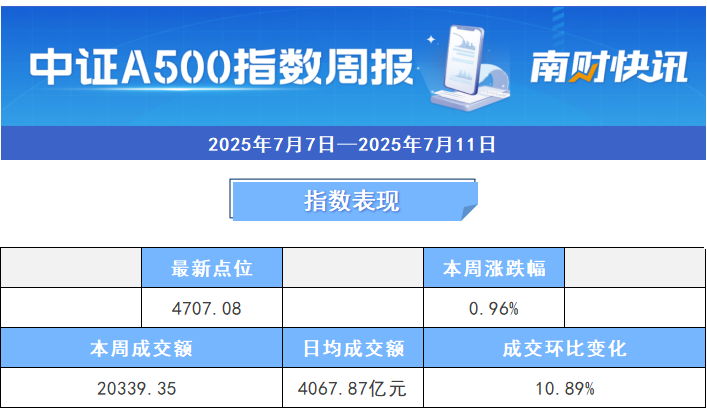
Index Performance - The CSI A500 Index rose by 0.96% this week, closing at 4707.08 points on July 11, marking three consecutive weeks of gains [6] - The average daily trading volume for the week was 4067.87 billion yuan, with a week-on-week increase of 10.89% [6] Component Stocks Performance - The top ten gainers this week included: 1. Zhongyou Capital (000617.SZ) with a gain of 27.78% 2. Quzhou Development (600208.SH) with a gain of 23.67% 3. Northern Rare Earth (600111.SH) with a gain of 21.66% 4. Shenghe Resources (600392.SH) with a gain of 18.99% 5. Harbin Investment (600864.SH) with a gain of 16.36% 6. China Rare Earth (000831.SZ) with a gain of 16.31% 7. Baogang Group (600010.SH) with a gain of 15.47% 8. New Town Holdings (601155.SH) with a gain of 12.98% 9. JA Solar Technology (002459.SZ) with a gain of 12.56% 10. Sungrow Power Supply (300274.SZ) with a gain of 12.50% [4] - The top ten losers included: 1. Huahai Pharmaceutical (600521.SH) with a loss of 9.50% 2. Kelun Pharmaceutical (002422.SZ) with a loss of 8.61% 3. Baillie Gifford (688506.SH) with a loss of 8.43% 4. Junshi Biosciences (688180.SH) with a loss of 7.54% 5. Dongpeng Beverage (605499.SH) with a loss of 6.30% 6. Yingfeng Environment (000967.SZ) with a loss of 5.94% 7. Ziwen Mining (601899.SH) with a loss of 5.79% 8. Juhua Group (600160.SH) with a loss of 5.62% 9. Shandong Gold (600547.SH) with a loss of 5.41% 10. Pudong Development Bank (600000.SH) with a loss of 5.35% [4] Fund Performance - All 38 CSI A500 funds collectively rose this week, with the top performer being the Fortune Fund, which increased by 1.48% [7] - The total scale of these funds reached 1985.44 billion yuan, with the top three being Huatai-PineBridge (189.17 billion yuan), Guotai (178.43 billion yuan), and GF Fund (171.80 billion yuan) [7] Market Insights - Recent reports indicate that the A-share market has broken through key levels, moving away from a "full reduction" mindset, with structural expansion observed [8] - The bond market is experiencing low interest rates and volatility, facing strong resistance both upwards and downwards [8] - The report suggests that the second half of the year will see an influx of incremental capital, driving the market to a new level, with insurance capital leading the way [8] - The technology sector is highlighted as having high probability and return potential due to industry trends and supportive policies [8] - Consumer data shows signs of improvement, with macroeconomic indicators reflecting positive trends, particularly in discretionary consumption [9]


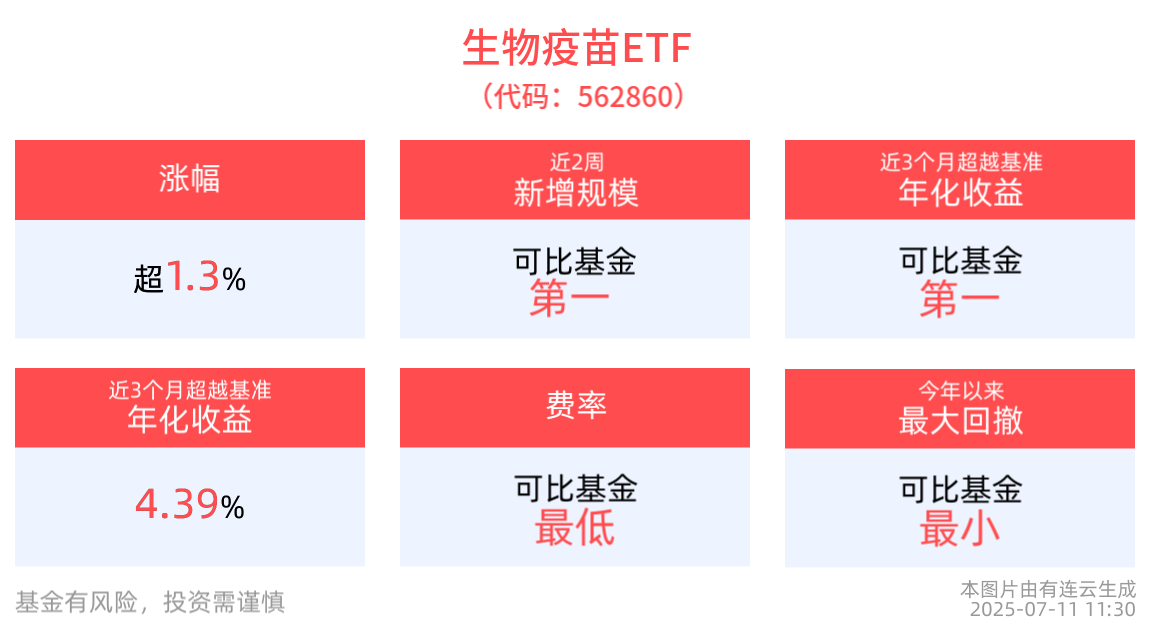
近2周新增规模同类第一,生物疫苗ETF(562860)半日收涨1.32%,机构:关注中国疫苗出海机会
Sou Hu Cai Jing· 2025-07-11 04:30
Group 1: ETF Performance and Liquidity - The biopharmaceutical vaccine ETF has a turnover rate of 1.9% during trading, with a transaction volume of 4.8922 million yuan [3] - Over the past two weeks, the biopharmaceutical vaccine ETF has seen a scale increase of 8.7844 million yuan, ranking first among comparable funds [3] - As of July 10, the biopharmaceutical vaccine ETF has achieved a net value increase of 22.89% over the past year [3] - The ETF's highest monthly return since inception is 26.27%, with the longest consecutive monthly gain being 3 months and the longest gain percentage being 14.87% [3] - The average return during the months of increase is 6.41% [3] Group 2: Index Valuation and Composition - The index tracked by the ETF, the CSI Vaccine and Biotechnology Index, is currently valued at a historical low, with a price-to-book ratio (PB) of 2.6 times, which is lower than 88.03% of the time over the past three years, indicating strong valuation attractiveness [3] - The CSI Vaccine and Biotechnology Index includes no more than 50 companies involved in vaccine research, production, and related biotechnology sectors, reflecting the overall performance of listed companies in this theme [3] Group 3: Major Stocks and Market Trends - As of June 30, 2025, the top ten weighted stocks in the CSI Vaccine and Biotechnology Index include Zhifei Biological Products, Wantai Biological Pharmacy, Watson Bio, and others, collectively accounting for 48.14% of the index [4] - The top weighted stocks and their respective weights are: Zhifei Biological (10.06%), Wantai Biological (8.43%), Watson Bio (6.19%), and others [6] - On July 8, the National Healthcare Security Administration and the National Health Commission released measures to support the high-quality development of innovative drugs, proposing 16 supportive policies [6] Group 4: International Market Opportunities - Institutions are focusing on the opportunities for Chinese vaccines in international markets under the "World Shared Market" concept, particularly in Belt and Road countries [7] - Chinese vaccines are expected to leverage cost advantages to expand into the pharmaceutical markets of Belt and Road countries, especially in light of supply chain risks faced by non-U.S. countries [7] - The vaccine market is sensitive to population variables, and Chinese companies have established production capacity and distribution channels in Belt and Road countries, laying a solid foundation for international expansion [7]

2024年我国累计在研创新药约占全球30%,科创医药ETF嘉实(588700)冲击3连涨
Xin Lang Cai Jing· 2025-07-11 03:47
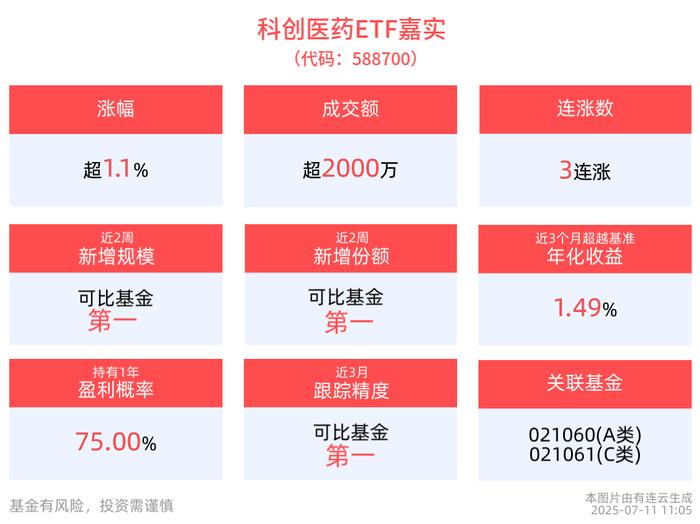
Core Viewpoint - The Shanghai Stock Exchange Science and Technology Innovation Board Biopharmaceutical Index has shown strong performance, with significant increases in constituent stocks, indicating a positive trend in the biopharmaceutical sector [1][3]. Market Performance - As of July 11, 2025, the Biopharmaceutical Index rose by 1.23%, with notable gains from stocks such as Yifang Biotech (+10.31%), Shouyao Holdings (+8.34%), and Te Bao Biotech (+7.18%) [1]. - The Jiashi Science and Technology Medicine ETF (588700) also increased by 1.14%, marking its third consecutive rise [1]. Liquidity and Trading Volume - The Jiashi Science and Technology Medicine ETF recorded a turnover rate of 9.54% and a trading volume of 21.11 million yuan [3]. - Over the past month, the ETF has maintained an average daily trading volume of 33.32 million yuan, ranking first among comparable funds [3]. Fund Growth and Performance - In the last two weeks, the Jiashi Science and Technology Medicine ETF's scale increased by 17.56 million yuan, leading among comparable funds [3]. - The ETF's net value has risen by 37.70% over the past year, with a maximum single-month return of 23.29% since its inception [3]. Top Holdings - As of June 30, 2025, the top ten weighted stocks in the Biopharmaceutical Index accounted for 50.3% of the index, including companies like United Imaging Healthcare, BeiGene, and Huatai Medical [3][5]. Policy Support and Market Outlook - Recent policy documents have been released to support the high-quality development of innovative drugs, highlighting government backing for the sector [6]. - The number of innovative drugs in development in China has reached over 4,000, representing approximately 30% of the global total [5][6].


科创医药ETF嘉实(588700)近2周新增规模同类第一!机构:创新药出海趋势将长期持续
Sou Hu Cai Jing· 2025-07-10 05:50
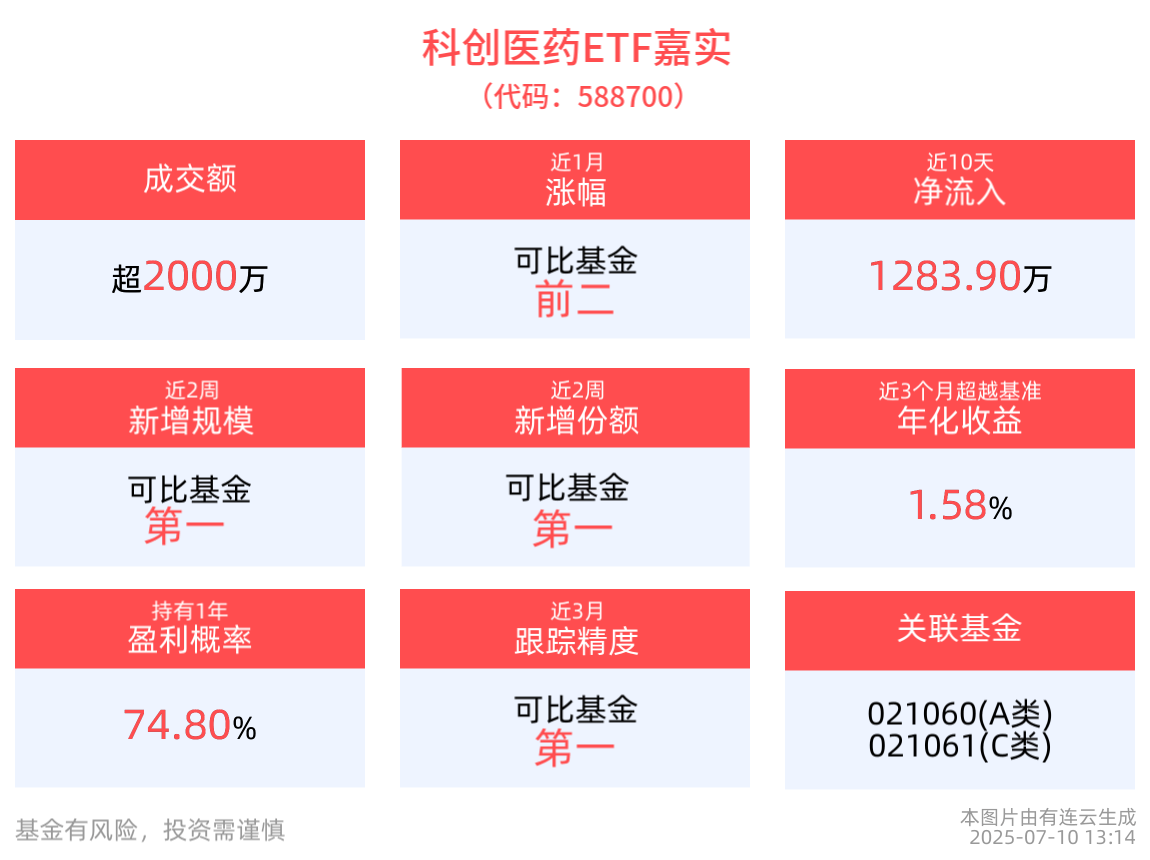
Group 1 - The core viewpoint highlights the significant growth and performance of the Kexin Pharmaceutical ETF managed by Jiashi, with a notable increase in trading volume and fund size [2] - As of July 9, the Kexin Pharmaceutical ETF achieved a daily average trading volume of 34.95 million yuan over the past month, ranking first among comparable funds [2] - The fund's size increased by 16.76 million yuan in the past two weeks, also ranking first among comparable funds [2] - The ETF saw a total inflow of 12.84 million yuan over the last ten trading days, indicating strong investor interest [2] - The net value of the Kexin Pharmaceutical ETF rose by 36.83% over the past year, showcasing its strong performance [2] Group 2 - The top ten weighted stocks in the Shanghai Stock Exchange Science and Technology Innovation Board Biopharmaceutical Index account for 50.3% of the index, with leading companies including United Imaging Healthcare and BeiGene [2][4] - On July 9, Shanghai Pharmaceuticals announced an expected net profit of 4.45 billion yuan for the first half of 2025, representing a year-on-year increase of approximately 52% [4] Group 3 - Short-term market expectations for overseas transactions in innovative drugs are high, leading to a continuous rise in valuations [5] - China's innovative drug research and development capabilities are competitive globally, and the trend of innovative drugs going overseas is expected to persist [5] - The commercial health insurance sector in China is anticipated to see significant growth in premium income and payout rates, becoming an important source of funding for innovative drugs [5]


君实生物20250708
2025-07-09 02:40
Summary of Junshi Biosciences Conference Call Company Overview - **Company**: Junshi Biosciences - **Industry**: Biopharmaceuticals, specifically focusing on oncology and immunotherapy Key Points Financial Performance - In Q1 2025, Junshi Biosciences reported sales of 447 million RMB, a year-on-year increase of over 40% [2][3] - The core product, Toripalimab, achieved sales of 1.5 billion RMB in 2024, reflecting a 67% year-on-year growth [3] - Projected domestic revenue for Toripalimab in 2025 is expected to exceed 2 billion RMB, contributing 500 to 600 million RMB in profit [2][4] Product Development and Pipeline - Toripalimab has received approval for 12 indications in China, with 10 included in medical insurance, providing a first-mover advantage [2][3] - The company is advancing several clinical projects, including: - BTOA monoclonal antibody and PD-1 subcutaneous formulation, with BTOA in Phase III trials for limited-stage small cell lung cancer and classical Hodgkin lymphoma [2][5] - PD-1 subcutaneous formulation expected to be submitted for production by the end of 2025 [5] - DKK1 monoclonal antibody showing promising early data in colorectal cancer [8] Clinical Trials and Research - Junshi is focusing on dual antibodies, particularly PD-1/VEGF, currently in multiple Phase II trials, with promising safety and efficacy data expected to be released in Q3 2025 [6][34] - The company plans to initiate several Phase III trials for Claudin18.2 ADC, CD20-CD3 dual antibody, and PSAKα by the end of 2025 [8][10] Strategic Direction - The company aims to consolidate its market share for Toripalimab while expanding its product pipeline with innovative drugs [7][10] - Junshi is exploring international collaborations to accelerate global expansion and enhance profitability [7][12] Market Trends and Future Outlook - The trend for immunotherapy drugs is moving towards combination therapies with chemotherapy and ADCs [8] - Junshi anticipates significant growth in the PD-1 product line due to an increase in approved indications and a strengthened sales team [30] - The company expects to achieve breakeven by around 2027, with R&D expenses projected to remain between 1.2 to 1.5 billion RMB annually [25][26] Sales and Management Expenses - Sales expenses are expected to grow at a rate lower than revenue growth, maintaining a sales expense ratio below 50% [31] - Management expenses are projected to remain stable at around 400 to 500 million RMB [31] Competitive Landscape - Junshi's PD-1/VEGF dual antibody project retains primary rights, with potential for significant market share in the oncology sector [19] - The company is also developing new molecules, including PD-1, IL-2, and EGFR ADCs, with some in early clinical stages [9][28] Regulatory and Market Challenges - The company is monitoring overseas policy changes, which currently have a limited impact on revenue but could affect future profitability [33] Conclusion - Junshi Biosciences is positioned for growth with a robust pipeline and strategic focus on oncology, aiming to leverage its first-mover advantage in the PD-1 market while expanding its product offerings through innovative therapies and international collaborations.