
Jinko Solar(688223)

Search documents
多晶硅价格波动加剧 上市公司加大套保!
Zheng Quan Shi Bao Wang· 2025-11-18 03:41
Core Viewpoint - The recent volatility in the prices of upstream raw materials, such as polysilicon, has led listed companies in the new energy sector to increase their participation in the futures market significantly, recognizing the importance of price risk management [2][3]. Group 1: Increase in Hedging Activities - In October alone, 458 listed companies announced hedging-related activities, a 2.3-fold increase compared to the same period in 2024, indicating a growing awareness of price risk management [2][3]. - Companies like JinkoSolar and EVE Energy have significantly raised their hedging limits, with JinkoSolar increasing its margin requirements from 660 million yuan to 1.5 billion yuan, and EVE Energy raising its limits from 350 million yuan to 1 billion yuan [3]. - The trend suggests that the number of companies participating in hedging activities is expected to exceed 2,000 by the end of the year [2][7]. Group 2: Polysilicon Price Volatility - Polysilicon prices have experienced significant fluctuations, dropping from 56,000 yuan per ton at the beginning of the year to 34,400 yuan per ton by the end of June, a decline of 38.6% [4]. - Following a rebound driven by "anti-involution" policies, polysilicon prices rose to 47,100 yuan per ton by the end of July, marking a 36.9% increase within a month [4]. - The futures market for polysilicon saw a record high of 57,945 yuan per ton on September 5, reflecting a 91% increase from late June [4]. Group 3: Industry Dynamics and Strategies - The "anti-involution" policy has created an uneven benefit distribution across the supply chain, with upstream polysilicon prices rising first before impacting downstream sectors like silicon wafers and battery cells [6]. - The domestic polysilicon production is projected to be around 382,000 tons in Q4, a slight increase of 3% year-on-year, while the total production for 2025 is expected to drop by 27.3% to approximately 1.34 million tons [6]. - Analysts emphasize the importance of differentiated strategies and risk control for companies, suggesting that production firms should focus on selling hedges, while downstream companies should engage in buying hedges [5][6]. Group 4: Market Participation and Trends - The number of A-share listed companies involved in hedging activities has surged, with 312 companies publishing 473 hedging-related announcements in October, a year-on-year increase of 231.91% [7]. - Overall, 1,737 A-share listed companies have reported hedging activities in the first ten months of the year, reflecting a 15.6% increase compared to the previous year [7]. - The electronics, basic chemicals, and power equipment sectors have the highest number of companies participating in hedging, with participation rates exceeding 40% in several industries [7].



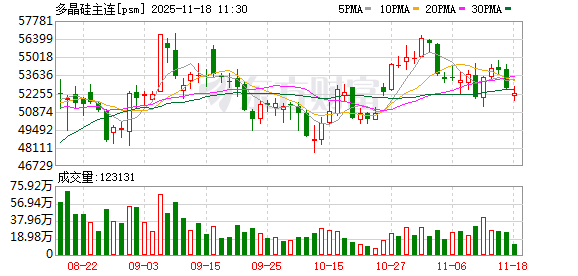
多晶硅价格过山车,新能源企业加码期货
Huan Qiu Wang· 2025-11-18 03:39
Core Viewpoint - The renewable energy industry is undergoing a significant pressure test due to drastic fluctuations in upstream raw material prices, particularly polysilicon, which has seen a dramatic price drop followed by a rapid rebound, leading to a survival competition among companies focused on risk management [1][2]. Group 1: Price Fluctuations and Industry Impact - Polysilicon prices fell from 56,000 yuan/ton at the beginning of 2025 to 34,400 yuan/ton by the end of June, a decline of nearly 40%, resulting in six consecutive quarters of deep losses for the industry [1]. - Following a policy push for healthy competition, prices rebounded sharply, increasing by 36.9% within a month, with futures prices reaching a new high in September [1]. Group 2: Increased Reliance on Hedging Tools - Major companies in the renewable energy sector are significantly increasing their hedging limits, indicating a strong commitment to risk mitigation [2]. - JinkoSolar announced an increase in its futures hedging margin limit from 660 million yuan to 1.5 billion yuan, with a maximum contract value of 10.3 billion yuan [2]. - EVE Energy raised its commodity hedging margin and premium limits from 350 million yuan to 1 billion yuan, with maximum contract values increasing from 3.5 billion yuan to 8.5 billion yuan [2]. Group 3: Broader Market Trends - The trend of embracing futures markets is not limited to the renewable energy sector but is becoming a consensus among listed companies in China, with 458 companies announcing hedging activities in October 2025, a 2.3-fold increase from the previous year [3]. - A total of 1,737 A-share listed companies participated in hedging activities in the first ten months of the year, a year-on-year increase of 15.6% [3]. - Manufacturing sectors such as electronics, basic chemicals, and power equipment are the main participants, with over 50% participation from industries like non-ferrous metals and home appliances [3].

通威刘汉元谈光伏“反内卷”:既要反垄断又要反过度竞争,光伏50ETF(516880)连续5日“吸金”累计1.59亿元,科士达上涨超4%
2 1 Shi Ji Jing Ji Bao Dao· 2025-11-18 02:18
Group 1 - The three major indices showed mixed performance, with the Shanghai Composite Index down 0.21%, the Shenzhen Component Index up 0.15%, and the ChiNext Index up 0.29% [1] - The CSI Photovoltaic Industry Index (931151.CSI) decreased by 0.3%, while key stocks such as Kstar, Junda, JinkoSolar, Roborock, and Trina Solar saw increases of over 3% [1] - The Photovoltaic 50 ETF (516880) experienced a decline of 0.46%, but recorded a net inflow of 27.81 million yuan on the previous trading day, marking five consecutive days of net inflows totaling 159 million yuan [1] Group 2 - Tongwei's Chairman Liu Hanyuan emphasized the need for the photovoltaic industry to combat excessive competition and promote self-discipline, suggesting the establishment of a platform company to manage silicon material capacity [1] - The recent self-regulatory measures in the photovoltaic industry aim to prevent over-competition, with a focus on "silicon material storage" to address dynamic demand changes [1] - According to a recent report from Zhongtai Securities, the ongoing "anti-involution" efforts in the photovoltaic sector are releasing positive signals, indicating an upward reversal in the industry's fundamentals [2]




多晶硅价格波动加剧 新能源企业套保额度大幅增加
Zheng Quan Shi Bao· 2025-11-17 23:54
Core Insights - The recent volatility in the prices of upstream raw materials like polysilicon has led listed companies in the new energy sector to increase their participation in the futures market for risk management [1][2] - In October alone, the number of listed companies announcing hedging activities reached 458, a 2.3-fold increase year-on-year, indicating a growing awareness of price risk management [1][5] Group 1: Company Actions - Camel Group announced a maximum trading margin and option premium of 90 million yuan for futures hedging to mitigate risks from raw material price fluctuations [2] - JinkoSolar plans to increase its maximum margin for futures hedging from 660 million yuan to 1.5 billion yuan, with a maximum contract value of 10.3 billion yuan, enhancing its financial stability [2] - EVE Energy adjusted its hedging limits, raising the maximum margin from 350 million yuan to 1 billion yuan, and the maximum contract value from 3.5 billion yuan to 8.5 billion yuan [2] Group 2: Market Trends - Polysilicon prices have experienced significant fluctuations, with a drop of 38.6% from 56,000 yuan/ton to 34,400 yuan/ton in the first half of 2025, leading to losses for many small and medium enterprises [3] - Following a rebound driven by "anti-involution" policies, polysilicon prices rose by 36.9% within a month, reaching 47,100 yuan/ton [3] - The futures market for polysilicon saw a record high of 57,945 yuan/ton on September 5, marking a 91% increase from late June [3] Group 3: Industry Outlook - The polysilicon market is expected to maintain a wide range of high-level fluctuations due to the interplay between policy expectations and market fundamentals [4] - The domestic polysilicon production is projected to be around 382,000 tons in Q4, a slight increase of 3% year-on-year, while the total production for 2025 is expected to decrease by 27.3% to approximately 1.34 million tons [4] - The industry is facing a need for nearly 100 billion yuan in funding to support potential storage initiatives aimed at stabilizing prices amid rapid capacity expansion [5] Group 4: Participation in Hedging - The number of listed companies engaging in hedging activities is expected to exceed 2,000 by the end of the year, reflecting a strong demand for new risk management tools [5] - In the first ten months of the year, 1,737 A-share listed companies issued hedging-related announcements, a year-on-year increase of 15.6% [5] - The electronics, basic chemicals, and power equipment sectors have the highest number of companies participating in hedging, with participation rates exceeding 40% in several industries [6]
多晶硅价格大起大落 新能源企业加大套保稳住利润盘
Zheng Quan Shi Bao· 2025-11-17 16:57
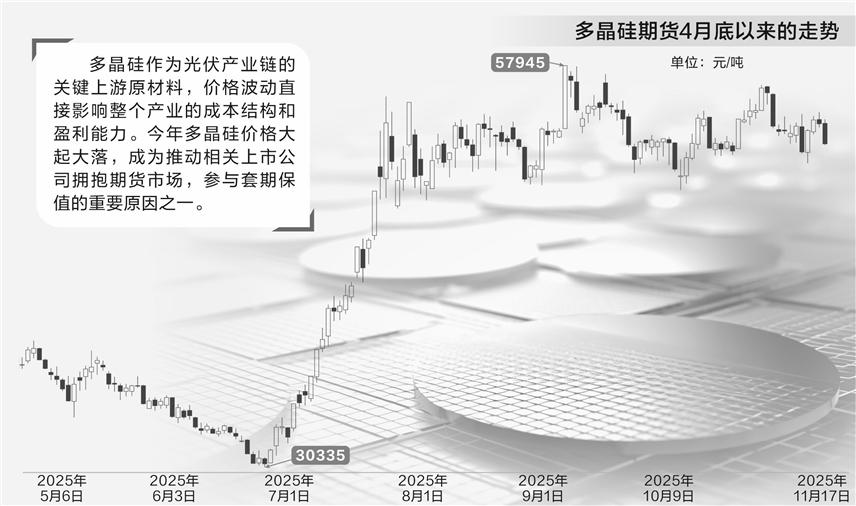
Core Insights - The volatility in the prices of upstream raw materials, particularly polysilicon, has led to an increased participation of listed companies in the futures market for risk management [2][3] - In October alone, 458 companies announced hedging activities, a 2.3-fold increase year-on-year, indicating a growing awareness of price risk management among companies [2][8] - The number of companies engaging in hedging activities is expected to exceed 2000 by the end of the year [2][8] Company Actions - Camel Group announced a maximum trading margin and premium limit of 90 million yuan for futures and options hedging to mitigate risks from price fluctuations [3] - JinkoSolar plans to increase its hedging margin from 660 million yuan to 1.5 billion yuan, with a maximum contract value of 10.3 billion yuan, enhancing its financial stability [3] - EVE Energy adjusted its hedging limits, raising the maximum margin from 350 million yuan to 1 billion yuan, and the maximum contract value from 3.5 billion yuan to 8.5 billion yuan [3] Market Dynamics - Polysilicon prices have experienced significant fluctuations, impacting the cost structure and profitability of the entire photovoltaic industry [4] - The price of polysilicon dropped from 56,000 yuan/ton at the beginning of the year to 34,400 yuan/ton by the end of June, a decline of 38.6% [4] - Following a rebound driven by "anti-involution" policies, polysilicon prices rose to 47,100 yuan/ton by the end of July, marking a 36.9% increase within a month [4] Industry Trends - The futures market is becoming a crucial tool for companies to manage risks and stabilize profits amid price volatility [8] - The number of listed companies engaging in hedging activities has increased significantly, with 1,737 companies reporting hedging announcements in the first ten months of the year, a 15.6% year-on-year increase [8] - The electronics, basic chemicals, power equipment, machinery, and automotive sectors have the highest number of companies participating in hedging [8]
晶科能源:选举职工代表董事
Zheng Quan Ri Bao· 2025-11-17 14:16
Core Viewpoint - JinkoSolar announced the election of Ms. Liu Hua as the employee representative director of the company's second board of directors during the employee representative assembly scheduled for November 17, 2025 [1] Company Summary - JinkoSolar will hold an employee representative assembly on November 17, 2025 [1] - Ms. Liu Hua has been elected as the employee representative director for the second board of directors [1]
晶科能源:向下修正“晶能转债”转股价格
Zheng Quan Ri Bao· 2025-11-17 13:37
Core Points - JinkoSolar announced a downward adjustment of the conversion price for its "Jingneng Convertible Bonds" from 13.48 CNY per share to 6.35 CNY per share [1] Summary by Category Company Announcement - The company will hold its 23rd meeting of the second board on November 17, 2025, to review the proposal for the adjustment of the conversion price [1]
晶科能源和日本DMM签订300MW飞虎3供货协议
Zheng Quan Shi Bao Wang· 2025-11-17 12:08
人民财讯11月17日电,近日,晶科能源宣布与日本企业DMM株式会社正式签署300MW的飞虎3(Tiger Neo3.0)高效组件供货协议。根据协议,这些产品将用于日本境内多个太阳能电站项目。 ...
晶科能源:非独立董事舒懿辞职
Ge Long Hui· 2025-11-17 10:50
Core Viewpoint - JinkoSolar (688223.SH) announced the resignation of non-independent director Shu Yi due to personal reasons, and the company has elected Liu Hua as the employee representative director following a vote at the employee representative assembly [1] Group 1 - Shu Yi submitted a written resignation report, resigning from her positions as a director and a member of the Strategy and Sustainable Development Committee [1] - After Shu Yi's resignation, she will no longer hold any position within the company [1] - The employee representative assembly was held on November 17, 2025, where Liu Hua was elected as the employee representative director for the second board term [1]
晶科能源(688223.SH):非独立董事舒懿辞职
Ge Long Hui· 2025-11-17 10:48
Core Viewpoint - JinkoSolar (688223.SH) announced the resignation of non-independent director Ms. Shu Yi due to personal reasons, effective immediately, and she will not hold any position in the company thereafter [1] Group 1 - The company's board received a written resignation report from Ms. Shu Yi, who applied to resign from her positions as a director and a member of the Strategy and Sustainable Development Committee [1] - Following Ms. Shu Yi's resignation, the company held a staff representative meeting on November 17, 2025, where Ms. Liu Hua was elected as the employee representative director for the second board, with her term lasting until the end of the second board's term [1]