Jinko Solar(688223)

Search documents
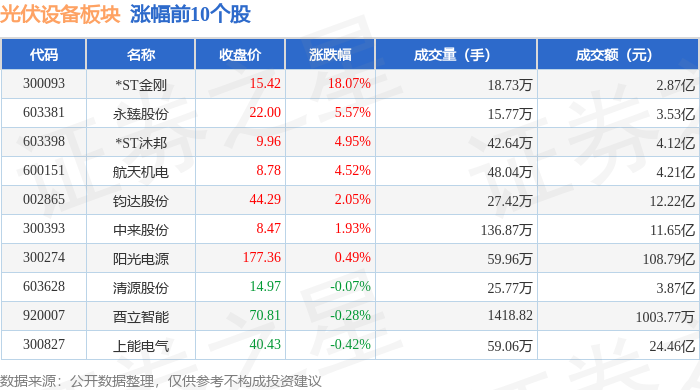
光伏设备板块11月20日跌2.59%,大全能源领跌,主力资金净流出19.65亿元
Zheng Xing Xing Ye Ri Bao· 2025-11-20 09:04
Core Insights - The photovoltaic equipment sector experienced a decline of 2.59% on November 20, with Daqo Energy leading the drop [1][2] - The Shanghai Composite Index closed at 3931.05, down 0.4%, while the Shenzhen Component Index closed at 12980.82, down 0.76% [1] Stock Performance - Notable gainers included: - *ST Quangang: Closed at 15.42, up 18.07% with a trading volume of 187,300 shares [1] - Yongshou Co.: Closed at 22.00, up 5.57% with a trading volume of 157,700 shares [1] - Major decliners included: - Daqo Energy: Closed at 28.42, down 6.70% with a trading volume of 172,800 shares [2] - Longi Green Energy: Closed at 20.10, down 5.19% with a trading volume of 2,338,800 shares [2] Capital Flow - The photovoltaic equipment sector saw a net outflow of 1.965 billion yuan from institutional investors, while retail investors contributed a net inflow of 1.747 billion yuan [2][3] - The capital flow for key stocks showed: - Sunshine Power: Net inflow of 391 million yuan from institutional investors [3] - Junda Co.: Net outflow of 329 million yuan from retail investors [3]




中金:25Q3光伏大幅减亏 重点关注储能系统及PCS环节
Zhi Tong Cai Jing· 2025-11-20 07:17
Core Viewpoint - The domestic photovoltaic demand in Q3 2025 has weakened due to the end of the rush for installation, but the financial performance of the main industry chain and glass segments has significantly improved, with a focus on potential price increases for components and further profit release for silicon material companies in Q4 2025 [1] Industry Summary - **Main Industry Chain Recovery**: The upstream of the main industry chain has significantly recovered, while the component prices are yet to show a clear upward trend. After the end of the rush for installation in the first half of 2025, photovoltaic demand has weakened, but the performance of silicon materials and silicon wafers has greatly improved due to anti-involution efforts [2] - **Stable Processing Fees and Glass Profit Improvement**: The shipment of slurry in Q3 2025 has slightly increased quarter-on-quarter, with overall gross margins remaining stable. Attention is drawn to the pace of mass production of low-cost metal slurry from this year to the first half of next year, as well as the second growth curve of leading companies. Leading glass and film companies have strengthened their advantages due to a higher proportion of overseas shipments and continuous cost reductions [3] - **High Demand for Energy Storage**: Despite a certain degree of weakness in inverter exports due to the European off-season in Q3 2025, domestic energy storage bidding has increased significantly year-on-year, driving demand for centralized inverters and energy storage systems. The large-scale energy storage market remains robust, with strong performance in emerging markets such as Australia and Southeast Asia [4] - **Focus on Q4 2025 Financial Recovery**: The overall profit and operating cash flow of the sector have improved significantly in Q3 2025. The average transaction price of silicon materials is expected to continue to rise quarter-on-quarter in Q4 2025, and with the support of anti-involution efforts, component prices are likely to gradually increase. The outlook for energy storage remains positive, with expectations of high growth in domestic large-scale energy storage installations and demand recovery in Europe [5] Company Recommendations - **Silicon Material Segment**: Recommended companies include Tongwei Co., Ltd. (600438), Daqo New Energy (688303) [6] - **High-Efficiency Component Leaders**: Recommended companies include JinkoSolar (688223), Aiko Solar (600732) [6] - **Copper Slurry and Second Growth Curve**: Recommended companies include Dike Co., Ltd. (300842), Juhe Materials (688503) [6] - **Glass Segment**: Recommended companies include Xinyi Solar (00968), Flat Glass Group (601865) [6] - **Energy Storage**: Recommended companies include Deye Technology (605117), Tongrun Equipment (002150), Ginlong Technologies (300763), Sangfor Technologies (300827), Yunnan Energy (688348), and Canadian Solar (688472) [6]



晶科能源20251118
2025-11-19 01:47
Summary of JinkoSolar Q3 2025 Earnings Call Company Overview - **Company**: JinkoSolar - **Date of Call**: November 18, 2025 Key Financial Metrics - **Total Revenue**: $2.7 billion, a 10% increase quarter-over-quarter and a 34% increase year-over-year [2][8] - **Gross Margin**: Improved to 7.3%, up 4.4 percentage points due to lower unit costs [2][8] - **Net Loss**: Continued to narrow, with significant improvement in operating cash flow reaching $340 million [2][8] - **Operating Expenses**: $363 million, down 36% quarter-over-quarter and 32% year-over-year [10][11] Business Segments Solar Products - **High-Power Products**: New Tiger series has reached a maximum power of 670 watts, with expectations for high-power product shipments to exceed 60% by 2026 [2][6] - **Module Shipments**: Anticipated total shipments between 85 GW to 500 GW [3][9] Energy Storage - **Growth in Energy Storage**: Over 3.3 GWh shipped in the first three quarters, with expectations for over 100% growth by 2026 [2][4][7] - **Production Capacity**: 12 GWh assembly capacity and 5 GWh battery cell capacity, focusing on high-margin overseas markets [2][7] Market Outlook - **Solar Market Demand**: Expected to remain stable in 2026 compared to 2025, with a positive outlook for installations to grow by at least 25% [2][16] - **Global Market Share**: Increased to 15%-16%, with confidence in regaining market share despite recent price pressures [5][26] Strategic Initiatives - **Cost Management**: Strategies in place to mitigate the impact of raw material price fluctuations, including partnerships with key suppliers [2][17] - **Shareholder Returns**: Commitment to return at least $100 million annually to shareholders, with ongoing stock buyback plans [5][20] Regional Insights - **China Market**: Optimistic outlook for 2026, with expected module shipments between 200 MW to 250 MW [20] - **ESS Business**: Anticipated to contribute significantly to revenue and margin expansion, particularly in the U.S. and Europe [15][24] Risks and Challenges - **Raw Material Prices**: Ongoing management of raw material price volatility, with proactive measures to minimize impacts [17][18] - **Regulatory Environment**: Adapting to changing policies in key markets, including the U.S. and China [19][28] Conclusion - **Future Growth**: JinkoSolar is positioned for growth through technological advancements, strategic market focus, and robust financial management, aiming to enhance its competitive edge in the solar and energy storage sectors [9][24]
光伏企业集体“换挡”
2 1 Shi Ji Jing Ji Bao Dao· 2025-11-18 23:08
Core Insights - Trina Solar has recently announced significant overseas energy storage contracts, totaling 2.66 GWh, indicating a strong entry into the energy storage market by major photovoltaic manufacturers [1] - Longi Green Energy's acquisition of the energy storage company Jingkong Energy marks a pivotal moment as the top photovoltaic manufacturers collectively enter the energy storage sector [1][3] - The energy storage market is becoming increasingly competitive, with different strategies being adopted by various companies, highlighting a shift from traditional photovoltaic manufacturing to integrated energy solutions [7] Company Strategies - Longi Green Energy has been hesitant about entering the energy storage market but has now taken a significant step by acquiring Jingkong Energy, which will enhance its capabilities in the energy storage sector [3][6] - Canadian Solar has been proactive in the energy storage market, achieving 4.5 billion yuan in revenue from energy storage in the first half of the year, accounting for 21.04% of its total revenue, with a gross margin of 31.42% [4] - Trina Solar aims to become a leader in the energy storage industry, with plans to achieve over 100 billion yuan in sales within the next 5-8 years, and has already established significant production capacity [5] Market Dynamics - The energy storage industry is experiencing intense competition, with companies focusing on technology, production capacity, and market channels [6][7] - Longi Green Energy's late entry into the energy storage market has led it to pursue acquisitions as a more cost-effective strategy compared to building its own production capacity [6] - The collective shift of photovoltaic companies into the energy storage market is driven by the need to address the intermittency of solar power generation and to enhance profitability through integrated energy solutions [7]

道指大跌超400点,科技股、中概股普跌,晶科能源跌超7%
2 1 Shi Ji Jing Ji Bao Dao· 2025-11-18 15:33
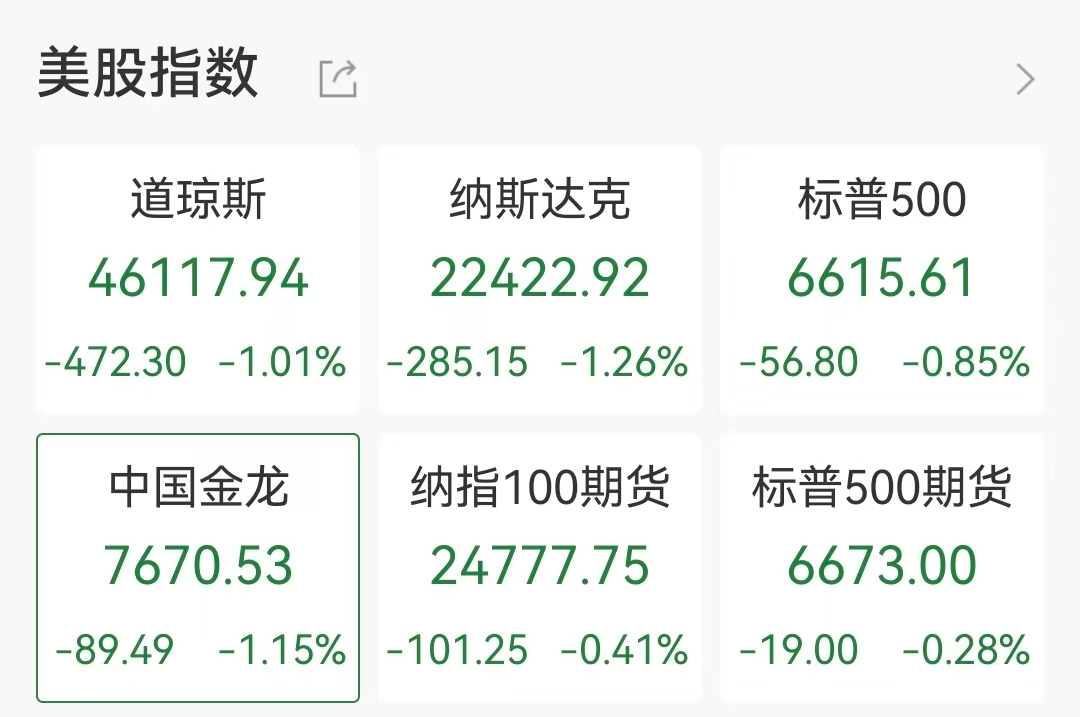
Market Overview - The U.S. stock market has shown significant weakness recently, particularly in the technology sector, with major indices like the Dow Jones, Nasdaq, and S&P 500 all experiencing declines [1][7] - The Nasdaq China Golden Dragon Index fell by 1.15%, indicating a broader downturn in Chinese stocks listed in the U.S. [3][7] Technology Sector Performance - Major tech stocks, including Nvidia, Tesla, Amazon, Microsoft, and Facebook, all dropped over 2%, contributing to a nearly 2% decline in the Nasdaq's seven tech giants index [1][2] - Micron Technology saw a decline of over 5%, while TSMC dropped more than 2%, reflecting a broader downturn in the semiconductor sector [1] Chinese Stocks - Chinese stocks listed in the U.S. faced significant losses, with JinkoSolar down over 7% and Daqo New Energy down over 6% [3][4] - Other notable declines included Atour and Xunlei, both falling over 3% [3] Cryptocurrency Market - The cryptocurrency market has also been under pressure, with Bitcoin dropping below $90,000 and Ethereum down over 2% [5] - In the last 24 hours, over 170,000 traders were liquidated, with a total liquidation amount of $800 million [6] Economic Factors - Concerns over high valuations in AI stocks and tightening liquidity have contributed to the recent downturn in the U.S. stock market [7] - The probability of a Federal Reserve rate cut in December has decreased to 48.6%, following hawkish comments from several Fed officials [7] - Market volatility has been exacerbated by investor positioning and high valuations, leading to a divergence from overly optimistic market sentiment [7]

多晶硅价格波动加剧,上市公司加大套保!
证券时报· 2025-11-18 07:56
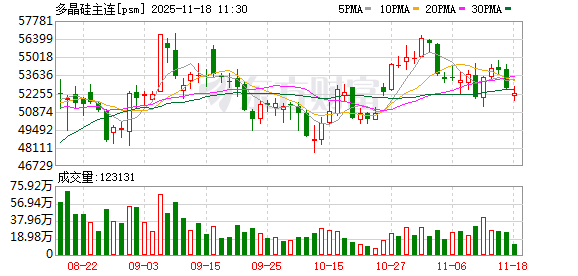
Core Viewpoint - The article highlights the increasing participation of listed companies in the futures market to manage price risks, particularly in the context of volatile raw material prices in the upstream solar energy sector, such as polysilicon [1][2]. Group 1: Market Participation and Trends - In October alone, 458 listed companies announced hedging activities, a 2.3-fold increase year-on-year, indicating a growing awareness of price risk management [2]. - The number of companies participating in hedging is expected to exceed 2000 by the end of the year, reflecting a significant trend in the industry [2][9]. Group 2: Company-Specific Hedging Activities - Camel Group announced a maximum trading margin and option premium of 90 million yuan for futures hedging to mitigate risks from raw material price fluctuations [4]. - JinkoSolar plans to increase its hedging margin from 660 million yuan to 1.5 billion yuan, with a maximum contract value of 10.3 billion yuan, emphasizing risk management over speculative trading [4]. - EVE Energy adjusted its hedging limits, raising the maximum margin from 350 million yuan to 1 billion yuan, and the maximum contract value from 3.5 billion yuan to 8.5 billion yuan [4]. Group 3: Polysilicon Price Volatility - Polysilicon prices have experienced significant fluctuations, with a drop from 56,000 yuan/ton at the beginning of the year to 34,400 yuan/ton by June, a decline of 38.6% [5]. - Following a rebound driven by "anti-involution" policies, polysilicon prices rose from 34,400 yuan/ton to 47,100 yuan/ton in July, marking a 36.9% increase [5]. - The weighted contract price for polysilicon futures reached a record high of 57,945 yuan/ton on September 5, reflecting a 91% increase from late June [5]. Group 4: Industry Dynamics and Strategies - The "anti-involution" policy is expected to create a short-term price fluctuation in the polysilicon market, with upstream price increases gradually affecting downstream sectors [7]. - The domestic polysilicon production is projected to be around 382,000 tons in Q4, a slight year-on-year increase of 3%, while the total production for 2025 is expected to drop by 27.3% to approximately 1.34 million tons [7]. - Differentiated strategies and comprehensive risk control are essential for success, with production companies primarily focusing on selling hedges, while downstream companies should focus on buying hedges [7]. Group 5: Storage and Supply-Demand Balance - The rapid expansion of polysilicon production capacity has led to supply-demand imbalances, prompting discussions on a storage platform to stabilize prices [8]. - The potential storage initiative may require nearly 100 billion yuan in funding, with several obstacles still needing to be addressed [8].
中邮证券:配套政策对2026年光伏装机需求具有利支撑 建议关注一体化组件
Zhi Tong Cai Jing· 2025-11-18 07:53
Core Viewpoint - The photovoltaic industry is experiencing a supply-demand expectation gap, with ongoing "anti-involution" actions on the supply side. China is proactive in energy transition, and related supportive measures are expected to be released intensively, potentially improving demand earlier than anticipated [1] Group 1: Industry Overview - In the first nine months of 2025, the cumulative newly installed capacity in the photovoltaic industry reached 240.3 GW, representing a year-on-year increase of 49.3%, with a consumption rate of 95% [1] - The installation in September was 9.7 GW, a year-on-year decrease of 53.8%, primarily due to the rush for installations caused by the deadline of Document 136 [1] - The overall photovoltaic installation for 2025 is expected to reach 300 GW, supported by the gradual adaptation and optimization of the mechanism electricity price model [1] Group 2: Supply and Demand Dynamics - The "anti-involution" policies on the supply side are continuously promoting improvements, and with China's submission of NDC 3.0, it is anticipated that related supportive measures will be released intensively [1] - The consumption capacity of large bases is expected to be accelerated, providing support for overall demand in 2026, thereby increasing the expectation gap [1] - The proportion of wind and solar power generation is continuously increasing, with expectations that it will exceed 20% for the entire year [1] Group 3: Investment Recommendations - The report suggests focusing on integrated components, specifically recommending companies such as Longi Green Energy (601012.SH) and JinkoSolar (688223.SH) [1]
多晶硅价格波动加剧 上市公司加大套保!
Zheng Quan Shi Bao Wang· 2025-11-18 03:41
Core Viewpoint - The recent volatility in the prices of upstream raw materials, such as polysilicon, has led listed companies in the new energy sector to increase their participation in the futures market significantly, recognizing the importance of price risk management [2][3]. Group 1: Increase in Hedging Activities - In October alone, 458 listed companies announced hedging-related activities, a 2.3-fold increase compared to the same period in 2024, indicating a growing awareness of price risk management [2][3]. - Companies like JinkoSolar and EVE Energy have significantly raised their hedging limits, with JinkoSolar increasing its margin requirements from 660 million yuan to 1.5 billion yuan, and EVE Energy raising its limits from 350 million yuan to 1 billion yuan [3]. - The trend suggests that the number of companies participating in hedging activities is expected to exceed 2,000 by the end of the year [2][7]. Group 2: Polysilicon Price Volatility - Polysilicon prices have experienced significant fluctuations, dropping from 56,000 yuan per ton at the beginning of the year to 34,400 yuan per ton by the end of June, a decline of 38.6% [4]. - Following a rebound driven by "anti-involution" policies, polysilicon prices rose to 47,100 yuan per ton by the end of July, marking a 36.9% increase within a month [4]. - The futures market for polysilicon saw a record high of 57,945 yuan per ton on September 5, reflecting a 91% increase from late June [4]. Group 3: Industry Dynamics and Strategies - The "anti-involution" policy has created an uneven benefit distribution across the supply chain, with upstream polysilicon prices rising first before impacting downstream sectors like silicon wafers and battery cells [6]. - The domestic polysilicon production is projected to be around 382,000 tons in Q4, a slight increase of 3% year-on-year, while the total production for 2025 is expected to drop by 27.3% to approximately 1.34 million tons [6]. - Analysts emphasize the importance of differentiated strategies and risk control for companies, suggesting that production firms should focus on selling hedges, while downstream companies should engage in buying hedges [5][6]. Group 4: Market Participation and Trends - The number of A-share listed companies involved in hedging activities has surged, with 312 companies publishing 473 hedging-related announcements in October, a year-on-year increase of 231.91% [7]. - Overall, 1,737 A-share listed companies have reported hedging activities in the first ten months of the year, reflecting a 15.6% increase compared to the previous year [7]. - The electronics, basic chemicals, and power equipment sectors have the highest number of companies participating in hedging, with participation rates exceeding 40% in several industries [7].

多晶硅价格过山车,新能源企业加码期货
Huan Qiu Wang· 2025-11-18 03:39
Core Viewpoint - The renewable energy industry is undergoing a significant pressure test due to drastic fluctuations in upstream raw material prices, particularly polysilicon, which has seen a dramatic price drop followed by a rapid rebound, leading to a survival competition among companies focused on risk management [1][2]. Group 1: Price Fluctuations and Industry Impact - Polysilicon prices fell from 56,000 yuan/ton at the beginning of 2025 to 34,400 yuan/ton by the end of June, a decline of nearly 40%, resulting in six consecutive quarters of deep losses for the industry [1]. - Following a policy push for healthy competition, prices rebounded sharply, increasing by 36.9% within a month, with futures prices reaching a new high in September [1]. Group 2: Increased Reliance on Hedging Tools - Major companies in the renewable energy sector are significantly increasing their hedging limits, indicating a strong commitment to risk mitigation [2]. - JinkoSolar announced an increase in its futures hedging margin limit from 660 million yuan to 1.5 billion yuan, with a maximum contract value of 10.3 billion yuan [2]. - EVE Energy raised its commodity hedging margin and premium limits from 350 million yuan to 1 billion yuan, with maximum contract values increasing from 3.5 billion yuan to 8.5 billion yuan [2]. Group 3: Broader Market Trends - The trend of embracing futures markets is not limited to the renewable energy sector but is becoming a consensus among listed companies in China, with 458 companies announcing hedging activities in October 2025, a 2.3-fold increase from the previous year [3]. - A total of 1,737 A-share listed companies participated in hedging activities in the first ten months of the year, a year-on-year increase of 15.6% [3]. - Manufacturing sectors such as electronics, basic chemicals, and power equipment are the main participants, with over 50% participation from industries like non-ferrous metals and home appliances [3].

通威刘汉元谈光伏“反内卷”:既要反垄断又要反过度竞争,光伏50ETF(516880)连续5日“吸金”累计1.59亿元,科士达上涨超4%
2 1 Shi Ji Jing Ji Bao Dao· 2025-11-18 02:18
Group 1 - The three major indices showed mixed performance, with the Shanghai Composite Index down 0.21%, the Shenzhen Component Index up 0.15%, and the ChiNext Index up 0.29% [1] - The CSI Photovoltaic Industry Index (931151.CSI) decreased by 0.3%, while key stocks such as Kstar, Junda, JinkoSolar, Roborock, and Trina Solar saw increases of over 3% [1] - The Photovoltaic 50 ETF (516880) experienced a decline of 0.46%, but recorded a net inflow of 27.81 million yuan on the previous trading day, marking five consecutive days of net inflows totaling 159 million yuan [1] Group 2 - Tongwei's Chairman Liu Hanyuan emphasized the need for the photovoltaic industry to combat excessive competition and promote self-discipline, suggesting the establishment of a platform company to manage silicon material capacity [1] - The recent self-regulatory measures in the photovoltaic industry aim to prevent over-competition, with a focus on "silicon material storage" to address dynamic demand changes [1] - According to a recent report from Zhongtai Securities, the ongoing "anti-involution" efforts in the photovoltaic sector are releasing positive signals, indicating an upward reversal in the industry's fundamentals [2]