VeriSilicon(688521)

Search documents
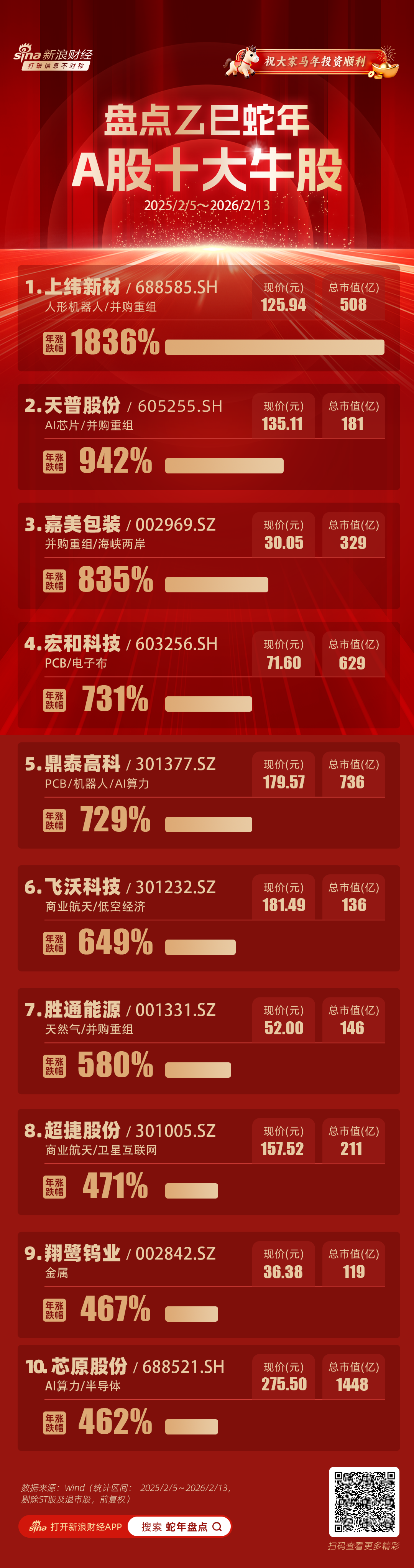
蛇年A股十大牛股出炉:上纬新材大涨18倍夺冠 共诞生7只5倍大牛股
Xin Lang Cai Jing· 2026-02-13 08:06
Group 1 - The top-performing stocks in the A-share market during the Year of the Snake include Shangwei New Materials, which saw an increase of over 18 times, and Tianpu Co., which surged by 942% [1] - A total of seven stocks achieved a fivefold increase, while one stock reached a tenfold increase during the Year of the Snake [1] Group 2 - Yunhe Technology (603256.SH) has a current price of 71.60 yuan and a total market capitalization of 62.9 billion yuan, with a growth of 781% [3] - Dingtai Gaoke (301377.SZ) has a market capitalization of 73.6 billion yuan and a current price of 179.57 yuan, showing a growth of 729% [3] - Feiwo Technology (301232.SZ) has a market capitalization of 18.149 billion yuan and a current price of 136 yuan, with a growth of 649% [3] - Shengtong Energy (001331.SZ) has a current price of 52.00 yuan and a market capitalization of 14.6 billion yuan, with a growth of 80% [4] - Chaojie Co. (301005.SZ) has a market capitalization of 21.1 billion yuan and a current price of 157.52 yuan, with significant annual growth [4] - Xianglu Tungsten Industry (002842.SZ) has a current price of 36.38 yuan and a market capitalization of 11.9 billion yuan, with a growth of 467% [4] - Xinyuan Co. (688521.SH) has a market capitalization of 144.8 billion yuan and a current price of 275.50 yuan, with a growth of 462% [4]


芯原股份股价创新高,订单增长与战略调整成关键
Jing Ji Guan Cha Wang· 2026-02-13 04:59
Core Insights - The recent stock performance of Chip Origin Co., Ltd. is linked to strategic adjustments and order growth, with a notable role played by the National Integrated Circuit Industry Investment Fund [1] Group 1: Strategic Advancement - In February 2026, Chip Origin's subsidiary, Tian Sui Xin Yuan Technology (Shanghai) Co., Ltd., increased its registered capital from 10 million to 950 million yuan, a growth of 9400%, and introduced strategic investors including Huaxin Dingxin from the National Fund III [2] - This strategic shift occurred two months after the termination of the acquisition of Chip Lai Zhi Rong, indicating a transition from external integration to internal development [2] Group 2: Performance and Operations - The company experienced significant order growth, with new orders of 2.711 billion yuan in Q4 2025, totaling 5.960 billion yuan for the year, representing a year-on-year increase of 103.41%, with over 73% of these orders related to AI computing power [3] - As of the end of 2025, the backlog of orders reached 5.075 billion yuan, marking a record high for nine consecutive quarters [3] - In terms of revenue, the company reported 3.153 billion yuan for 2025, a year-on-year growth of 35.81%, with losses narrowing compared to the previous year [3] Group 3: Financial Movements - The National Fund III provided strategic support through capital increase in Tian Sui Xin Yuan, but adjusted its shareholding strategy in Chip Origin's parent company [4] - In December 2025, the fund announced plans to reduce its stake in Chip Origin by no more than 1.7%, marking its first reduction in seven years [4] - Despite this, both parties maintained cooperation through a joint acquisition of a semiconductor company for 930 million yuan [4] Group 4: Recent Stock Trends - As of February 13, 2026, Chip Origin's stock price reached 273.80 yuan, with a year-to-date increase of 99.90%, and a daily fluctuation of 7.78% [5] - The stock price exhibited a range of 328.63% throughout 2025, with a low of 44.47 yuan and a high of 216.77 yuan [5] - The current stock price surge is primarily driven by high order growth and positive expectations for the AI computing power business, with the National Fund's capital increase being part of the strategic ecosystem support [5]

科创芯片ETF汇添富(588750)开盘跌0.95%,重仓股中芯国际跌0.30%,海光信息跌0.89%
Xin Lang Cai Jing· 2026-02-13 03:34
Group 1 - The core viewpoint of the article highlights the performance of the Sci-Tech Chip ETF managed by Huatai-PineBridge, which opened at a decline of 0.95% on February 13, 2024, priced at 1.771 yuan [1] - The major holdings of the ETF include companies such as SMIC, Haiguang Information, and Cambrian, all of which experienced declines in their stock prices, with the largest drop being 2.78% for Chipone [1] - The ETF's performance benchmark is the Shanghai Stock Exchange Sci-Tech Board Chip Index, with a return of 78.76% since its inception on December 18, 2024, and a monthly return of 1.72% [1]






资金风向标|两融余额较上一日增加11.67亿元 电子行业获融资净买入额居首
Sou Hu Cai Jing· 2026-02-13 01:40
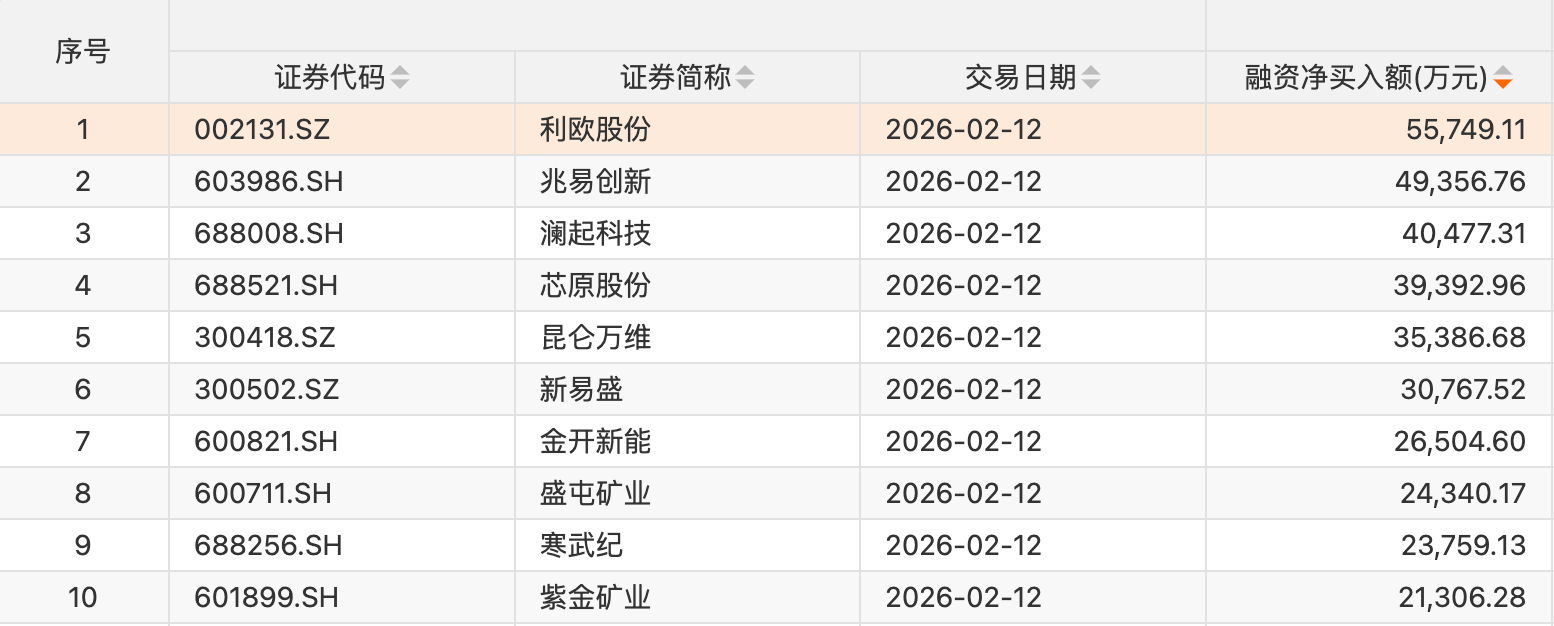
Group 1 - As of February 12, the A-share margin financing balance reached 26,456.02 billion yuan, an increase of 1.17 billion yuan from the previous trading day, accounting for 2.54% of the A-share circulating market value [1] - The margin trading volume on the same day was 2,161.58 billion yuan, which is an increase of 35.52 billion yuan from the previous trading day, representing 10% of the total A-share trading volume [1] - Among the 31 primary industries, 12 experienced net financing inflows, with the electronics industry leading at a net inflow of 759 million yuan [1] Group 2 - A total of 43 stocks had net financing inflows exceeding 100 million yuan, with Liou Co., Ltd. leading at a net inflow of 557 million yuan [2] - Other notable stocks with significant net financing inflows include Zhaoyi Innovation, Lanke Technology, Chip Origin, Kunlun Wanwei, New Yisheng, Jinkai New Energy, Shengtun Mining, Cambricon, and Zijin Mining [2] - According to Guotai Haitong Securities, the price increase of traditional fiberglass electronic cloth has accelerated since February, indicating a tightening supply and rising demand due to AI electronic cloth [2]




【ETF洞察】11只科创人工智能ETF,强势上涨
Zhong Guo Ji Jin Bao· 2026-02-12 13:06
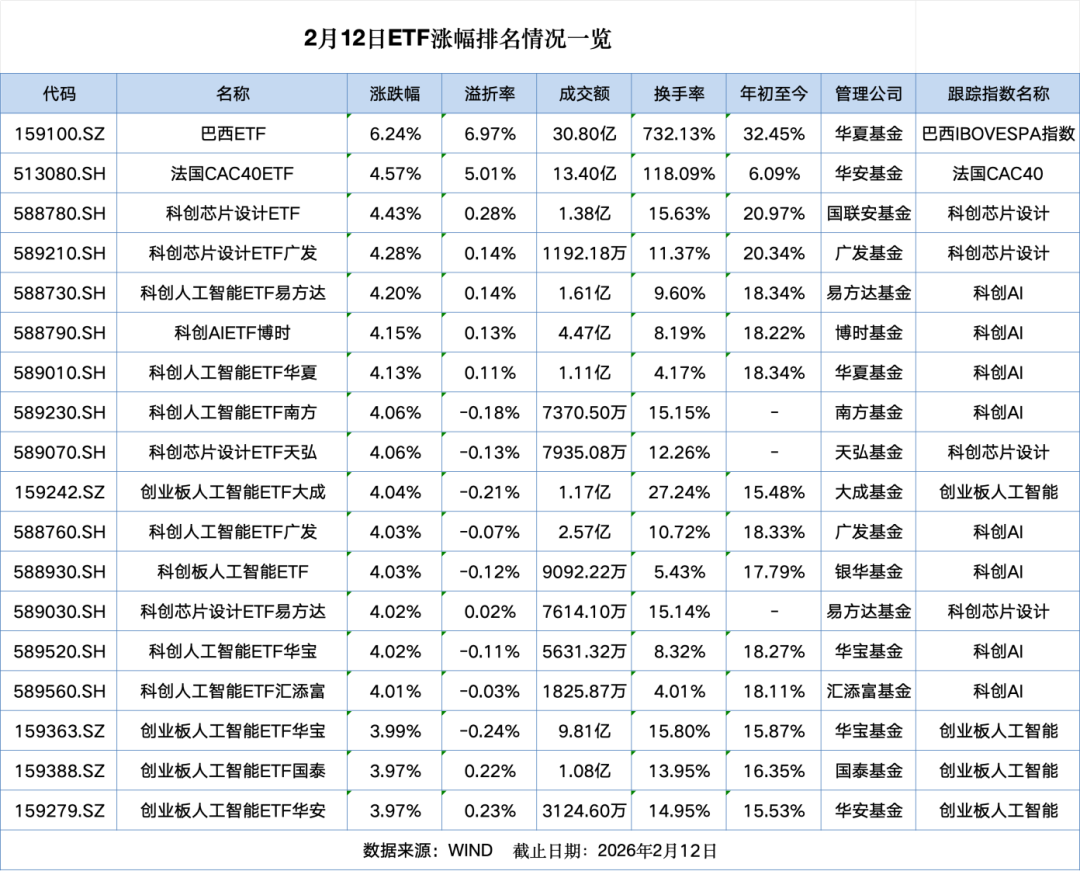
Core Viewpoint - The AI-focused ETFs have shown strong performance, particularly the cross-border ETFs, with significant gains in the Brazilian and French markets, while the domestic sectors like film, liquor, and finance have weakened [1][2]. ETF Performance Summary - On February 12, 873 ETFs rose in value, with the Brazilian ETF increasing by 6.24% and the French CAC40 ETF by 4.57% [1][2]. - The top-performing AI ETFs included: - E Fund's AI ETF rose by 4.20% - Bosera's AI ETF increased by 4.15% - Huaxia's AI ETF gained 4.13% [4][5]. - The largest AI ETF by scale is Bosera's AI ETF, with a total size of 5.555 billion yuan, followed by Huaxia's and GF's AI ETFs at 2.724 billion yuan and 2.433 billion yuan, respectively [4]. Sector Analysis - The Sci-Tech AI Index (950180) led the market, with 11 AI ETFs tracking this index performing well [3][4]. - Notable stocks within the AI sector included: - Chip Origin Co., Ltd. surged by 12.89% - Jingchen Co., Ltd. rose by 15.75% - Other significant gains were seen in companies like Cambricon Technologies and Fudan Microelectronics [6][4]. Investment Trends - There was a notable inflow of funds into the ChiNext and satellite industry ETFs, indicating strong investor interest in these sectors [7]. - The top sectors for fund inflows included ChiNext (1.31 billion yuan) and satellite industry (890 million yuan) [7][8].
“AI双子星”荣登C位,159363、589520携手狂飙!机构:春季行情值得期待,建议关注科技+周期主线!
Xin Lang Cai Jing· 2026-02-12 12:00
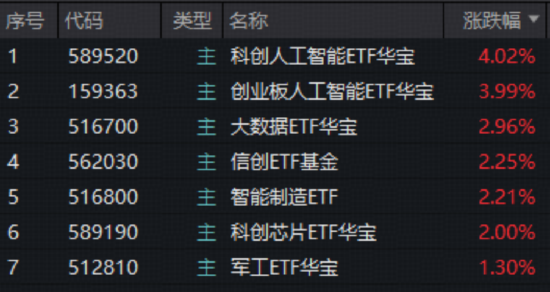
春节近在眼前,交投热情依然高涨!今日(2月12日)沪指窄幅震荡,深证成指与创业板指走势较强, 创业板指领涨超1.3%。沪深京三市成交额2.16万亿元,较昨日放量1598亿元。 AI赛道,喜迎迎多重利好催化:①国资委提出,推动中央企业积极扩大算力有效投资,推进"算力+电 力"协同发展;②智谱发布新一代旗舰模型GLM-5并上调AI编程订阅套餐价格,Deepseek、MiniMax、 字节豆包集体宣布上新;③Meta宣布将斥资100亿美元建设数据中心。 盘面上,科技成长方向再度走强!"AI双子星"方面,天孚通信股价刷新历史新高,一键布局"算力+AI 应用"的创业板人工智能ETF华宝(159363)场内价格大涨近4%;豆包大模型2.0初定2月14日发布,字 节跳动产业链权重占比超29%的科创人工智能ETF华宝(589520)场内价格猛拉4.02%。 AI推动云计算市场高增长,智谱AI、优刻得等头部厂商正式上调云服务价格,优刻得20CM涨停,重点 布局国产算力、AI应用领域的大数据ETF华宝(516700)场内价格涨近3%,斩获日线6连阳。中信证券 表示,算力发展具备高确定性,看好国产算力芯片及国产系统级厂商投资机遇* ...
电子行业周报:云厂商capex高增,光模块+NPO CPO共进
Guolian Minsheng Securities· 2026-02-12 10:35
Investment Rating - The report maintains a "Recommended" rating for Pengding Holdings (002938) with a target PE of 30x for 2025E and 24x for 2026E, while other companies like Shenghong Technology (300476) and Shengyi Technology (600183) do not have a specific rating [3]. Core Insights - North American cloud vendors are experiencing a significant increase in capital expenditures, driven by AI demand, with total capital expenditures projected to rise from approximately $160 billion to about $450 billion from 2023 to 2025, indicating a strong alignment between capital expenditure growth and AI computing demand [9][25]. - The NPO (Near-Photonics Optics) and CPO (Co-Packaged Optics) technologies are gaining traction in the industry, providing substantial growth opportunities for domestic optical communication companies [31][46]. - The report emphasizes the importance of scalable optical modules in future cloud infrastructure, with NPO currently favored by domestic cloud vendors due to its advantages in interconnect density and cost [34][36]. Summary by Sections North American Cloud Vendors' Financial Performance - Microsoft reported Q4 FY26 revenue of $81.273 billion, a year-over-year increase of 16.72%, with a net profit of $38.458 billion, up 59.52% [12]. - Google achieved Q4 FY25 revenue of $113.828 billion, a 17.99% increase year-over-year, with a net profit of $34.455 billion, up 29.84% [16]. - Amazon's Q4 FY25 revenue reached $213.386 billion, a 13.62% increase year-over-year, with a net profit of $2.1192 billion, up 5.93% [20]. - Meta's Q4 FY25 revenue was $59.893 billion, a 23.78% increase year-over-year, with a net profit of $22.768 billion, up 9.26% [21]. Capital Expenditure Outlook for 2026 - Google is expected to have a capital expenditure of $175-185 billion in 2026, representing a year-over-year increase of 97% [25]. - Meta's capital expenditure is projected to be in the range of $115-135 billion for 2026, indicating a 77% increase year-over-year [27]. - Amazon's capital expenditure for 2026 is estimated at around $200 billion, a 50% increase from previous estimates [20]. NPO and CPO Technology Developments - NPO technology is gaining popularity among cloud vendors due to its high interconnect density and cost-effectiveness, making it suitable for distributed scale-up networks [34][36]. - CPO technology, which integrates optical engines and switching chips, is being actively promoted by NVIDIA and is expected to replace traditional pluggable optical modules in the future [37][42]. - The report highlights the significant development space for domestic optical communication companies driven by the advancements in NPO and CPO technologies [31][46].



数字人民币板块2月12日涨1.28%,芯原股份领涨,主力资金净流出2.58亿元
Sou Hu Cai Jing· 2026-02-12 09:28
从资金流向上来看,当日数字人民币板块主力资金净流出2.58亿元,游资资金净流出8.67亿元,散户资 金净流入11.25亿元。数字人民币板块个股资金流向见下表: 证券之星消息,2月12日数字人民币板块较上一交易日上涨1.28%,芯原股份领涨。当日上证指数报收 于4134.02,上涨0.05%。深证成指报收于14283.0,上涨0.86%。数字人民币板块个股涨跌见下表: 以上内容为证券之星据公开信息整理,由AI算法生成(网信算备310104345710301240019号),不构成 投资建议。 ...


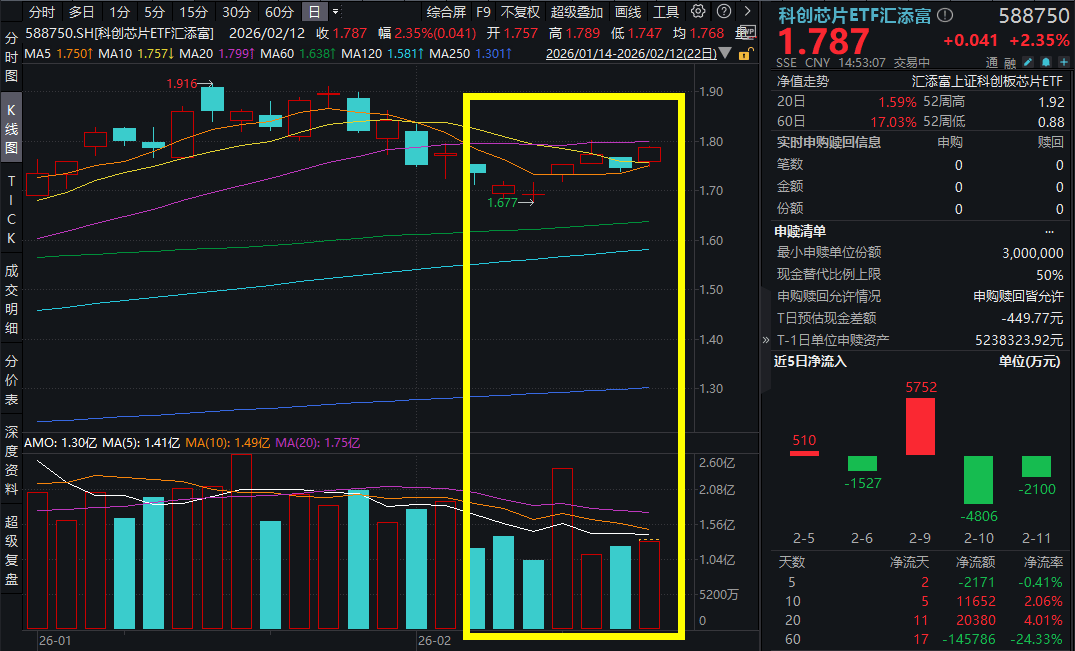
大模型接连上新!AI竞赛加速,存储芯片延续暴涨!芯原股份涨近13%,科创芯片ETF汇添富(588750)涨超2%,大厂抢占春节AI流量,算力需求爆发
Sou Hu Cai Jing· 2026-02-12 07:22
Core Viewpoint - The A-share market is experiencing an upward trend, particularly in the sci-tech chip sector, with significant gains in the ETF Huatai-PineBridge (588750) and its constituent stocks [1][3]. Group 1: Market Performance - As of 14:53, the sci-tech chip ETF Huatai-PineBridge (588750) rose over 2%, with a slight increase in trading volume [1]. - Key constituent stocks such as Chip Origin (涨近13%), Baiwei Storage (涨超7%), and Cambricon (涨超3%) showed notable gains [3]. Group 2: Stock Performance Details - The following stocks were highlighted for their performance: - Haiguang Information: 2.89% increase [4] - Chip Origin: 12.92% increase [4] - Baiwei Storage: 7.21% increase [4] - The performance of these stocks indicates a strong interest in the electronic sector, particularly in chip-related companies [4]. Group 3: Policy and Investment Trends - Recent policy initiatives emphasize the need for state-owned enterprises to enhance investment in computing power and promote the synergy between computing and electricity [5]. - Major tech companies are significantly increasing their capital expenditures, with Alibaba planning to raise its investment in AI infrastructure from 380 billion to 480 billion RMB over the next three years [6]. Group 4: AI and Cloud Services - The demand for AI applications is surging, with major companies like Tencent, Alibaba, ByteDance, and Baidu investing over 4.5 billion RMB to capture the AI market [5]. - International cloud service providers are also ramping up their capital expenditures, with Meta, Alphabet, Amazon, and Microsoft projecting substantial increases in their investments for AI infrastructure [7]. Group 5: Index and Investment Strategy - The sci-tech chip 50 ETF (588750) focuses on high-tech segments of the chip industry, with a high concentration of core segments at 95%, indicating strong growth potential [8][11]. - The index has shown a remarkable profit growth rate of 94% in the first three quarters of 2025, significantly outperforming peers [11]. - The ETF is characterized by high elasticity and rapid rebound potential, making it an attractive option for investors looking to capitalize on the chip sector's growth [12].

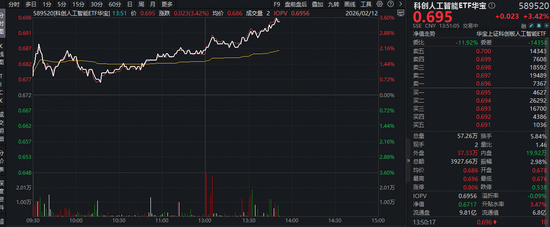
豆包大模型2.0初定2月14日发布!字节含量29%的科创人工智能ETF(589520)猛拉3.5%,优刻得20CM涨停
Xin Lang Ji Jin· 2026-02-12 06:05
Core Viewpoint - The article highlights the significant performance of the Huabao AI ETF (589520), which has a weight of over 29% in the ByteDance industrial chain, and the upcoming release of major upgrades to the Doubao model by ByteDance on February 14, 2024 [1][3]. Group 1: ETF Performance - The Huabao AI ETF (589520) saw an intraday increase of 3.57%, currently up 3.42%, and has recovered all moving averages [1]. - Notable stocks within the ETF include Youke De-W, which surged by 20.01%, and other companies like Chuangliang Co. and Xinyuan Co. showing significant gains [2][4]. Group 2: ByteDance Developments - ByteDance is set to release the Doubao model 2.0, along with upgrades to the Seedance 2.0 and Seedream 5.0 models, enhancing foundational model capabilities and enterprise-level agent functionalities [2][3]. - The Seedance 2.0 video generation model has gained widespread popularity, and ByteDance plans to distribute over 100,000 tech gifts and cash red envelopes during the 2026 Spring Festival Gala [3]. Group 3: Industry Outlook - Guolian Minsheng Securities expresses optimism about AI investment opportunities, citing four dimensions of industry growth: increased capital expenditure by tech giants, the transition of AI assistants to executors, ongoing supply-demand tension in computing infrastructure, and the acceleration of AI application demand [3]. - The Huabao AI ETF focuses on the domestic AI industry chain, with significant allocations in semiconductor and software sectors, indicating a strong offensive strategy [6].