VeriSilicon(688521)

Search documents
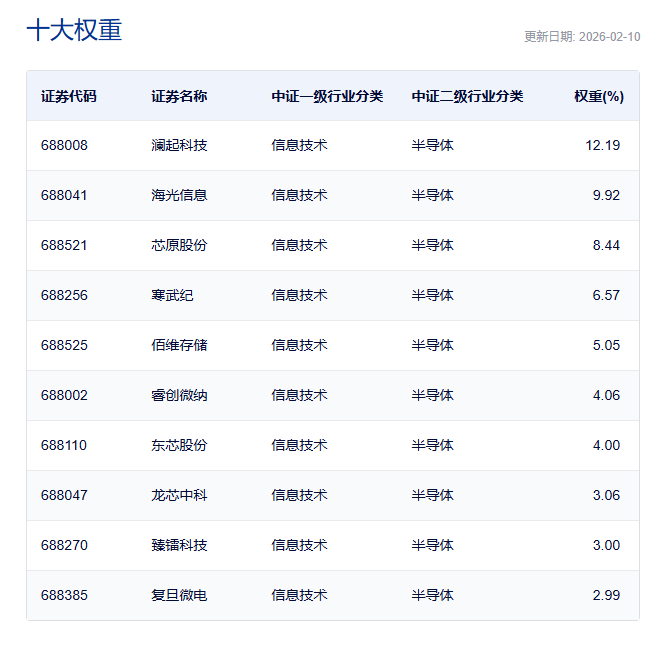
科创板“芯”高度:一文看懂科创芯片设计ETF易方达(589030)的底层资产
Xin Lang Cai Jing· 2026-02-11 10:07
Core Viewpoint - The semiconductor industry chain places chip design at the top, recognized for its high R&D investment, high gross margins, and light asset operation, making it the segment with the highest added value in the industry. The E Fund Sci-Tech Chip Design ETF (589030) serves as a standardized observation tool to effectively monitor fluctuations in this segment [1]. Group 1: Index Characteristics - The E Fund Sci-Tech Chip Design ETF (589030) closely tracks the Shanghai Stock Exchange Sci-Tech Board Chip Design Theme Index, which has a high "purity" as it exclusively selects listed companies in the semiconductor design sector from the Sci-Tech Board, excluding heavy asset wafer manufacturing and backend testing [2]. - Digital chip design and analog chip design are the top two weighted industries in the index, together accounting for over 90%, allowing the index to accurately reflect the overall prosperity of the chip design segment without being affected by manufacturing capital expenditure fluctuations [2]. Group 2: Component Stock Overview - The ETF's holdings include several core enterprises in the domestic semiconductor field, with the top ten component stocks being: - Lanqi Technology - Haiguang Information - Chipone Technology - Cambricon - Baiwei Storage - Ruichuang Micro-Nano - Dongxin Technology - Loongson Technology - Zhenlei Technology - Fudan Microelectronics [3]. - The business distribution focuses on three main areas: - Computing and calculation chips, such as Haiguang Information and Cambricon, which are crucial for domestic computing infrastructure [4]. - Memory interface and storage logic, including Lanqi Technology (memory interface chips) and Baiwei Storage (storage devices) [5]. - Analog chips, such as Ruichuang Micro-Nano (infrared detectors) and Zhenlei Technology (RF chips), applicable in various industrial and consumer electronics scenarios [6]. Group 3: Market Insights - Recent reports from major brokerages highlight structural recovery opportunities in the semiconductor industry, with the chip design segment identified as a direction where performance elasticity is expected to be realized first [7]. - In the storage sector, Guosheng Securities notes that under the backdrop of original manufacturers reducing production and supply-demand tightness, module manufacturers with stable, high-quality particle supply are likely to benefit significantly from the AI era's supply-demand tightness, price increases, and domestic production upgrades [8]. - CITIC Securities emphasizes that "self-control and AI computing power" will be the absolute main line throughout 2026, indicating that the domestic computing power industry chain is transitioning from "point breakthroughs to systematic reconstruction" [9]. Group 4: Industry Tool Attributes - For observers focused on semiconductor industry logic, tracking the performance of the E Fund Sci-Tech Chip Design ETF (589030) provides a direct reflection of market recognition of valuation fluctuations in the chip design segment. This index tool, focusing on the upstream high-value-added segment, offers a precise "slice" for analyzing the trends of hard technology on the Sci-Tech Board [11]. - As of February 11, 2026, the index achieved a 69.47% increase over the statistical period, significantly reflecting the high elasticity characteristics of the chip design segment during industry upcycles [12].




未知机构:芯原股份交流更新重视ASIC赛道扩容份额提升双击核心CSP及GPU客-20260211
未知机构· 2026-02-11 01:50
Company and Industry Summary Company: 芯原股份 (Chip Origin) Key Points 1. **Core Customer Engagements** - Confirmed collaboration with Tencent on accelerator cards and DPU, with project involvement exceeding that of ByteDance, reaching a turnkey level [1] - Confirmed significant deployment of PPU with Alibaba on Samsung, with project involvement slightly lower than ByteDance, projecting profits of $200-300 per unit [1] - Confirmed successful testing of MX return chips, with further mass production progress to be monitored within the year [1] - Confirmed an increase in wafer orders from ByteDance, contributing to overall demand, with further tracking of specific wafer return progress required [1] - Baidu's Kunlun chip project remains under observation for confirmation [1] - Other projects including ByteDance's VPU/DPU, Ideal's second-generation autonomous driving, and VIVO's ISP are all in mass production [1] 2. **Market Potential** - The market space for Chip Origin is substantial, with Alibaba estimated at 40-50 billion, ByteDance at 30-40 billion, and Tencent and Baidu's markets currently unknown, indicating a market exceeding 100 billion [2] - Even with a 15% net profit margin, this translates to a profit potential of 15 billion [2] 3. **Long-term Viability** - The role of ASICs is expected to persist alongside the growth of the domestic computing market, with initial project experience and core IP accumulation serving as a competitive moat [2] Additional Important Insights - The emphasis on the growth of domestic computing power driven by companies like ByteDance and Alibaba highlights the increasing importance of ASIC technology in the market [1] - The ongoing developments in various projects indicate a robust pipeline for Chip Origin, suggesting potential for sustained revenue growth [1] - The need for continuous monitoring of production progress and market dynamics is critical for assessing future performance and opportunities [1][2]
阿里推出Qwen-Image-2.0!科创芯片设计ETF天弘(589070)规模再创上市以来新高
Mei Ri Jing Ji Xin Wen· 2026-02-11 01:20
Group 1 - The core viewpoint of the news highlights the strong performance of the semiconductor design sector, particularly the Tianhong ETF, which focuses on chip design companies in the Sci-Tech Innovation Board, showing a 1.25% increase in its index and a transaction volume of 48.5467 million yuan on February 10 [1] - The Tianhong Sci-Tech Chip Design ETF has seen a cumulative net inflow of 69.3491 million yuan since its launch, with its latest scale reaching 654 million yuan as of February 9, 2026, marking a new high since its inception [1] - The ETF covers three major sub-sectors within chip design, allowing it to capture explosive growth in individual sectors while diversifying risks associated with individual stocks, especially as the semiconductor industry enters a recovery phase supported by favorable policies and demand [1] Group 2 - Alibaba has launched its next-generation image generation model, Qwen-Image-2.0, which excels in precise rendering, complex instruction support, and Chinese typesetting, achieving a score of 1029 in the AIArena evaluation, surpassing several international competitors [2] - The model is based on a lightweight 7B architecture, enabling efficient handling of complex image and text generation tasks, and is the first to integrate generation and editing functionalities [2] - The recent strong trend in the Sci-Tech chip sector is viewed positively by Guangfa Securities, which suggests it offers a good entry point for investors seeking stable returns in the current market environment [2]


2025年电子业绩前瞻:AIPCB/存储、服务器业绩高增,封装及设备国产化加速
Shenwan Hongyuan Securities· 2026-02-10 13:10
Investment Rating - The report maintains a positive outlook on the electronic industry, indicating an "Overweight" rating for the sector, driven by AI computing and semiconductor localization trends [3][4]. Core Insights - The electronic industry is expected to leverage AI computing as a growth engine, with strong performance anticipated in PCB, storage, AI/GPU chips, and semiconductor equipment sectors [3][4]. - The semiconductor equipment and parts sector is experiencing a recovery in demand, particularly benefiting from domestic production [3][4]. - The storage sector is witnessing a significant increase in profitability due to the AI industry trend, with a notable rise in demand and prices for storage products [3][6]. - The AI server and chip sectors are seeing a surge in demand both domestically and internationally, particularly for cloud servers and high-speed switches [3][6]. - The PCB sector is expected to benefit from high-end AI PCB product demand, with companies like Shenghong Technology and Shenyin Electronics leading in performance [3][8]. Summary by Sections 2025 Industry Outlook - The electronic industry is projected to thrive with AI as the main driver and semiconductor localization as a catalyst, with strong performances expected across various sub-sectors [4][5]. - Specific forecasts for companies include: - Jiangfeng Electronics: Revenue of approximately 4.6 billion, net profit growth of 7.5% to 27.5% [5]. - ShenGong Co.: Revenue growth of 42.04% to 48.65%, net profit growth of 118.71% to 167.31% [5]. - Zhongwei Company: Revenue of 12.385 billion, net profit growth of 28.74% to 34.93% [5]. Semiconductor Storage Sector - The storage sector is benefiting from increased demand driven by AI, with prices stabilizing and then rising due to supply-demand imbalances [6][7]. - Key company forecasts include: - Jiangbolong: Expected net profit growth of 150.66% to 210.82% [7]. - Aibin Storage: Revenue growth of 49.36% to 79.23%, with net profit growth of 427.19% to 520.22% [7]. PCB Sector - The PCB sector is expected to continue benefiting from high-end AI product demand, with companies like Shenghong Technology and Shenyin Electronics showing strong performance [8][9]. - Forecasts for Shenghong Technology indicate a net profit increase of 260% to 295% [8].




ETF复盘资讯|创新药反弹还看港股!520880放量摸高近4%!字节Seedance2.0爆火出圈,科创AI、科创芯片连续上攻
Sou Hu Cai Jing· 2026-02-10 12:19
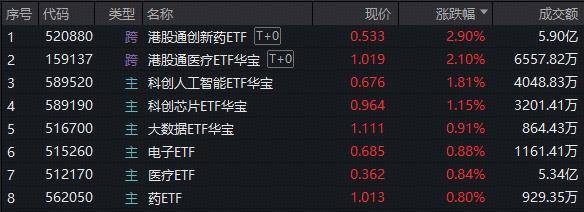
Market Overview - A-shares experienced narrow fluctuations, with the Sci-Tech Innovation Board showing strong performance, particularly in AI applications and computing chips [1] - The Hong Kong stock market saw a significant rebound in the pharmaceutical sector, with the Hong Kong Innovation Drug ETF (520880) reaching a peak increase of 3.86% and closing up 2.9% [3][5] ETF Performance - The Hong Kong Innovation Drug ETF (520880) recorded a trading volume of 5.9 billion, while the Hong Kong Medical ETF (159137) rose by 2.1%, marking its sixth consecutive day of gains [2][3] - The Sci-Tech Artificial Intelligence ETF (589520) increased by 1.81%, with a peak rise of over 2.4% during the trading session [8] Industry Insights - The Chinese innovative drug sector is experiencing a dual breakthrough in internationalization and commercialization, with over 70% of innovative drug companies reporting positive revenue growth [6][7] - Significant collaborations in the innovative drug space include a strategic partnership between Innovent Biologics and Eli Lilly, valued at up to $8.85 billion, and a $18.5 billion collaboration between CSPC Pharmaceutical and AstraZeneca [6] AI and Technology Developments - ByteDance's recent launches, including the Seedance 2.0 video generation model and Seedream 5.0 image generation model, have generated significant interest in the AI sector [11] - The Sci-Tech Artificial Intelligence ETF (589520) has a substantial exposure to ByteDance, with a weight of 29.42% in its index [11][13] Semiconductor and Chip Industry - The semiconductor equipment industry is experiencing an upward trend, with projected sales growth of 26% in 2026, reaching $791.7 billion [17] - The Sci-Tech Chip ETF (589190) is positioned to benefit from the ongoing "super cycle" in the semiconductor industry, with a focus on domestic production and expansion [15][17] Investment Strategy - Analysts suggest that the current market conditions present a favorable opportunity for investment in innovative drugs and AI sectors, with a recommendation to focus on ETFs that track these industries [7][19] - The Sci-Tech Chip ETF has shown a strong annualized return of 17.93%, outperforming other semiconductor indices [19][20]


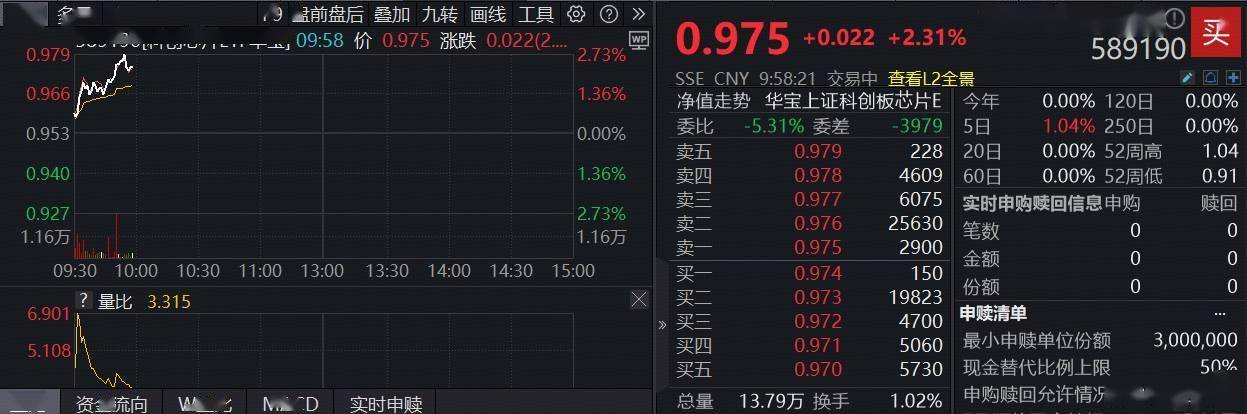
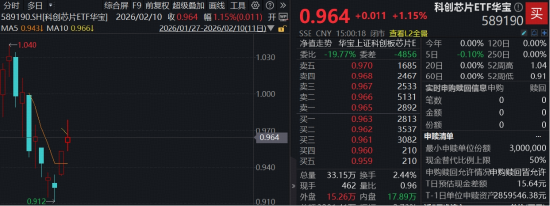
“超级周期”已至!存储芯片、半导体设备齐升,芯原股份历史新高!“全芯”科创芯片ETF(589190)上探2%
Xin Lang Cai Jing· 2026-02-10 11:48
Group 1 - The core viewpoint of the article highlights the strong performance of computing hardware, storage chips, and semiconductor equipment, with significant stock price increases for companies like Chip Origin and Huafeng Measurement Control [1][10] - The global memory price is expected to surge by 80% to 90% in Q1 2026, marking an unprecedented increase, driven by the AI wave, with storage revenue projected to reach $551.6 billion [2][11] - The semiconductor equipment industry is experiencing an upward trend, with total sales expected to reach $791.7 billion in 2025 and grow by 26% in 2026, indicating a faster-than-expected approach to the $1 trillion milestone [3][11] Group 2 - Domestic storage industry investment opportunities are viewed positively due to the rapid growth in AI server demand and domestic substitution trends [3][11] - The Sci-Tech Chip ETF Huabao (589190) tracks the Sci-Tech Board Chip Index, which includes 50 companies across the semiconductor supply chain, with over 90% weight in core areas like integrated circuits and semiconductor equipment [3][11] - The annualized return of the Sci-Tech Chip Index since its inception is 17.93%, outperforming similar indices, with a lower maximum drawdown, indicating a favorable risk-return profile [5][13]
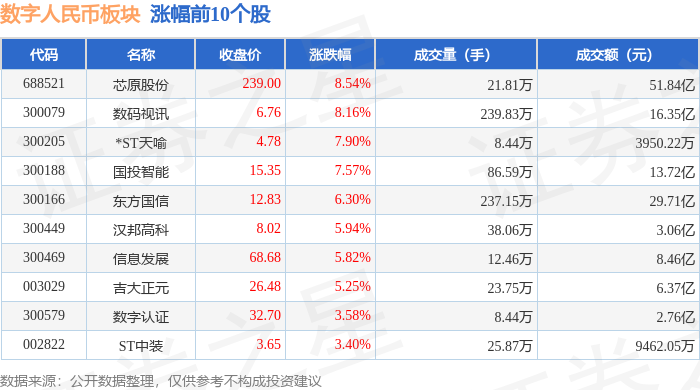
数字人民币板块2月10日涨1.2%,芯原股份领涨,主力资金净流出3.57亿元
Sou Hu Cai Jing· 2026-02-10 09:12
Core Viewpoint - The digital RMB sector experienced a 1.2% increase on February 10, with Chip Origin Technology leading the gains, reflecting positive market sentiment towards digital currency initiatives [1]. Market Performance - The Shanghai Composite Index closed at 4128.37, up 0.13% - The Shenzhen Component Index closed at 14210.63, up 0.02% [1]. Digital RMB Sector Stocks - Chip Origin Technology (688521) closed at 239.00, up 8.54%, with a trading volume of 218,100 shares and a transaction value of 5.184 billion yuan - Digital Vision (300079) closed at 6.76, up 8.16%, with a trading volume of 2,398,300 shares and a transaction value of 1.635 billion yuan - ST Tianxiang (300205) closed at 4.78, up 7.90%, with a trading volume of 84,400 shares and a transaction value of 39.502 million yuan - Other notable stocks include Guotou Intelligent (300188) up 7.57% and Dongfang Guoxin (300166) up 6.30% [1]. Capital Flow Analysis - The digital RMB sector saw a net outflow of 357 million yuan from institutional investors, while retail investors contributed a net inflow of 288 million yuan [2]. - Notable stocks with significant capital inflows include Guotou Intelligent with a net inflow of 1.29 billion yuan from institutional investors [3]. ETF Information - The Entrepreneurial Board Artificial Intelligence ETF (product code: 159381) tracks the performance of the Entrepreneurial Board AI Index, with a recent five-day change of 1.28% and a net redemption of 672.5 million yuan [6]. - The Science and Technology Innovation Artificial Intelligence ETF (product code: 589010) tracks the Shanghai Stock Exchange Science and Technology Innovation Board AI Index, with a recent five-day change of -0.43% and a net subscription of 276.27 million yuan [6].


科创芯片ETF广发(589160)开盘涨0.85%,重仓股海光信息涨1.90%,中芯国际涨0.23%
Xin Lang Cai Jing· 2026-02-10 04:54
Group 1 - The core viewpoint of the article highlights the performance of the 科创芯片 ETF (GFA) on February 10, with an opening increase of 0.85% to 0.953 yuan [1] - The major holdings of the 科创芯片 ETF include companies such as 海光信息, 中芯国际, and others, with varying performance on the same day [1] - The performance benchmark for the 科创芯片 ETF is the Shanghai Stock Exchange Science and Technology Innovation Board Chip Index, managed by 广发基金管理有限公司, with a return of -5.38% since its establishment on January 21, 2026 [1]


超2800只个股下跌
第一财经· 2026-02-10 03:51
Core Viewpoint - The article discusses the performance of the A-share market, highlighting the fluctuations in major indices and the notable movements in specific sectors such as media and pharmaceuticals. Market Performance - The Shanghai Composite Index decreased by 0.02% to 4122.34, while the Shenzhen Component Index also fell by 0.02% to 14206.26. The ChiNext Index dropped by 0.14% to 3328.02, and the Sci-Tech Innovation Board Index rose by 0.19% to 1800.35 [4][12]. - The total trading volume in the Shanghai and Shenzhen markets reached 1.4 trillion yuan, with over 2800 stocks declining [6]. Sector Highlights - The media sector experienced significant gains, with multiple stocks such as Light Media and China Film hitting the daily limit, and Huace Film and Happiness Blue Sea rising over 15% [5][6]. - The innovative drug concept saw a surge, with stocks like Guangsheng Tang increasing by over 13% [6]. - The semiconductor sector also performed well, with stocks like Chipone Technology rising over 8% [10]. New Listings - Three new stocks were listed, with N Electric Technology opening at a remarkable increase of 750.05% on its first day [11]. Other Market Movements - The precious metals, shipping, and liquor sectors showed weakness, contrasting with the strong performance of the media and innovative drug sectors [5][6].



ETF盘中资讯|存储价格创纪录暴涨,芯原股份创新高!科创芯片继续走强,“全芯”589190涨超2%
Sou Hu Cai Jing· 2026-02-10 02:46
Group 1 - The core viewpoint of the news highlights the strong performance of computing hardware and storage chip stocks, with significant price increases observed in companies like Xinyuan Co., which rose over 10% to reach a historical high [1] - The Huabao Chip ETF (589190) has seen an increase of over 2%, surpassing the 10-day moving average, indicating positive market sentiment towards chip-related investments [1] - A report from Counterpoint indicates that memory prices have surged by 80%-90% year-to-date, marking unprecedented growth, with expectations of a 60% increase in DRAM prices in Q1 [2][3] Group 2 - Major global tech companies, including Google and Amazon, are significantly increasing their capital expenditures for AI infrastructure, with projections of $175-185 billion and $200 billion respectively by 2026, which exceeds market expectations [3] - The Huabao Chip ETF tracks the Shanghai Stock Exchange's chip index, which includes 50 companies across various semiconductor sectors, indicating a strong focus on high-tech and high-barrier industries [3] - The annualized return of the Shanghai Stock Exchange's chip index since its inception is 17.93%, outperforming other semiconductor indices, with a lower maximum drawdown, suggesting a favorable risk-return profile [5][6]