
CDBIO(688739)

Search documents
成大生物10月24日获融资买入748.14万元,融资余额2.57亿元
Xin Lang Zheng Quan· 2025-10-27 01:27
Core Viewpoint - Chengda Biological experienced a slight decline of 0.18% in stock price on October 24, with a trading volume of 50.58 million yuan, indicating a high level of market activity and investor interest [1] Financing Summary - On October 24, Chengda Biological had a financing buy-in amount of 7.48 million yuan and a financing repayment of 6.40 million yuan, resulting in a net financing buy of 1.08 million yuan [1] - As of October 24, the total financing and securities lending balance for Chengda Biological was 258 million yuan, with the financing balance at 257 million yuan, accounting for 2.26% of the circulating market value, which is above the 80th percentile of the past year [1] - The company repaid 2,400 shares in securities lending and sold 1,400 shares on October 24, with a selling amount of 38,300 yuan, while the securities lending balance was 1.0685 million yuan, exceeding the 90th percentile of the past year [1] Business Performance Summary - As of June 30, Chengda Biological had 25,300 shareholders, a decrease of 0.42% from the previous period, with an average of 16,431 circulating shares per person, an increase of 121.52% [2] - For the first half of 2025, the company reported an operating income of 707 million yuan, a year-on-year decrease of 19.75%, and a net profit attributable to the parent company of 122 million yuan, down 44.47% year-on-year [2] - Since its A-share listing, Chengda Biological has distributed a total of 1.492 billion yuan in dividends, with 1.075 billion yuan distributed over the past three years [2] Shareholding Structure Summary - As of June 30, 2025, the top ten circulating shareholders included Southern CSI 1000 ETF, which held 1.9087 million shares, an increase of 357,200 shares from the previous period [2] - Hong Kong Central Clearing Limited was the fifth largest circulating shareholder with 1.9033 million shares, a decrease of 509,000 shares [2] - Other notable changes included a decrease in holdings for Bosera SSE STAR 100 ETF and an increase for CSI 1000 ETF, indicating shifts in institutional investment [2]

科创板股破发幅度榜 最高破发75.93%
Zheng Quan Shi Bao Wang· 2025-10-24 09:58
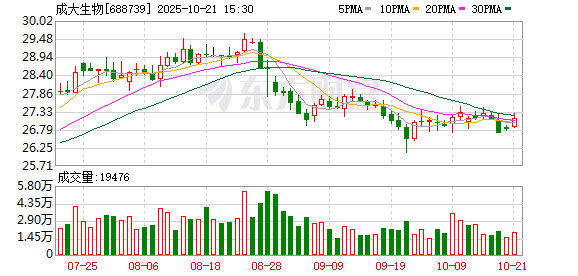
Group 1 - The average premium of the latest closing prices of listed Sci-Tech Innovation Board stocks compared to their issue prices is 147.14%, with 119 stocks experiencing a decline in value [1][2] - Among the 589 listed Sci-Tech Innovation Board stocks, 468 have closing prices above their issue prices, while the highest premium is seen in Shangwei New Materials at 4311.48% [1][2] - The stocks with the largest declines include ST Pava, with a decline of 75.93%, and Chengda Bio, with a decline of 72.26% [1][2] Group 2 - ST Pava was issued at 51.88 yuan and is currently priced at 10.30 yuan, reflecting a significant decline [2] - Chengda Bio was issued at 110.00 yuan and is currently priced at 27.33 yuan, also showing a substantial decline [2] - Other notable declines include Wanrun New Energy at 70.07%, Tianyi New Materials at 65.40%, and CanSino at 64.27% [2][3] Group 3 - The data indicates a trend of significant price volatility among Sci-Tech Innovation Board stocks, with a notable number of stocks trading below their issue prices [1][2] - The industry average price-to-earnings ratio for ST Pava is 29.25, while its issue price was based on a P/E ratio of 93.68, indicating a substantial overvaluation at the time of issuance [1] - The performance of these stocks may reflect broader market conditions and investor sentiment towards the technology and innovation sectors [1][2]




成大生物牵手中国科学院微生物所,将发展视野外延至创新药、创新疗法
Huan Qiu Wang· 2025-10-23 01:05
Core Viewpoint - Chengda Biological (688739.SH) has signed a strategic cooperation agreement with the Institute of Microbiology, Chinese Academy of Sciences, focusing on emerging infectious diseases and vector-borne disease prevention [1][4]. Group 1: Strategic Cooperation - The strategic cooperation aims to accelerate the research and development of vaccines and biopharmaceuticals for emerging infectious diseases, enriching the company's innovation pipeline [4]. - The collaboration will enhance the core competitiveness in the field of infectious disease prevention, aligning with the company's long-term strategy of focusing on vaccines and expanding into biopharmaceuticals [4]. Group 2: Company Overview - Chengda Biological primarily engages in the research, production, and sales of human vaccines, with leading products including human rabies vaccine and inactivated Japanese encephalitis vaccine [4]. - The company has maintained a leading market share in the human rabies vaccine since 2008, and its inactivated Japanese encephalitis vaccine is currently the only one available in the domestic market [4]. Group 3: Recent Achievements - In the first half of 2025, the company achieved a 100% approval rate for vaccine product batch releases, with 189 batches of human rabies vaccine approved, totaling 4.17 million doses, a year-on-year increase of 82% [4]. - The inactivated Japanese encephalitis vaccine received 15 batches of approvals, ensuring stable supply for sales [4]. Group 4: International Expansion - Chengda Biological is actively pursuing an international market strategy, enhancing cooperation with distributors in Egypt, Thailand, and Bangladesh, and successfully gaining market access in Indonesia [5]. - In the first half of 2025, the company reported overseas revenue of 123 million yuan, a year-on-year increase of 26.96% [5]. Group 5: Technological Innovation - In July, the company signed a cooperation agreement with Zhongke Zidong Taichu Technology Co., Ltd. to establish an "AI + Vaccine R&D Joint Laboratory," aiming to leverage AI technology for upgrading research paradigms [5]. - The company plans to continue focusing on human vaccines while exploring innovative drugs and therapies, actively seeking investment opportunities in new projects and businesses to create a second growth curve [5].

生物制品板块10月22日跌0.57%,奥浦迈领跌,主力资金净流出1.92亿元
Zheng Xing Xing Ye Ri Bao· 2025-10-22 08:20
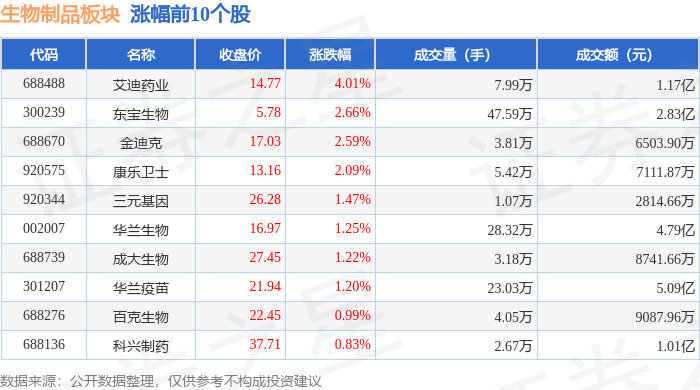
Market Overview - The biopharmaceutical sector experienced a decline of 0.57% on October 22, with Aopumai leading the drop [1] - The Shanghai Composite Index closed at 3913.76, down 0.07%, while the Shenzhen Component Index closed at 12996.61, down 0.62% [1] Stock Performance - Notable gainers in the biopharmaceutical sector included: - Wendi Pharmaceutical (688488) with a closing price of 14.77, up 4.01% [1] - Dongbao Bio (300239) at 5.78, up 2.66% [1] - Jinke (688670) at 17.03, up 2.59% [1] - Major decliners included: - Aopumai (688293) at 55.19, down 4.40% [2] - Wofu Bio (300357) at 31.63, down 3.18% [2] - Sanofi (688336) at 59.60, down 2.39% [2] Capital Flow - The biopharmaceutical sector saw a net outflow of 192 million yuan from institutional investors, while retail investors contributed a net inflow of 53.82 million yuan [2] - Specific stock capital flows included: - Te Bao Bio (688278) with a net inflow of 19.00 million yuan from institutional investors [3] - Hualan Bio (002007) with a net inflow of 12.05 million yuan from institutional investors [3] - Aopumai (688293) with a net outflow of 4.40% from institutional investors [3]


浩欧博与罗氏诊断签署框架协议;圣湘生物拟出资2000万元与专业机构共同投资设立基金丨医药早参
Mei Ri Jing Ji Xin Wen· 2025-10-21 23:22
Group 1 - Haobio signed a framework agreement with Roche Diagnostics for the procurement of chemiluminescent antibody detection products, which will enhance brand recognition and market share in China, although the agreement does not specify financial details and may have limited impact on stock price [1] - Chengda Bio entered into a strategic cooperation agreement with the Institute of Microbiology, Chinese Academy of Sciences, focusing on emerging infectious disease prevention, which is expected to synergize with existing vaccine development platforms [2] - Shengxiang Bio plans to invest 20 million yuan in a fund aimed at innovative healthcare startups, aligning with its strategic development and investment direction [3] Group 2 - China National Pharmaceutical Group reported a revenue of approximately 39.38 billion yuan and a net profit of about 1.49 billion yuan for the first three quarters of 2025, reflecting a slight increase in both metrics despite industry competition [4] - Puluo Pharmaceutical announced a revenue of approximately 7.76 billion yuan and a net profit of about 700 million yuan for the first three quarters of 2025, indicating a decline in performance due to pressures in the formulation and raw material drug sectors, with expectations for gradual recovery next year [5]


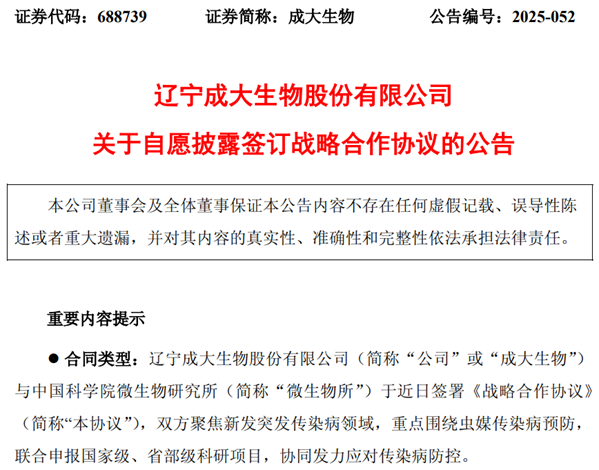
辽宁成大生物股份有限公司关于自愿披露签订战略合作协议的公告
Shang Hai Zheng Quan Bao· 2025-10-21 19:29
Core Viewpoint - The announcement details a strategic cooperation agreement between Liaoning Chengda Biological Co., Ltd. and the Institute of Microbiology, Chinese Academy of Sciences, focusing on the prevention of vector-borne infectious diseases and collaborative research projects [2][15]. Group 1: Agreement Overview - The strategic cooperation agreement is an intention-based collaboration aimed at addressing emerging infectious diseases, particularly vector-borne diseases [2][10]. - The agreement was signed on October 21, 2025, in Shenyang, Liaoning Province [5]. - The agreement does not require board or shareholder approval, as it is an intention-based agreement [7][8]. Group 2: Parties Involved - The Institute of Microbiology is a research institution with a registered capital of 63.23 million yuan, located in Beijing [4]. - There is no related party relationship between the Institute of Microbiology and Chengda Biological [4]. Group 3: Cooperation Details - The cooperation will focus on joint research projects, strategic consulting for disease prevention, and deep integration of industry and academia [10][11]. - A joint laboratory will be established to support the development of a key laboratory for synthetic immunology and vaccine manufacturing [11]. - Both parties will share knowledge and conduct training to enhance technological capabilities in the field of infectious disease prevention [11]. Group 4: Impact on Company - The collaboration is expected to integrate top resources from the Institute of Microbiology with the company's vaccine development platform, accelerating the research and development of vaccines and biopharmaceuticals [15]. - The partnership aligns with the company's long-term strategy to focus on vaccines and expand into the biopharmaceutical sector, laying a solid foundation for building a biopharmaceutical industry cluster [15]. - The agreement is not expected to have a direct impact on the company's performance in 2025, with specific effects dependent on future project developments [2][15].

成大生物战略携手中国科学院微生物研究所
Zheng Quan Shi Bao· 2025-10-21 17:28
Core Insights - Company signed a strategic cooperation agreement with the Institute of Microbiology, Chinese Academy of Sciences, focusing on emerging infectious diseases and vector-borne disease prevention [2][3] - The collaboration aims to leverage both parties' resources and expertise to enhance research and development in vaccine and biopharmaceuticals [3] Group 1: Strategic Collaboration - The agreement emphasizes joint applications for national and provincial research projects to secure government support and resources [2] - Both parties will establish a long-term partnership to share resources and amplify their efforts in infectious disease prevention [2][3] Group 2: Research and Development Focus - The collaboration will enhance the company's vaccine development platform by integrating top-tier resources from the Institute of Microbiology [3] - The partnership aims to accelerate the R&D process for vaccines and biopharmaceuticals targeting emerging infectious diseases [3] Group 3: Intellectual Property and Confidentiality - Each party retains ownership of their respective intellectual property, with jointly developed results being co-owned as per specific agreements [3] - Both parties will maintain confidentiality regarding project details and proprietary technologies throughout the collaboration [3] Group 4: Long-term Strategy - The strategic cooperation aligns with the company's long-term strategy to focus on vaccines while expanding into the biopharmaceutical sector [3] - The agreement is considered an intention for collaboration and is not expected to have a direct impact on the company's performance until specific projects are advanced [3]
成大生物战略携手 中国科学院微生物研究所
Zheng Quan Shi Bao· 2025-10-21 17:19
Core Viewpoint - Chengda Bio (688739) has signed a strategic cooperation agreement with the Institute of Microbiology, Chinese Academy of Sciences, focusing on the prevention of emerging infectious diseases, particularly vector-borne diseases, and aims to jointly apply for national and provincial research projects [1][2]. Group 1: Strategic Cooperation - The agreement emphasizes collaboration in the field of emerging infectious disease prevention, leveraging both parties' resources and expertise to enhance research and development efforts [1]. - Chengda Bio and the Institute of Microbiology will establish a long-term partnership to share resources and amplify their respective strengths in vaccine and biopharmaceutical development [1][2]. Group 2: Research and Development Focus - The collaboration will focus on joint research projects targeting vector-borne disease prevention, with plans to apply for government support and resources to foster innovation [1]. - The strategic partnership aims to accelerate the development of vaccines and biopharmaceuticals for emerging infectious diseases, enriching Chengda Bio's innovation pipeline [2]. Group 3: Intellectual Property and Confidentiality - Each party retains ownership of their respective intellectual property, with jointly developed project outcomes being co-owned as per specific agreements [2]. - Both parties will maintain confidentiality regarding project details and proprietary technologies throughout the collaboration [2].
成大生物:关于自愿披露签订战略合作协议的公告
Zheng Quan Ri Bao· 2025-10-21 13:42
Group 1 - The core point of the article is that Chengda Biological has signed a strategic cooperation agreement with the Institute of Microbiology, Chinese Academy of Sciences, focusing on emerging infectious diseases and vector-borne disease prevention [2] - The collaboration aims to jointly apply for national and provincial-level scientific research projects to enhance efforts in infectious disease prevention and control [2] - This partnership signifies a strategic move to leverage academic research capabilities in addressing public health challenges related to infectious diseases [2]
成大生物与中国科学院微生物研究所战略合作 协同发力应对传染病防控
Zheng Quan Shi Bao Wang· 2025-10-21 10:44
Core Viewpoint - The strategic cooperation agreement between Chengda Biological and the Institute of Microbiology focuses on addressing emerging infectious diseases, particularly vector-borne diseases, through joint research and project applications for national and provincial funding [1][2][4]. Company Overview - Chengda Biological is a biopharmaceutical company specializing in the research, production, and sales of human vaccines, with a leading market position in rabies and Japanese encephalitis vaccines in China [1]. - The company has established production bases in Shenyang and Benxi, and has a dedicated R&D team of over 200 personnel, with independent research capabilities and a comprehensive management system [1]. Research Collaboration - The collaboration aims to leverage the strengths of both parties, combining the Institute's research capabilities with Chengda's development and production resources to enhance vaccine and biopharmaceutical research [2][4]. - The focus will be on joint applications for national and provincial research projects to secure government support and resources, fostering innovation and high-quality industrial development [2][3]. Strategic Goals - The partnership is expected to accelerate the development of vaccines and biopharmaceuticals for emerging infectious diseases, enriching Chengda's innovation pipeline and strengthening its core competitiveness in the field of infectious disease prevention [4]. - The agreement is characterized as an intention-based collaboration, with no immediate impact on the company's financial performance for 2025, as the effects will depend on the progress of specific projects [4].