PAB(000001)

Search documents
信用债周度观察(20251222-20251226):信用债发行量环比上升,各行业信用利差涨跌互现-20251227
EBSCN· 2025-12-27 08:28
1. Report Industry Investment Rating - Not provided in the given content 2. Core View of the Report - From December 22 to December 26, 2025, the issuance volume of credit bonds increased month - on - month, and the credit spreads of various industries showed mixed trends [1] 3. Summary by Directory 3.1 Primary Market 3.1.1 Issuance Statistics - During the week from December 22 to December 26, 2025, 267 credit bonds were issued, with a total issuance scale of 427.702 billion yuan, a month - on - month increase of 15.42%. Among them, 117 industrial bonds were issued, with a scale of 219.258 billion yuan (a 34.26% month - on - month increase, accounting for 51.26% of the total); 110 urban investment bonds were issued, with a scale of 71.364 billion yuan (an 18.87% month - on - month decrease, accounting for 16.69% of the total); 40 financial bonds were issued, with a scale of 137.08 billion yuan (a 14.92% month - on - month increase, accounting for 32.05% of the total) [1][11] - The average issuance term of credit bonds this week was 2.74 years. The average issuance term of industrial bonds was 2.36 years, urban investment bonds was 3.25 years, and financial bonds was 2.35 years [1][14] - The average issuance coupon rate of credit bonds this week was 2.26%. The average issuance coupon rate of industrial bonds was 2.12%, urban investment bonds was 2.41%, and financial bonds was 2.23% [2][19] 3.1.2 Cancellation of Issuance Statistics - Five credit bonds were cancelled for issuance this week [2][23] 3.2 Secondary Market 3.2.1 Credit Spread Tracking - By industry, in the Shenwan primary industries, the largest upward movement of the AAA - rated industry credit spread was in the pharmaceutical and biological industry (up 5.1BP), and the largest downward movement was in the real estate industry (down 1.3BP); the largest upward movement of the AA + - rated industry credit spread was in the household appliances industry (up 6.4BP), and the largest downward movement was in the textile and clothing industry (down 9.8BP); the largest upward movement of the AA - rated industry credit spread was in the building materials industry (up 11BP), and the largest downward movement was in the commercial trade industry (down 1BP) [3] - By region for urban investment bonds, this week, the largest upward movement of the AAA - rated credit spread was in Gansu (up 8.7BP), and the largest downward movement was in Jilin (down 2.9BP); the largest upward movement of the AA + - rated credit spread was in Liaoning (up 6.7BP), and the largest downward movement was in Fujian (down 3.2BP); the largest upward movement of the AA - rated credit spread was in Jiangxi (up 4.5BP), and the largest downward movement was in Anhui (down 3.3BP) [3] 3.2.2 Trading Volume Statistics - The total trading volume of credit bonds was 1.782747 trillion yuan, a month - on - month increase of 28.47%. The top three in terms of trading volume were commercial bank bonds, corporate bonds, and medium - term notes. Specifically, the trading volume of commercial bank bonds was 630.894 billion yuan (a 38.88% month - on - month increase, accounting for 35.39% of the total); the trading volume of corporate bonds was 521.309 billion yuan (a 15.93% month - on - month increase, accounting for 29.24% of the total); the trading volume of medium - term notes was 347.636 billion yuan (a 40.63% month - on - month increase, accounting for 19.50% of the total) [4][28] 3.2.3 Actively Traded Bonds This Week - According to DM client data, the top 20 urban investment bonds, industrial bonds, and financial bonds in terms of trading volume this week are provided for investors' reference [30]



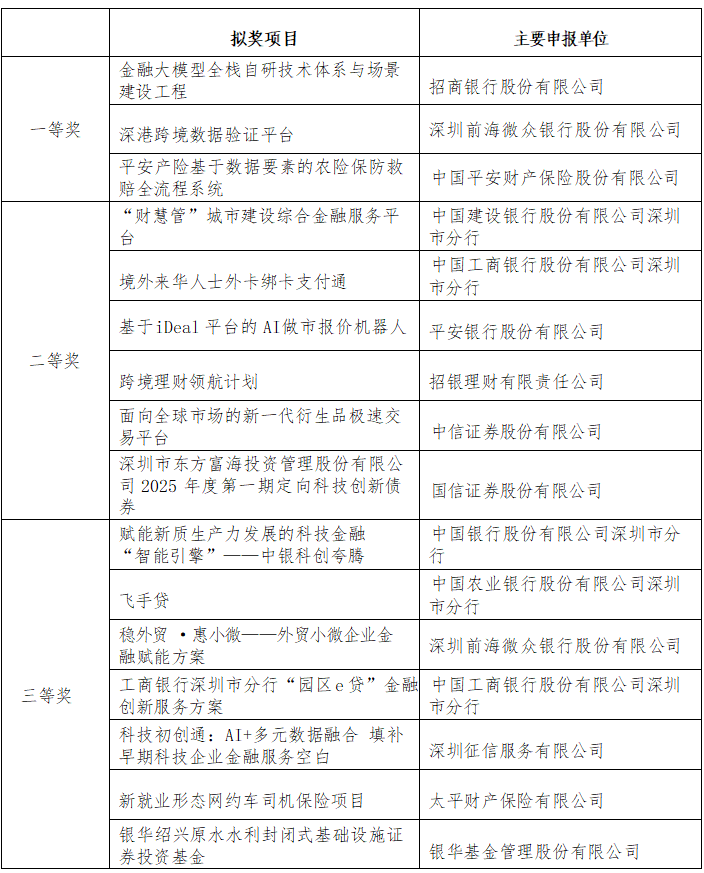
关于2025深圳金融创新大赛拟获奖项目的公示
Xin Lang Cai Jing· 2025-12-26 12:21
Core Viewpoint - The 2025 Shenzhen Financial Innovation Competition aims to enhance the financial services of local institutions and promote Shenzhen as a globally influential financial center, showcasing the innovation level of the financial industry in Shenzhen [1][4]. Summary by Category Competition Overview - The competition was announced in September 2025, receiving submissions from 113 units with a total of 173 projects [4]. - After various evaluation stages, 30 projects were selected for awards, including 3 first prizes, 6 second prizes, 12 third prizes, 3 most potential awards, 3 best growth awards, and 3 innovation breakthrough awards [4]. Awarded Projects - **First Prize Projects**: - Financial model full-stack self-research technology system and scenario construction project by China Merchants Bank and WeBank [6]. - Hong Kong-Shenzhen cross-border data verification platform [6]. - Agricultural insurance prevention and rescue system based on data elements by Ping An Property & Casualty Insurance [6]. - **Second Prize Projects**: - Cross-border wealth management navigation plan by China Merchants Bank Wealth Management [6]. - New generation derivative rapid trading platform for global markets by CITIC Securities [6]. - Technology financial empowerment plan for new quality productivity development by Bank of China Shenzhen Branch [6]. - **Third Prize Projects**: - AI and multi-data integration service for early-stage technology enterprises by Shenzhen Credit Service [6]. - New employment form ride-hailing driver insurance project by Taiping Property Insurance [6]. - **Most Potential Award Projects**: - "Housing Dream" project for large-scale urban village renovation by the National Development Bank Shenzhen Branch [7]. - New energy "technology + insurance" model construction by Ping An Property & Casualty Insurance Shenzhen Branch [7]. - **Best Growth Award Projects**: - New model for marine pastoral + insurance + N by Taiping Property Insurance [7]. - **Innovation Breakthrough Award Projects**: - "WeChat Quick Compensation" proactive claim model by Weimin Insurance Agency [7]. - Online self-service tax refund mini-program "Xing Shui Tong" by Guangdong Huaxing Bank Shenzhen Branch [7].




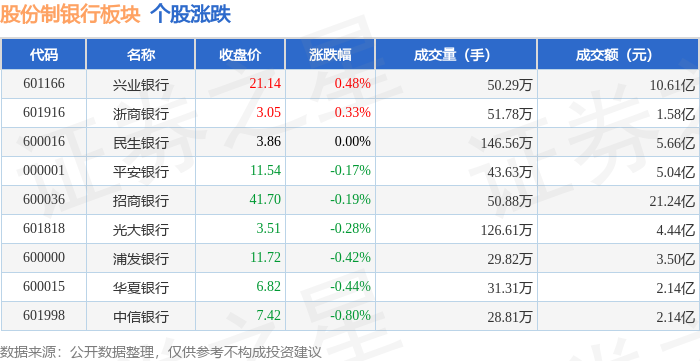
股份制银行板块12月26日跌0.18%,中信银行领跌,主力资金净流入4.48亿元
Zheng Xing Xing Ye Ri Bao· 2025-12-26 09:07
Market Overview - On December 26, the share price of the banking sector fell by 0.18% compared to the previous trading day, with CITIC Bank leading the decline [1] - The Shanghai Composite Index closed at 3963.68, up 0.1%, while the Shenzhen Component Index closed at 13603.89, up 0.54% [1] Individual Bank Performance - Industrial Bank (601166) closed at 21.14, up 0.48% with a trading volume of 502,900 shares and a transaction value of 1.061 billion [1] - Zhejiang Commercial Bank (601916) closed at 3.05, up 0.33% with a trading volume of 517,800 shares and a transaction value of 158 million [1] - Minsheng Bank (600016) closed at 3.86, unchanged with a trading volume of 1,465,600 shares and a transaction value of 566 million [1] - Ping An Bank (000001) closed at 11.54, down 0.17% with a trading volume of 436,300 shares and a transaction value of 504 million [1] - China Merchants Bank (600036) closed at 41.70, down 0.19% with a trading volume of 508,800 shares and a transaction value of 2.124 billion [1] - Everbright Bank (601818) closed at 3.51, down 0.28% with a trading volume of 1,266,100 shares and a transaction value of 444.1 million [1] - Shanghai Pudong Development Bank (600000) closed at 11.72, down 0.42% with a trading volume of 298,200 shares and a transaction value of 350 million [1] - Huaxia Bank (600015) closed at 6.82, down 0.44% with a trading volume of 313,100 shares and a transaction value of 214 million [1] - CITIC Bank (601998) closed at 7.42, down 0.80% with a trading volume of 288,100 shares and a transaction value of 214 million [1] Fund Flow Analysis - The banking sector saw a net inflow of 448 million from main funds, while retail funds experienced a net outflow of 231 million and 217 million respectively [1] - In terms of individual banks, China Merchants Bank had a main fund net inflow of 241 million, while retail funds saw a net outflow of 79.09 million [2] - Industrial Bank had a main fund net inflow of 159 million, with retail funds experiencing a net outflow of 108 million [2] - Shanghai Pudong Development Bank recorded a main fund net inflow of 62.09 million, while retail funds had a net outflow of 776,980 [2] - Everbright Bank had a main fund net inflow of 39.78 million, with retail funds seeing a net outflow of 1.45 million [2] - Ping An Bank had a main fund net inflow of 29.27 million, while retail funds experienced a net outflow of 4.01 million [2] - Minsheng Bank had a significant main fund net outflow of 67.19 million, but retail funds saw a net inflow of 27.19 million [2]




鹿山新材:为全资子公司江苏鹿山提供10000.00万元担保
2 1 Shi Ji Jing Ji Bao Dao· 2025-12-26 08:36
南财智讯12月26日电,鹿山新材公告,2025年12月25日,公司与平安银行股份有限公司广州分行签订 《最高额保证担保合同》,为全资子公司江苏鹿山新材料有限公司提供10,000万元连带责任保证担保, 担保金额为10000.00万元,保证期间为三年,本次担保无反担保。截至公告披露日,公司已实际为江苏 鹿山提供的担保余额为16,601.11万元。公司所有担保均为对全资子公司/孙公司的担保,无逾期对外担 保情况。 ...

平安银行取得银行业务资格校验方法专利
Sou Hu Cai Jing· 2025-12-26 07:40
国家知识产权局信息显示,平安银行股份有限公司取得一项名为"一种银行业务的资格校验方法及相关 装置"的专利,授权公告号CN117422535B,申请日期为2023年10月。 来源:市场资讯 天眼查资料显示,平安银行股份有限公司,成立于1987年,位于深圳市,是一家以从事货币金融服务为 主的企业。企业注册资本1142489.4787万人民币。通过天眼查大数据分析,平安银行股份有限公司共对 外投资了11家企业,参与招投标项目1146次,财产线索方面有商标信息501条,专利信息4629条,此外 企业还拥有行政许可71个。 声明:市场有风险,投资需谨慎。本文为AI基于第三方数据生成,仅供参考,不构成个人投资建议。 ...
又有股份行官宣!年内已有超10家银行首席合规官陆续补齐
Nan Fang Du Shi Bao· 2025-12-25 12:12
近日,兴业银行发布第十一届董事会第十二次会议决议公告,审议通过《关于聘任孙雄鹏先生为首席合 规官的议案》,孙雄鹏待国家金融监督管理总局核准任职资格后正式履新。无独有偶,同月平安银行董 事会全票通过决议,聘任现任行长助理兼首席风险官吴雷鸣兼任首席合规官。 银行业首席合规官配置进程正全面提速。 超十家银行年内聘任首席合规官 事实上,上述银行对聘任首席合规官"统一"的动作还要追溯到《金融机构合规管理办法》(下称《办 法》)。 根据《办法》规定,金融机构可以根据自身经营情况单独设立首席合规官、合规官,也可以由金融机构 的高级管理人员、省级分支机构或者一级分支机构的高级管理人员兼任。 其中,由金融机构行长兼任首席合规官的,不受该办法规定的首席合规官或者合规官的任职条件限制, 不需要另行取得任职资格许可。这意味着,由行长兼任首席合规官的,无需再次取得金融监管总局的核 准。因此,不少银行选择由行长或副行长"挂帅"首席合规官。 12月25日,南都湾财社记者从国家金融监督管理总局官网及各银行公告获悉,2025年以来,已有不少于 10家银行完成首席合规官相关聘任或任职资格核准。此外,理财公司、保险、信托等其他金融细分领域 亦同步 ...

平安银行科创贷亮相央视,成功入选典型案例
Hua Xia Shi Bao· 2025-12-25 09:40
Core Viewpoint - The event "Financial Empowerment of the Bay Area - Financial Night" showcased the financial reform and innovation achievements during the 14th Five-Year Plan period in the Greater Bay Area, highlighting the role of financial institutions like Ping An Bank in supporting technological innovation and development [1][8]. Group 1: Financial Support and Innovation - Ping An Bank's "Science and Technology Loan" program was recognized as a typical case of high-quality financial development in the Greater Bay Area, demonstrating its effectiveness in supporting technology enterprises [1][5]. - The bank's comprehensive financial solutions integrate insurance, banking, securities, and leasing to provide a multi-layered support system for technology innovation companies, covering the entire lifecycle from research and development to sales [1][6]. Group 2: Case Study of He Yi New Energy - He Yi New Energy, a company specializing in micro-battery technology, faced a funding gap of 3 million yuan to fulfill a large order but received timely support from Ping An Bank, which provided a loan of 300,000 yuan to upgrade its production line [5][6]. - Following the financial assistance, He Yi New Energy successfully upgraded its production capabilities, achieving an annual production capacity of over 50 million batteries and securing orders totaling over 300 million yuan [6][7]. Group 3: Science and Technology Loan Features - The "Science and Technology Loan" focuses on the technological capabilities of enterprises, utilizing data from the industry chain and innovation qualifications for credit assessment, thus facilitating financing for technology-driven companies [7]. - As of now, Ping An Bank has approved over 10 billion yuan in "Science and Technology Loans," providing financing services to more than 2,300 technology-oriented small and micro enterprises across various sectors [7]. Group 4: Future Directions - Ping An Bank aims to continuously optimize its technology financial service system and enhance its role in supporting real innovation and the construction of a modern industrial system [8].

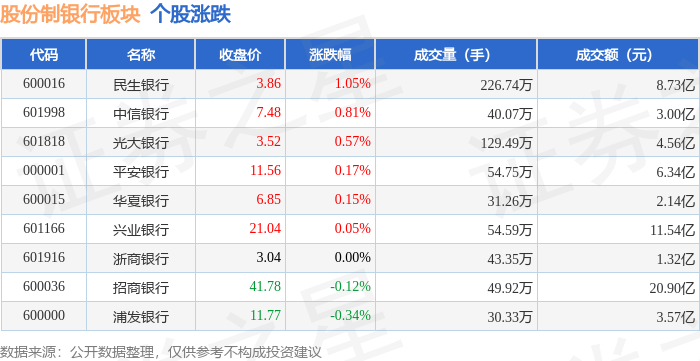
股份制银行板块12月25日涨0.12%,民生银行领涨,主力资金净流入1.22亿元
Zheng Xing Xing Ye Ri Bao· 2025-12-25 09:03
Group 1 - The banking sector saw a slight increase of 0.12% on December 25, with Minsheng Bank leading the gains [1] - The Shanghai Composite Index closed at 3959.62, up 0.47%, while the Shenzhen Component Index closed at 13531.41, up 0.33% [1] - The trading volume for Minsheng Bank was 2.2674 million shares, with a transaction value of 873 million yuan [1] Group 2 - The net inflow of main funds in the banking sector was 122 million yuan, while retail funds experienced a net outflow of 69.36 million yuan [1] - The detailed fund flow for individual banks shows that Ping An Bank had a net inflow of 51.47 million yuan from main funds [2] - Industrial Bank experienced the highest net outflow from main funds at 70.30 million yuan [2]

商业银行“出海”验成色:中行领跑,谁在悄然发力?
2 1 Shi Ji Jing Ji Bao Dao· 2025-12-25 08:34
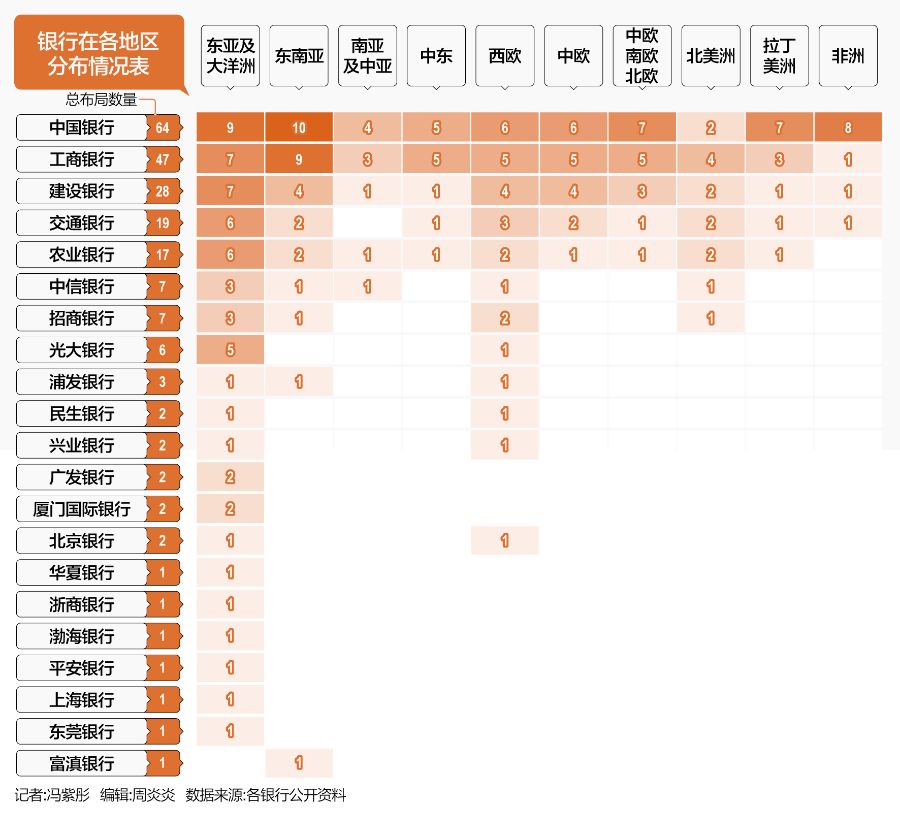
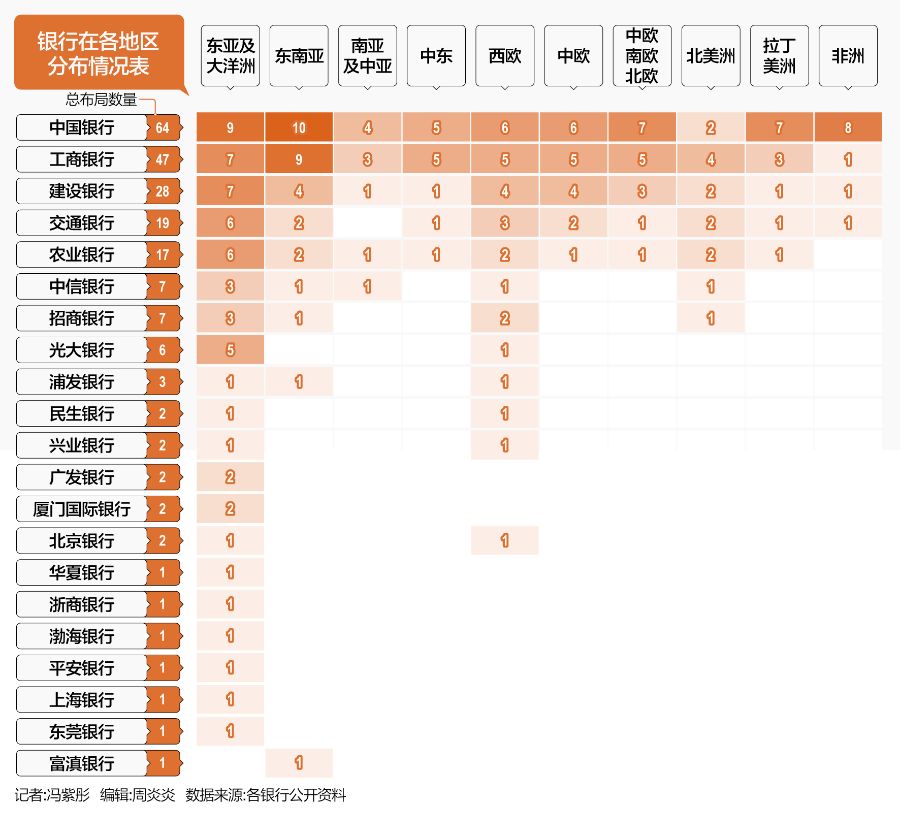
Core Insights - Chinese banks are expanding their overseas presence, establishing a comprehensive service network that covers major financial centers globally and key regions along the Belt and Road Initiative [1][4] - The internationalization strategy of Chinese banks has shifted from focusing primarily on traditional markets in Europe and the US to emerging markets in Southeast Asia, the Middle East, Latin America, and countries involved in the Belt and Road Initiative [1][9] Group 1: Overseas Expansion Strategies - Chinese banks utilize three main forms for overseas expansion: representative offices, branches, and subsidiaries, with larger banks often establishing branches or subsidiaries in mature markets and starting with representative offices in emerging markets [2][4] - The distribution of overseas institutions varies among banks, with a notable focus on new emerging markets and developing countries [2][4] Group 2: Performance of Major Banks - Bank of China leads in global presence with 539 overseas branches in 64 countries, including 45 countries involved in the Belt and Road Initiative, and has a strong focus on enhancing its competitive edge in Southeast Asia [4][12] - Industrial and Commercial Bank of China has 413 overseas institutions in 49 countries, with a significant presence in 30 Belt and Road countries, showcasing a flexible internationalization strategy [4][12] - Agricultural Bank of China has established 13 branches and 4 representative offices, focusing on supporting high-quality Belt and Road initiatives [4][12] Group 3: Revenue Growth and Performance Metrics - In the first half of 2025, Bank of China reported overseas revenue of 783.13 billion yuan, a 14.4% increase from the previous year, with overseas revenue accounting for 23.77% of total revenue [11][12] - Agricultural Bank of China achieved a 21.03% increase in overseas revenue, while Construction Bank's overseas revenue grew by 40.92%, indicating strong expansion momentum [12][14] - Shanghai Pudong Development Bank's overseas revenue surged by 119.37%, marking a significant growth and highlighting the effectiveness of its international strategy [14] Group 4: Challenges and Market Dynamics - Chinese banks face regulatory challenges in overseas markets, including compliance with both domestic and foreign regulations, which can lead to significant penalties [15][19] - The demand from Chinese enterprises for overseas financial services is evolving, with a shift towards more complex needs such as global treasury management and cross-border mergers and acquisitions [16][17] - Small and medium-sized enterprises are becoming a key growth driver for overseas financial services, emphasizing the need for lower financing thresholds and cost-effective payment solutions [16][17] Group 5: Future Directions and Strategic Focus - The future competitiveness of Chinese banks in international markets will depend on enhancing global collaboration, improving localization capabilities, and strengthening compliance risk management [18][19] - Emphasis on financial technology innovation and the development of cross-border digital infrastructure will be crucial for expanding their international footprint [19]


深度丨商业银行“出海”验成色:中行领跑,谁在悄然发力?
2 1 Shi Ji Jing Ji Bao Dao· 2025-12-25 08:32
Core Insights - Chinese banks are expanding their overseas presence, establishing a comprehensive service network that covers major financial centers globally and key regions along the Belt and Road Initiative [1][2] - The internationalization strategy of Chinese banks has shifted from traditional markets in Europe and the US to emerging markets in Southeast Asia, the Middle East, Latin America, and countries involved in the Belt and Road Initiative [1][2] Group 1: Global Expansion Strategy - Chinese banks are utilizing representative offices, branches, and subsidiaries for overseas expansion, with larger banks often establishing branches in mature markets and starting with representative offices in emerging markets [2] - The distribution of overseas institutions shows that major state-owned banks are leading the expansion, with a focus on both traditional and emerging markets [2][4] Group 2: Performance Metrics - As of June 2025, Bank of China leads with 539 overseas branches in 64 countries, including 45 Belt and Road countries, showcasing its extensive global network [4] - Industrial and Commercial Bank of China follows with 413 overseas institutions in 49 countries, including 250 in Belt and Road countries, demonstrating a flexible international strategy [4] - Agricultural Bank of China has established 13 branches and 4 representative offices, focusing on supporting high-quality Belt and Road initiatives [4] Group 3: Revenue Growth and Market Dynamics - In the first half of 2025, Bank of China reported overseas revenue of 783.13 billion yuan, a 14.4% increase from the previous year, with overseas revenue accounting for 23.77% of total revenue [12] - Industrial and Commercial Bank of China's overseas revenue was 562.52 billion yuan, showing a slight decline of 1.88%, while Agricultural Bank of China experienced a 21.03% increase [12][11] - The growth of overseas revenue among joint-stock banks, such as Shanghai Pudong Development Bank, which saw a 119.37% increase, highlights the varying performance across banks [14] Group 4: Challenges and Future Directions - Chinese banks face regulatory challenges in overseas markets, including compliance with both domestic and foreign regulations, which can lead to significant penalties [15] - The demand for diversified financial services is evolving, with a shift from traditional trade financing to more complex needs such as global treasury management and cross-border mergers [16] - Future competitiveness will depend on enhancing global collaboration, local operational capabilities, compliance risk management, and financial technology innovation [18][19]