
TYN(000591)

Search documents
太阳能:公司下属光伏发电项目公司收到可再生能源补贴资金6.27亿元
Xin Lang Cai Jing· 2025-08-05 09:10
Core Viewpoint - The company announced that its subsidiary photovoltaic power generation project received a total of 627 million yuan in renewable energy subsidy funds from January 1 to July 31, 2025, which will positively impact the cash flow of its photovoltaic power stations [1] Group 1 - The renewable energy subsidy includes 572 million yuan from the national renewable energy subsidy fund [1] - The recovery of this subsidy will improve the cash flow of the company's photovoltaic power stations [1] - The repayment will not have a significant impact on the company's profit and loss for the fiscal year 2025 [1]

高佳太阳能取得硅片分选机分选机构专利
Jin Rong Jie· 2025-08-05 07:25
Core Viewpoint - Gaojia Solar Co., Ltd. has obtained a patent for a "silicon wafer sorting machine" with the authorization announcement number CN119634282B, applied for on December 2024 [1] Company Overview - Gaojia Solar Co., Ltd. was established in 2005 and is located in Wuxi City, primarily engaged in the production and supply of electricity and heat [1] - The company has a registered capital of 1.18457 billion RMB [1] - Gaojia Solar has made investments in 3 companies and participated in 5 bidding projects [1] - The company holds 4 trademark information and 182 patent information, along with 17 administrative licenses [1]
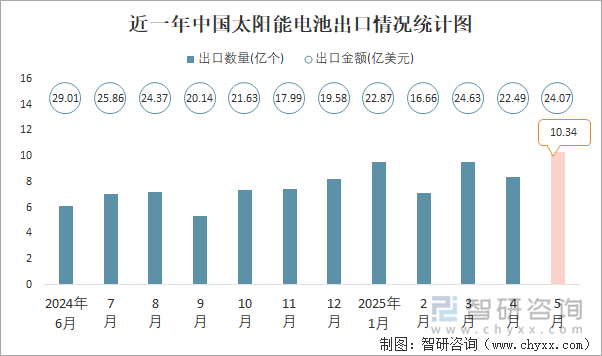
2025年5月中国太阳能电池出口数量和出口金额分别为10.34亿个和24.07亿美元
Chan Ye Xin Xi Wang· 2025-08-05 03:44
Group 1 - The core point of the article highlights that in May 2025, China's solar cell exports reached 1.034 billion units, representing a year-on-year increase of 74.2%, while the export value was $2.407 billion, showing a year-on-year decline of 14.8% [1] Group 2 - The data source for the information is from China Customs, and the analysis is organized by Zhiyan Consulting, a leading industry consulting firm in China [3]

中国太阳能玻璃:预计 2025 年下半年 - 2026 年情况更糟;重申对信义和福莱特的 “卖出” 评级-China Solar_ Glass_ Expect a worse 2H25-2026; Reiterate Sell on Xinyi and Flat
2025-08-05 03:15
Summary of Conference Call on Solar Glass Industry Industry Overview - The conference call focused on the solar glass industry, specifically discussing the performance and outlook for Xinyi Solar and Flat Glass [1][2][7][35]. Key Points and Arguments 1. **Performance Decline**: Both Xinyi Solar and Flat Glass reported results significantly below expectations due to lower recognized glass prices and asset impairment losses. Xinyi Solar's 1H25 revenue decreased by 7% year-on-year to Rmb10.9 billion, with net income down 59% to Rmb746 million [25][29]. 2. **Price Forecast Adjustments**: The pricing forecast for solar glass has been lowered by 9%-20% for 3Q25-2026, now expected to be Rmb10-11/sqm. This adjustment reflects deteriorating supply-demand dynamics and ongoing raw material price deflation [2][15][30]. 3. **Capacity and Cost Changes**: Effective capacity is expected to decline by approximately 20% in 2H25, with idling furnaces contributing to a 10% increase in unit production costs due to fixed energy and depreciation costs [3][19][27]. 4. **Earnings Estimates Revision**: EBITDA forecasts for 2025E-26E have been cut by an average of 58% for Flat Glass and 73% for Xinyi Solar, with target prices remaining largely unchanged due to valuation roll-over [4][30][34]. 5. **Market Dynamics**: The solar glass market is experiencing a profitability downturn, with expectations of a deeper decline in 2H25-2026 driven by lower prices and higher costs. The anticipated glass shipment is expected to nearly halve to an average of 25GW per month in Aug-Dec 2025 [2][14][32]. 6. **Inventory Management**: There has been a fast depletion of producer-side inventory since mid-July, primarily due to module-side inventory re-stocking. This has led to a temporary stabilization of glass prices at Rmb10/sqm [8][12][9]. 7. **Regulatory Environment**: Management indicated that no glass price regulations have been imposed, but Tier 1 players are expected to be better positioned in a regulated pricing scenario. There is also a positive outlook on potential poly capacity buyout developments [27][32]. Additional Important Insights - **Export Tax Rebate Cuts**: The anticipation of further export tax rebate cuts has led to front-loading of export module shipments, impacting glass demand and pricing [13][14]. - **Long-term Industry Outlook**: The industry landscape is viewed as deteriorating rapidly, with structural margin pressures on Tier 1 players due to aggressive expansion by Tier 2 players and slower demand growth [32][35]. - **Key Risks**: Potential risks include stronger-than-expected solar demand, slower industry-wide capacity expansion, and faster-than-expected cost reduction progress by the companies [34][36]. This summary encapsulates the critical discussions and insights from the conference call regarding the solar glass industry, focusing on the performance and outlook of Xinyi Solar and Flat Glass.
中国太阳能:反内卷 —— 打造多晶硅自身 “欧佩克” 的第一步-China Solar_ Anti-Involution_ A first step in forming polysilicon‘s own ‘OPEC‘
2025-08-05 03:15
Summary of Key Points from the Conference Call Industry Overview - **Industry**: Polysilicon market in China - **Context**: The call discusses the recent buyout plan aimed at reducing excess polysilicon capacity and its implications for the market dynamics. Core Insights 1. **Buyout Plan Initiation**: Six low-tier polysilicon producers have agreed to exit the market, selling a total production capacity of 0.7 million tons (mt), equivalent to 350 gigawatts (GW) per annum. This is the first step towards forming a coordinated production strategy akin to "OPEC" for polysilicon [1] 2. **Capacity Reduction**: The buyout plan will reduce China's polysilicon production capacity from 3.2 mt (1,602 GW) to 2.5 mt (1,252 GW), which is below the initial target of a 1.0 mt reduction. The market is expected to remain oversupplied, with utilization rates projected to improve only slightly from 38% in 2025 to 41% in 2026, amid declining global demand [2] 3. **Price Control Impact**: Recent government price controls have resulted in a 37% increase in polysilicon prices within a month. This price recovery is crucial for the earnings of polysilicon producers, particularly for cost leaders like GCL, which is nearing breakeven [3] 4. **Investment Recommendation**: A "Buy" rating is maintained on GCL (3800 HK), identified as a cost leader in polysilicon. The company is expected to benefit from ongoing market consolidation and policy developments favoring a quicker consolidation process in 2026 [4][7] Financial Projections 1. **Earnings Scenario Analysis**: The analysis indicates that the average selling price (ASP) is a significant driver for recovery. Different scenarios project unit net profits for GCL Tech under varying ASPs (RMB/kg) and utilization rates, with potential profits increasing significantly if ASP reaches RMB 80/kg [18][19] 2. **Valuation Metrics**: GCL Tech's target price is set at HKD 1.65, implying a 32% upside from the current price of HKD 1.25. The valuation is based on a price-to-book (P/B) ratio of 1.14x for the solar materials segment [22][24] Risks and Considerations 1. **Downside Risks**: Potential risks include a significant drop in polysilicon prices, reduced demand from the US or other global markets due to trade disputes, and rising upstream raw material costs [22] 2. **Market Volatility**: Investor sentiment remains mixed, leading to share price volatility amid uncertain policy and recovery outlooks [4] Additional Insights - **Utilization Rate Projections**: The expected utilization rates post-capacity buyout are limited, with various scenarios suggesting rates of 41%, 47%, and 55% depending on global demand [12][14] - **Government Intervention**: The Chinese government's direct intervention in pricing is a new development, and its effectiveness in stabilizing the market remains to be seen [14] This summary encapsulates the key points discussed in the conference call regarding the polysilicon market in China, focusing on the buyout plan, financial projections, and associated risks.
通威太阳能(合肥)申请光伏组件专利,避免电池串发生紫外光致衰减与老化
Jin Rong Jie· 2025-08-05 02:40
专利摘要显示,本发明提供了一种光伏组件,至少包括依次排布的正面玻璃(100)、正面胶膜 (200)、电池串(300)和背面胶膜(400);背面胶膜(400)整体或局部包括阻氧胶膜(410),阻 氧胶膜(410)用于为正面胶膜(200)阻氧;阻氧胶膜(410)包括:阻氧材料层(411),包括相对设 置的第一表面和第二表面;封装材料层(412),粘结至阻氧材料层(411)的第一表面和/或第二表 面,用于将阻氧胶膜(410)粘结至电池串(300)。通过将背面胶膜整体或局部采用阻氧胶膜为正面胶 膜阻氧,避免位于电池串正面的光转化胶膜被背面侵入的氧气所氧化导致光转化胶膜的功能失效和老 化,进而避免电池串发生紫外光致衰减与老化,从而提高了光伏组件的转换效率,延长了光伏组件的使 用寿命。 天眼查资料显示,通威太阳能(合肥)有限公司,成立于2010年,位于合肥市,是一家以从事其他制造 业为主的企业。企业注册资本215000万人民币。通过天眼查大数据分析,通威太阳能(合肥)有限公司 参与招投标项目511次,财产线索方面有商标信息5条,专利信息462条,此外企业还拥有行政许可20 个。 国家知识产权局信息显示,通威太阳能(合肥) ...
斯凯蒙太阳能上涨5.23%,报3.473美元/股,总市值9375.75万美元
Jin Rong Jie· 2025-08-04 17:51
Core Viewpoint - SkyMoon Solar's stock price increased by 5.23% on August 5, reaching $3.473 per share, with a total market capitalization of $93.75 million [1] Financial Performance - For the fiscal year ending September 30, 2024, SkyMoon Solar reported total revenue of $49.864 million, a year-over-year decrease of 1.87% [1] - The company's net profit attributable to shareholders was $471,000, reflecting a significant year-over-year decline of 57.17% [1] Company Overview - SkyMoon Solar Group Limited is a holding company registered in the Cayman Islands, primarily operating through its domestic subsidiaries [1] - The company designs, develops, manufactures, and sells solar photovoltaic products and solar system solutions through its wholly-owned subsidiaries [1] - Additionally, SkyMoon Solar provides high-performance computing (HPC) products through its indirect wholly-owned subsidiaries [1]
瑞银中国股票策略:太阳能、化工和锂行业是“反内卷”主题最佳投资板块
Zhi Tong Cai Jing· 2025-08-04 14:56
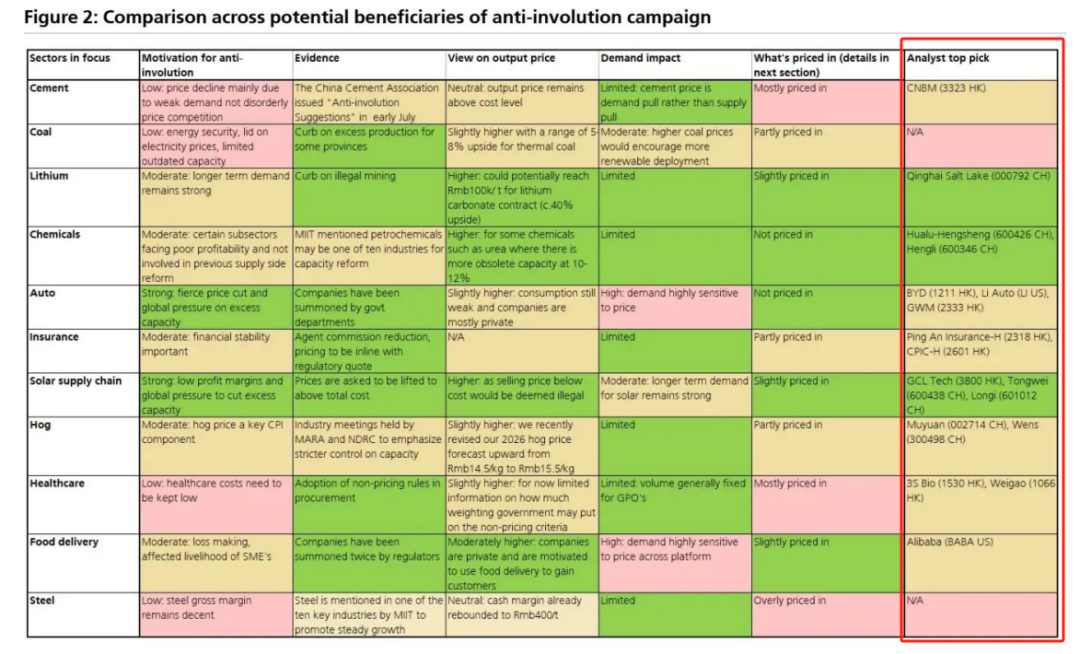
Core Viewpoint - UBS analysts express mixed feedback on the anti-involution measures, indicating that the market remains skeptical about their potential impact on stock prices [1][4]. Industry Analysis - **Cement**: Price decline mainly due to weak demand, with output prices remaining above cost levels. The sector is mostly priced in, with CNBM (3323 HK) as a top pick [2]. - **Coal**: Limited outdated capacity and energy security concerns lead to a slight price increase, with moderate demand impact. The sector is partly priced in [2]. - **Lithium**: Long-term demand remains strong, with potential price increases for lithium carbonate contracts. The sector is slightly priced in, with Qinghai Salt Lake (000792 CH) as a top pick [2]. - **Chemicals**: Certain subsectors face poor profitability, with potential for capacity reform. The sector is not priced in, with Hualu-Hengsheng (600426 CH) and Hengli (600346 CH) as top picks [2]. - **Auto**: Strong price cuts and global pressure on excess capacity lead to slightly higher consumption. The sector is not priced in, with BYD (1211 HK), Li Auto (LI US), and GWM (2333 HK) as top picks [2]. - **Insurance**: Financial stability is important, with limited demand impact. The sector is partly priced in, with Ping An Insurance-H (2318 HK) and CPIC-H (2601 HK) as top picks [2]. - **Solar Supply Chain**: Low profit margins and global pressure to cut excess capacity lead to higher prices. The sector is slightly priced in, with GCL Tech (3800 HK), Tongwei (600438 CH), and Longi (601012 CH) as top picks [2]. - **Hog**: Hog prices are a key component of CPI, with limited demand impact. The sector is partly priced in, with Muyuan (002714 CH) and Wens (300498 CH) as top picks [2]. - **Healthcare**: Healthcare costs need to be kept low, with limited demand impact. The sector is mostly priced in, with 3S Bio (1530 HK) and Weigao (1066 HK) as top picks [2]. - **Food Delivery**: Companies face loss-making conditions, with high demand sensitivity. The sector is slightly priced in, with Alibaba (BABA US) as a top pick [2]. - **Steel**: Steel gross margins remain decent, with limited demand impact. The sector is overly priced in [2]. Investment Opportunities - UBS identifies solar, chemicals, and lithium industries as the most attractive for selective investment based on their low profitability, growth potential, and valuation risks [4][12].
瑞银:“反内卷”运动扩展至多领域 首选板块包括太阳能、化工和锂行业
智通财经网· 2025-08-04 09:36
Core Viewpoint - UBS reports that the "anti-involution" movement in mainland China is expanding into various sectors, including healthcare and financial services, with analysts expressing skepticism about the potential impacts of these measures on the market [1][2] Group 1: Industry Impact - The "anti-involution" movement has shown varying intensity across different industries, with regulatory bodies urging companies in the food delivery and automotive sectors to rectify promotional behaviors and engage in rational competition [2] - In the solar industry, manufacturers are prohibited from selling below cost according to the Price Law, while in the coal sector, production is limited to 110% of total capacity across eight provinces [2] - The lithium industry is facing increased scrutiny over illegal mining activities, and in the pig farming sector, stricter capacity controls are being emphasized [2] - Overall, the current measures are considered less intense compared to interventions in 2014-2015 but cover a broader range of industries [2] Group 2: Investment Opportunities - UBS identifies key motivations behind these measures, including enhancing corporate profitability and government tax revenue domestically, and addressing international resistance to China's industrial overcapacity [3] - The firm believes that the risk is skewed to the upside, as average performance in related sectors has not significantly outperformed the market, and investor expectations are generally low [3] - UBS ranks sectors based on motivation, demand response, and market pricing, favoring solar, chemical, and lithium industries for investment [3] - Preferred stocks in the solar supply chain include GCL-Poly Energy (03800), Tongwei Co. (600438.SH), and LONGi Green Energy (601012.SH); in the chemical sector, Hualu Chemical (600426.SH) and Hengli Petrochemical (600346.SH) are favored; and in the lithium sector, Salt Lake Potash (000792.SZ) is highlighted [3]





爱疆科技布局太阳能电池AI检测系统
Zhong Guo Jing Ji Wang· 2025-08-04 05:40
据了解,爱疆科技下一步将以AI为技术杠杆,构建以新型光电材料研发全周期检测体系为基石,搭建 跨领域数据协同平台,完成从实验室验证到规模化商用的跨越式发展,为产业升级提供核心驱动力。 该智检服务系统实现了光伏电池设备检测效率提升12倍、成本降低40%的突破。系统以98.7%的缺陷识 别准确率覆盖晶硅/钙钛矿叠层电池检测,并创建光电材料数据库(含25类钙钛矿材料标准数据)。 目前,"星汉AI"检测系统已获得高校实验室、顶尖科研院所及头部光伏组件厂商的采用,应用于柔性光 伏组件、Micro-LED显示面板等领域。爱疆科技CEO袁五辉说,通过自主研发的多模态AI模型集成检测 与智能洞察,星汉AI"智检专家"不仅实现行业客户成本优化与提质增效,还进一步积累钙钛矿叠层电池 的检测数据,为打造高精密度智检AI大模型打下坚实基础。 近日,武汉爱疆科技有限公司自主研发的专家级智检服务系统——"星汉AI"正式发布。该产品将机器视 觉与人工智能技术相结合,创建光电材料检测数据集以及基于多模态AI大模型的智能检测系统,应用 于包括晶硅太阳能电池、钙钛矿叠层太阳能电池等新型光电材料检测场景中,大幅提升电池检测精度和 效率,实现降本增效 ...