Pangang (000629)

Search documents
钒钛股份(000629) - 关于回购公司股份进展的公告
2025-10-09 10:17
截至 2025 年 9 月 30 日,公司通过深圳证券交易所交易系统以集 中竞价交易方式回购公司股份 36,354,559 股,占公司目前总股本的比 例为 0.39%,最高成交价为 2.96 元/股,最低成交价为 2.57 元/股,成 交总金额为人民币 100,982,925.66 元(不含交易费用)。回购资金来源 股票代码:000629 股票简称:钒钛股份 公告编号:2025-76 攀钢集团钒钛资源股份有限公司 关于回购公司股份进展的公告 本公司及董事会全体成员保证信息披露内容的真实、准确、完整,没有虚假记载、 误导性陈述或重大遗漏。 攀钢集团钒钛资源股份有限公司(以下简称"公司")于 2025 年 4 月 21 日召开了第九届董事会第二十三次会议,审议通过了《关于回 购公司股份方案的议案》,同意公司使用自有资金以集中竞价交易方式 回购部分公司已发行的人民币普通股(A 股)股票,回购股份将用于 实施股权激励。本次回购的资金总额不低于人民币 1 亿元(含),不超 过人民币 2 亿元(含);回购股份价格不超过 4.30 元/股,回购期限自 公司第九届董事会第二十三次会议审议通过本次股份回购方案之日起 12 个月 ...

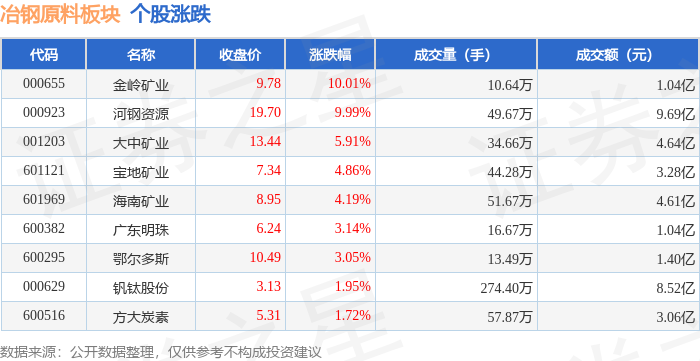
冶钢原料板块10月9日涨4.06%,金岭矿业领涨,主力资金净流入9168.02万元
Zheng Xing Xing Ye Ri Bao· 2025-10-09 08:53
Market Overview - The steel raw materials sector increased by 4.06% compared to the previous trading day, with Jinling Mining leading the gains [1] - The Shanghai Composite Index closed at 3933.97, up 1.32%, while the Shenzhen Component Index closed at 13725.56, up 1.47% [1] Stock Performance - Jinling Mining (000655) closed at 9.78, with a rise of 10.01% and a trading volume of 106,400 shares, totaling a transaction value of 104 million yuan [1] - Hebei Steel Resources (000923) rose by 9.99% to 19.70, with a trading volume of 496,700 shares and a transaction value of 265.96 million yuan [1] - Dazhong Mining (001203) increased by 5.91% to 13.44, with a trading volume of 346,600 shares and a transaction value of 464 million yuan [1] - Other notable stocks include Baodi Mining (601121) up 4.86%, Hainan Mining (696109) up 4.19%, and Guangdong Mingzhu (600382) up 3.14% [1] Capital Flow - The steel raw materials sector saw a net inflow of 91.68 million yuan from main funds, while retail funds experienced a net inflow of 45.44 million yuan [1] - The main funds showed a significant net inflow in Hebei Steel Resources, amounting to 88.93 million yuan, while retail funds had a net outflow of 14.83 million yuan [2] - Jinling Mining had a net inflow of 47.12 million yuan from main funds, but retail funds saw a net outflow of 25.86 million yuan [2]


钒钛股份:与大连融科合资建有一条2000立方米/年钒电解液产线,并已长时间达产达效
Mei Ri Jing Ji Xin Wen· 2025-10-09 03:42
Core Viewpoint - The company is actively preparing for the supply of vanadium electrolyte and has established a strong partnership for product cooperation, indicating a positive outlook for the vanadium flow battery market. Group 1: Company Operations - The company has established a joint venture with Dalian Rongke to build a 2000 cubic meters/year vanadium electrolyte production line, which has been operating effectively for a long time [1] - The company has supplied over 20,000 tons of vanadium products to Dalian Rongke from 2021 to 2024, which is equivalent to vanadium pentoxide and does not include raw materials needed for the joint venture [1] - A framework agreement for the supply of vanadium energy storage raw materials for 2025 has been signed, with an expected total supply of 20,000 tons (equivalent to vanadium pentoxide) [1] Group 2: Market Outlook - The company is actively working on the preliminary construction of a larger-scale electrolyte production line, indicating a commitment to expanding its production capacity [1]
趋势研判!2025年中国海洋金属钛行业政策、发展现状、细分市场需求情况及未来发展前景分析:“深海科技”赋能,海洋金属钛市场空间持续扩容[图]
Chan Ye Xin Xi Wang· 2025-10-03 02:31
Core Insights - The article emphasizes the strategic importance of marine titanium in addressing corrosion and structural challenges in marine engineering, shipbuilding, and seawater utilization, highlighting its role in enhancing the reliability, durability, and economic viability of marine equipment [1][7][11]. Industry Overview - Marine titanium refers specifically to titanium and titanium alloys used in marine environments and related industries, characterized by excellent corrosion resistance, high specific strength, low density, and non-magnetic properties [2][3]. - The Chinese government has prioritized the development of marine titanium, integrating "deep-sea technology" into national strategic emerging industries by 2025, which supports the large-scale application of titanium materials in deep-sea exploration, manned submersibles, and oil and gas extraction [1][7]. Industry Chain - China's marine titanium industry chain includes upstream titanium ore mining, midstream sponge titanium smelting and processing, and downstream high-end applications, with leading companies like Baotai and Western Superconducting playing significant roles [1][7][10]. - The industry is experiencing rapid growth, with the marine engineering equipment manufacturing sector projected to have a compound annual growth rate (CAGR) of 15.54% from 2022 to 2024, indicating a significant increase in titanium demand [1][10]. Current Development Status - From 2019 to 2024, China's titanium processing output is expected to grow from 75,300 tons to 172,000 tons, with sales increasing from 68,900 tons to 151,000 tons, reflecting a CAGR of 18% and 17% respectively [9][10]. - Despite the low penetration of titanium in marine engineering, projected demand for marine engineering titanium is expected to reach approximately 2,555 tons by 2024, with further growth anticipated as deep-sea exploration and development plans advance [10][13]. Future Development Trends - The marine titanium industry is expected to evolve through strategic drivers, technological breakthroughs, and expanded applications, with a focus on high-performance and low-cost dual pathways [17][18]. - The demand for marine titanium will diversify beyond traditional applications in ships and submersibles to include emerging sectors such as offshore wind power, underwater data centers, and blue energy, promoting a shift towards integrated solutions in the industry [19].


钒钛股份成交额创2024年12月12日以来新高
Zheng Quan Shi Bao Wang· 2025-09-30 06:59
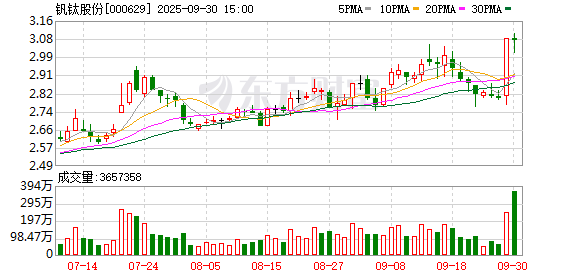
Group 1 - The trading volume of Vanadium Titanium Co., Ltd. reached 1.003 billion RMB, marking a new high since December 12, 2024 [2] - The latest stock price decreased by 0.97%, with a turnover rate of 3.53% [2] - The previous trading day's total trading volume for the stock was 724 million RMB [2] Group 2 - Pangang Group Vanadium Titanium Resources Co., Ltd. was established on March 27, 1993, with a registered capital of 9.29497 billion RMB [2]
钢铁板块震荡走强
Di Yi Cai Jing· 2025-09-29 10:37
Group 1 - Maanshan Iron & Steel Co., Ltd. (马钢股份) reached the daily limit increase in stock price [1] - Vanadium Titanium Resources Co., Ltd. (钒钛股份) previously hit the daily limit increase [1] - Other companies such as Jinzhu Pipeline Co., Ltd. (金洲管道), Wujin Stainless Steel Co., Ltd. (武进不锈), Changbao Steel Pipe Industry Co., Ltd. (常宝股份), Hainan Mining Co., Ltd. (海南矿业), and Jiuli Special Materials Co., Ltd. (久立特材) also experienced stock price increases [1]


集体大涨!刚刚,重磅发布!
券商中国· 2025-09-29 09:44
Core Viewpoint - The article highlights the release of the "Mechanical Industry Stabilization and Growth Work Plan (2025-2026)" by six government departments, aiming to promote high-quality development in the manufacturing sector, particularly in key areas such as industrial mother machines, agricultural machinery, and robotics [1][3][6]. Group 1: Policy Initiatives - The plan aims for the mechanical industry to maintain a stable and positive trend, targeting an average annual revenue growth rate of approximately 3.5%, with total revenue exceeding 10 trillion yuan by 2025-2026 [3]. - Specific measures include enhancing major technological renovations and large-scale equipment updates, focusing on replacing outdated equipment with more efficient and environmentally friendly alternatives [3][4]. - The plan emphasizes the promotion of intelligent manufacturing and the integration of new technologies such as artificial intelligence and quantum technology into equipment development [6][7]. Group 2: Market Response - Following the announcement, the robotics sector saw significant activity in the stock market, with nearly 20 related stocks hitting the daily limit or rising over 10% [2][8]. - The non-ferrous metals sector also experienced a collective surge, with an overall increase of more than 3.7% on the same day, driven by supportive policies in various industries [2]. Group 3: Industry Development Focus - The plan outlines the need to cultivate competitive small and medium-sized enterprises and industry clusters with international competitiveness, particularly in high-tech fields [3][7]. - It encourages the development of new economic models such as the "first economy," "ice and snow economy," and "smart tourism," expanding the application of specialized robots and smart equipment [5][6]. - The initiative aims to enhance the integration of artificial intelligence in healthcare, promoting the use of smart medical equipment and robotics in various healthcare scenarios [5][6].





钛白粉概念涨2.73%,主力资金净流入7股
Zheng Quan Shi Bao Wang· 2025-09-29 08:49
Core Viewpoint - The titanium dioxide sector has seen a notable increase of 2.73% as of the market close on September 29, ranking it as the 10th highest gaining sector, with significant contributions from stocks like Donghua Technology and Vanadium Titanium Co., which hit the daily limit up [1]. Group 1: Sector Performance - The titanium dioxide concept sector experienced a rise of 2.73%, with 13 stocks advancing, including Donghua Technology and Vanadium Titanium Co., which reached their daily limit up [1]. - The top gainers in the sector included China Nuclear Titanium Dioxide, Jinpu Titanium Industry, and Anning Co., with respective increases of 4.54%, 3.47%, and 2.10% [1]. Group 2: Capital Flow - The titanium dioxide sector attracted a net inflow of 293 million yuan from main funds, with seven stocks receiving net inflows, led by Vanadium Titanium Co. with a net inflow of 302 million yuan [1]. - The main capital inflow ratios for leading stocks were 41.69% for Vanadium Titanium Co., 13.51% for Lubek Chemical, and 9.33% for Donghua Technology [2]. Group 3: Individual Stock Performance - Vanadium Titanium Co. had a daily increase of 10.00% with a turnover rate of 2.62% and a main capital flow of 301.90 million yuan [2]. - Donghua Technology also saw a rise of 10.02% with a turnover rate of 3.56% and a main capital flow of 23.99 million yuan [2]. - China Nuclear Titanium Dioxide increased by 4.54% with a turnover rate of 3.64% and a main capital flow of 17.07 million yuan [2].


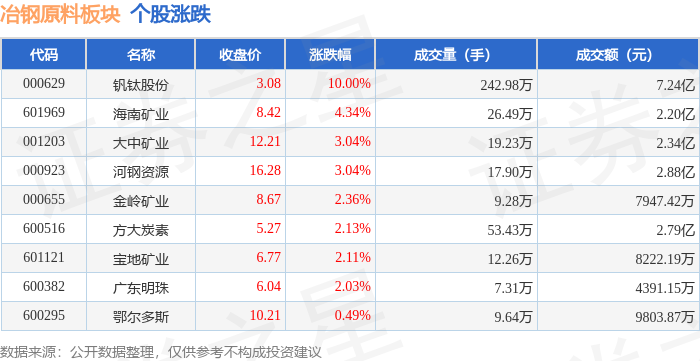
冶钢原料板块9月29日涨4.06%,钒钛股份领涨,主力资金净流入3.45亿元
Zheng Xing Xing Ye Ri Bao· 2025-09-29 08:39
Core Viewpoint - The steel raw materials sector experienced a significant increase of 4.06% on September 29, with Vanadium Titanium Co. leading the gains. The Shanghai Composite Index closed at 3862.53, up 0.9%, while the Shenzhen Component Index closed at 13479.43, up 2.05% [1]. Group 1: Market Performance - The steel raw materials sector saw a notable rise, with individual stocks showing varying degrees of increase, highlighted by Steel Titanium Co. which surged by 10% to a closing price of 3.08 [1]. - The trading volume for Steel Titanium Co. reached 2.4298 million shares, with a transaction value of 724 million yuan [1]. - Other notable performers included Yidian Tishi, which rose by 4.34%, and Dazhong Mining, which increased by 3.04% [1]. Group 2: Capital Flow - The steel raw materials sector experienced a net inflow of 345 million yuan from institutional investors, while retail investors saw a net outflow of 149 million yuan [1]. - The capital flow data indicates that Steel Titanium Co. attracted a significant net inflow of 303 million yuan, accounting for 41.91% of the total institutional investment [2]. - In contrast, retail investors withdrew 169 million yuan from Steel Titanium Co., representing a net outflow of 23.28% [2].
A500ETF基金(512050)盘中上涨1.56%,持仓股湖南裕能涨超17%,景顺增加对中国股票的配置
Mei Ri Jing Ji Xin Wen· 2025-09-29 06:12
Core Viewpoint - The A-share market is experiencing significant gains, with major indices showing substantial increases, driven by strong performance in specific ETFs and stocks, alongside positive sentiment from foreign investment strategies [1] Market Performance - As of September 29, the Shanghai Composite Index rose by 1.21%, the Shenzhen Component increased by 2.22%, and the ChiNext Index surged by 3.07% [1] - The A500 ETF (512050), which tracks the CSI A500 Index, saw an increase of 1.56% with a trading volume exceeding 5.2 billion yuan, ranking first among similar products [1] - Notable stocks within the ETF included Hunan YN, which rose over 17%, and China Tianying and Vanadium Titanium Co., both hitting the daily limit [1] Fund Flows - There has been a net inflow into the A500 ETF for three consecutive trading days, accumulating 1.332 billion yuan over the past five days [1] Investment Sentiment - In a strategic shift, Invesco has increased its allocation to Chinese stocks while reducing its holdings in Indian stocks, citing the latter as "expensive" [1] - Chang Hwan Sung, a multi-asset portfolio manager at Invesco, expressed optimism about Chinese stocks, noting their attractive valuations despite recent gains [1] Analyst Insights - Zhongtai Securities indicated that with the upcoming National Day holiday, there may be a rise in risk-averse sentiment, suggesting a potential short-term adjustment in high-tech sectors [1] - However, the long-term outlook remains positive due to unchanged supportive policy stances, with both long-term and foreign investors favoring A-shares, and retail investor sentiment appearing rational [1] - The financial sector, including brokerages, is still viewed as undervalued, leading to a recommendation for investors to "hold stocks through the holiday" [1]