Bank of Ningbo(002142)

Search documents
宁波银行(002142) - 董事会决议公告
2025-04-28 11:40
本议案同意票 14 票,反对票 0 票,弃权票 0 票。 二、《宁波银行股份有限公司 2025 年第一季度第三支柱报告》。 本议案同意票 14 票,反对票 0 票,弃权票 0 票。 证券代码:002142 证券简称:宁波银行 公告编号:2025-017 优先股代码:140001、140007 优先股简称:宁行优01、宁行优02 宁波银行股份有限公司 第八届董事会第六次临时会议决议公告 本公司及董事会全体成员保证信息披露内容的真实、准确和完整, 没有虚假记载、误导性陈述或重大遗漏。 宁波银行股份有限公司(以下简称"公司")于 2025 年 4 月 23 日以电子邮件及书面方式向全体董事发出关于召开第八届董事 会第六次临时会议的通知,并于 2025 年 4 月 28 日进行了表决。公 司应参加表决董事 14 名,实际参加表决董事 14 名。会议召开符合 《公司法》《公司章程》等规定。会议以通讯表决的方式审议通过 了以下议案: 一、《宁波银行股份有限公司 2025 年第一季度报告》。 1 特此公告。 宁波银行股份有限公司董事会 2025 年 4 月 29 日 ...

宁波银行(002142) - 2025 Q1 - 季度财报
2025-04-28 11:05
Financial Performance - In Q1 2025, the company's operating revenue reached RMB 18,495 million, a 5.63% increase compared to RMB 17,509 million in Q1 2024[4] - The net profit attributable to shareholders was RMB 7,417 million, reflecting a 5.76% growth from RMB 7,013 million in the same period last year[4] - The bank's net cash flow from operating activities was RMB 93,060 million, down 2.50% from RMB 95,445 million in Q1 2024[4] - In Q1 2025, the company achieved a net profit of RMB 7.417 billion, representing a year-on-year growth of 5.76%[31] - The company's operating revenue for Q1 2025 was RMB 18.495 billion, an increase of 5.63% compared to the previous year[31] - Net interest income rose to RMB 12,835 million, up 11.6% from RMB 11,502 million year-over-year[40] - Investment income increased to RMB 4,992 million, a 26.3% rise from RMB 3,952 million in the previous year[40] - Basic and diluted earnings per share for Q1 2025 were both RMB 1.12, up from RMB 1.06 in Q1 2024[41] Asset and Liability Management - Total assets as of March 31, 2025, amounted to RMB 3,396,035 million, an 8.67% increase from RMB 3,125,232 million at the end of 2024[5] - The bank's total liabilities were RMB 1,850,000 million, reflecting a 10% increase year-over-year[40] - Customer loans and advances reached RMB 1,640,169 million, marking an 11.12% increase from RMB 1,476,063 million year-over-year[6] - Customer deposits totaled RMB 2,182,604 million, an 18.86% increase from RMB 1,836,345 million at the end of 2024[6] - The total amount of loans and advances reached RMB 1,640,169 million, with a 0.76% non-performing loan ratio[21] Capital Adequacy and Risk Management - Capital adequacy ratio stands at 14.94% as of March 31, 2025, exceeding the regulatory requirement of 10.75%[10] - The bank's core tier 1 capital adequacy ratio is 9.32%, above the regulatory minimum of 7.75%[10] - The provision coverage ratio is 370.54%, well above the required 150%[10] - Non-performing loan ratio is 0.76%, remaining stable compared to previous periods[10] - The bank's leverage ratio is 5.38% as of March 31, 2025, indicating a stable capital structure[17] - The liquidity coverage ratio is 209.72%, significantly above the minimum requirement of 100%[19] - The bank's liquidity ratio is 108.08%, significantly exceeding the regulatory minimum of 25%[10] Shareholder Information - The total number of shareholders at the end of the reporting period is 104,999[25] - The largest shareholder, Ningbo Development Investment Group Co., Ltd., holds 18.74% of shares, totaling 1,237,489,845 shares[25] - Singapore Overseas Chinese Bank holds 18.69% of shares, totaling 1,233,993,375 shares, with 75,819,056 shares under limited sale conditions[25] - The top 10 shareholders did not engage in repurchase transactions during the reporting period[25] - The total number of preferred shareholders at the end of the reporting period is 18[27] - The largest preferred shareholder, Huabao Trust, holds 16.06% of preferred shares, totaling 7,790,000 shares[27] - The second-largest preferred shareholder, Huabao Trust's Baofu Investment, holds 13.59% of preferred shares, totaling 6,590,000 shares[27] - The company has no pledged shares among its major shareholders[25] - The company has not reported any participation in securities lending transactions during the reporting period[25] - The preferred shares code 140001 and 140007 are noted, indicating the existence of multiple preferred share classes[28] Other Key Metrics - The weighted average return on equity (annualized) decreased to 14.18%, down 1.33 percentage points from 15.51% in Q1 2024[4] - Non-recurring losses amounted to RMB 16 million in Q1 2025, compared to RMB 40 million in Q1 2024[8] - The company reported a significant increase in foreign exchange gains, amounting to RMB 612 million, compared to a loss of RMB 257 million in the previous year[9] - The cost-to-income ratio improved to 29.07%, down from 35.52% in the previous year[11] - The bank's total assets return rate (annualized) is 0.91% as of March 31, 2025[10] - The company continues to implement a strategy focused on sustainable development and customer-centric financial services[31] - No other significant events were reported during the reporting period[33]
宁波银行:一季度净利润74.17亿元 同比增长5.76%
news flash· 2025-04-28 11:05
Core Insights - Ningbo Bank reported a revenue of 18.495 billion yuan for the first quarter of 2025, representing a year-on-year growth of 5.63% [1] - The net profit attributable to shareholders of the listed company was 7.417 billion yuan, showing a year-on-year increase of 5.76% [1] Financial Performance - Revenue for Q1 2025: 18.495 billion yuan, up 5.63% year-on-year [1] - Net profit for Q1 2025: 7.417 billion yuan, up 5.76% year-on-year [1]
银行行业今日净流出资金4.29亿元,工商银行等8股净流出资金超3000万元
Zheng Quan Shi Bao Wang· 2025-04-28 09:08
沪指4月28日下跌0.20%,申万所属行业中,今日上涨的有5个,涨幅居前的行业为银行、钢铁,涨幅分 别为0.98%、0.53%。银行行业位居今日涨幅榜首位。跌幅居前的行业为房地产、综合,跌幅分别为 3.66%、2.52%。 资金面上看,两市主力资金全天净流出298.94亿元,主力资金净流入的行业仅有2个,钢铁行业净流入 资金2.00亿元;石油石化行业净流入资金6693.31万元。 主力资金净流出的行业有29个,电子行业主力资金净流出规模居首,全天净流出资金31.04亿元,其次 是汽车行业,净流出资金为25.16亿元,净流出资金较多的还有机械设备、医药生物、非银金融等行 业。 银行行业今日上涨0.98%,全天主力资金净流出4.29亿元,该行业所属的个股共42只,今日上涨的有37 只;下跌的有3只。以资金流向数据进行统计,该行业资金净流入的个股有13只,其中,净流入资金超 千万元的有8只,净流入资金居首的是建设银行,今日净流入资金7850.75万元,紧随其后的是宁波银 行、渝农商行,净流入资金分别为6536.62万元、5726.19万元。银行行业资金净流出个股中,资金净流 出超3000万元的有8只,净流出资金居前 ...




A股市场增持回购热情升温,港股回购潮持续
Yang Shi Xin Wen Ke Hu Duan· 2025-04-25 23:28
Group 1: A-share Buyback and Increase Trends - A-share buyback and increase activities are on the rise, with 194 companies disclosing buyback plans totaling a maximum of 61.5 billion yuan from April 7 to 24 [1] - A total of 532 A-share companies have announced plans to use special loans for stock buybacks, with a combined maximum amount of 122.8 billion yuan, alongside 180 billion yuan from two capital operation companies, bringing the total to over 300 billion yuan [1] Group 2: Market Confidence and Corporate Strategy - Large-scale buybacks reflect companies' belief that their stock is undervalued and aim to optimize capital structure, enhance earnings per share, and improve market competitiveness [3] - The trend of buybacks and increases indicates corporate confidence in future development and contributes positively to market stability [3] Group 3: Hong Kong Market Buyback Activities - The Hong Kong market has also seen a buyback wave, with 172 companies participating and a total buyback amount of 53.7 billion HKD as of April 21 [4] - The number of buybacks in Hong Kong has significantly increased, with 144 buybacks occurring in April alone, and six companies have exceeded 1 billion HKD in buyback amounts [4] Group 4: Diversification and Future Expectations - The buyback behavior in Hong Kong has shown industry diversification, indicating a re-evaluation of core assets across different sectors [6] - The Hong Kong Stock Exchange's push for stock repurchase system reforms is expected to further enhance corporate buyback intentions, supporting market stability [6] Group 5: Shareholder Returns and Dividends - A-share companies are also focusing on shareholder returns, with 1,096 companies announcing cash dividends totaling 212.6 billion yuan, marking a historical high [7] - Notable cash dividends include 5.9 billion yuan from Ningbo Bank and 2.9 billion yuan from Changan Automobile, indicating a simultaneous trend of buybacks and dividends in the A-share market [8] Group 6: Overall Market Impact - Companies are using buybacks to stabilize stock prices and enhance investor confidence while also providing cash dividends to maximize shareholder value [10] - These comprehensive strategies demonstrate companies' proactive responses to complex environments and their strong belief in future development, contributing to the stability and healthy growth of the capital market [10]


长三角谁最强?“3万亿俱乐部”再添一员,上海银行不良率最高
Xin Lang Cai Jing· 2025-04-25 00:25
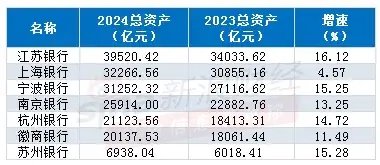
Core Insights - The Yangtze River Delta urban agglomeration is a crucial intersection of the "Belt and Road" initiative and the Yangtze River Economic Belt, comprising Shanghai, Jiangsu, Zhejiang, and Anhui provinces, with seven listed city commercial banks [1] - In 2024, the total asset scale of these seven banks reached 17.72 trillion yuan, with Jiangsu Bank, Shanghai Bank, and Ningbo Bank each exceeding 3 trillion yuan [1][3] - All seven banks reported positive growth in revenue and net profit, with asset quality remaining strong, as six banks maintained non-performing loan ratios below 1% [1][18] Asset Scale and Growth - Jiangsu Bank's total assets reached 39,520.42 billion yuan, a 16.12% increase from the previous year [3][5] - Shanghai Bank's total assets were 32,266.56 billion yuan, growing by 4.57% [3][5] - Ningbo Bank's total assets amounted to 31,252.32 billion yuan, with a growth rate of 15.25% [3][5] - Nanjing Bank, Hangzhou Bank, and Huishang Bank surpassed 20 trillion yuan in assets, while Suzhou Bank had the smallest asset scale at nearly 700 billion yuan [1][3] Revenue and Profitability - Jiangsu Bank led in revenue with 808.15 billion yuan, marking an 8.78% increase [10][12] - Ningbo Bank followed with 666.31 billion yuan in revenue, up 8.19% [10][12] - Nanjing Bank achieved a revenue growth rate of 11.32%, the only bank with double-digit growth [10][12] - Net profit for Jiangsu Bank exceeded 300 billion yuan, with a growth of 10.76% [13][12] Asset Quality - The non-performing loan ratio for Jiangsu Bank was 0.89%, while Ningbo and Hangzhou Banks had the lowest at 0.76% [18][19] - Shanghai Bank had the highest non-performing loan ratio at 1.18% [17][18] - The provision coverage ratios for most banks were robust, with Jiangsu, Nanjing, and Ningbo Banks exceeding 300% [20][18] Loan Distribution - Jiangsu Bank's loans in Jiangsu province accounted for 86.13% of its total loans, with significant portions also allocated to the Yangtze River Delta and Guangdong-Hong Kong-Macau Greater Bay Area [7] - Nanjing Bank's loans were primarily distributed in Jiangsu, with 84.92% of its loans in the province [7] - Huishang Bank's loans were predominantly in Anhui, making up 88.87% of its total [8]




银行股热度持续攀升 去年四季度业绩改善“强势出圈”
Zheng Quan Shi Bao· 2025-04-24 22:13
Group 1 - Since April, 9 bank stocks have reached historical highs, indicating a sustained increase in industry interest [1][2] - In Q4 2024, bank performance has significantly improved, with many banks reporting positive results in Q1 of this year [1][5] - The total cash dividends for the banking sector are expected to reach a new high, with 12 bank stocks each exceeding 10 billion yuan in annual dividends [1][7] Group 2 - On April 24, the banking index closed up 1.16%, with major banks like Bank of China, Agricultural Bank of China, and Industrial and Commercial Bank of China hitting record highs [2] - The stock prices of major banks have steadily increased this year, with Shanghai Bank showing a year-to-date increase of 15.52% [2] - The banking sector is favored as a low-valuation, high-dividend defensive asset amid ongoing market fluctuations [3] Group 3 - Over 90% of the 36 bank stocks that have released their 2024 annual reports or performance forecasts reported year-on-year profit growth [5] - Shanghai Pudong Development Bank reported the highest year-on-year profit growth at 23.31%, driven by rapid credit growth and improved asset quality [5] - The total net profit of the disclosed bank stocks in Q4 2024 exceeded 480 billion yuan, marking a 5.66% increase from the previous year [5] Group 4 - Five bank stocks have released Q1 2025 performance reports, with several banks reporting year-on-year profit growth [6] - Major banks have indicated ongoing improvements in their asset-liability structures and operational efficiency [6] Group 5 - As of April 24, 29 bank stocks have announced dividend plans, with a total cash dividend amounting to 357.84 billion yuan [7] - The cumulative cash dividends for the banking sector in 2024 have reached 616.13 billion yuan, surpassing the previous year's total [8] - Industrial and Commercial Bank of China announced a cash dividend of 1.646 yuan per 10 shares, totaling 58.66 billion yuan, marking a continuous growth for nine years [8]



“大象股”也疯狂!这个板块密集新高
Zheng Quan Shi Bao Wang· 2025-04-24 11:03
Group 1 - The banking sector has seen 9 stocks reach historical highs this month, including major state-owned banks like ICBC, ABC, and CCB, with significant year-to-date gains [2][4] - The banking sector index rose by 1.16% on April 24, outperforming the market, with notable increases in stock prices for major banks [2][3] - The overall performance of the banking sector improved significantly in Q4 of the previous year, with 33 out of 36 banks reporting year-on-year profit growth [4][5] Group 2 - The total cash dividends announced by banks for 2024 have reached a record high of 6,161.26 billion yuan, surpassing the previous year's total [6][7] - Major banks like ICBC, CCB, and ABC have declared dividends exceeding 500 billion yuan, contributing to the sector's reputation for high dividends [6][7] - Ningbo Bank reported the highest year-on-year increase in dividends at 50%, indicating a strong commitment to shareholder returns [7]

数次授信数据资产融资的宁波银行,2024年报入表数据资源600万元
2 1 Shi Ji Jing Ji Bao Dao· 2025-04-24 05:22
Core Insights - Ningbo Bank has reported a data resource entry amount of 6 million yuan in its 2024 annual report, marking it as the second bank in China to implement data asset accounting after CITIC Bank [1][2] - The bank achieved an operating income of 66.631 billion yuan in 2024, a year-on-year increase of 8.19%, and a net profit attributable to shareholders of 27.127 billion yuan, up 6.23% year-on-year [1] - By the end of 2024, Ningbo Bank's total assets reached 31.252 trillion yuan, a growth of 15.25% compared to the previous year, officially entering the "30 trillion club" [1] Financial Performance - The total loans and advances amounted to 14.76063 trillion yuan, reflecting a year-on-year growth of 17.83%, while total deposits reached 18.36345 trillion yuan, up 17.24% year-on-year [1] - The non-performing loan ratio stood at 0.76%, indicating a stable performance in asset quality [1] Interest Margins - The net interest margin for 2024 was 1.86%, a decrease of 2 basis points year-on-year, while the net profit margin was 1.91%, down 10 basis points year-on-year [2] - The decline in net interest margin was attributed to effective credit demand shortages, falling market interest rates, and adjustments in existing mortgage rates [2] Digital Transformation - The annual report emphasized the importance of digitalization, mentioning upgrades to systems like Kunpeng Treasury and Financial Management solutions, which aim to enhance operational efficiency and customer service [2] - In July 2023, Ningbo Bank launched its fintech brand "Ningxing Cloud," offering various financial services including fund management and foreign exchange [2] Data Asset Financing - Despite limited details on data resources in the annual report, Ningbo Bank has engaged in data asset financing, indicating a deeper involvement in data elements than presented [3] - In October 2023, a company in Deqing County secured a 10 million yuan loan from Ningbo Bank by pledging its autonomous driving simulation data as collateral [3]
上市城商行2024业绩盘点!郑州银行营收同比降超5%,北京银行净利排名被宁波银行超越
Xin Lang Cai Jing· 2025-04-24 00:40
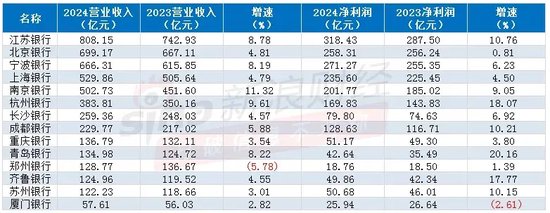
Core Insights - In 2024, 14 out of 17 A-share listed city commercial banks have reported their financial results, with 13 showing positive revenue growth, while only Zhengzhou Bank experienced a decline [1][2][4] - Beijing Bank fell to third place in net profit rankings, overtaken by Ningbo Bank, with a slight increase of 0.81% year-on-year [1][5][6] - Asset quality improved for 10 banks, with a decrease in non-performing loan (NPL) ratios, while Zhengzhou Bank had the highest NPL ratio at 1.79% [1][7][10] Revenue Performance - Jiangsu Bank led with a revenue of 808.15 billion yuan, followed by Beijing Bank and Ningbo Bank, both exceeding 600 billion yuan [3][4] - Zhengzhou Bank reported a revenue decline of 5.78%, dropping to the 11th position among the banks [2][4] - Nanjing Bank showed strong performance with a revenue increase of 11.32%, reaching 502.73 billion yuan [4] Net Profit Analysis - The top three banks in net profit were Jiangsu Bank (318.43 billion yuan), Ningbo Bank (271.27 billion yuan), and Beijing Bank (258.31 billion yuan) [5][6] - Beijing Bank's net profit growth was the lowest in four years, while Qingdao Bank, Hangzhou Bank, and Qilu Bank reported significant growth rates exceeding 17% [6] Asset Quality Metrics - Ten banks reported a decrease in NPL ratios, with Zhengzhou Bank having the highest at 1.79% [8][10] - The provision coverage ratios for all banks were above the regulatory minimum of 150%, with Hangzhou Bank leading at 541.45% [11][12] Asset Growth - Total assets for the 14 banks showed positive growth, with Jiangsu Bank, Suzhou Bank, and Ningbo Bank exceeding 15% growth [13][15] - Beijing Bank maintained the largest asset size at over 4.2 trillion yuan, while Xiamen Bank had the smallest at 407.83 billion yuan [15][16] Strategic Insights - Banks are focusing on regional advantages and optimizing their business strategies to enhance competitiveness [16][17] - Nanjing Bank aims for high-quality development and value creation, while Hangzhou Bank emphasizes regional marketing strategies [17]