IFLYTEK(002230)

Search documents
造机器人:一场“谁都能干”的“全民运动”?
经济观察报· 2025-08-23 10:47
Core Viewpoint - The threshold for entering the robotics industry has significantly lowered, leading to a surge of diverse companies from various sectors attempting to manufacture robots, raising questions about the sustainability and viability of this trend [4][5][6]. Group 1: Industry Trends - The nature of "building robots" is changing, evolving from a complex task to a more accessible one, where assembling a robot is becoming a reality rather than a joke [3][6]. - The number of humanoid robot-related companies in China reached 834 by late July 2025, with over half having registered capital exceeding 10 million [6][11]. - The growth in registrations of humanoid robot companies surged by over 180% in the first half of 2025 compared to the previous year [6]. Group 2: New Players and Cross-Industry Involvement - Companies from various backgrounds, including traditional manufacturing and investment sectors, are entering the robotics field, such as Vision Technology and Jiuding Investment [4][5][13]. - Midea Group, leveraging its ownership of KUKA, is developing humanoid robots for home and factory applications, showcasing a strategic approach to robotics [15]. - Automotive companies like GAC Group are also entering the robotics space, emphasizing the technological synergies between automotive and robotics [15]. Group 3: Technological Advancements - The availability of standardized components for robots, such as sensors and actuators, has made it easier for companies to assemble robots [6][11]. - Domestic suppliers are beginning to break the monopoly of foreign brands in critical components like harmonic reducers and planetary roller screws [8][9]. - The development of specialized components, such as the BrainCo bionic hand and advanced laser radar from Hesai Technology, indicates significant progress in the robotics supply chain [7][8]. Group 4: Market Dynamics and Challenges - The influx of capital into the robotics sector has led to a competitive environment, with many companies seeking to establish themselves amid rising expectations [6][19]. - Despite the enthusiasm, the integration of various components and ensuring system stability remains a significant challenge for the industry [19][20]. - The industry is still in its early commercial stages, with many companies relying on external funding rather than self-sustaining business models [21]. Group 5: Future Outlook - The future of the robotics industry may lead to a diverse ecosystem where specialized companies coexist, focusing on niche applications while core component suppliers support the overall market [21]. - The successful companies will likely be those that can identify real-world applications and maintain resilience in a capital-intensive environment [21].




上半年营收破百亿、亏损收窄 科大讯飞正从G到C突围
Zhong Guo Jing Ying Bao· 2025-08-23 09:53
Core Viewpoint - The financial performance of iFlytek in the first half of 2025 shows revenue growth and improved loss margins, indicating a strategic shift towards consumer (C-end) business amidst challenges in government (G-end) sectors [1][2][3]. Financial Performance - iFlytek achieved a revenue of 10.911 billion yuan in the first half of 2025, a year-on-year increase of 17.01% [1][2]. - The net loss attributable to shareholders was 239 million yuan, but this represented a 40.37% improvement year-on-year [1]. - The cash flow from operating activities showed a net outflow of 772 million yuan, which improved by 49.73% compared to the previous year [1]. Business Segmentation - The revenue structure of iFlytek's GBC (Government, Business, Consumer) segment is evolving, with C-end business revenue growing by 38%, accounting for 32% of total revenue [1][2]. - The B-end and G-end businesses also showed improvements, with significant growth in sectors like education and healthcare [3]. Strategic Adjustments - iFlytek is shifting focus from G-end to C-end business due to challenges in G-end sectors, with a more cautious approach to digital government projects [2][3]. - The company has increased its marketing and R&D expenditures, with sales expenses rising by 28.28% to 2.086 billion yuan and R&D investment growing by 9.2% to 2.392 billion yuan, representing 21.92% of revenue [4]. Product and Market Development - The AI learning machine's revenue doubled year-on-year, highlighting the success of C-end products [3]. - iFlytek's overseas revenue reached 179 million yuan, a significant increase of 212.08% year-on-year, indicating strong international market growth [5]. Future Outlook - The company anticipates three major benefits from AI commercialization: accelerated industry penetration, increased AI hardware innovation, and enhanced international expansion capabilities [6].

科大讯飞上半年营收首破百亿 AI出海或成为增长新引擎
Sou Hu Cai Jing· 2025-08-23 03:03
Core Insights - The company reported a revenue of 10.911 billion yuan for the first half of 2025, marking a year-on-year increase of 17.01% [1] - The net profit attributable to the parent company was a loss of 239 million yuan, which represents a 40.37% reduction in losses compared to the previous year [1] - The company has achieved significant growth in its AI applications across education and healthcare sectors, with revenue growth of 23% and 21% respectively in these areas [3] Financial Performance - Revenue for the first half of 2025 reached 10.911 billion yuan, surpassing the 10 billion yuan mark for the first time [1] - Sales collections also exceeded 10 billion yuan, totaling 10.361 billion yuan, with a year-on-year increase of 13.50 million yuan [1] - Operating cash flow increased by over 764 million yuan, reflecting a 49.73% year-on-year improvement [1] AI Application and Development - In the education sector, the learning machine business saw a doubling in growth, contributing to a 25% increase in gross profit [3] - The healthcare sector's AI application, "Smart Medical Assistant," has expanded to 697 counties and over 75,000 grassroots medical institutions, providing over 1.01 billion AI-assisted diagnosis suggestions [3] - The company has developed a robust AI ecosystem with 813 AI capabilities available on its open platform, attracting over 8.7 million AI developers [3] Strategic Initiatives - The company is committed to developing its AI capabilities on a domestically controlled computing infrastructure, focusing on the research and training of large models [3][4] - The exploration of AI overseas has resulted in a more than threefold increase in overseas AI hardware sales [3] - The company has established a commercial framework for AI applications, open platforms, and consumer products, driving a "model algorithm—product value—business growth" effect [4]
科大讯飞2025年中报简析:营收上升亏损收窄,盈利能力上升
Zheng Quan Zhi Xing· 2025-08-22 23:19
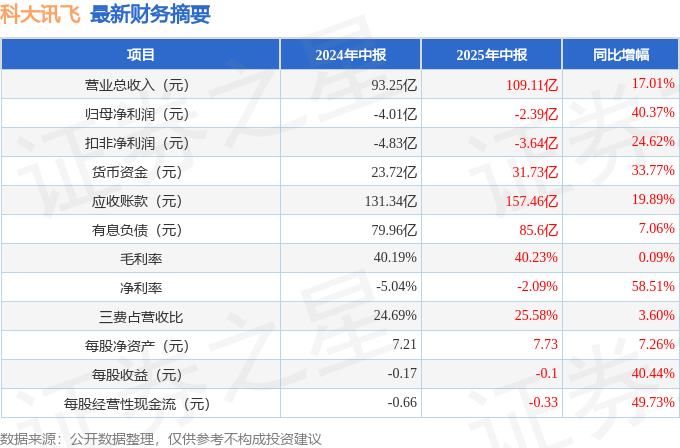
Core Viewpoint - The recent financial report of Keda Xunfei (002230) shows a significant increase in revenue and a notable improvement in profitability metrics, despite still reporting a net loss [1] Financial Performance - Total revenue for the first half of 2025 reached 10.911 billion yuan, a year-on-year increase of 17.01% [1] - The net profit attributable to shareholders was -239 million yuan, showing a year-on-year improvement of 40.37% [1] - In Q2 2025, total revenue was 6.253 billion yuan, up 10.12% year-on-year, while the net profit attributable to shareholders was -45.68 million yuan, an increase of 54.41% year-on-year [1] - Gross margin improved slightly to 40.23%, with a year-on-year increase of 0.09%, while net margin improved significantly to -2.09%, reflecting a 58.51% year-on-year increase [1] Cost and Expenses - Total selling, administrative, and financial expenses amounted to 2.791 billion yuan, accounting for 25.58% of revenue, which is a 3.6% increase year-on-year [1] - The company reported a significant increase in cash flow from operating activities, with a net cash flow change of 49.73% due to increased sales collections [1] Investment and Market Position - The company has a low historical return on invested capital (ROIC) of 2.55% for the previous year, with a median ROIC of 6.24% over the past decade, indicating weak capital returns [2] - The company relies heavily on research and marketing for its performance, necessitating a deeper analysis of these drivers [2] Fund Holdings - The largest fund holding Keda Xunfei is the Huaxia CSI Robot ETF, which has increased its holdings, reflecting growing interest in the company [3] - The fund has a total scale of 14.471 billion yuan and has seen a significant increase in net value over the past year [3]
上半年营收破百亿元后还要定增募资40亿元,科大讯飞这场业绩会透露了哪些信号?
Mei Ri Jing Ji Xin Wen· 2025-08-22 15:37
Core Viewpoint - The company reported a significant increase in revenue and a narrowing of losses in the first half of the year, while also announcing a capital increase plan to enhance its technological capabilities in the education sector [1][2]. Financial Performance - The company achieved a revenue of 10.911 billion yuan in the first half of the year, marking a year-on-year growth of 17.01%, with the first-time revenue surpassing 10 billion yuan [1]. - Gross profit reached 4.389 billion yuan, up 17.12% year-on-year, while the net profit attributable to shareholders was a loss of 239 million yuan, which is a reduction in losses compared to the previous year [1]. - The net cash flow from operating activities was -772 million yuan [1]. Capital Increase Plan - The company plans to issue up to 100 million shares, accounting for 4.33% of the total share capital before the issuance, aiming to raise 4 billion yuan, with 800 million yuan allocated for the Spark Education model and 3.2 billion yuan for working capital [1][6]. - The controlling shareholder, Anhui Yanzhi Technology Co., Ltd., intends to subscribe for shares worth between 250 million yuan and 350 million yuan [6]. Business Segmentation - The revenue structure for the company in the reporting period was 26% from government, 42% from enterprises, and 32% from consumers, with the consumer segment showing the fastest growth at 38% [2]. - AI learning machine products in the consumer segment saw a revenue increase of 100% year-on-year [2]. - Major revenue contributors included the open platform and consumer business (36%) and smart education (32.36%) [2]. Research and Development - R&D expenses amounted to 2.392 billion yuan, representing 21.92% of revenue, with an increase of 91.7% in spending related to the core technology of the Spark model [2]. - Sales expenses also rose significantly, reaching 2.086 billion yuan, a year-on-year increase of 28.28% [2]. Cash Collection - The company achieved sales collections of 10.361 billion yuan, a year-on-year increase of 14.99%, marking the first time collections exceeded 10 billion yuan [3]. - The company has prioritized improving collection mechanisms to enhance cash flow [3].
调研速递|科大讯飞接受[X]家机构调研,上半年业绩与技术亮点纷呈
Xin Lang Cai Jing· 2025-08-22 15:00
Financial Performance - In the first half of 2025, the company's operating revenue reached 10.911 billion yuan, a 17.01% increase from 9.325 billion yuan in the same period last year [1] - Gross profit was 4.389 billion yuan, reflecting a year-on-year growth of 17.12% [1] - The net profit attributable to shareholders was -239 million yuan, an improvement of 40.37% compared to -401 million yuan in the previous year [1] - The net profit after deducting non-recurring gains and losses was -364 million yuan, showing a year-on-year increase of 24.62% [1] - The net cash flow from operating activities was -772 million yuan, narrowing by 49.73% from -1.536 billion yuan in the same period last year [1] Sales and Collection - The company achieved sales collections of 10.361 billion yuan in the first half of 2025, a year-on-year increase of 14.99%, marking the first time collections exceeded 10 billion yuan in a half-year period [1] - The collection rate has improved for three consecutive years, rising from 93.75% in 2022 to 97.20% in 2024 [1] Business Structure and R&D Investment - The revenue structure of the GBC segment continues to optimize, with C-end business revenue becoming the main growth driver. G-end accounts for 26%, C-end for 32%, and B-end for 42% [1] - R&D investment in the first half of 2025 grew by 9.2%, accounting for 21.92% of revenue, maintaining stable investment intensity [1] - R&D expenses increased by 610 million yuan, focusing on three main areas: core technology related to the Spark large model, industry application product development and market promotion, and C-end hardware product channel marketing [1] Technological Advancements - The company has achieved a breakthrough in deep reasoning models, being the only one to train a large model based on domestic computing power, with the 70B parameter Spark-X1-0420 model surpassing several international benchmarks [2] - The model supports over 130 languages, providing a fully autonomous and controllable large model base as an alternative for the global market [2] Industry Applications - In the education sector, the Spark X1 has been implemented in over 270 regions, with more than 200,000 teachers participating in teaching practices, achieving an 88.4% activity rate [2] - In the healthcare sector, the medical large model has shown superior performance in tasks such as general consultation and report interpretation, with a 52% year-on-year revenue growth in grassroots consultation [2] - The company collaborates with leading financial institutions and state-owned enterprises to develop large models for various industries [2] C-end Product Performance - Revenue from learning machines increased by 104% year-on-year, with a strong presence in high-end shopping malls and rapid expansion into lower-tier markets [3] - Other products, including translation machines and recording pens, continue to see iterative improvements, with significant user engagement in applications like the iFlytek input method [3]
科大讯飞(002230) - 2025年8月22日投资者关系活动(业绩说明会)PPT
2025-08-22 14:14
Financial Performance - The total revenue for the first half of 2025 was 10.911 billion CNY, representing a 17.01% increase compared to 9.325 billion CNY in the same period of 2024 [4] - Gross profit increased by 17.12% to 4.389 billion CNY from 3.748 billion CNY [4] - Net profit attributable to shareholders improved to -0.239 billion CNY from -0.401 billion CNY, a 40.37% reduction in losses [4] - Cash flow from operating activities showed significant improvement, narrowing to -0.772 billion CNY from -1.536 billion CNY, a 49.73% increase [4] Revenue Structure - The revenue structure has been optimized, with C-end business revenue becoming the main growth driver [5] - Revenue contributions by segment: G-end (26%), B-end (42%), C-end (32%) [6] Cash Collection and Management - Sales collections reached 10.361 billion CNY, a year-on-year increase of 14.99%, marking the first time collections exceeded 100 billion CNY in a half-year [9] - The company has prioritized collection efforts, achieving a collection rate improvement from 93.75% in 2022 to a projected 97.20% in 2024 [9] Research and Development - R&D investment grew by 9.2% to 21.92% of revenue, maintaining stable investment intensity [13] - Key areas of R&D focus include: 1. Core technology for the Spark model with an increase of 82 million CNY [16] 2. Industry application product development and market promotion with an increase of 180 million CNY [16] 3. C-end hardware marketing expenses increased by 340 million CNY [16] Model Performance - The Spark model achieved competitive performance in various assessments, including: - Scoring 53 out of 60 in a high school essay evaluation, ranking first among six models [22] - Scoring 19.5 out of 20 in an English essay evaluation, also ranking first [26] - Achieving a total score of 141 in a math assessment, ranking second [27] Market Position and Expansion - The Spark model has been recognized as a leader in the education and medical sectors, with significant advancements in AI applications [47] - The company has established a strong presence in the AI hardware market, with a 104% year-on-year revenue growth in learning machines [96] - The overseas revenue reached 57.21 million CNY in the first half of 2025, a 212% increase compared to the same period in 2024 [118] Strategic Partnerships and Collaborations - Collaborations with various government and educational institutions to promote AI in education and healthcare [41] - The company has signed strategic agreements to enhance AI capabilities and applications across multiple sectors [41]
科大讯飞上半年营收首次破百亿:国产AI渐入收获期
2 1 Shi Ji Jing Ji Bao Dao· 2025-08-22 13:45
Core Viewpoint - The company achieved its first-ever revenue exceeding 10 billion yuan in the first half of the year, indicating significant improvement in its operational fundamentals compared to previous years [1] Financial Performance - The company's revenue for the first half of 2025 reached 10.911 billion yuan, a year-on-year increase of 17.01% [1] - Sales receipts also surpassed 10 billion yuan, totaling 10.361 billion yuan, with a year-on-year increase of 1.35 billion yuan [1] - The net profit attributable to shareholders was -239 million yuan, a reduction in losses by 40.37% compared to the same period last year [1] - The net cash flow from operating activities improved by 49.73%, increasing by over 764 million yuan [1] Business Segments - The C-end business grew by 38%, becoming the core driver of growth, with the learning machine segment showing outstanding performance, doubling its revenue and maintaining the top position in both sales and volume in the high-end learning machine market [1][2] - The To B and To G businesses also showed improvement, with revenue growth in the education and medical sectors of 23% and 21% respectively [3] - The education sector's AI model has served over 200 regions and 200,000 teachers, creating a feedback loop of "algorithm-data-application" [3] - In the medical sector, the AI assistant has expanded to over 69,700 grassroots medical institutions, providing 1.01 billion AI-assisted diagnosis suggestions [3] Collection and Payment Performance - The collection rate for To G business continues to improve, with a 91% increase in contract amounts in first-tier regions and a 30% growth in third-tier reserves [2][3] - The accounts receivable collection rate from the government sector improved from 93% in 2022 to 98.14% in 2024, with controllable bad debt risks [3] Research and Development - The company maintained a high level of R&D investment, totaling 2.39 billion yuan in the first half of the year, a year-on-year increase of 9.2%, accounting for 21.92% of revenue [3] Industry Trends - The company's half-year report reflects two major trends in the domestic AI industry: the commercialization of C-end hardware and the collaborative development of domestic computing power and large models [4] - The large models trained on domestic computing power have achieved lower hallucination rates in serious applications such as education and healthcare, laying the foundation for future large-scale applications [4]
人工智能半年激荡:抬头看月亮的厂商被困在“最后一公里”丨新经济·半年报
Sou Hu Cai Jing· 2025-08-22 13:17
Group 1 - Major internet companies are focusing on AI development while others engage in cash subsidies for delivery services [2][4] - Leading companies like BAT are investing heavily in AI, with Baidu reporting a 35% increase in net profit driven by AI [4][5] - Tencent's advertising revenue grew by 20% due to AI deployment, marking its 11th consecutive quarter of double-digit growth [5][6] Group 2 - Alibaba plans to invest 380 billion yuan in AI and cloud infrastructure over three years, with a significant portion of its revenue driven by AI-related products [6][9] - The AI industry in China is projected to exceed 700 billion yuan in 2024, maintaining a growth rate of over 20% [11][12] - The number of AI-related companies in China has surpassed 4.24 million, with a notable increase in registrations over the past five years [12][17] Group 3 - AI applications are expanding across various sectors, with significant advancements in generative AI products [11][20] - Despite high adoption rates, the conversion of AI technology into tangible business results remains a challenge, with many companies not seeing returns on their investments [18][19] - The industry faces a paradox where high adoption does not equate to effective transformation, particularly in sectors with lower information density [19][20] Group 4 - Experts suggest that AI represents a new production variable and may be the last major technological revolution [22][23] - The future of AI development is expected to require sustained investment and may lead to a more complex competitive landscape [23][24] - Successful integration of AI into traditional industries is essential for enhancing productivity and efficiency [24]




华为「押注」安徽
AI研究所· 2025-08-22 10:33
Core Viewpoint - Huawei's establishment of its East China regional headquarters in Hefei is a strategic move to integrate with local industries and enhance its presence in the rapidly growing technology and automotive sectors in Anhui province [2][5][6]. Group 1: Huawei's Strategic Positioning in Anhui - The East China regional headquarters in Hefei represents Huawei's commitment to its home province, as the company's executive, Yu Chengdong, hails from Anhui [8][9]. - The headquarters will serve as a hub for research and development, manufacturing, and support services, allowing for centralized operations and quicker responses to local market demands [17][18]. - The location in Hefei leverages the city's advantages in the Yangtze River Delta and its emerging status as a leader in the new energy vehicle industry [12][13][20]. Group 2: Impact on Local Industry and Innovation - Huawei's presence is expected to accelerate industrial development in Anhui, attracting a multitude of suppliers and partners to the region [21]. - The collaboration between Huawei and local research institutions, such as the University of Science and Technology of China, is anticipated to enhance innovation in fields like artificial intelligence and 5G applications [22][35][36]. - The establishment of the headquarters is seen as a catalyst for the growth of a comprehensive industrial ecosystem, particularly in the smart automotive sector, with partnerships already in place with local car manufacturers [25][29]. Group 3: Expanding Partnerships and Ecosystem - Huawei's collaborations with local automotive companies, such as Chery and JAC Motors, highlight its deep integration into the regional automotive supply chain [25][30]. - The partnership with iFlytek has evolved into a comprehensive collaboration, focusing on developing domestic computing power platforms [30][33]. - Huawei's long-standing relationship with local universities has fostered numerous research projects, enhancing the technological capabilities of both the company and the region [36][37].