IFLYTEK(002230)

Search documents
科大讯飞发布星火X1.5,率先在全国产算力平台攻克MoE模型全链路训练效率
Zheng Quan Shi Bao Wang· 2025-11-06 03:06
Core Insights - The company Keda Xunfei (002230) has launched the Xunfei Spark X1.5 deep reasoning model based on domestic computing power, achieving over 93% efficiency compared to international competitors in end-to-end performance [1] - The model's capabilities in language understanding, text generation, knowledge Q&A, logical reasoning, mathematical skills, and coding abilities are on par with mainstream international large models [1] - The multilingual capabilities of the Spark model have been upgraded to support over 130 languages, with overall performance exceeding 95% of GPT-5 [1]

讯飞星火行业分析师通过工信部认证
Bei Jing Shang Bao· 2025-11-06 03:06
Core Insights - The launch of "Xinghuo Industry Analyst," the first AI intelligent entity certified by the Ministry of Industry and Information Technology, marks a significant advancement in AI applications in various industries [1] - The AI achieved a high score of 92 in the "Big Data Analyst Technical Level Examination," surpassing over 85% of human candidates [1] - The intelligent entity is currently operational in key sectors such as energy, electricity, finance, and mining, providing professional support for risk insight, situational awareness, and decision-making assistance [1]
科大讯飞发布星火X1.5
3 6 Ke· 2025-11-06 03:00
Core Insights - On November 6, iFlytek launched the Xunfei Spark X1.5 deep reasoning model based on fully domestic computing power, achieving over 93% efficiency compared to international competitors in end-to-end performance [1] - The model excels in language understanding, text generation, knowledge Q&A, logical reasoning, mathematical capabilities, and coding skills, aligning with mainstream international large models [1] - The multilingual capabilities of the Spark model have been continuously upgraded, now supporting over 130 languages and achieving 95% overall performance compared to GPT-5 [1]
科大讯飞:“星火行业分析师”通过工信部认证,已在多家央国企上岗
Xin Lang Ke Ji· 2025-11-06 02:57
Core Insights - The launch of the AI analyst "Xinghuo Industry Analyst" by iFlytek at the 8th World Voice Expo demonstrates significant advancements in AI capabilities, achieving a score of 92 in the Ministry of Industry and Information Technology's examination, surpassing 85% of human candidates [1] Group 1: AI Development and Applications - The AI analyst is currently deployed in key sectors such as energy, electricity, finance, and mining, providing professional support for risk insight, situational awareness, and decision-making assistance [1] - The AI Developer Competition held concurrently attracted 36,898 teams from 17 countries and 325 cities, showcasing 4,622 specialized AI applications, indicating a trend towards lower barriers to AI development [1] Group 2: Industry Trends - Nearly half of the participating teams in the AI Developer Competition lacked technical backgrounds, reflecting the trend that "everyone is a developer" in the AI space [1]
主力个股资金流出前20:吉视传媒流出6.87亿元、赛力斯流出6.20亿元





Jin Rong Jie· 2025-11-06 02:38
Core Insights - The main focus of the article is on the significant outflow of capital from specific stocks as of November 6, with notable amounts being withdrawn from various companies [1] Group 1: Major Stocks with Capital Outflow - The top stock with the highest capital outflow is Jishi Media, with a withdrawal of 687 million yuan [1] - Following Jishi Media, Sairisi experienced an outflow of 620 million yuan [1] - Xue Ren Group saw a capital outflow of 607 million yuan, ranking third in the list [1] Group 2: Additional Stocks with Significant Outflows - Tebian Electric experienced a capital outflow of 565 million yuan [1] - Haima Automobile had an outflow of 554 million yuan [1] - Pingtan Development saw a withdrawal of 367 million yuan [1] Group 3: Other Notable Stocks - Longi Green Energy experienced a capital outflow of 309 million yuan [1] - Shanzigaoke had an outflow of 295 million yuan [1] - Fulongma saw a withdrawal of 270 million yuan [1] Group 4: Remaining Stocks in the Top 20 - Xagong Co. experienced a capital outflow of 261 million yuan [1] - Leo Group had an outflow of 258 million yuan [1] - China Duty Free Group saw a withdrawal of 256 million yuan [1] - Hainan Development experienced an outflow of 253 million yuan [1] - Sanbian Technology had a capital outflow of 252 million yuan [1] - BlueFocus Communication Group saw a withdrawal of 250 million yuan [1] - Dawi Co. experienced an outflow of 229 million yuan [1] - Industrial Fulian had a capital outflow of 217 million yuan [1] - Runhe Software saw a withdrawal of 215 million yuan [1] - Wentai Technology experienced an outflow of 210 million yuan [1] - ST Huatuo had a capital outflow of 206 million yuan [1]
中国人工智能团队加速壮大更趋多元
Xin Hua She· 2025-11-06 02:35
Core Insights - The article highlights the rapid growth and diversification of China's artificial intelligence (AI) developer community, emphasizing the emergence of innovative applications and products in various sectors [3][4]. Group 1: AI Industry Growth - The AI industry in China is projected to exceed 900 billion yuan by 2024, reflecting a year-on-year growth of 24% [3]. - The number of developer teams on the iFlytek Open Platform has been increasing by approximately 2 million annually, with over 960,000 developers currently engaged [4]. Group 2: Developer Community Characteristics - The developer community is transitioning from a concentrated group of elite professionals to a more diverse and widespread demographic, including a significant increase in female participation and non-programmers [4]. - The age distribution of developers shows that those aged 28 to 32 constitute 28% of the community, indicating a blend of experience and innovation [4]. Group 3: Educational and Social Impact - Over 40 universities in Anhui have established more than 500 AI-related programs, while initiatives in other regions aim to enhance AI education and resources [8]. - AI technologies are being utilized to assist marginalized groups, such as visually impaired individuals, by providing tools that enhance their interaction with technology and improve their quality of life [8].

计算机行业资金流出榜:润和软件、科大讯飞等净流出资金居前
Zheng Quan Shi Bao Wang· 2025-11-05 09:02
Market Overview - The Shanghai Composite Index rose by 0.23% on November 5, with 20 industries experiencing gains, led by the power equipment and coal sectors, which increased by 3.40% and 1.39% respectively [1] - The computer and non-bank financial sectors saw the largest declines, with decreases of 0.97% and 0.49% respectively, placing the computer industry at the top of the decline list [1] Capital Flow Analysis - The main capital outflow from the two markets totaled 8.638 billion yuan, with 11 industries experiencing net inflows [1] - The power equipment industry had the highest net inflow of 14.608 billion yuan, while the coal industry followed with a net inflow of 1.092 billion yuan [1] - The computer industry faced the largest net outflow, totaling 6.363 billion yuan, followed by the electronics sector with a net outflow of 4.616 billion yuan [1] Computer Industry Performance - The computer industry declined by 0.97%, with a total of 335 stocks in the sector; 93 stocks rose, including one that hit the daily limit, while 232 stocks fell [2] - Among the stocks with net inflows, 96 stocks saw capital inflows, with eight stocks receiving over 30 million yuan; the top inflow was for Inspur Software, which received 285 million yuan [2] - The stocks with the largest net outflows included Runhe Software, iFlytek, and Haixia Innovation, with outflows of 391 million yuan, 339 million yuan, and 307 million yuan respectively [2][3] Capital Inflow and Outflow Rankings - The top stocks in the computer industry by capital inflow included: - Inspur Software: +10.01%, 285.02 million yuan - Chunz中科技: +9.72%, 121.95 million yuan - Zhongdian Xindong: +2.53%, 76.40 million yuan [2] - The top stocks by capital outflow included: - Runhe Software: -3.31%, -391.15 million yuan - iFlytek: -2.44%, -339.41 million yuan - Haixia Innovation: -5.17%, -307.10 million yuan [3]


马斯克“万亿薪酬”要黄?机器人板块承压!机器人ETF基金(159213)弱势五连阴,再获资金逆势加仓!机构坚定看好人形机器人产业趋势!
Sou Hu Cai Jing· 2025-11-05 08:57
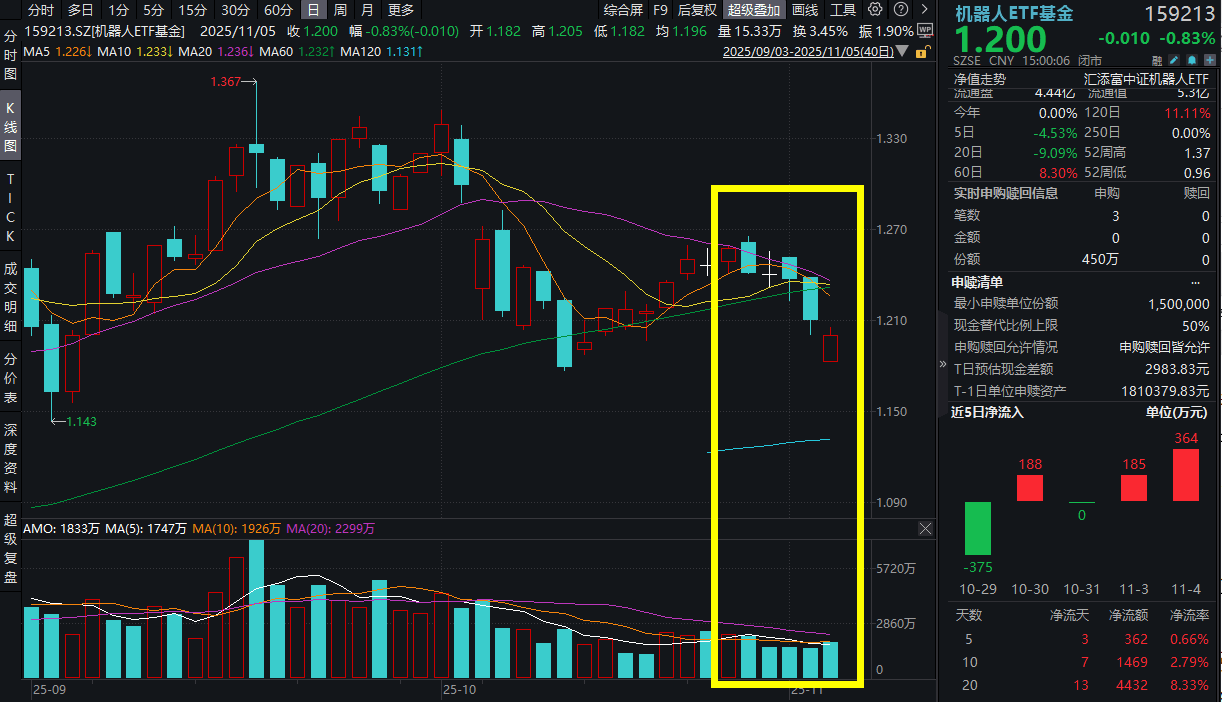
Group 1 - The robotics sector remains under pressure, with the Robotics ETF (159213) experiencing a slight decline of 0.83%, marking five consecutive days of weakness, although it showed signs of recovery today with a low-open high-close candlestick pattern [1] - The Robotics ETF (159213) saw a net inflow of 5.4 million yuan, indicating a strong buying trend as funds continue to flow into the ETF despite market declines [1] - The China Securities Robotics Index (H30590) fell by 0.62%, with mixed performance among constituent stocks, including notable gains from Guomao Co. (+4.66%) and Tianzhun Technology (+3.65%) [3][4] Group 2 - The robotics industry is experiencing significant growth, with revenue projected to increase from 106.1 billion yuan in 2020 to 237.89 billion yuan by 2024, effectively doubling in size [6] - In the first three quarters of this year, the industry revenue grew by 29.5%, with industrial robot production reaching 595,000 units and service robot production hitting 13.5 million units, both exceeding the total production targets for 2024 [6] - The 2025 China Robotics Industry Development Conference is scheduled to take place from November 10 to 12 in Shanghai, organized by the China Machinery Industry Federation [6] Group 3 - Recent developments include Leju Intelligent's registration for IPO guidance in Shenzhen, marking it as the second humanoid robot company to pursue listing on the A-share market [7] - Gigastar Legend announced a sales contract with Adata Technology for 1,000 quadruped robots, valued at over 20 million yuan, with Utree Technology responsible for the product's technology and production [7] - Utree Technology has established a significant barrier in the quadruped robot sector through self-developed hardware and software, achieving over 70% localization of core components [8] Group 4 - The humanoid robot industry is on the verge of a breakthrough, with Tesla's Gen3 model and potential mass production expected to support market optimism [9] - The industry is anticipated to enter a phase of validation and consolidation, with a focus on key players that have clear advantages in the supply chain [9] - Global tech giants are increasingly investing in humanoid robotics, indicating that the industry is approaching a critical mass for production [9]





讯飞AI“工作搭子”进化成团,明日工作方式今日已至
Xin Lang Cai Jing· 2025-11-05 02:18
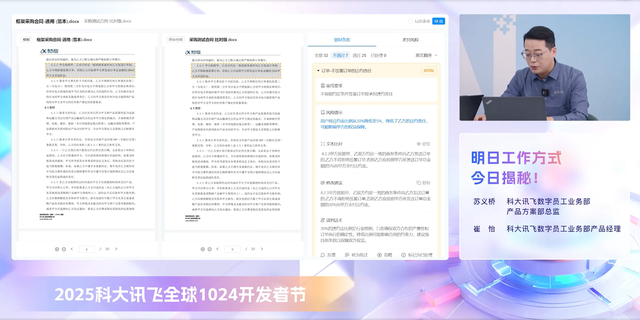
Core Insights - The article highlights the transformative impact of AI technology on enterprise operations, showcasing the integration of AI in various business functions through the "AI Digital Employee Team" presented at the iFLYTEK 1024 Developer Festival [1][9] - AI is shifting from being a tool to becoming an interactive and decision-making entity, enhancing efficiency and risk management in business processes [5][9] AI in Risk Management - AI's role in legal compliance is emphasized, with capabilities to conduct contract reviews in seconds, identifying risks such as reduced penalty clauses and potential liability issues [1][3] - The transition from reactive to proactive risk management is noted, allowing businesses to eliminate risks before contract signing [1] Operational Risk Control - The "Operational Risk Officer" demonstrates the ability to detect discrepancies in employee expense reports and automatically filter out unqualified suppliers, showcasing AI's precision in operational oversight [3] Human-AI Collaboration - The introduction of the "Chief Image Officer," a virtual AI entity, signifies a new phase in human-AI collaboration, where AI can engage in real-time interactions and assist in decision-making processes [5] Client Experiences and Efficiency Gains - Client testimonials reveal significant efficiency improvements, such as a commercial management group achieving a 70% increase in processing efficiency by automating the review of 600,000 documents monthly [7] - The focus is on not just cost reduction but a fundamental upgrade in operational models through AI integration [7] Ongoing AI Engagement - The iFLYTEK 1024 Expo is open until November 6, allowing visitors to interact with AI digital employees and experience cutting-edge solutions firsthand [8] Digital Transformation Pathways - The AI digital employee system is seen as a pathway for enterprises to undergo digital transformation, emphasizing human-machine collaboration as a core principle [9] - The system has already been implemented across various industries, including energy, manufacturing, and finance, indicating a growing trend towards AI integration in business operations [9] Future AI Developments - The upcoming iFLYTEK Global 1024 Developer Festival will feature advancements in AI capabilities, including multi-modal interaction technologies and applications across diverse sectors [10]
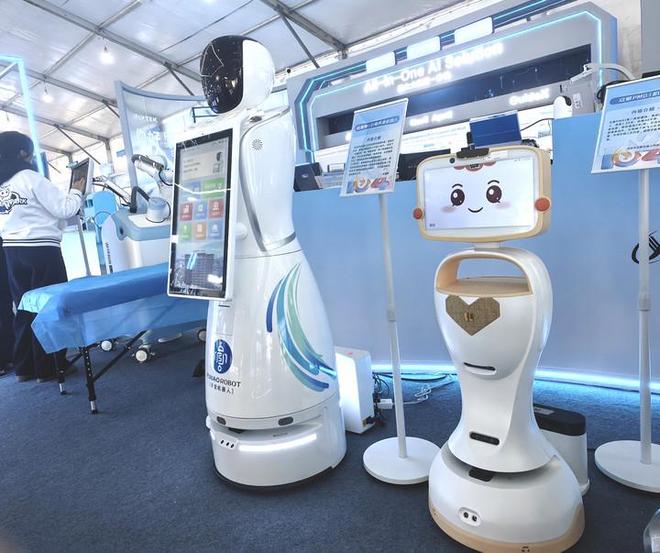
2025年中国智慧考场行业发展历程、产业链、发展现状、重点企业经营情况及未来趋势研判:信息技术飞速发展,智慧考场带来教育新体验[图]
Chan Ye Xin Xi Wang· 2025-11-05 01:28
Core Insights - The smart examination room is transforming traditional examination models towards intelligent, automated, and fair systems, leveraging technologies like AI, big data, and cloud computing to enhance the integrity, security, and efficiency of the examination process [1][11] - The smart examination room market is rapidly growing globally, with significant advancements in Asia, particularly in China, where the market size is projected to increase from 1.668 billion yuan in 2017 to 4.575 billion yuan in 2024, reflecting a compound annual growth rate (CAGR) of 11.86% [1][11] - The increasing number of candidates for national examinations, such as the college entrance examination, is driving the demand for smart examination solutions, which are essential for improving examination governance and maintaining educational fairness [1][9] Industry Overview - The smart examination room utilizes advanced technologies such as image processing, facial recognition, voice analysis, and behavior analysis to create a comprehensive monitoring system that identifies and alerts against cheating behaviors throughout the examination process [4] - The construction of smart examination rooms involves upgrading existing computer examination facilities with intelligent monitoring systems and robots, enhancing the anti-cheating capabilities and service efficiency of the examination system [4] Market Dynamics - The smart examination room industry is characterized by a multi-faceted ecosystem involving traditional educational examination institutions, technology innovation companies, and research institutions, all contributing to the development and implementation of smart examination solutions [11] - Key players in the smart examination room market include companies like Tuowei Information, Jiafa Education, and Keda Xunfei, which provide comprehensive solutions encompassing intelligent monitoring, identity verification, and cheating prevention [12][11] Industry Challenges - The smart examination room industry faces several challenges, including technological bottlenecks in AI applications for monitoring and automated scoring, as well as data security and privacy concerns related to the handling of personal information and examination data [15][16] - High construction and operational costs pose a barrier for smaller examination institutions, necessitating strategies to reduce expenses while maintaining quality and effectiveness [17] Future Trends - The future of the smart examination room industry is expected to see deeper integration of edge computing and IoT technologies, enhancing device interconnectivity and data processing capabilities [20] - There will be a shift towards personalized services in smart examination systems, allowing for tailored examination environments based on individual candidate profiles [21] - The application scenarios for smart examination rooms are anticipated to expand beyond traditional education to include vocational skills certification and corporate talent assessment, with advancements in remote monitoring technologies supporting international examination standards [22]