KING-STRONG(300629)

Search documents
新劲刚:接受中国中金财富证券有限公司等投资者调研
Mei Ri Jing Ji Xin Wen· 2025-10-15 10:30
Group 1 - The company Xinjin announced that it will accept investor research on October 15, 2025, from 9:30 to 11:30, with participation from the board secretary Zhou Yibo and others to answer investor questions [1] - There is a significant opportunity in the silver rental market, with annualized interest rates soaring to 35%, indicating a lucrative investment environment [1] - A large volume of silver is being airlifted to the UK for profit, suggesting a major market event characterized as an epic short squeeze [1]

新劲刚(300629) - 2025年10月15日投资者关系活动记录表
2025-10-15 10:04
Financial Performance - The company's revenue for the first half of 2025 was CNY 162.14 million, a decrease of 41.01% compared to the same period last year [2] - The net profit attributable to shareholders for the same period was CNY 7.60 million, down 90.34% year-on-year [2] - The second quarter of 2025 saw a 145.56% increase in revenue compared to the first quarter, but a 20.03% decrease compared to the same quarter last year [2] Operational Challenges - The decline in revenue was attributed to concentrated demand from downstream customers, leading to challenges in production planning and capacity allocation [2] - Delays from upstream suppliers due to industry order concentration affected material availability, impacting overall delivery progress [2] - The company faced prolonged payment cycles from downstream customers, resulting in a high balance of accounts receivable and increased credit impairment losses [2][4] Strategic Initiatives - The company is actively pursuing a dual-use strategy, transitioning military technology to civilian applications, particularly in the low-altitude economy and satellite internet sectors [3] - Recent projects include the delivery of radar systems for low-altitude monitoring and strategic partnerships for drone countermeasures [5] - The company aims to establish a stable market share in the low-altitude economy, leveraging its technological advantages [5] Accounts Receivable Management - The increase in accounts receivable is attributed to industry fluctuations and extended settlement periods, typical for the sector [4] - The company maintains a good credit quality with major clients, primarily state-owned enterprises and listed companies, minimizing bad debt risks [4] - Ongoing efforts to enhance communication with clients and optimize accounts receivable management are in place to accelerate payment recovery [4] Mergers and Acquisitions Strategy - The company has a clear acquisition strategy focusing on enhancing its capabilities in special application RF microwave solutions through horizontal and vertical mergers [6] - Investment incubation and acquisitions are being pursued to build a leading position in special application thermal barrier and composite materials [6]
新劲刚:目前与深圳市时代速信暂无业务往来
Zheng Quan Ri Bao· 2025-10-14 08:05
Group 1 - The company, New Jingang, currently has no business dealings with Shenzhen Times Speed Trust [2] - In the RF microwave chip sector, various companies leverage their technological characteristics and core advantages to compete in the market, driving industry development [2] - The company will continue to focus on its main business, enhancing lean management and promoting technological innovation to solidify its production and operations [2] Group 2 - The company aims for high-quality development and strives to deliver better operational results to its investors [2]


新劲刚(300629.SZ):目前与深圳市时代速信暂无业务往来
Ge Long Hui· 2025-10-14 07:52
Core Viewpoint - The company, 新劲刚 (300629.SZ), currently has no business dealings with Shenzhen Shidai Suxin, indicating a focus on its own operations and partnerships in the industry [1] Group 1: Company Focus - The company is committed to its main business and aims to enhance operational efficiency through lean management and technological innovation [1] - The company emphasizes the importance of high-quality development and aims to deliver better operational results to its investors [1] Group 2: Industry Context - In the field of RF microwave chips, various companies leverage their technological characteristics and core advantages to compete in the market, contributing to industry development [1]
新劲刚:邹卫峰减持公司股份12万股,本次减持计划期限届满
Mei Ri Jing Ji Xin Wen· 2025-10-09 10:44
Group 1 - The company Xin Jing Gang (SZ 300629) announced on October 9 that shareholder Zou Weifeng reduced his stake by 120,000 shares, representing 0.048% of the total shares outstanding [1] - The reduction plan has now reached its deadline [1] - As of the report, Xin Jing Gang has a market capitalization of 5 billion yuan [1] Group 2 - For the fiscal year 2024, Xin Jing Gang's revenue composition is as follows: 98.7% from electronics, 0.88% from materials, and 0.43% from other sources [1]
新劲刚(300629) - 关于董事、副总经理股份减持计划期限届满暨实施情况的公告
2025-10-09 10:24
本公司及董事会全体成员保证公告内容与信息披露义务人提供的信息一 致。 广东新劲刚科技股份有限公司(以下简称"公司")于 2025 年 6 月 18 日披 露了《关于董事、副总经理减持股份预披露公告》(以下简称"预披露公告", 公告编号:2025-031),对董事、副总经理邹卫峰先生的股份减持计划进行了预 披露。邹卫峰先生计划:自本公告披露之日起 15 个交易日后的 3 个月内(窗口 期不减持)以集中竞价交易方式共计减持公司股份不超过 160,000 股(占公司总 股本的 0.0636%,占扣除回购专户股数后总股本比例为 0.0640%)。 公司于近日收到上述股东出具的《股份减持完成告知函》。截至本公告日, 上述股东减持计划期限届满,具体情况如下: 一、减持股份计划实施情况 1、减持股份情况: 证券代码:300629 证券简称:新劲刚 公告编号:2025-056 广东新劲刚科技股份有限公司 关于董事、副总经理股份减持计划期限届满 暨实施情况的公告 公司董事、副总经理邹卫峰先生保证向本公司提供的信息内容真实、准确、 完整,没有虚假记载、误导性陈述或重大遗漏。 注:1、上述股东减持股份来源为股权激励及资本公积金转增 ...
新劲刚:现阶段公司正围绕矢量信号源技术推进专项业务布局
Zheng Quan Ri Bao Zhi Sheng· 2025-10-09 10:13
Core Viewpoint - The company is focusing on advancing its vector signal source technology and is planning to accelerate talent recruitment and equipment procurement to build a comprehensive R&D and production system [1] Group 1 - The company is currently working on a specialized business layout centered around vector signal source technology [1] - There will be a coordinated effort to integrate internal resources to enhance collaboration with its subsidiary, Renjian Microwave, in the production phase [1] - The aim is to jointly promote the development of the vector signal source product line [1]
新劲刚:公司9kHz~40GHz微波信号源产品主要应用于半导体等领域
Zheng Quan Ri Bao Zhi Sheng· 2025-10-09 09:44
(编辑 袁冠琳) 证券日报网讯 新劲刚10月9日在互动平台回答投资者提问时表示,公司9kHz~40GHz微波信号源产品具 备核心优势:可提供-120dBm~+17dBm的大动态输出功率,且拥有高杂散信号抑制能力、低相位噪声特 性,以及卓越的信号纯度与频率稳定性。该产品主要应用于半导体、雷达、量子、通信等领域,为相关 领域的器件、模块、组件及系统提供调试与测试支持。 ...
新劲刚:公司核心业务聚焦于射频模块与组件
Zheng Quan Ri Bao Wang· 2025-09-23 09:41
Group 1 - The company, Xin Jing Gang (300629), focuses on the core business of radio frequency modules and components [1] - The design of components and modules is fully controllable and independent [1] - The chips used internally have achieved 100% localization [1]
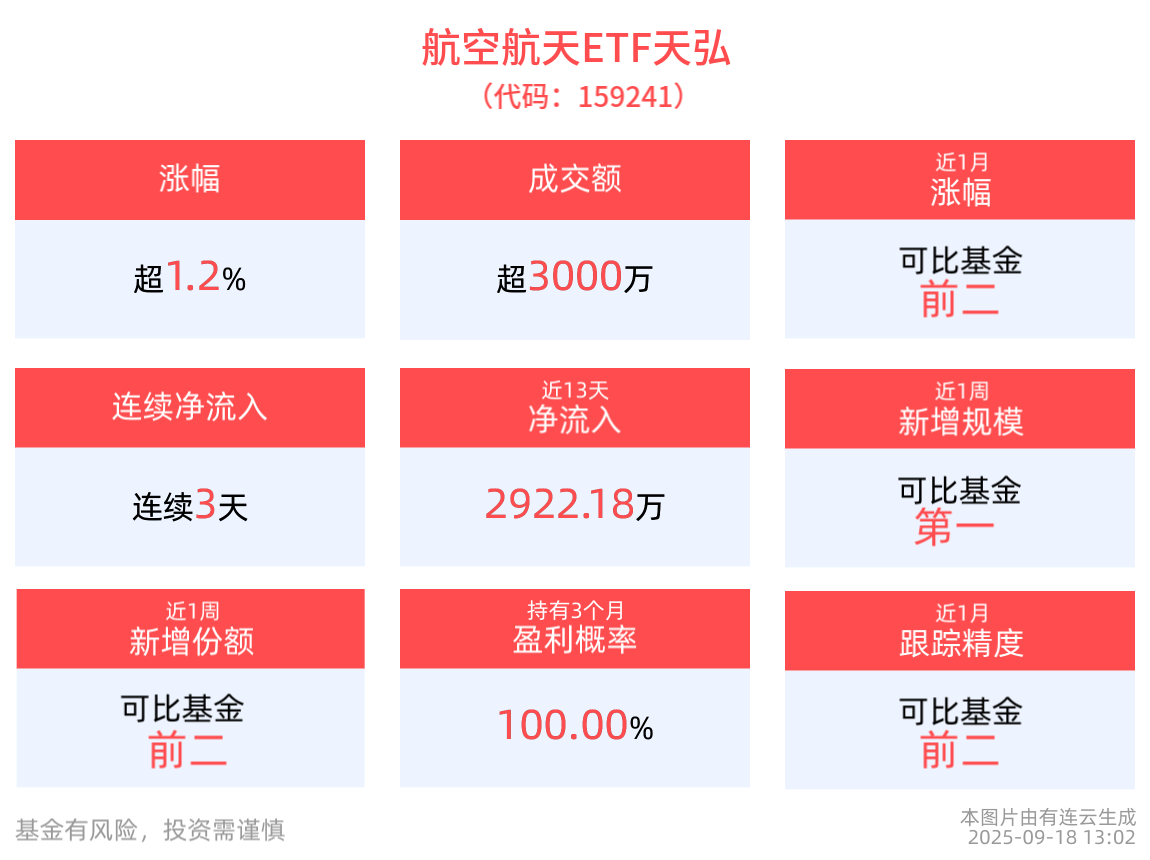
资本追逐低空经济万亿“蓝海”,聚焦空天国防的航空航天ETF天弘(159241)大幅反弹,连续3日获资金净流入
Sou Hu Cai Jing· 2025-09-18 06:24
Core Viewpoint - The aerospace ETF Tianhong (159241) has shown significant growth in both scale and share, indicating strong investor interest in the aerospace sector, particularly in companies involved in advanced technologies and military applications [3][4]. Group 1: ETF Performance - As of September 18, 2025, the aerospace ETF Tianhong (159241) increased by 1.23%, with a turnover of 8.78% and a transaction volume of 39.2827 million yuan [3]. - The ETF has seen a weekly scale growth of 2.4731 million yuan, ranking first among comparable funds, and a share increase of 5 million units [3]. - In the last three days, the ETF attracted a net inflow of 11.2857 million yuan [3]. Group 2: Sector Highlights - The aerospace ETF Tianhong (159241) closely tracks the National Aerospace and Aviation Industry Index, which includes sectors such as aerospace equipment, military electronics, and satellite internet, highlighting the high-tech barriers and strong R&D attributes of these industries [4]. - Hefei Xinghuo Space Technology Co., Ltd. recently completed a 55 million yuan angel round financing, with total financing nearing 100 million yuan, focusing on the development of China's first electric cycle liquid launch vehicle [5]. - The Chinese low-altitude economy market is projected to reach 1.5 trillion yuan by 2025 and 3.5 trillion yuan by 2035, with financial institutions actively investing in this emerging sector [5]. Group 3: Institutional Insights - Zhonghang Securities emphasizes that satellite internet can extend traditional internet services to broader areas, facilitating information integration and breaking down service barriers, thus creating new opportunities for industry development [6]. - The integration of satellite internet with low-altitude economy, vehicle networking, and other new fields can enhance communication and operational capabilities [6].