
AVIC CHENGDU AIRCRAFT COMPANY LIMITED(302132)

Search documents
成飞概念下跌2.50%,主力资金净流出33股
Zheng Quan Shi Bao Wang· 2025-07-23 08:46
| 300227 | 光韵达 | -2.41 | 3.97 | -2753.92 | | --- | --- | --- | --- | --- | | 300471 | 厚普股份 | -3.46 | 5.10 | -2461.93 | | 300719 | 安达维尔 | -3.07 | 5.15 | -2367.88 | | 002179 | 中航光电 | -0.79 | 0.76 | -2233.56 | | 600765 | 中航重机 | -1.34 | 1.41 | -1772.20 | | 000571 | 新大洲A | -3.25 | 2.48 | -1576.68 | | 300733 | 西菱动力 | -1.82 | 2.18 | -1568.87 | | 688033 | 天宜新材 | -2.65 | 3.01 | -1331.98 | | 002520 | 日发精机 | -2.40 | 5.35 | -1303.17 | | 301289 | 国缆检测 | -2.48 | 2.39 | -929.80 | | 300447 | 全信股份 | -2.90 | 11.68 | -861.65 ...


航空航天ETF(159227)冲击四连阳,航天局加强商业航天项目监督管理
Xin Lang Cai Jing· 2025-07-22 07:10
Group 1 - The National Space Administration of China announced a notification on enhancing quality supervision and management of commercial space projects, aiming to improve quality levels and promote standardized management in the commercial space sector [1] - The commercial aerospace sector is entering a phase of infrastructure construction and application demand exploration, with significant changes occurring in policy, funding, and industry dimensions [1] - The CN5082 Aerospace Industry Index component stocks showed mixed performance, with Changcheng Military Industry leading with a 10.01% increase, while Inner Mongolia First Machinery Group led the decline [1] Group 2 - The Aerospace ETF (159227) tracks the CN5082 Aerospace Index and has a high concentration in defense and military sectors, with a 98.2% weight in the industry [2] - The top ten weighted stocks in the CN5082 Aerospace Industry Index account for 49.42% of the index, with companies like Guangqi Technology and AVIC Shenyang Aircraft leading the list [2] - The ETF focuses on aerospace capabilities, with a significant weight of 66.5% in the "Aerospace + Aerospace Equipment" category within the secondary industry [2]



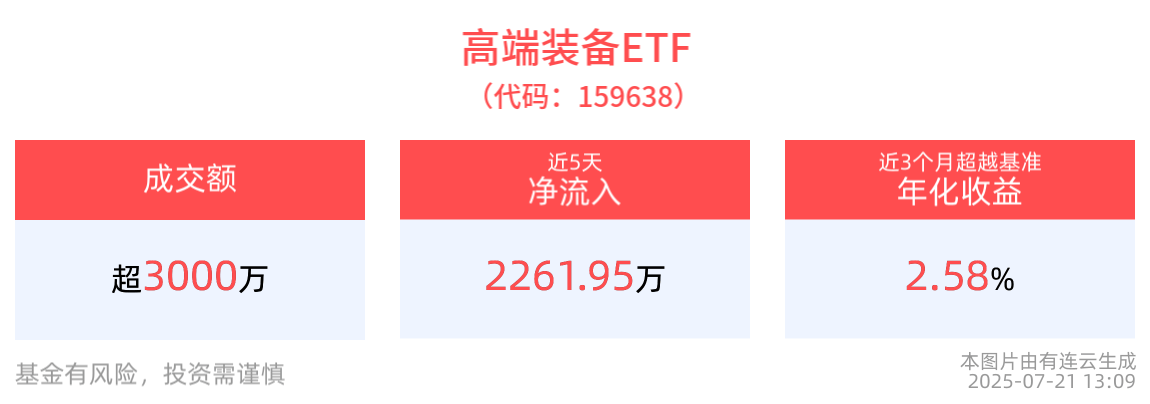
eVTOL订单创纪录!高端装备ETF(159638)整固蓄势,近5日合计“吸金”超2200万元
Sou Hu Cai Jing· 2025-07-21 05:39
Core Viewpoint - The high-end equipment sector is experiencing mixed performance, with notable developments in the defense and aerospace industries, supported by increasing military expenditure and significant contracts. Group 1: Market Performance - As of July 21, 2025, the CSI High-End Equipment Sub-Index decreased by 0.17%, with stocks showing varied performance, including a 5.81% increase in Feiliwa and a 2.33% rise in Hongdu Aviation [1] - The High-End Equipment ETF (159638) saw a turnover of 2.56% and a transaction volume of 32.22 million yuan, with an average daily transaction volume of 55.38 million yuan over the past month [3] - The latest scale of the High-End Equipment ETF reached 1.255 billion yuan, with a total inflow of 22.62 million yuan over the last five trading days [3] Group 2: Financial Metrics - The High-End Equipment ETF has achieved a net value increase of 32.27% over the past year, with the highest single-month return recorded at 19.30% since its inception [3] - The ETF's longest consecutive monthly gains reached two months, with a maximum increase of 29.39% and an average monthly return of 6.55% [3] Group 3: Industry Developments - On July 16, 2025, UAE company Autocraft signed a $1 billion order with Chinese company "Shide Technology" for 350 units of the E20 eVTOL, marking a record single order for China's eVTOL sector [3] - National defense spending in China is expected to grow steadily, providing a solid foundation for the stable development of the defense and military industry, with industry scale and profits likely to continue rising [3] - China's global competitiveness in shipbuilding, aerospace, and satellite navigation has been improving, positioning the defense and military industry as a crucial area for new productivity breakthroughs [3]


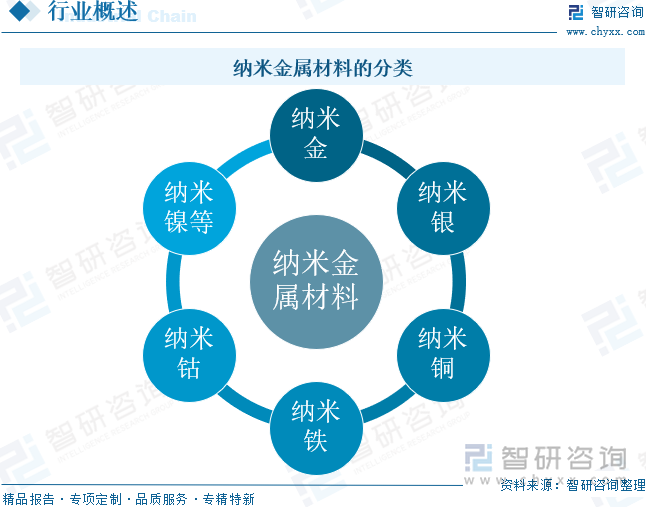
趋势研判!2025年中国纳米金属材料行业生产方式、相关政策、产业链、发展现状及未来前景展望:纳米金属材料应用前景广阔,行业规模超700亿元[图]
Chan Ye Xin Xi Wang· 2025-07-21 01:21
Core Insights - The article highlights the rapid growth and strategic importance of the nano-metal materials industry in China, driven by technological advancements and increasing market demand [1][14]. Industry Overview - Nano-metal materials, characterized by grain sizes between 1-100 nanometers, exhibit superior properties such as ultra-high strength, excellent thermal stability, and unique electromagnetic characteristics [1][14]. - The market size for nano-metal materials in China is projected to grow from 28.98 billion yuan in 2018 to 74.451 billion yuan in 2024, with a compound annual growth rate (CAGR) of 17.03% [1][14]. - Key applications of nano-metal materials include electronics, new energy development, biomedicine, and aerospace [1][14]. Production Methods - The production methods for nano-metal materials are categorized into physical and chemical methods, including evaporation-condensation, high-energy ball milling, and chemical reduction [5]. Policy Support - The Chinese government has identified nano-materials as a key area for development, with various policies aimed at promoting innovation and industrial upgrades [7]. Industry Chain - The upstream of the nano-metal materials industry includes raw material supply and manufacturing equipment, while the downstream encompasses applications in biomedical, aerospace, construction, automotive, and electronics sectors [9]. Key Companies - Notable companies in the nano-metal materials sector include Jiangsu Boqian New Materials Co., Ltd., Jiangxi Baohong Nano Technology Co., Ltd., and Shandong Changxin Nano Technology Co., Ltd., which are involved in the R&D and production of high-performance nano-metal materials [17][19][21]. Development Trends - The industry is moving towards high-performance and multifunctional materials, with innovations in atomic-level structure design and surface modification technologies [25]. - There is a shift towards green and low-carbon production methods, emphasizing sustainable practices in the manufacturing of nano-metal materials [26][27]. - Cross-disciplinary integration is expanding the application boundaries of nano-metal materials, particularly in biomedicine and information technology [28].



军贸业务有望提速提效,继续看好军贸板块
Orient Securities· 2025-07-20 14:17
Investment Rating - The report maintains a "Positive" outlook on the defense and military industry [5] Core Insights - The military trade market is expected to accelerate and improve efficiency, with a continued positive outlook on the military trade sector [10][12] - Geopolitical instability is likely to lead to sustained global demand for military trade, presenting significant development opportunities for China's military trade [14][15] - The current market position suggests a continued positive outlook on the military industry, with military trade expected to become a second growth driver [16] Summary by Sections Military Trade Sector - A high-level meeting between AVIC and Shaanxi Aircraft Industry Group highlighted the importance of military trade, focusing on high-quality development and addressing international market needs [9][12][13] - The European defense sector is undergoing upgrades, with countries increasing defense budgets, which may create supply gaps and opportunities for China's military exports [14][15] Performance and Market Trends - The defense and military industry index increased by 2.26%, outperforming the Shanghai Composite Index [18][19] - The report notes that most military companies have shown rapid growth in their half-year performance for 2025, with significant increases in net profits for several companies [30][32] Investment Recommendations - Suggested investment targets include: - Military Electronics: Zhenhua Technology (000733, Buy), Aerospace Electronics (002025, Buy) [17] - Key Materials and Parts: Western Superconductor (688122, Buy), Chujian New Materials (002171, Buy) [17] - Engine Supply Chain: Aero Engine Corporation of China (600893, Not Rated), Western Superconductor (688122, Buy) [17] - Military Trade: AVIC Shenyang Aircraft Corporation (600760, Not Rated), Guorui Technology (600562, Not Rated) [17]


中航成飞(302132) - 中航成飞股份有限公司投资者关系活动记录表(2025年7月16日)
2025-07-16 13:46
Group 1: Strategic Planning and Development - The company aims to build "Innovative Chengfei, Digital Chengfei, and Quality Chengfei" during the 14th Five-Year Plan, focusing on aviation as the core business and enhancing core capabilities in market demand management and integrated product development [2][3] - Key areas of future development include technological innovation, industrial chain control, cost control, and talent accumulation, with a focus on manned and unmanned systems, civil aviation, and service maintenance [2][3] Group 2: Technological Innovation - The company emphasizes technological innovation, achieving breakthroughs in advanced manufacturing technologies and processes, and accelerating the transformation of technological achievements into productive forces [3][4] - The company has established a national-level technology innovation center for high-end aviation equipment, focusing on R&D and industrial incubation [7] Group 3: Talent Development - The company implements a talent strategy to enhance technological innovation and industrial control, with a focus on rapid model development and independent product R&D [4] - The current workforce remains stable compared to the end of the 13th Five-Year Plan, with a significant increase in the proportion of technical personnel and a reduction in management personnel [4] Group 4: Supply Chain Management - The company has built a reliable supplier resource pool, achieving a flexible external capability layout while balancing costs, risks, and market competitiveness [5][6] - The supply chain remains stable and fully domestic, mitigating risks of "bottleneck" issues in product supply [6] Group 5: Profitability Improvement - The company plans to enhance profit margins through quality improvement, cost reduction, and efficient management of operational costs [7] - A comprehensive cost control strategy will be implemented across the value chain to improve overall efficiency and profitability [7] Group 6: Financing and Incentives - The company is considering refinancing and equity incentive plans to support high-quality development in line with the 14th Five-Year Plan [7] - Long-term incentive mechanisms will be established to align the interests of management and employees with the company's value enhancement [7]
中证诚通国企战略新兴产业指数下跌0.2%,前十大权重包含中航成飞等
Sou Hu Cai Jing· 2025-07-16 13:36
Core Points - The China Securities Index for State-Owned Enterprises in Strategic Emerging Industries has shown a monthly increase of 7.95%, a quarterly increase of 12.55%, and a year-to-date increase of 6.09% [1] - The index is designed by China Chengtong Holdings Group and includes 50 state-owned enterprises with significant growth potential in strategic emerging industries [1] - The index's base date is December 30, 2016, with a base point of 1000.0 [1] Index Composition - The top ten weighted stocks in the index are: Northern Rare Earth (10.8%), BOE Technology Group (9.36%), Shengyi Technology (6.23%), Shanghai Silicon Industry (4.52%), China Power (3.75%), AVIC Chengfei (3.57%), Shenghe Resources (3.25%), Huahong Semiconductor (3.2%), Dingsheng Technology (2.69%), and Chipone Technology (2.45%) [1] - The index's holdings are primarily listed on the Shanghai Stock Exchange (58.47%), followed by the Shenzhen Stock Exchange (41.37%) and the Beijing Stock Exchange (0.17%) [1] Industry Breakdown - The industry composition of the index includes: Information Technology (40.12%), Industrial (31.03%), Materials (21.09%), Communication Services (3.37%), Healthcare (2.54%), Consumer Staples (1.49%), and Utilities (0.36%) [2] - The index samples are adjusted biannually, with adjustments occurring on the next trading day after the second Friday of June and December [2]
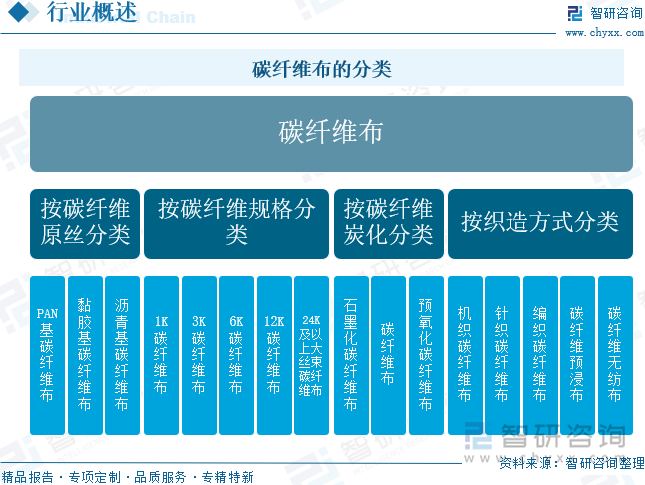
2025年中国碳纤维布行业制造工艺、产业链、发展现状、代表品牌及未来前景:下游应用领域持续扩展,碳纤维布市场规模超70亿元[图]
Chan Ye Xin Xi Wang· 2025-07-16 01:12
Core Insights - The carbon fiber cloth industry in China is experiencing rapid growth, with a projected market size of approximately 7.713 billion yuan by 2024, driven by its applications in various sectors such as construction, aerospace, automotive, and high-end sports equipment [1][13]. Industry Overview - Carbon fiber cloth, known for its high strength, lightweight, and excellent corrosion resistance, is a key material for industry transformation, particularly in building reinforcement [1][4]. - The manufacturing of carbon fiber cloth involves processes such as weaving and molding, with machine weaving allowing for mass production [6]. - The industry supply chain includes raw materials (carbon fiber, resin, etc.), manufacturing, and downstream applications across multiple sectors [8][10]. Market Dynamics - The demand for high-performance carbon fiber is increasing, with the carbon fiber market in China expected to grow from 4.76 billion yuan in 2018 to 17.14 billion yuan by 2024, reflecting a compound annual growth rate (CAGR) of 23.8% [10]. - The aerospace sector is a significant downstream market for carbon fiber cloth, with applications in aircraft and spacecraft manufacturing, enhancing performance and fuel efficiency [11]. Competitive Landscape - The Chinese carbon fiber cloth industry features both international giants (e.g., TORAY, Hexcel) and domestic leaders (e.g., Guangwei Composite Materials, Hengshen) competing in the market [16][17]. - Companies are focusing on technological innovation and quality management to maintain competitive advantages in a rapidly evolving market [16]. Key Companies - Guangwei Composite Materials is a leading player with a comprehensive product range and a projected revenue of 1.452 billion yuan in 2024 [18]. - Zhongfu Shenying specializes in high-performance carbon fiber and is expected to generate 1.543 billion yuan in revenue in 2024 [20]. Industry Trends - The industry is moving towards lightweight materials to meet the demands of sectors like automotive and aerospace, with innovations in weaving techniques and ultra-thin carbon fiber cloth [22]. - Future developments include high-performance products exceeding T1000 grade, enhanced by nanomaterial modifications for improved durability [23]. - Multi-functional carbon fiber cloths are being developed, integrating features like conductivity and fire resistance, expanding market opportunities [25]. - Cost reduction strategies are being implemented through production process optimizations and recycling technologies, facilitating broader applications in civilian sectors [26].





天弘国证航天航空行业ETF投资价值分析:多重因素共振下的军工行业投资机会
CMS· 2025-07-09 14:13
Quantitative Models and Construction Methods - **Model Name**: Guozheng Aerospace and Aviation Industry Index (CN5082.CNI) **Model Construction Idea**: The index is designed to reflect the market performance of aerospace and aviation industry companies listed on the Shanghai, Shenzhen, and Beijing Stock Exchanges [41][42] **Model Construction Process**: 1. **Sample Space**: Select A-shares and red-chip enterprises' depositary receipts that meet the following conditions: - Non-ST/*ST securities - Listed for over 1 year (for STAR Market and Beijing Stock Exchange securities) or over 6 months (for other securities) - No major violations or financial reporting issues in the past year - No abnormal price fluctuations during the observation period - Belong to the aerospace and aviation industry under Guozheng's tertiary industry classification [43] 2. **Candidate Pool**: - Calculate the average daily free-float market capitalization and average daily trading volume over the past six months for eligible securities - Exclude the bottom 10% of securities ranked by trading volume if the pool exceeds 10 securities [43] 3. **Sample Selection**: - If the candidate pool contains ≤30 securities, all are included - If the pool contains 30<N≤50 securities, select securities covering 85% of free-float market capitalization, rounded to the nearest multiple of 10 [43] - If the pool contains >50 securities, select securities covering 85% of free-float market capitalization, rounded to the nearest multiple of 10, capped at 50 securities [43] 4. **Weighting**: Free-float market capitalization weighting [43] 5. **Adjustment**: Regular adjustments occur semi-annually, with temporary adjustments for special cases like delisting or corporate actions [44] **Model Evaluation**: The index is highly focused on the aerospace and aviation sector, with a strong representation of small-cap stocks and high exposure to the defense industry [44][47] Model Backtesting Results - **Guozheng Aerospace and Aviation Industry Index**: - **Annualized Return**: 6.26% (past five years) [61][62] - **Sharpe Ratio**: 0.33 (past five years) [61][62] - **Maximum Drawdown**: -55.93% (past five years) [61][62] - **Annualized Volatility**: 34.13% (past five years) [61][62] - **Recent Performance**: 33.78% return in the past year, outperforming other broad-based indices and military-themed indices [64][66] - **Bull Market Elasticity**: Demonstrated strong performance during bull market periods, with gains of 40.56%, 50.90%, and 38.36% in specific intervals [65] Quantitative Factors and Construction Methods - **Factor Name**: "Military Exposure" **Factor Construction Idea**: Focus on stocks with high exposure to the defense industry, particularly aerospace and aviation [47][55] **Factor Construction Process**: - Select stocks with significant involvement in defense-related activities, such as aircraft manufacturing, satellite technology, and unmanned systems [47][55] - Weight stocks based on their free-float market capitalization [43][55] **Factor Evaluation**: The factor achieves high representation of military-related stocks, with 97% of the index's components belonging to the defense industry [47][55] - **Factor Name**: "Aerospace Exposure" **Factor Construction Idea**: Emphasize stocks within the aerospace and aviation sub-sector [47][60] **Factor Construction Process**: - Identify stocks classified under the aerospace and aviation sub-sector [47][60] - Weight stocks based on their free-float market capitalization [43][60] **Factor Evaluation**: The factor has a high concentration in aerospace stocks, with 51% of the index's weight allocated to this sub-sector [47][60] Factor Backtesting Results - **Military Exposure Factor**: - **Representation**: 97% of index components belong to the defense industry [47][55] - **Aerospace Exposure Factor**: - **Representation**: 51% of index weight allocated to aerospace stocks [47][60] - **Unmanned Systems Factor**: - **Representation**: Over 12% of index weight allocated to stocks involved in unmanned systems, such as drones [60]


盘中直线拉升,航空航天ETF(159227)涨超1%,中航成飞领涨
Mei Ri Jing Ji Xin Wen· 2025-07-09 02:24
Group 1 - The A-share market saw a collective rise in the three major indices, with the aerospace ETF (159227) experiencing a significant increase of 1.09% and a trading volume of 23.51 million yuan, leading its category [1] - The aerospace ETF has recorded a net inflow of capital for nine consecutive trading days, totaling 214 million yuan, reaching a new high of 473 million yuan since its listing [1] - The military industry is expected to see accelerated order demand fulfillment as the "14th Five-Year Plan" approaches its conclusion in 2025, providing a clear development blueprint for the next three to five years [1] Group 2 - The aerospace ETF (159227) tracks the Guozheng Aerospace Index, with a high weight of 98.2% in the defense and military sector, making it the purest military ETF in the market [2] - The ETF focuses on aerospace capabilities, with a weight of 66% in the "Aerospace + Aerospace Equipment" sector within the secondary industry [2]