
AMD(AMD)

Search documents
AMD CEO苏姿丰:到2030年AI数据中心市场规模料突破1万亿美元
Zheng Quan Shi Bao Wang· 2025-11-12 00:30
Core Insights - AMD CEO Lisa Su expressed optimism about the AI market, predicting that the total addressable market (TAM) for AI data centers will exceed $1 trillion by 2030, significantly up from approximately $200 billion this year, with a compound annual growth rate (CAGR) exceeding 40% [1] Group 1: Company Projections - AMD anticipates that its annual revenue CAGR will exceed 35% over the next three to five years, with AI data center revenue expected to grow at an average rate of 80% [1] - The demand for AI infrastructure remains strong, and customer investments in AI have not stabilized [1] Group 2: Market Dynamics - The growth in AI and GPUs is increasing the demand for CPUs, indicating that AI accelerators have not led to a decline in the CPU market [1] - AI workloads are shifting from training to inference, with the market for inference chips expected to grow at a faster rate [1] Group 3: Future Developments - AMD projects that its data center AI business will reach "tens of billions" in annual revenue by 2027 [1] - The first next-generation MI450 series accelerator compute clusters are set to launch in the second half of 2026, with a partnership already established with OpenAI [1]

苏姿丰表达35%增速
小熊跑的快· 2025-11-12 00:25
Core Viewpoint - AMD is expected to achieve a "double-digit" market share in the data center AI chip market within the next three to five years, driven by the insatiable demand for AI chips, leading to an overall revenue growth rate of approximately 35% annually [1] Group 1: Revenue Growth and Market Share - The data center AI business is projected to contribute to 80% of the growth, with sales expected to reach hundreds of billions of dollars by 2027 [1] - Currently, AMD's growth rate for the first three quarters is 34.4%, indicating that the projected 35% growth rate is higher than the current performance [1] - AMD's GPU market share is currently below 7%, but the company anticipates achieving a "double-digit" market share in the near future [1] Group 2: CPU Performance and Market Position - AMD's CPU segment is experiencing significant growth, with the Zen 6 expected to see large shipments in the second half of next year, utilizing TSMC's 2nm technology [1] - AMD is becoming the preferred CPU for major manufacturers adapting their own ASIC acceleration chips, indicating a potential for further market share expansion, particularly at the expense of Intel [1] - AMD holds an 80% dominant position in the desktop segment and is expected to reach a 40% market share in the server segment this year [1]

AMD预计2030年数据中心市场规模将达1万亿美元
Di Yi Cai Jing· 2025-11-12 00:01
Group 1 - The core market for data center chips and systems is projected to reach $1 trillion by 2030, driven primarily by artificial intelligence (AI) [2] - AI is leading to a structural expansion in the global data center industry, necessitating upgrades in both hardware architecture and software tools to support the vast computational power required for training and inference [3] - AMD's revenue for Q3 reached $9.246 billion, a 36% year-over-year increase, with the data center segment contributing approximately $4.3 billion, a 22% increase, accounting for nearly half of total revenue [3] Group 2 - AMD's overall revenue is expected to grow at an annual rate of about 35% over the next three to five years, with the data center-related business anticipated to grow at 60% annually [3] - The semiconductor industry is experiencing accelerated consolidation, particularly in the AI server and software sectors, to enhance system-level capabilities and ecosystem compatibility [4] - AMD plans to launch the next-generation MI400 series AI chips in 2026, which will cover scientific computing and generative AI tasks, along with integrated server systems to meet customer demands for unified computing solutions [4] Group 3 - AMD has announced the acquisition of AI software company MK1 to strengthen its AI ecosystem, emphasizing the need for both hardware performance and software capabilities in AI development [4] - The competition in the market is intensifying, with NVIDIA's CEO projecting that the broader AI infrastructure market could reach $3 trillion to $4 trillion by 2030 [4] - AI is fundamentally changing the design of chips and reshaping the economic logic of data centers, affecting energy consumption, heat dissipation, and capital efficiency [5]
AMD stock soars after company says its data center revenue will jump 60% over the next 3 to 5 years
Yahoo Finance· 2025-11-11 23:40
Core Insights - AMD expects its data center revenue to increase by 60% over the next three to five years, reaching $16 billion by 2025, driven by advancements in AI and competition with Nvidia [1] - The total addressable market for AI data centers is projected to grow to $1 trillion over the next five years, encompassing GPUs, CPUs, and networking equipment [2] - AMD's overall revenue is anticipated to rise by 35% over the next five years from $34 billion in 2025, primarily fueled by the data center business [2] Financial Projections - AMD's gross margins are projected to be between 55% and 58%, while operating margins are expected to exceed 35% over the next three to five years [3] - The company aims to capture up to 50% of the server revenue market share, increasing from the current 40% [7] Strategic Initiatives - AMD has secured a 6-gigawatt deal with OpenAI and plans to supply Oracle with 50,000 chips, both projects set to commence in 2026 [3] - The company is also developing its next-generation MI500 series data center processors, although specific details on their capabilities were not disclosed [6] Market Positioning - AMD is targeting increased market share from Intel, which is currently undergoing a multi-year turnaround [8] - The company anticipates over 10% revenue growth in its client market, which includes gaming and PC chip sales, over the next five years [7]
AI Fuels AMD’s Soaring Outlook, Palm Oil Prices Face Squeeze, and Bill Holdings Considers Sale
Stock Market News· 2025-11-11 23:38
Company Insights - AMD is projecting annual revenue growth exceeding 35% and approximately 80% growth in data-center AI over the next three to five years, with a target of earnings per share greater than $20 and a focus on competing in the $1 trillion AI chip market [2][11] - Bill Holdings is exploring various strategic alternatives, including a potential sale, amid pressure from activist investor Starboard [4][11] Industry Trends - The global commodities market is anticipating significant shifts in palm oil supply due to Indonesia's planned increase of its biodiesel blend to B50 next year, which is expected to tighten global supply and potentially drive prices towards 5,000 Ringgit a ton [3][11] - The industrial metals sector is experiencing strong performance, with aluminum prices reaching a one-year high in Shanghai, driven by record trading volumes and supply curbs, as well as demand from the renewables sector and AI-driven power infrastructure [5][11] - LG Energy Solution and South8 have partnered to develop advanced aerospace batteries, indicating ongoing innovation in high-performance energy storage technologies [6][11] Economic Indicators - Japan's manufacturers' sentiment has surged to its highest level in nearly four years, signaling potential strengthening in the manufacturing sector, alongside government support for companies pursuing rare earth interests [7]


盘后大涨近4%!苏姿丰:到2030年AI数据中心市场规模料突破1万亿,AMD营收年增或超35%
美股IPO· 2025-11-11 23:37
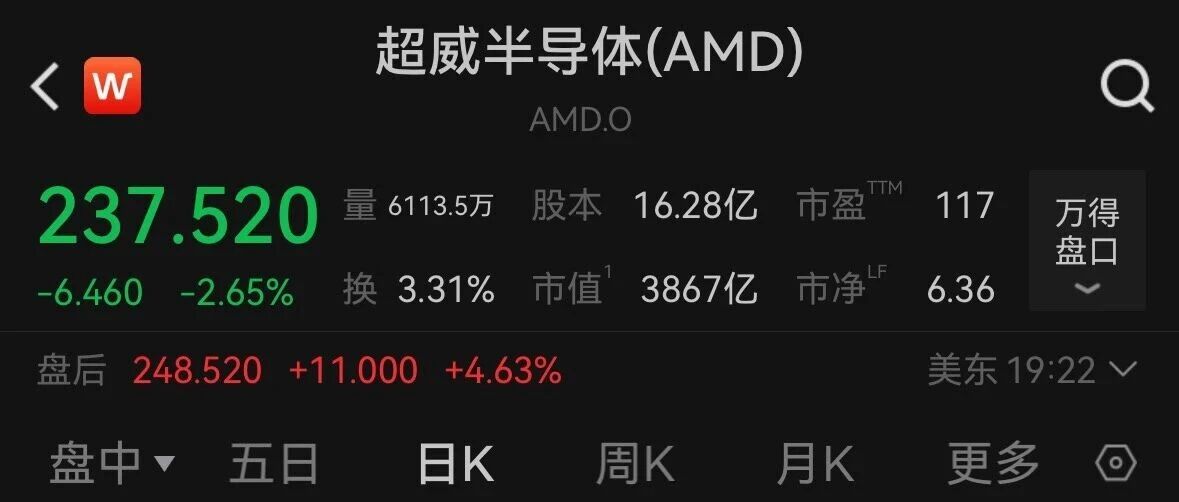
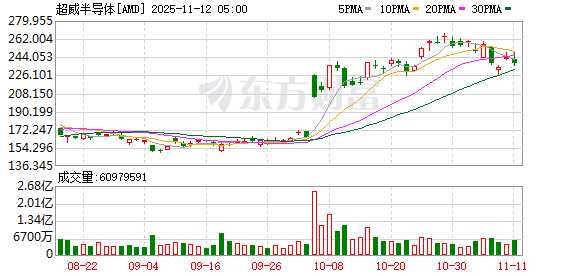
Core Viewpoint - AMD is optimistic about the AI market, projecting that the total addressable market (TAM) for AI data centers will exceed $1 trillion by 2030, with a compound annual growth rate (CAGR) of over 40% [1][4]. Group 1: Market Projections - AMD expects the annual revenue CAGR to exceed 35% over the next three to five years, with AI data center revenue projected to grow by an average of 80% [1][4]. - The TAM for AI processors is anticipated to surpass $500 billion by 2028 [1]. - Contrary to previous expectations, demand for AI infrastructure is expected to remain strong rather than stabilize [3]. Group 2: AI and CPU Demand - AMD's CEO stated that the growth of AI and GPUs is increasing, rather than decreasing, the demand for CPUs, indicating that AI accelerators have not led to a decline in the CPU market [4]. - There are clear signs that AI workloads are shifting from training to inference, with the AI accelerator market growing at over 60% CAGR [4]. Group 3: Financial Performance - AMD reported a 36% year-over-year revenue increase in Q3, reaching $9.246 billion, with data center revenue growing by 22% to $4.3 billion [8]. - The Q4 revenue guidance is set between $9.3 billion and $9.9 billion, with a midpoint of $9.6 billion, which is above analyst expectations but below some optimistic forecasts [8][9]. - AMD's long-term AI revenue target includes reaching "hundreds of billions" in annual revenue from data center AI business by 2027 [8]. Group 4: Market Reactions - Despite positive long-term outlooks and exceeding Q4 revenue guidance, AMD's stock price fell over 3% post-announcement, indicating that some investors had higher expectations [9]. - The growth in sales is primarily driven by PC and server processors rather than the more closely watched AI accelerator business, leading to a lukewarm response from investors [9].

Here's where AMD stands as AI competition heats up
Yahoo Finance· 2025-11-11 23:15
Patrick, it is great to see you. You are just the man to talk to about this, Patrick. So, here here's what AMD CEO Lisa Sue says.She says, "The total AI chip market is going to reach 1 trillion, that's with a T, by 2030." I guess let's start there, Patrick. How how much of that market do you think AMD can really take long term, Patrick. I know AMD will lay out their bogeies, but what does the Patrick Morehead take.>> Yeah. So, just to be clear on that number that they put out there, that's a combination of ...

Here's where AMD stands as AI competition heats up
Youtube· 2025-11-11 23:15
Core Insights - AMD's CEO Lisa Su projects that the total AI chip market will reach $1 trillion by 2030, indicating significant growth potential for the company in this sector [1][19] - AMD aims to capture a double-digit market share in the AI chip market, with a focus on data center revenue growth, which is expected to have a 60% CAGR, and AI-specific data center revenue projected to grow at an 80% CAGR [3][4] - The company is working on next-generation AI chips to compete with Nvidia, with architectural advancements that could enhance performance and reduce costs [7][8] Market Position and Strategy - AMD is targeting over 50% market share in the server segment, including ARM-based variants, which are gaining traction [3] - The company is currently perceived to have a weaker position in the enterprise market compared to hyperscalers, primarily due to sales and marketing challenges rather than technology [10][12] - AMD's roadmap for AI chips is still developing, particularly in creating enterprise solutions comparable to Nvidia's offerings [11] Competitive Landscape - AMD's upcoming AI chips, including the MI450 and MI500 lines, are expected to help the company gain market share from Nvidia and Intel in the data center and client segments [20] - The company is also focusing on improving its software capabilities to better integrate with enterprise software vendors [12] - Recent market movements, such as SoftBank selling its stake in Nvidia, indicate a potential shift in investment focus that could impact AMD's competitive landscape [16][17] Future Outlook - AMD's long-term prospects in the AI market are contingent on product releases and competitive positioning against Nvidia, with significant developments expected by the third quarter of 2026 [4][8] - The company's ability to penetrate the China AI market remains uncertain, with current data center AI business being non-existent due to regulatory constraints [13][15] - Overall, AMD is optimistic about its growth trajectory in the AI sector, despite current stock performance reflecting broader market challenges [20]

美股指数涨跌不一,道指创历史新高,市场押注美国政府停摆将结束
Feng Huang Wang· 2025-11-11 22:40
Market Overview - The U.S. stock market showed mixed results with the Dow Jones reaching a historical high, driven by expectations of an end to the government shutdown [1] - The Senate passed a budget bill to end the government shutdown, which is now under consideration by the House of Representatives [1] - Concerns over high valuations in AI stocks led to a decline in companies like Nvidia, which saw a sell-off after SoftBank liquidated its Nvidia shares for $5.8 billion [1][2] Employment and Economic Data - Recent ADP data indicated a loss of an average of 11,250 jobs per week in the U.S. private sector over the last four weeks, contributing to negative market sentiment [2] Stock Performance - The Dow Jones increased by 559.33 points (1.18%) to close at 47,927.96, while the Nasdaq fell by 58.87 points (0.25%) to 23,468.30 [3] - The S&P 500 rose by 14.18 points (0.21%) to 6,846.61, with healthcare and energy sectors performing well, while the technology sector declined by 0.72% [3] Notable Company Movements - Nvidia's stock dropped by 2.96%, reflecting broader concerns in the AI sector [4] - CoreWeave, an Nvidia-invested cloud computing company, lowered its revenue guidance for the year, further pressuring AI stocks [2][4] - AMD's CEO stated that the AI data center market is expected to exceed $1 trillion by 2030, with significant growth anticipated in their data center business [6] - Google announced a $6.4 billion investment in Germany for data center construction, marking a significant commitment to European infrastructure [7] - Microsoft plans to invest $10 billion in Portugal for AI infrastructure, collaborating with Nvidia and other partners [8]



隔夜美股 | 美政府停摆即将结束 三大指数涨跌不一
智通财经网· 2025-11-11 22:35
Market Overview - The three major U.S. indices showed mixed results, with the Dow Jones Industrial Average rising by 559.33 points (1.18%) to close at 47927.96 points, while the Nasdaq Composite fell by 58.87 points (0.25%) to 23468.3 points, and the S&P 500 increased by 14.18 points (0.21%) to 6846.61 points [1] - European indices also experienced gains, with Germany's DAX30 up by 123.68 points (0.52%) to 24099.75 points, the UK's FTSE 100 rising by 112.90 points (1.15%) to 9900.05 points, and France's CAC40 increasing by 100.72 points (1.25%) to 8156.23 points [2] Commodity Prices - Crude oil prices saw an increase, with light crude futures for December delivery rising by $0.91 to $61.04 per barrel (1.51% increase), and January delivery of Brent crude rising by $1.10 to $65.16 per barrel (1.72% increase) [2] - The spot price of gold rose by 0.26% to $4126.64 [4] Currency Exchange Rates - The U.S. Dollar Index fell by 0.15% to 99.443, with the Euro trading at 1.1590 USD, the British Pound at 1.3172 USD, and the Japanese Yen at 154.09 JPY per USD [3] Economic Insights - UBS analysts indicated that a proposed 50-year mortgage in the U.S. could lower monthly payments but potentially double the interest paid over the loan's lifetime, with a projected monthly payment reduction of approximately $119 for a median-priced home [5] - The U.S. small business confidence index dropped to 98.2, marking a six-month low, with a notable decline in owners reporting improved earnings [7] Company Developments - AMD's CEO Lisa Su projected that the data center market could reach $1 trillion by 2030, driven largely by artificial intelligence [8] - Google announced a €5.5 billion (approximately $6.4 billion) investment in Germany over the next four years, focusing on data center construction [9] - Elon Musk's $1 trillion compensation plan at Tesla aligns his interests with shareholder value, as it is contingent on achieving higher market valuations and operational goals [10]


