AMD(AMD)

Search documents
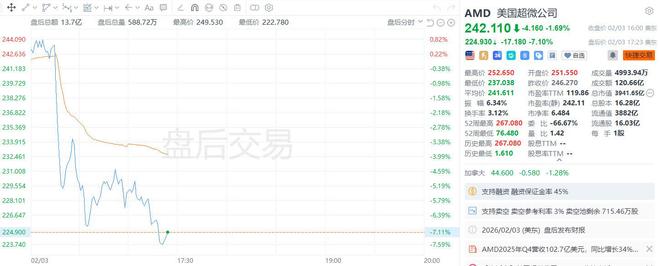
AMD美股盘后下跌7.85%
Jin Rong Jie· 2026-02-03 23:40
本文源自:金融界AI电报 AMD美股盘后下跌7.85%。公司第四季度营收102.7亿美元,同比增长34%;净利润25.2亿美元,同比增 长42%。 ...

U.S. Stocks Fall as Tech Sells Off; Gold Gains | The Close 2/3/2026
Youtube· 2026-02-03 23:35
Market Overview - The S&P 500 is down 1.1%, indicating a risk-off sentiment across asset classes, while the Russell 2000 is down only 0.6%, suggesting a rotation trade favoring smaller companies [1] - Gold has rebounded by 5.6%, reflecting volatility in the metal space, while Bitcoin remains under pressure [1] - The AI sector has faced scrutiny, with major companies like NVIDIA and Microsoft experiencing declines, raising questions about the sustainability of AI-driven growth [1] Economic Impact of AI - The AI boom has significantly contributed to U.S. GDP growth, accounting for at least half of the growth rate in the first three quarters of the year, with projections suggesting it could swell to two-thirds of GDP by 2025 [1] - Investors are beginning to question the effectiveness of AI spending on company earnings, indicating a shift in sentiment towards more fundamental investments [1] Sector Performance - The software industry is experiencing a shift in investor sentiment, with concerns that companies heavily invested in AI may not deliver on promised returns, leading to a cautious outlook [3] - The healthcare and software sectors are identified as fast-growing areas, with private equity managers focusing on optimizing returns through NAV financing [3] Commodities and Metals - The commodities market, particularly gold and silver, is experiencing volatility, with gold being viewed as a diversification asset while silver is seen as more cyclical [2] - The recent increase in oil prices, driven by geopolitical tensions, has added complexity to the commodities landscape [2] Corporate Developments - USA Rare Earth Inc. has secured a $1.6 billion funding commitment as part of a broader $12 billion initiative to reduce reliance on Chinese minerals, with plans to begin metal production by 2027 and magnet production by 2028 [6] - Netflix is under scrutiny regarding its proposed acquisition of Warner Bros. Discovery, with concerns about potential monopolistic behavior in the streaming market [4]



盘后大跌超7%!AMD Q4数据中心收入猛增近40%创纪录,Q1营收指引不够炸裂
美股IPO· 2026-02-03 23:34
Core Viewpoint - AMD's Q4 revenue growth remains above 30% year-over-year, with EPS growth slowing but exceeding analyst expectations by nearly 16% [1][3] Revenue and Earnings Performance - Q4 revenue reached $10.27 billion, a 34% year-over-year increase, slightly lower than the 36% growth in Q3 [6] - Adjusted EPS for Q4 was $1.53, a 40% year-over-year increase, surpassing analyst expectations of $1.32 by nearly 16% [7][8] - Operating profit for Q4 was $2.85 billion, a 41% year-over-year increase, exceeding analyst expectations of $2.47 billion by 15.4% [9] Business Segments - Data center revenue hit a record $5.4 billion in Q4, a 39% year-over-year increase, accelerating from 22% growth in Q3 [12] - Client and gaming business contributed approximately $3.9 billion in revenue, with a 37% year-over-year increase, slowing from 73% growth in Q3 [16] Guidance and Market Reaction - Q1 revenue guidance is set at $9.5 billion to $10.1 billion, with a midpoint of $9.8 billion, slightly above analyst consensus of $9.39 billion but below some optimistic forecasts exceeding $10 billion [3][5] - Following the earnings report, AMD's stock price fell, reflecting investor disappointment over the revenue guidance not meeting high expectations [3][5] Cost and Investment Considerations - AMD's adjusted gross margin guidance is approximately 55%, slightly above market expectations of 54.5% [5] - R&D expenses for Q4 were $2.33 billion, exceeding analyst expectations of $2.16 billion, indicating continued investment in next-generation CPU/GPU and AI platforms [9][10] Export Restrictions Impact - Sales of the MI308 chip in China amounted to approximately $390 million in Q4, with U.S. export restrictions expected to impact around $440 million in inventory and related costs by 2025 [17]

Advanced Micro Devices (AMD) Beats Q4 Earnings and Revenue Estimates
ZACKS· 2026-02-03 23:31
Advanced Micro Devices (AMD) came out with quarterly earnings of $1.53 per share, beating the Zacks Consensus Estimate of $1.32 per share. This compares to earnings of $1.09 per share a year ago. These figures are adjusted for non-recurring items.This quarterly report represents an earnings surprise of +16.18%. A quarter ago, it was expected that this chipmaker would post earnings of $1.17 per share when it actually produced earnings of $1.2, delivering a surprise of +2.56%.Over the last four quarters, the ...
2月4日你需要知道的隔夜全球重要信息
Sou Hu Cai Jing· 2026-02-03 23:27
1、美国总统特朗普签署拨款法案,结束美国政府部分停摆,国土安全部仅获两周资金,各方后续将继 续就该部门运作改进进行谈判。 2、美联储理事米兰辞去白宫经济顾问委员会主席一职,在继任者获得 确认前,他将继续担任美联储理事。 3、SpaceX正式宣布全资收购 人工智能初创公司xAI,旨在构建跨 越地表与太空的垂直整合 创新引擎,马斯克预计未来2至3年太空或将成为生成AI 算力成本最低场所。 4、德国政府宣布拟投入30亿欧元重启电动汽车购车补贴计划,政策持续至2029年且未设置地域限制, 中国品牌电动汽车可纳入补贴范围。 5、俄罗斯总统普京表示俄罗斯2025年国内生产总值增长1%,增 速放缓符合预期,2025年通胀率已下降到5.6%。 6、澳大利亚央行宣布将现金利率上调25个基点至 3.85%,为2023年以来首次加息。 7、美军称在阿拉伯海击落一架对林肯号航母实施蓄意逼近的伊朗无 人机,同时指控伊朗快艇在霍尔木兹海峡高速逼近并威胁美籍油轮。 8、伊朗方面表示正与美国磋商谈 判地点,土耳其、阿曼等国已表示愿意主办美伊会谈。 9、美国 证券交易委员会文件显示,甲骨文申请 发行高达200亿美元的普通股。 10、AMD第四 ...
AMD(AMD) - 2025 Q4 - Annual Report
2026-02-03 23:14
UNITED STATES SECURITIES AND EXCHANGE COMMISSION Washington, D.C. 20549 FORM 10-K (Mark One) Commission File Number 001-07882 ADVANCED MICRO DEVICES, INC. (Exact name of registrant as specified in its charter) Delaware 94-1692300 (State or other jurisdiction of incorporation or organization) (I.R.S. Employer Identification No.) 2485 Augustine Drive Santa Clara, California 95054 (Address of principal executive offices)(Zip Code) (408) 749-4000 (Registrant's telephone number, including area code) Securities r ...
AMD(AMD) - 2025 Q4 - Earnings Call Transcript
2026-02-03 23:02
Financial Data and Key Metrics Changes - In 2025, the company achieved record revenue of $34.6 billion, a 34% year-over-year increase, with net income rising 42% to a record $2.5 billion and free cash flow nearly doubling to $2.1 billion [5][6][23] - For Q4 2025, revenue reached $10.3 billion, up 34% year-over-year, with gross margin at 57%, an increase of 290 basis points year-over-year [5][24] Business Segment Data and Key Metrics Changes - Data center segment revenue increased 39% year-over-year to a record $5.4 billion, driven by strong demand for EPYC processors and MI350 products [7][25] - Client and gaming segment revenue rose 37% year-over-year to $3.9 billion, with client revenue at a record $3.1 billion, up 34% year-over-year [16][26] - Embedded segment revenue grew 3% year-over-year to $950 million, reflecting demand across various end markets [18][26] Market Data and Key Metrics Changes - The company reported strong demand from hyperscalers in the cloud market, with EPYC cloud instances increasing over 50% year-over-year [8][9] - The enterprise market saw a significant shift towards EPYC adoption, with over 3,000 solutions optimized for major workloads [8][9] Company Strategy and Development Direction - The company is focused on capturing growth opportunities in high-performance computing and AI, with plans to grow data center segment revenue by over 60% annually over the next three to five years [15][20] - Strategic partnerships, such as with Tata Consultancy Services, aim to co-develop industry-specific AI solutions [12] Management's Comments on Operating Environment and Future Outlook - Management expressed confidence in the growth trajectory for 2026, driven by increased adoption of EPYC and Instinct products, alongside a return to growth in the embedded segment [22][30] - The company anticipates significant top-line and bottom-line growth, with a target of greater than 35% CAGR over the next three to five years [22] Other Important Information - The company closed the sale of its ZT Systems manufacturing business, which is reported separately in financial statements [27] - The company generated a record $2.3 billion in cash from operations during the quarter [28] Q&A Session Summary Question: Can you discuss customer engagements and demand for MI450 and Helios platforms? - Management confirmed strong customer engagements and progress on MI450 series development, with a ramp expected in the second half of the year [33][34] Question: Can you provide details on March guidance and data center GPU ramp? - Management indicated a sequential decline in client revenue but strong growth in data center, with expectations for GPU revenue to increase [38][40] Question: What are the assumptions for China MI308 sales beyond Q1? - Management forecasted $100 million in Q1 from MI308 sales to China but did not expect additional revenue due to the dynamic situation [45][46] Question: How is the company addressing server CPU capacity and growth trajectory? - Management noted increased supply capacity for server CPUs and strong demand, indicating a positive outlook for growth throughout 2026 [51][52] Question: What is the outlook for gross margins as new products ramp? - Management expressed optimism about gross margin progression, benefiting from favorable product mix and new product ramps [55][56]
AMD(AMD) - 2025 Q4 - Earnings Call Transcript
2026-02-03 23:02
Financial Data and Key Metrics Changes - In 2025, the company achieved record revenue of $34.6 billion, a 34% year-over-year increase, with net income rising 42% to $2.5 billion and free cash flow nearly doubling to $2.1 billion [5][6][23] - For Q4 2025, revenue reached $10.3 billion, up 34% year-over-year, with gross margin at 57%, an increase of 290 basis points year-over-year [5][24] Business Segment Data and Key Metrics Changes - Data center segment revenue grew 39% year-over-year to a record $5.4 billion, driven by strong demand for EPYC processors and MI350 products [7][25] - Client and gaming segment revenue increased 37% year-over-year to $3.9 billion, with client revenue at a record $3.1 billion, up 34% year-over-year [16][26] - Embedded segment revenue rose 3% year-over-year to $950 million, supported by demand in test and measurement and aerospace sectors [19][27] Market Data and Key Metrics Changes - In the cloud market, the number of EPYC cloud instances grew over 50% year-over-year to nearly 1,600, with significant adoption among hyperscalers [8][9] - The company noted a meaningful shift in EPYC adoption in the enterprise sector, with over 3,000 solutions now available optimized for major workloads [8] Company Strategy and Development Direction - The company is entering a multi-year demand supercycle for high-performance and AI computing, positioning itself to capture significant growth opportunities across all business segments [20] - The launch of the MI400 series and Helios platform is seen as a major inflection point for the AI business, with expectations of scaling AI revenue to tens of billions by 2027 [15][22] Management's Comments on Operating Environment and Future Outlook - Management expressed confidence in the growth trajectory for 2026, anticipating strong demand for EPYC and Instinct products, with a target of over 60% annual growth in the data center segment [22][48] - The company is optimistic about the data center AI revenue potential, with significant customer engagements and a strong order book [33][41] Other Important Information - The company repurchased 12.4 million shares in 2025, returning $1.3 billion to shareholders, and ended the year with $9.4 billion remaining in its share repurchase program [29] - The company is actively working on multi-year agreements with suppliers to ensure adequate supply for future growth [84] Q&A Session Summary Question: Can you discuss customer engagements and demand for MI450 and Helios platforms? - Management confirmed strong customer engagement and progress on MI450 development, with expectations for a second-half launch and significant ramp-up in 2027 [34][35] Question: Can you provide details on March guidance and data center GPU ramp? - Management indicated a sequential decline in client revenue but strong growth in data center, with expectations for a solid ramp in GPU revenue throughout the year [38][40] Question: What is the outlook for data center revenue growth in 2026? - Management expressed bullishness on data center growth, citing strong demand for EPYC and MI450 products, with a long-term target of over 60% growth [45][48] Question: How is the company addressing supply chain challenges for server CPUs? - Management noted increased supply capacity for server CPUs and strong demand, indicating confidence in meeting growth targets [52][53] Question: What is the strategy regarding memory procurement and inflationary costs? - Management highlighted proactive planning for memory procurement, ensuring alignment with demand and ramp-up schedules [82][84] Question: How does the company view the competitive landscape with ARM and x86? - Management emphasized the importance of high-performance x86 CPUs for AI workloads, asserting that EPYC is optimized for current and future demands [79][80]
AMD(AMD) - 2025 Q4 - Earnings Call Transcript
2026-02-03 23:00
Financial Data and Key Metrics Changes - In Q4 2025, revenue grew 34% year-over-year to a record $10.3 billion, driven by strong sales of EPYC, Ryzen, and Instinct processors [4][22] - Net income increased 42% to a record $2.5 billion, and free cash flow nearly doubled year-over-year to a record $2.1 billion [5][22] - For the full year, revenue grew 34% to $34.6 billion, with gross margin at 52% and record earnings per share of $4.17, up 26% year-over-year [22][24] Business Segment Data and Key Metrics Changes - Data center segment revenue increased 39% year-over-year to a record $5.4 billion, driven by strong demand for EPYC processors and MI350 products [5][24] - Client gaming segment revenue was $3.9 billion, up 37% year-over-year, with the PC processor business performing exceptionally well [14][25] - Embedded segment revenue increased 3% year-over-year to $950 million, supported by demand in test and measurement and aerospace markets [18][25] Market Data and Key Metrics Changes - Hyperscaler demand for EPYC processors was strong, with over 500 AMD-based instances launched in 2025, increasing EPYC cloud instances by more than 50% year-over-year [6][19] - The number of large businesses deploying EPYC on-premises more than doubled in 2025, indicating a significant market share gain [7][19] - The client market is expected to face inflationary pressures, but the company anticipates growth in its PC business, particularly in the enterprise segment [70] Company Strategy and Development Direction - The company is entering a multi-year demand supercycle for high-performance and AI computing, positioning itself to capture significant growth opportunities [19] - The launch of the next-generation Venice CPU and MI400 series is expected to extend the company's leadership in performance and efficiency [8][12] - Strategic partnerships, such as with Tata Consultancy Services, aim to co-develop industry-specific AI solutions [11] Management's Comments on Operating Environment and Future Outlook - Management expressed confidence in the strong demand for server CPUs and AI workloads, anticipating data center segment revenue growth of over 60% annually over the next three to five years [13][20] - The company expects significant top-line and bottom-line growth in 2026, driven by increased adoption of EPYC and Instinct products [20][29] - Management highlighted the importance of maintaining operational scale and deep customer partnerships to support long-term growth [19] Other Important Information - The company generated a record $2.3 billion in cash from continuing operations during the quarter, with inventory increasing to support strong data center demand [26] - The company repurchased 12.4 million shares and returned $1.3 billion to shareholders in 2025 [27] Q&A Session Summary Question: Can you talk about customer engagements and demand for MI450 and Helios platforms? - Management confirmed strong customer engagement and progress on MI450 series development, with expectations for a second-half launch and ramp [32][33] Question: Can you provide details on March guidance and data center GPU ramp? - Management indicated a sequential decline in client revenue but strong growth in data center, with expectations for GPU revenue to also increase [36][39] Question: What are the expectations for data center revenue growth in 2026? - Management expressed optimism about achieving the long-term target of over 60% growth in data center revenue, supported by strong demand for EPYC and MI450 products [44][46] Question: How is the company addressing supply chain challenges for server CPUs? - Management noted increased supply capacity for server CPUs and ongoing collaboration with supply chain partners to meet demand [50][51] Question: What is the outlook for operating expenses as AI revenue ramps? - Management expects operating expenses to grow slower than revenue, indicating potential leverage as revenue increases [62][63] Question: How does the company view the competitive landscape with ARM CPUs? - Management emphasized the importance of x86 CPUs for AI workloads and the optimization of EPYC processors to meet diverse customer needs [78][80]
美股异动|AMD盘后跌逾7% 收入预测令市场失望
Xin Lang Cai Jing· 2026-02-03 22:47
来源:格隆汇APP 期内,经营利润率报28%,高过分析员预期的25.4%;资本开支录得2.22亿美元,少过市场估计的2.31亿 美元;研发开支报23.3亿美元,多于分析员预期的21.6亿美元。 格隆汇2月4日|美国超微半导体(AMD.US)盘后跌逾7%,报224.93美元。超微半导体公布,第四财政季 度经营利润录得28.5亿美元,优于分析员预期的24.7亿美元;经调整后每股盈利报1.53美元,胜于市场 估计的1.32美元;经营收入录得102.7亿美元,当中包括来自中国的MI308人工智能(AI)芯片销售额3.9亿 美元,整体收入好过分析员预期的96.5亿美元。 AMD预计,第一财季经营收入将录得95亿至101亿美元,优于分析员平均估计的93.9亿美元,但部分预 测超过100亿美元,这项展望令原本希望看到AI算力开出增加、能带来更大回报的投资者感到失望;预 计经调整后毛利率约为55%,则高过市场预期的54.5%。 ...