ASML Holding(ASML)

Search documents
先进封装设备厂商如何应对全球化市场挑战-How Do Advanced Packaging Equipment Vendors Tackle Challenges in a Globalized Market_
2025-08-27 15:20
Summary of Key Points from the Semiconductor Industry Research Industry Overview - The research focuses on the global semiconductor industry, particularly the front-end Wafer Fab Equipment (WFE) and back-end advanced packaging supply chains, highlighting the challenges posed by globalization and geopolitics [2][6][32]. Core Companies Involved - Major players in the semiconductor industry include TSMC, UMC, Samsung Electronics, Intel, ASML, Applied Materials (AMAT), Lam Research, Tokyo Electron (TEL), KLA, ASE, Amkor, JCET, Disco, Besi, ASMPT, K&S, Semes, Hanmi, Hanwha, EVG, SUSS, Teradyne, SCREEN, Canon, Nikon, and Lasertec [19][49]. Key Trends and Insights 1. **Advanced Packaging Demand**: The demand for advanced packaging technologies such as 2.5D/3D packaging, Hybrid Bonding, and CoWoS is surging due to the rise of AI and high-performance computing (HPC) applications [2][8][10]. 2. **Moore's Law and Packaging**: As Moore's Law slows, advanced packaging has become the primary pathway for sustaining semiconductor performance gains, with technologies like CoWoS and SoIC leading the way [3][38][49]. 3. **Geopolitical Challenges**: Geopolitical pressures and government policies, such as the CHIPS Act, are reshaping the supply chain dynamics, pushing companies to diversify their manufacturing and service locations [7][44][60]. 4. **Localization Trends**: There is a significant trend towards localization in the semiconductor supply chain, with companies establishing production bases in North America, Europe, Japan, and Southeast Asia to mitigate risks [7][32][60]. 5. **Material Innovation**: The shift from equipment-centric to materials-centric innovation is becoming critical, with new materials like UV resins, advanced thermal interface materials, and low-Dk dielectrics emerging as strategic differentiators [15][47][49]. Market Dynamics - The WFE market is projected to grow from approximately USD 13.3 billion in 2024 to USD 16.5 billion by 2029, with a significant portion of revenue coming from equipment shipments [49][72]. - The back-end packaging market is also expanding, with the TCB equipment market estimated at around USD 936 million and HB equipment projected at USD 397 million by 2030 [53]. Challenges and Opportunities 1. **Cost and Pricing Pressures**: Equipment suppliers face challenges related to cost, pricing, and sustainability, which are becoming critical factors in maintaining competitiveness [8][29][49]. 2. **Technological Integration**: The ability to integrate differentiated materials and technologies will increasingly define competitiveness in the semiconductor industry [39][49]. 3. **Sustainability Goals**: Companies are embedding sustainability into their operational metrics, with ESG (Environmental, Social, and Governance) goals becoming essential for process efficiency and cost competitiveness [45][49][69]. Conclusion - The semiconductor industry is undergoing significant transformations driven by technological advancements, geopolitical factors, and evolving market demands. Companies that can effectively navigate these challenges while innovating in materials and processes are likely to secure a competitive edge in the future [49][72].


ASML: Negative Sentiment Presents A Long-Term Opportunity
Seeking Alpha· 2025-08-26 20:58
Core Insights - ASML Holding N.V. has faced significant challenges since the last coverage in October of the previous year [1] Company Overview - ASML is a long-term investment option, appealing to investors with a 5-10 year horizon [1] - The investment strategy typically includes a mix of growth, value, and dividend-paying stocks, with a focus on value [1] Investment Position - The analyst holds a beneficial long position in ASML shares, indicating confidence in the company's future performance [2]

What Is One of the Best Artificial Intelligence (AI) Stocks to Buy Now?
The Motley Fool· 2025-08-26 15:59
Group 1: AI Market Overview - The AI market is projected to grow to $4.8 trillion annually by 2033 according to a United Nations Trade and Development report [1] - Major tech companies are incorporating AI into their products, making it a driving force in the tech market since the launch of ChatGPT in 2022 [1] Group 2: ASML's Position in the Semiconductor Industry - ASML is identified as one of the AI stocks best positioned for long-term success due to its wide moat in the semiconductor industry [2] - ASML manufactures lithography systems essential for chip production, particularly for advanced AI chips using extreme ultraviolet (EUV) lithography systems [5][6] - ASML holds over 90% of the lithography market share and is the only supplier of EUV lithography equipment, making it difficult for competitors to enter this market [6] Group 3: Clientele and Growth Potential - Major chipmakers such as Taiwan Semiconductor Manufacturing, Intel, and Samsung rely on ASML's equipment, indicating strong demand for its products [7] - With its competitive advantages, ASML is expected to deliver strong growth over the next decade [7] Group 4: Valuation and Investment Consideration - ASML is trading at 27 times forward earnings, which is considered reasonably valued compared to other AI stocks [8] - The company is recommended as a quality AI investment opportunity for portfolio consideration [8]

ASML: Valued Like It's March 2020 Again
Seeking Alpha· 2025-08-26 14:00
Core Insights - ASML Holding N.V. (NASDAQ: ASML) has experienced significant volatility in its share price, notably underperforming compared to the S&P 500 index [1] - The author emphasizes a strong background in IT and fundamental analysis, which has contributed to a confident approach in investment decisions [1] - The intention is to provide clear and accessible insights for investors of all experience levels, focusing on technology stocks and broader economic sectors [1] Company Performance - The stock has notably underperformed relative to the S&P 500 index since the last bullish writeup [1] - The volatility in ASML's share price indicates potential challenges in the current market environment [1] Investment Perspective - The author expresses a commitment to sharing insights and contributing to the investor community through detailed analysis [1] - The focus is on uncovering promising investment opportunities across various sectors, not limited to technology [1]
ASML Sees 30% EUV Growth in 2025: Is Demand Sustainable Through 2026?
ZACKS· 2025-08-26 13:40
Core Insights - ASML Holding N.V. is expected to achieve solid growth, with EUV sales projected to increase by approximately 30% in 2025, driven by chipmakers' expansion in advanced logic and memory chips for AI and high-performance computing [1][10] - The latest EUV tools, such as the NXE:3800E, enhance customer efficiency by simplifying processes, which boosts productivity and supports margin expansion for chipmakers [2] - While 2025 shows strong growth potential, the outlook for 2026 is uncertain due to external pressures like tariff uncertainties and geopolitical tensions affecting customer investment decisions [3][4] Company Performance - ASML's advanced lithography equipment is in high demand, with revenue growth expectations for 2025 indicating a year-over-year increase of 23.8%, while 2026 estimates suggest a slight decline of 0.9% [6] - The Zacks Consensus Estimate for ASML's earnings indicates a year-over-year increase of approximately 35.1% for 2025 and 1.5% for 2026, with recent upward revisions for 2025 earnings [13] Market Context - Export restrictions on advanced semiconductor chips and equipment are impacting ASML and its competitors, including Applied Materials and Lam Research, which are also navigating similar challenges [7][8] - ASML's share price has increased by 8.9% year-to-date, compared to a 12.5% gain in the Zacks Computer and Technology sector [9] Valuation Metrics - ASML trades at a forward price-to-sales ratio of 7.89, which is significantly higher than the sector average of 6.66 [11]

全球TOP30半导体巨头集体亮相,湾芯展2025成产业合作新纽带
半导体芯闻· 2025-08-26 10:09
Core Viewpoint - The Bay Area Semiconductor Industry Ecological Expo (Bay Chip Expo 2025) aims to enhance international collaboration and resource integration in the semiconductor industry, showcasing cutting-edge technologies and fostering global partnerships [3][17]. Group 1: Event Overview - The second Bay Chip Expo will be held from October 15 to 17, 2025, at the Shenzhen Convention Center, focusing on semiconductor wafer manufacturing equipment, components, materials, advanced packaging, IC design, and third-generation semiconductors [3][18]. - The expo will serve as a platform for communication, trade, and international cooperation, expanding its reach beyond regional boundaries [3][17]. Group 2: International Participation - The expo will feature a significant increase in international exhibitors, with leading semiconductor companies from over 20 countries, including ASML, Applied Materials, Tokyo Electron, and others, showcasing innovations across the entire semiconductor value chain [4][6]. - Domestic leaders such as North Huachuang and Shanghai Microelectronics will also participate, highlighting the complementary nature of the global supply chain [6][11]. Group 3: High-Level Dialogues and Forums - The event will host high-level dialogues, including the 9th International Advanced Lithography Technology Seminar, focusing on key areas such as lithography equipment and process technology [8][10]. - A comprehensive academic exchange conference, the 2025 Chip Conference, will feature over 50 renowned scholars discussing significant advancements in chip science [8][10]. Group 4: Global Networking and Collaboration - The expo aims to strengthen global semiconductor industry networks by inviting key industry organizations from Japan, Singapore, and Malaysia to facilitate deep connections between international buyers and exhibitors [11][12]. - The event will also organize over 20 high-level forums addressing global semiconductor market dynamics and cross-border cooperation strategies [10][12]. Group 5: Future Prospects - The Bay Chip Expo is positioned to become a leading platform for technological innovation and industry collaboration, with a high renewal rate of exhibitors from the first event indicating strong market recognition [17]. - The expo's international characteristics will enhance the coupling of the semiconductor supply chain, creating greater value through global integration [17].



佳能,能拉日本半导体设备一把吗?
3 6 Ke· 2025-08-25 10:45
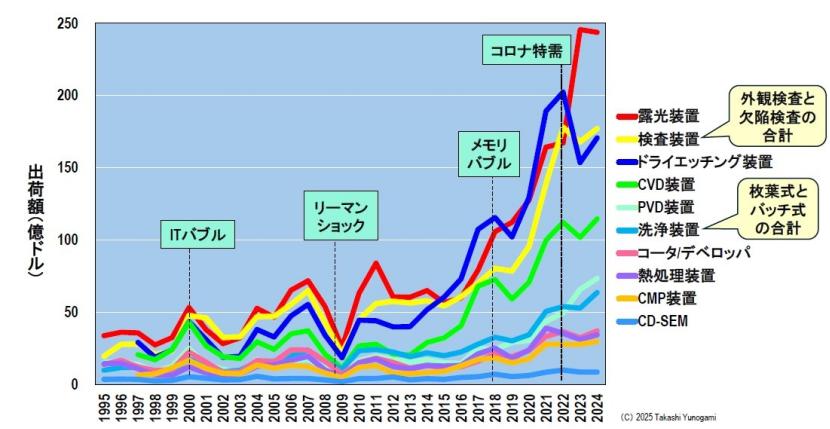
Core Insights - Canon is thriving in the semiconductor manufacturing equipment market, particularly with its Nano Imprint Lithography (NIL) technology, which is expected to bring a paradigm shift in optical lithography processes [1][34] - The semiconductor industry experienced a downturn in 2023 after a surge in 2022 due to COVID-19, but is projected to recover in 2024, with most equipment shipments expected to increase [1][9] - The market for front-end semiconductor manufacturing equipment is primarily dominated by European and American manufacturers, with significant market shares held by companies like ASML, Lam Research, and Applied Materials [2][6] Market Share and Trends - The market size for major equipment types exceeds $10 billion, with lithography equipment valued at $24.4 billion, primarily dominated by ASML (94.1% market share) [2][6] - Japan holds significant shares in several equipment categories, such as coating and developing equipment (94.5%) and vertical diffusion furnaces (82.2%), but these markets are relatively small [2][6] - Japan's market share in front-end equipment has been declining since 2011, with projections indicating a further drop to 21.7% by 2024, while the U.S. is expected to hold 44.3% and Europe 29.2% [9][11] Canon's Performance - Canon has shown strong performance in the lithography equipment sector, with its market share increasing from 14.5% in 2011 to an expected 32.7% by 2024, while Nikon's share has significantly declined [16][34] - Canon's strategy focuses on KrF and i-line technologies, where it has achieved a dominant market position, particularly in i-line with a projected share of 74.6% by 2024 [28][34] - The company is developing NIL technology, which offers a cost-effective and simpler method for creating fine patterns, potentially disrupting the current lithography market dominated by ASML [34] Future Outlook - If NIL technology is successfully implemented in semiconductor mass production, it could weaken ASML's dominance in EUV and ArF immersion technologies, positioning Canon to establish NIL as a new business pillar [34] - The NIL technology, while facing challenges related to defects from contaminants on masks, presents a lower-cost alternative compared to EUV systems, which are priced over 30.8 billion yen [34]


2 Magnificent Dividend Stocks Down 17% and 27% I'm Buying Right Now
The Motley Fool· 2025-08-25 10:30
Group 1: ASML - ASML is a critical player in the global semiconductor supply chain, specializing in lithography technology essential for manufacturing semiconductor chips [3][4] - The company holds a dominant position in both mature and leading-edge lithography markets, particularly benefiting from the rise of AI technologies [6][7] - Despite its strong market position, ASML's stock is currently 17% below its 52-week high, primarily due to geopolitical issues rather than operational challenges [7][8] - ASML's current valuation is 28 times earnings, aligning with the S&P 500 average and significantly below its 10-year average of 38 [9] - The global semiconductor industry is projected to grow by 8% through 2040, indicating a favorable outlook for ASML [11] - ASML has a history of returning value to shareholders through stock buybacks and a 31% annual growth rate in dividends over the past decade [12] Group 2: Badger Meter - Badger Meter is North America's leading provider of water and sewer monitoring solutions, with significant historical stock performance, turning $1 invested in 2000 into $74 today [13] - The company's stock has recently declined by 27% from its 52-week high due to disappointing second-quarter earnings, where EPS growth was only 5% [14] - Despite the EPS shortfall, free cash flow grew by 19%, indicating underlying strength in the business [14][15] - Badger Meter's BlueEdge solutions are modernizing traditional water and sewer infrastructure, with a growing SaaS revenue stream that has increased by 28% annually since 2019 [16][19] - 85% of Badger Meter's sales are replacement-driven, providing ample opportunity for upselling to smart water solutions amid stricter regulations [19] - The company currently trades at 34 times free cash flow, below its five-year average of 43, and has a 0.7% dividend yield with a history of increasing payments for 31 consecutive years [21][22]

全球半导体资本设备:中国 7 月进口追踪(2025 年 7 月),年度月度新高,需求仍具韧性,年初至今进口增长 2%
2025-08-25 01:39
Summary of Key Points from the Conference Call Industry Overview - The conference call focuses on the **Global Semiconductor Capital Equipment** industry, specifically the **Wafer Fabrication Equipment (WFE)** imports to China for July 2025, which reached a record high for the year at **USD 3,761 million**, reflecting a **10% year-over-year (YoY)** and **11% month-over-month (MoM)** increase, with year-to-date (YTD) imports up **2% YoY** [2][27][26]. Core Insights and Arguments - **Dry Etch Segment Performance**: The Dry Etch segment showed significant growth, with imports totaling **USD 755 million**, marking a **30% MoM** and **232% YoY** increase. Notably, imports from Malaysia nearly doubled MoM to **USD 300 million** [3][28]. - **Lithography Weakness**: The Lithography segment continues to exhibit weakness, potentially indicating a normalization after previous strong demand. However, fluctuations suggest that this may be temporary, with expectations for a rebound in the second half of 2025 [3][34]. - **Regional Import Dynamics**: The import share by region indicates that the U.S. and Singapore combined account for **42%**, while Japan's share has decreased to **22%** from an average of **26%** last year. This decline is attributed to the lack of favorable foreign exchange conditions for Japanese vendors and a shift in purchasing priorities towards U.S. equipment [4][39]. - **Provincial Import Trends**: The largest buyers of WFE have shifted from Guangdong (21%) to Shanghai (32%) in July, suggesting a potential for sustained strength in these regions into the second half of 2025 and beyond [5][27]. Company-Specific Insights - **ASML**: Projected sales in China for Q3CY25 are estimated at **EUR 1.51 billion**, reflecting a **46% YoY decline** but flat compared to the previous quarter. The monthly import data is noted to be quite variable [6][65]. - **LRCX (Lam Research)**: Expected to see a **14% QoQ increase** in China revenues for the September quarter, with China exposure estimated to be in the high 30s percentage of total revenues [7][81]. - **AMAT (Applied Materials)**: Reported a **44% QoQ increase** in China revenues, aligning with regression analysis predictions of a **53% increase** [8][90]. - **Kokusai**: Anticipated to see a **41% YoY** and **37% QoQ increase** in China revenue, with a significant contribution expected in the September quarter [12]. - **Advantest**: Projected to experience a **38% YoY** and **32% QoQ decline** in China revenue, indicating potential challenges ahead [13]. Additional Important Insights - **Market Dynamics**: The overall WFE market in China is becoming increasingly significant, with global vendors still capturing approximately **84%** of the market share in 2024. The data on imports provides critical insights into demand trends [23]. - **Investment Implications**: Companies like NAURA, AMEC, and Piotech are positioned favorably due to their broad product portfolios and domestic market leadership, benefiting from the ongoing WFE domestic substitution in China [15][16][17]. - **Long-term Outlook**: The overall sentiment suggests that while there may be short-term fluctuations, the long-term growth trajectory for the WFE market in China remains positive, driven by domestic demand and technological advancements [20][22]. This summary encapsulates the key points discussed in the conference call, highlighting the current state and future outlook of the semiconductor capital equipment industry, particularly in relation to WFE imports to China.


Investing $1,000 in Each of These Growth Stocks Could Go a Long Way for Patient Investors
The Motley Fool· 2025-08-24 09:45
Group 1: ON Semiconductor - ON Semiconductor is heavily reliant on the automotive market, particularly the electric vehicle (EV) sector, which has faced challenges due to high interest rates and increased competition leading to low profitability [4][5]. - Despite current struggles, ON Semiconductor is a highly profitable company trading at less than 15 times estimated free cash flow in 2025, indicating potential undervaluation [6]. - The company has long-term growth opportunities, including a partnership with Nvidia for next-generation data center technology, suggesting a positive outlook for future revenue growth [7]. Group 2: Centrus Energy - Centrus Energy is positioned to benefit from the growing interest in nuclear energy in the U.S., especially following recent executive orders that have spurred investment in the sector [9][10]. - The company reported a backlog of $3.8 billion as of March 31, 2025, with $2.8 billion attributed to its low-enriched uranium segment, indicating strong demand and growth potential [11]. - Centrus Energy is uniquely capable of producing high-assay low-enriched uranium (HALEU), which is increasingly needed for advanced nuclear projects, further enhancing its growth prospects [12]. Group 3: ASML - ASML plays a critical role in semiconductor manufacturing, particularly in producing extreme ultraviolet (EUV) lithography machines essential for AI chip production [14]. - The demand for AI chips is expected to drive growth for ASML, as semiconductor fabs will need to increase production to meet rising workloads [15]. - Although ASML faces short-term challenges due to trade tensions and has tempered growth expectations for 2026, the long-term investment thesis remains strong, supported by reasonable valuation and dividend payments [16][17].