ASML Holding(ASML)

Search documents
高盛:中国光刻机落后20年!
国芯网· 2025-09-02 13:20
Core Viewpoint - The report from Goldman Sachs indicates that China's domestic lithography machines can only produce chips with a 65nm process, lagging approximately 20 years behind international leader ASML [1][3]. Group 1: Current State of Chinese Semiconductor Technology - Although China can produce 7nm process chips, it likely relies on older DUV lithography machines from ASML, as China lacks the capability to manufacture such equipment [3]. - The latest High-NA EUV lithography machines from ASML are crucial for processes below 1.4nm and have begun delivery to major companies like Intel, TSMC, and Samsung [3]. - ASML's lithography machines have taken 20 years and $40 billion in R&D and capital expenditures to evolve from 65nm to 3nm and below [3]. Group 2: Market Dynamics and Competition - The global lithography machine market is dominated by ASML, which holds over 80% market share, and 100% of the advanced EUV lithography machine market [4]. - The relationship between lithography machines and chip manufacturing processes is direct, with specific machines designed for corresponding process nodes [4]. Group 3: Lithography Machine Classification - The classification of lithography machines includes various generations, with the current domestic machines being ArF type, suitable for 90nm process chips, indicating a significant technological gap compared to ASML [5]. - The table of lithography machine classifications shows the evolution from G-line machines for processes greater than 350nm to EUV machines for processes below 7nm [5].


1000+深度报告下载:半导体材料/显示材料/新材料能源/新材料等
材料汇· 2025-09-02 12:08
Investment - The article discusses various investment opportunities in new materials, semiconductors, and renewable energy sectors, highlighting the growing demand and technological advancements in these areas [1][3][4]. Semiconductor - It emphasizes the importance of semiconductor materials such as photolithography, electronic special gases, and silicon wafers, which are critical for the production of advanced electronic devices [1][3]. - The report outlines the trends in third-generation semiconductors, including silicon carbide and gallium nitride, which are expected to drive future growth [1][3]. New Energy - The article covers the advancements in new energy technologies, particularly lithium batteries and solid-state batteries, which are pivotal for electric vehicles and energy storage solutions [1][3]. - It also mentions the significance of hydrogen energy and wind power as part of the broader renewable energy landscape [1][3]. Photovoltaics - The report highlights the growth in the photovoltaic sector, focusing on materials such as solar glass and photovoltaic back sheets, which are essential for solar panel manufacturing [1][3]. New Display Technologies - The article discusses innovations in display technologies, including OLED, MiniLED, and MicroLED, which are transforming consumer electronics and display applications [3]. Fibers and Composite Materials - It addresses the development of advanced fiber materials like carbon fiber and aramid fiber, which are crucial for lightweight and high-strength applications in various industries [3]. Notable Companies - The article lists key players in the materials sector, including ASML, TSMC, and Tesla, emphasizing their roles in driving innovation and market growth [4]. Investment Strategies - The report outlines different investment stages, from seed rounds to pre-IPO, detailing the associated risks and characteristics of companies at each stage, which is essential for potential investors [6].




莫迪推动芯片自给 阿斯麦(ASML.US)积极拓展印度业务
Zhi Tong Cai Jing· 2025-09-02 11:04
阿斯麦发言人拒绝透露任何有关潜在销售的细节,比如销售的时间表或具体产品型号。 莫迪希望建立可靠的本土芯片产业,并期望首批印度制造的芯片将于年底前上市,这可能为阿斯麦的设 备开辟一个新的市场。这个南亚国家正与美国、日本和中国等国一道,建设其半导体制造能力,部分原 因是为了减少对其他地区的依赖。 据报道,尽管全球大型芯片制造商尚未承诺在印度投资,但ChatGPT制造商OpenAI正在寻找当地合作伙 伴,建立一个至少拥有1吉瓦容量的数据中心。 (原标题:莫迪推动芯片自给 阿斯麦(ASML.US)积极拓展印度业务) 智通财经APP获悉,在印度总理纳伦德拉·莫迪寻求在本地生产芯片并减少关键技术进口之际,半导体 设备制造商阿斯麦(ASML.US)积极拓展印度业务。 阿斯麦首席执行官Christophe Fouquet周二在新德里举行的印度半导体峰会上表示,该公司希望在未来一 年深化与印度公司的合作。这家总部位于荷兰费尔德霍芬的公司是台积电和三星电子的重要供应商。 Fouquet表示:"我们致力于通过合作、知识交流和人才共享支持印度的雄心壮志。我们先进的光刻解决 方案可以帮助印度晶圆厂实现尖端性能。" 阿斯麦生产制造高端芯 ...
美银下调阿斯麦目标价至724欧元
Ge Long Hui A P P· 2025-09-02 10:53
Group 1 - Bank of America has lowered the target price for ASML from €755 to €724 [1]
中国光刻机,落后20年?
半导体芯闻· 2025-09-02 10:39
Core Viewpoint - Investment bank Goldman Sachs believes that Chinese lithography companies are at least 20 years behind their American counterparts in advanced lithography technology, which is a critical bottleneck in high-end chip manufacturing [2][4]. Group 1: Lithography Technology - Lithography is one of the steps in chip manufacturing, involving the transfer of chip designs from photomasks to silicon wafers. Advanced equipment like ASML's EUV and high numerical aperture EUV scanners can transfer smaller circuit patterns, enhancing chip performance [4]. - The report from Goldman Sachs emphasizes that ASML invested $40 billion over 20 years to transition from 65nm lithography to below 3nm technology, highlighting the significant time and capital required for such advancements [5]. Group 2: Current Industry Status - Leading chip manufacturers like Taiwan's TSMC are currently mass-producing 3nm chips and are accelerating the production of 2nm products, while Chinese lithography equipment manufacturers are still at the 65nm process stage [5]. - ASML's CEO, Christophe Fouquet, stated that due to the inability to obtain the most advanced EUV lithography equipment, Chinese companies lag behind industry giants like Intel, TSMC, and Samsung Electronics by approximately 10 to 15 years [5]. Group 3: Export Controls and International Relations - The U.S. government is pressuring ASML not to provide maintenance services for advanced DUV systems sold to China, in line with current sanctions against the Chinese semiconductor industry. However, the Dutch government has not agreed to these U.S. requests [6]. - ASML aims to retain control over its equipment to prevent sensitive information leaks, as allowing Chinese companies to take over maintenance could compromise this information [6].
美国万万没想到,欧洲芯片巨头,大规模加码“中国制造”
Sou Hu Cai Jing· 2025-09-02 02:01
美国万万没想到,欧洲芯片巨头,大规模加码"中国制造" 美国万万没想到 欧洲芯片巨头 大规模加码"中国制造" 大家好啊 我是老陈。昨天看到一个让人拍手叫好的消息 欧洲最大的芯片设备制造商ASML 居然宣布要在中国大规模扩产!你说这事儿有多打脸 美国人费 尽心思拉着欧洲小弟们一起围堵中国芯片产业 结果人家欧洲企业转头就跑到中国来建厂 这不是啪啪打脸吗? 想当年 美国是怎么忽悠欧洲的 说起这事儿 还得从几年前说起。2018年开始 美国就开始各种给中国芯片产业使绊子 什么实体清单啊 什么技术封锁啊 反正就是不让中国搞芯片。但是美 国一个人唱独角戏不够啊 得拉上小弟们一起干 于是就开始忽悠欧洲 说什么"中国威胁论" 说什么要保护西方的技术优势。 那时候的欧洲人 特别是荷兰 还真被美国给忽悠瘸了。ASML这家公司 掌握着全球最先进的光刻机技术 美国人软磨硬泡 又是威胁又是利诱的 硬是让荷兰 政府出台政策 禁止向中国出售最先进的EUV光刻机。当时老陈看到这个新闻 心里那个憋屈啊 明明是荷兰的公司 凭啥要听美国人的? | ompany | Investment in China | | --- | --- | | TMicr ...
突然全线暴跌,发生了什么?
Zheng Quan Shi Bao· 2025-09-01 11:50
Group 1 - The semiconductor sector in Japan and South Korea experienced a significant sell-off, with major companies like Advantest and SK Hynix seeing declines of over 9% and 5% respectively, influenced by a sell-off in US tech stocks [1][3] - Concerns about the future performance of AI chip companies arose after underwhelming earnings guidance from US chip giants, leading to fears of slowing growth in the AI chip market [1][3] - Nvidia's reliance on a small number of customers was highlighted, with nearly 40% of its second-quarter revenue for fiscal year 2026 coming from just two clients, raising questions about its dependency on these major customers [1][3][4] Group 2 - The Philadelphia Semiconductor Index dropped over 3%, with notable declines in companies like Marvell Technology and Oracle, further impacting investor sentiment towards AI chip stocks [3] - The overall valuation of the US stock market has reached unprecedented levels, with the S&P 500's price-to-sales ratio hitting 3.23, surpassing the peak during the dot-com bubble [7] - Analysts express skepticism about the sustainability of high valuations for tech giants, suggesting that fundamental performance will ultimately dictate stock prices [8]




突然!全线暴跌,发生了什么?
券商中国· 2025-09-01 11:06
Core Viewpoint - The semiconductor sector in Japan and South Korea has experienced a significant sell-off, primarily influenced by the recent decline in U.S. tech stocks, raising concerns about the future performance of AI chip companies [2][3]. Group 1: Market Reaction - Following the opening of the market, major chip manufacturers in Japan and South Korea saw substantial declines, with Advantest dropping over 9%, Hanmi Semiconductor down over 6%, SK Hynix falling over 5%, and Samsung Electronics decreasing over 3% [2]. - The overall market indices also suffered, with the Nikkei 225 index falling by 1.24% and the KOSPI index declining by 1.35% [3]. Group 2: U.S. Market Influence - The sell-off in Japanese and Korean semiconductor stocks was largely attributed to a more than 3% drop in the Philadelphia Semiconductor Index, with notable declines in companies like Marvell Technology (down over 18%) and Oracle (down 5.9%) [3]. - Concerns were raised regarding the future growth of AI chip companies due to disappointing earnings guidance from some U.S. chip giants [3]. Group 3: Nvidia's Client Dependency - Nvidia's recent disclosures indicated that nearly 40% of its revenue for the second fiscal quarter of 2026 came from just two clients, raising alarms about the company's reliance on a limited customer base [4]. - The two major clients contributed 23% and 16% to Nvidia's total revenue, significantly higher than the previous year's contributions of 14% and 11% [4]. Group 4: Valuation Concerns - Analysts have pointed out that the extreme volatility in U.S. AI chip stocks stems from previously inflated expectations and high valuations, leaving little room for error in earnings reports [5]. - The S&P 500 index's price-to-sales ratio has reached a historic high of 3.23, surpassing levels seen during the dot-com bubble, while the forward P/E ratio stands at 22.5, well above the long-term average of 16.8 since 2000 [6]. Group 5: Market Concentration - The top 10 companies in the S&P 500 now account for 39.5% of the index's total market capitalization, the highest recorded level, primarily driven by tech giants like Nvidia and Microsoft [7]. - Concerns have been raised about the sustainability of these high valuations, with some market participants skeptical about whether fundamentals will support current price levels over time [7]. Group 6: AI Investment Bubble Warnings - Increasing warnings about an "AI investment bubble" have emerged, with industry leaders comparing the current situation to past investment failures, such as SoftBank's investments in WeWork and Zume [8].


光刻工艺套刻设备,本土亟待突破
半导体行业观察· 2025-09-01 01:17
Core Viewpoint - The article emphasizes the urgent need for domestic production of semiconductor overlay measurement equipment in China, particularly in light of the low localization rate and the increasing demand driven by advanced process nodes and AI chip production [1][32]. Group 1: Semiconductor Equipment Landscape - China's semiconductor industry is making significant progress in equipment, but the localization rate for advanced process semiconductor equipment remains low [1]. - The manufacturing of a chip typically requires hundreds of devices and involves 400-500 processes, with overlay measurement being a critical step [1][5]. - Overlay measurement equipment is essential for ensuring the precision of layer alignment in semiconductor manufacturing, which directly impacts chip functionality and yield [5][11]. Group 2: Overlay Measurement Equipment - Overlay measurement devices are crucial for detecting and correcting alignment errors between layers during the chip manufacturing process [5][8]. - The acceptable range for overlay errors is closely related to the critical dimensions (CD) of the layers, with specific requirements for different process nodes [11][18]. - The demand for overlay equipment is increasing, particularly in advanced process nodes, with 80% of the demand coming from these processes [22][33]. Group 3: Market Dynamics - The overlay measurement market is dominated by KLA and ASML, which together hold over 90% of the market share [24]. - KLA has a significant presence in the market with a focus on IBO technology, while ASML has gained market share through DBO technology [24][26]. - The competitive landscape shows that KLA's equipment is preferred for memory chip manufacturing, while ASML's DBO technology is favored for logic chip processes [26]. Group 4: Domestic Challenges and Opportunities - The localization rate for overlay measurement equipment in China is less than 5%, highlighting the urgent need for domestic alternatives [33]. - Domestic manufacturers like Erwei Micro are emerging, with capabilities to develop competitive overlay measurement equipment, but challenges remain in achieving consistency and stability compared to international giants [34][38]. - The collaboration with local suppliers to enhance the domestic supply chain is crucial for the sustainable development of China's semiconductor industry [38][40].

费城半导体指数跌2.5%
Ge Long Hui A P P· 2025-08-29 14:52
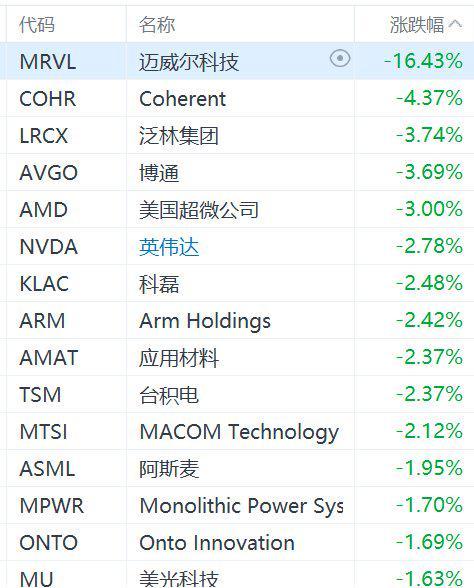
Core Viewpoint - The semiconductor sector in the US stock market experienced a significant decline, with the Philadelphia Semiconductor Index dropping by 2.5% at the beginning of trading [1] Company Performance - Marvell Technology saw a sharp decline of over 16% [1] - Other companies such as Lam Research, Broadcom, and AMD experienced declines of over 3% [1] - Major players like NVIDIA, ARM, Applied Materials, and TSMC fell by more than 2% [1] - ASML and Micron Technology also reported declines of over 1% [1]