ASML Holding(ASML)

Search documents
全球半导体资本设备:中国 7 月进口追踪(2025 年 7 月),年度月度新高,需求仍具韧性,年初至今进口增长 2%
2025-08-25 01:39
Summary of Key Points from the Conference Call Industry Overview - The conference call focuses on the **Global Semiconductor Capital Equipment** industry, specifically the **Wafer Fabrication Equipment (WFE)** imports to China for July 2025, which reached a record high for the year at **USD 3,761 million**, reflecting a **10% year-over-year (YoY)** and **11% month-over-month (MoM)** increase, with year-to-date (YTD) imports up **2% YoY** [2][27][26]. Core Insights and Arguments - **Dry Etch Segment Performance**: The Dry Etch segment showed significant growth, with imports totaling **USD 755 million**, marking a **30% MoM** and **232% YoY** increase. Notably, imports from Malaysia nearly doubled MoM to **USD 300 million** [3][28]. - **Lithography Weakness**: The Lithography segment continues to exhibit weakness, potentially indicating a normalization after previous strong demand. However, fluctuations suggest that this may be temporary, with expectations for a rebound in the second half of 2025 [3][34]. - **Regional Import Dynamics**: The import share by region indicates that the U.S. and Singapore combined account for **42%**, while Japan's share has decreased to **22%** from an average of **26%** last year. This decline is attributed to the lack of favorable foreign exchange conditions for Japanese vendors and a shift in purchasing priorities towards U.S. equipment [4][39]. - **Provincial Import Trends**: The largest buyers of WFE have shifted from Guangdong (21%) to Shanghai (32%) in July, suggesting a potential for sustained strength in these regions into the second half of 2025 and beyond [5][27]. Company-Specific Insights - **ASML**: Projected sales in China for Q3CY25 are estimated at **EUR 1.51 billion**, reflecting a **46% YoY decline** but flat compared to the previous quarter. The monthly import data is noted to be quite variable [6][65]. - **LRCX (Lam Research)**: Expected to see a **14% QoQ increase** in China revenues for the September quarter, with China exposure estimated to be in the high 30s percentage of total revenues [7][81]. - **AMAT (Applied Materials)**: Reported a **44% QoQ increase** in China revenues, aligning with regression analysis predictions of a **53% increase** [8][90]. - **Kokusai**: Anticipated to see a **41% YoY** and **37% QoQ increase** in China revenue, with a significant contribution expected in the September quarter [12]. - **Advantest**: Projected to experience a **38% YoY** and **32% QoQ decline** in China revenue, indicating potential challenges ahead [13]. Additional Important Insights - **Market Dynamics**: The overall WFE market in China is becoming increasingly significant, with global vendors still capturing approximately **84%** of the market share in 2024. The data on imports provides critical insights into demand trends [23]. - **Investment Implications**: Companies like NAURA, AMEC, and Piotech are positioned favorably due to their broad product portfolios and domestic market leadership, benefiting from the ongoing WFE domestic substitution in China [15][16][17]. - **Long-term Outlook**: The overall sentiment suggests that while there may be short-term fluctuations, the long-term growth trajectory for the WFE market in China remains positive, driven by domestic demand and technological advancements [20][22]. This summary encapsulates the key points discussed in the conference call, highlighting the current state and future outlook of the semiconductor capital equipment industry, particularly in relation to WFE imports to China.





Investing $1,000 in Each of These Growth Stocks Could Go a Long Way for Patient Investors
The Motley Fool· 2025-08-24 09:45
Group 1: ON Semiconductor - ON Semiconductor is heavily reliant on the automotive market, particularly the electric vehicle (EV) sector, which has faced challenges due to high interest rates and increased competition leading to low profitability [4][5]. - Despite current struggles, ON Semiconductor is a highly profitable company trading at less than 15 times estimated free cash flow in 2025, indicating potential undervaluation [6]. - The company has long-term growth opportunities, including a partnership with Nvidia for next-generation data center technology, suggesting a positive outlook for future revenue growth [7]. Group 2: Centrus Energy - Centrus Energy is positioned to benefit from the growing interest in nuclear energy in the U.S., especially following recent executive orders that have spurred investment in the sector [9][10]. - The company reported a backlog of $3.8 billion as of March 31, 2025, with $2.8 billion attributed to its low-enriched uranium segment, indicating strong demand and growth potential [11]. - Centrus Energy is uniquely capable of producing high-assay low-enriched uranium (HALEU), which is increasingly needed for advanced nuclear projects, further enhancing its growth prospects [12]. Group 3: ASML - ASML plays a critical role in semiconductor manufacturing, particularly in producing extreme ultraviolet (EUV) lithography machines essential for AI chip production [14]. - The demand for AI chips is expected to drive growth for ASML, as semiconductor fabs will need to increase production to meet rising workloads [15]. - Although ASML faces short-term challenges due to trade tensions and has tempered growth expectations for 2026, the long-term investment thesis remains strong, supported by reasonable valuation and dividend payments [16][17].



ASML: A Fundamentally Undervalued Monopoly At The Heart Of The AI Revolution
Seeking Alpha· 2025-08-21 18:42
Company Overview - ASML Holding N.V. is a crucial player in the global technology industry, currently valued at $296 billion with a price-to-earnings (P/E) ratio of 26, indicating a potential undervaluation in the market [1]. Analyst Background - The analyst has extensive experience in financial markets, having started trading in 2005 and working as an analyst in various brokerage firms in Russia and Ukraine since 2010. This background provides a solid foundation for understanding macroeconomic trends and market dynamics [1].

ASML Has Entered Buy Territory, But Only For Patient Investors
MarketBeat· 2025-08-21 12:04
Core Viewpoint - The technology sector has players with near monopolies, and ASML Holding is highlighted as a key investment opportunity due to its unique position in the semiconductor industry, particularly in extreme ultraviolet (EUV) lithography equipment essential for advanced chip manufacturing [1][4][5]. Company Overview - ASML Holding trades at $749.49 with a 52-week range of $578.51 to $945.05, a dividend yield of 0.84%, and a P/E ratio of 31.28. The price target is set at $923.80, indicating a potential upside of 23.26% [2][10]. Market Position - ASML holds a near monopoly in EUV lithography, crucial for producing chips at five-nanometer technology and below, which are vital for major companies like NVIDIA and Intel [4][5]. - The current market setup is characterized by popularity-driven valuations, leading to undervaluation of ASML despite its strong fundamentals [3][8]. Valuation Insights - ASML's stock is currently trading at 76% of its 52-week high, reflecting a significant undervaluation primarily due to market fears related to its exposure to China [7][8]. - The forward P/E ratio of 27.8x is well below its historical average of 40.0x, suggesting a substantial upside potential if market sentiment shifts positively [8][12]. Investor Sentiment - The market's fear surrounding ASML, particularly its ties to China, has created an emotional undervaluation, presenting a buying opportunity for patient investors [6][8][14]. - Despite ASML's critical role in the semiconductor industry, it remains under-discussed among major investors, indicating that it is still early for broader market recognition [11][15]. Financial Metrics - ASML's price-to-book (P/B) ratio stands at 14.6x, contrasting with the average P/B of 9.1x in the computer sector, indicating a premium valuation that may precede a significant stock movement [12][13].

What Are the 3 Top Artificial Intelligence (AI) Stocks to Buy Right Now?
The Motley Fool· 2025-08-21 08:08
Core Viewpoint - The stock market is experiencing significant growth, driven by investments in artificial intelligence (AI), which is expected to evolve into a multitrillion-dollar industry in the future [1]. Group 1: AI Market Dynamics - Major technology companies are investing billions into AI infrastructure, contributing to the upward trajectory of the stock market [1]. - Despite the market's growth, it is essential to consider valuations when selecting AI stocks to invest in [2]. Group 2: Company Highlights - **Advanced Micro Devices (AMD)**: - AMD is positioned to gain market share in the AI chip sector, competing with Nvidia [4]. - The Instinct MI355X chip offers up to 40% more AI output per dollar compared to Nvidia's equivalent, attracting significant customer interest [5]. - AMD's stock trades at a price-to-sales ratio of just under 10, significantly lower than Nvidia's, indicating potential for growth if market share is captured [6]. - **ASML**: - ASML is the sole producer of extreme ultraviolet (EUV) lithography machines, essential for manufacturing advanced AI chips [8]. - The stock has declined over 30% from its all-time high due to geopolitical tensions, presenting a potential buying opportunity [9]. - Analysts project long-term annualized earnings growth of over 16%, with a price-to-earnings ratio of 28, suggesting the stock may be undervalued [10]. - **Alphabet**: - Alphabet, the parent company of Google, continues to perform well despite regulatory challenges, with Google Search revenue increasing by 12% year-over-year [11][12]. - The company's other segments, including Google Cloud and Waymo, are benefiting from AI advancements, with Google Cloud revenue surging 32% [12]. - Alphabet's stock trades at a P/E ratio of less than 22, with anticipated earnings growth of almost 15% annually, making it an attractive investment [13].


ASML: The Best Disappointing Chip Stock To Buy
Seeking Alpha· 2025-08-19 16:18
Group 1 - ASML is recognized as the leading manufacturer of lithography machines, and there is a bullish outlook on the stock with a recent price target increase and a "Strong Buy" rating [2] - The stock has shown a performance increase of 16.8%, indicating positive market sentiment and growth potential [2] Group 2 - The Aerospace Forum aims to identify investment opportunities within the aerospace, defense, and airline sectors, leveraging data analytics for informed decision-making [2] - The analysis provided by the forum is rooted in a background of aerospace engineering, which enhances the understanding of industry complexities and growth prospects [2]

芯片设备公司,冰火两重天
半导体行业观察· 2025-08-19 01:24
Core Insights - The profitability of top chip equipment manufacturers is diverging, with some losing momentum due to declining sales in China, while others are capitalizing on the demand for AI chips [2][5] - Among ten manufacturers from Japan, the US, and Europe, five reported a year-on-year decline in net profit or lower growth compared to the previous year [2] - The combined net profit of these manufacturers has remained robust, growing approximately 40% for the fifth consecutive quarter, reaching $9.4 billion [2] Group 1: Company Performance - Lam Research's net profit surged by 69%, driven by strong sales of deposition and etching equipment for high-bandwidth memory and advanced logic chips [2] - KLA's net profit increased by 44%, benefiting from growth in inspection and measurement equipment for advanced packaging [2] - ASML Holding, ASM International, and Advantest also reported higher profit growth compared to the same period in 2024 [2] Group 2: Challenges Faced - Tokyo Electron, Screen Holdings, and Teradyne experienced declines in net profit after significant growth of over 50% to 90% in the previous year [5] - A major factor for the decline is the slowdown in sales to China, with nine companies reporting a combined sales drop of 5% to $9.3 billion, accounting for 30% of total sales, down from approximately 40% at the end of 2023 [5] - Tokyo Electron's sales from China accounted for 39%, a decrease of 11 percentage points from the previous year, and growth in its Taiwan business could not compensate for this loss [5] Group 3: Market Outlook - Despite the challenges, five US and European companies expect sales growth in the upcoming quarter, with four Japanese companies also projected to achieve revenue growth [6] - The industry faces uncertainty as Washington considers imposing new semiconductor tariffs and restricting AI semiconductor exports [6] - The total market capitalization of the top ten semiconductor equipment manufacturers is approximately $910 billion, down about 20% from the latest peak in July 2024 [7]



湾芯展2025再升级:展区扩容50%,百亿级产业机遇蓄势爆发
半导体行业观察· 2025-08-19 01:24
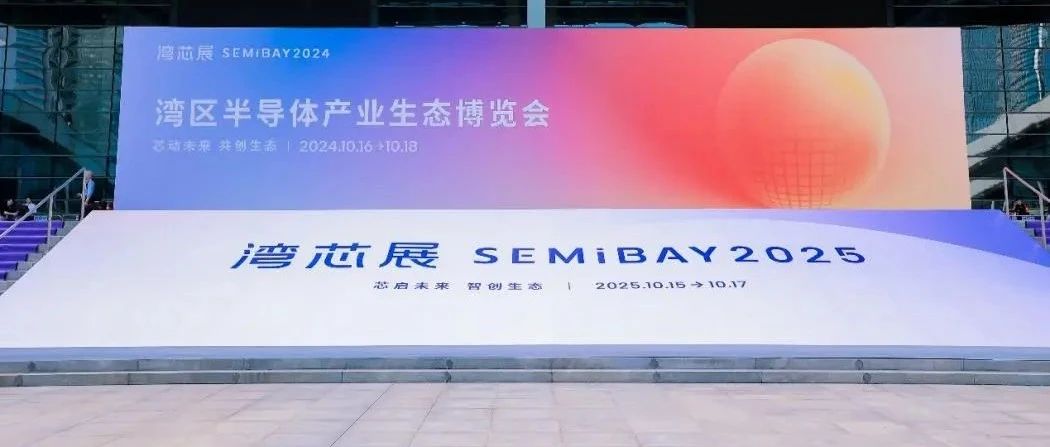
Core Viewpoint - The 2025 Bay Area Semiconductor Industry Eco-Expo aims to showcase the innovation and business opportunities within the global semiconductor industry, featuring a significant scale upgrade and a comprehensive industry ecosystem [1][17]. Group 1: Event Overview - The expo will take place from October 15 to 17, 2025, at the Shenzhen Convention Center, with a total exhibition area exceeding 60,000 square meters, which is equivalent to eight standard football fields [1]. - The event will gather over 600 leading industry companies and is expected to attract 60,000 professional visitors, along with hosting more than 20 cutting-edge technology summits and industry forums [1][9]. Group 2: Industry Coverage - The expo will feature four core exhibition areas: wafer manufacturing, compound semiconductors, IC design, and advanced packaging, covering the entire industry chain from upstream materials and equipment to downstream applications [4][7]. - Each exhibition area is meticulously planned to not only showcase the latest technological achievements but also to focus on practical application scenarios, providing an immersive industry experience for exhibitors and visitors [4]. Group 3: Innovative Display Modes - The expo introduces an innovative "technology + application ecosystem" display mode, with three ecological zones dedicated to AI chip ecosystems, RISC-V ecosystems, and Chiplet and advanced packaging ecosystems [6]. - This approach allows visitors to deeply experience semiconductor technology in various application scenarios, including AI computing centers, robotics, smart vehicles, smart cities, Industry 4.0, and consumer electronics [6]. Group 4: Business Opportunities - The wafer manufacturing exhibition area will showcase top global wafer manufacturing equipment and materials suppliers, presenting comprehensive solutions for the entire wafer manufacturing process, including key technological breakthroughs [7]. - The expo is expected to unlock over 10 billion yuan in industrial cooperation opportunities across various fields, including equipment procurement, technology licensing, production line construction, and material supply [9]. Group 5: Year-Round Service Ecosystem - The expo will establish a year-round service ecosystem, breaking the traditional three-day exhibition time limitation, and will include a demand database and supplier resource library for precise matching before, during, and after the event [10][19]. - An innovative "project procurement exhibition" model will be introduced, focusing on project demand to facilitate efficient matching between suppliers and buyers [11]. Group 6: Collaborative Development - The expo will connect six major semiconductor industry cities in China, leveraging local industrial characteristics and resource advantages to form a collaborative development pattern [12]. - It will provide a platform for global product launches, technical exchanges, and precise procurement matching, inviting key downstream purchasers from the industry [12][14]. Group 7: Comprehensive Professional Services - The organizers will offer a full range of professional services throughout the exhibition process, including pre-exhibition demand research, on-site business coordination, and post-exhibition project tracking [19]. - The expo aims to promote the deep integration of the global semiconductor industry ecosystem, contributing to the transition of China's semiconductor industry from "technology following" to "innovation leading" [17].
ASML Stock Trades at a Discount: Should You Buy, Sell or Hold?
ZACKS· 2025-08-18 14:46
Core Insights - ASML Holding N.V. is currently trading at a discounted valuation with a forward 12-month P/E ratio of 26.14, lower than the Zacks Computer and Technology sector average of 28.19 [1][3] - The stock has underperformed compared to major semiconductor companies like Broadcom, NVIDIA, and AMD, which have P/E multiples of 38.58, 36, and 24.47 respectively [3] - Despite strong Q2 results, ASML's stock dropped 9.6% due to weaker-than-expected third-quarter guidance and concerns about the 2026 growth outlook [4][5] Financial Performance - ASML reported Q2 net sales of €7.69 billion, a 23.2% year-over-year increase, and EPS of €5.90, up 47.1% [4] - Converted to USD, Q2 revenues and EPS were $8.7 billion and $6.70, respectively, both exceeding analysts' expectations [4] - The company issued disappointing guidance for Q3, expecting revenues between €7.4 billion and €7.9 billion, translating to $8.6 billion to $9.2 billion, below the Zacks Consensus Estimate of $9.81 billion [11] Growth Outlook - Management expressed uncertainty about the growth outlook for 2026, stating they "cannot confirm growth" due to customer hesitation and ongoing market uncertainty [9][10] - Ongoing U.S.-China tariff discussions are negatively impacting customer capital spending timelines, potentially delaying orders and revenue recognition [10] - The Zacks Consensus Estimate for 2026 earnings has been revised downward by 4.1% over the past 30 days [12] Market Performance - Year-to-date, ASML's stock has gained 7.1%, underperforming the tech sector's growth of 13.7% and major semiconductor players like Broadcom, NVIDIA, and AMD, which have risen 32.1%, 34.4%, and 47% respectively [6] - The stock's valuation discount is viewed as a reflection of real risks ahead rather than a buying opportunity [13]

美股Q2 机构持仓大动作:科技股分歧加剧,巨头策略各有侧
贝塔投资智库· 2025-08-18 04:16
Core Viewpoint - The article discusses the contrasting strategies of major financial institutions regarding their holdings in the U.S. stock market, particularly in technology stocks, amidst the AI boom and market volatility [3]. Group 1: UBS's Strategy - UBS reduced its holdings in major tech stocks like Apple (down 10.86%), Nvidia (down 5.16%), and Microsoft (down 3.95%), while increasing its position in Nasdaq 100 index put options by 84.21%, indicating a defensive stance [4][5]. - The overall market value of UBS's U.S. stock holdings increased by 7% to $580 billion, but the firm opted to take profits and hedge against potential declines in tech stocks rather than the entire market [5]. Group 2: Wells Fargo's Approach - Wells Fargo showed strong confidence in the broader market, increasing its total holdings by 9.77% to $483 billion, with a significant 47.29% increase in the S&P 500 ETF [6]. - The bank exhibited a "structural increase" in tech stocks, notably boosting its position in Google by 30.89% and adding Broadcom to its top holdings, reflecting a commitment to the AI supply chain [6]. Group 3: Nomura's Aggressive Position - Nomura's holdings grew by 13% to $60.5 billion, with a focus on AI applications and individual stock volatility, notably increasing its position in Meta call options by 10.98% [7]. - The firm employed a unique strategy with Tesla, simultaneously increasing both call and put options, indicating a bet on significant price volatility amid uncertainties [7]. Group 4: Hedge Fund Strategies - Hedge fund managers displayed varied strategies, with Ackman focusing on consumer stocks like Amazon and Alphabet, while Soros Fund increased its positions in S&P 500 put options by 168.75% [8][9]. - Michael Burry's shift from shorting tech stocks to buying call options in healthcare and tech reflects a significant change in market sentiment, aligning with the broader market rebound [9]. Group 5: Market Signals - The analysis of institutional holdings reveals three key market signals: the division within tech stocks, the standardization of hedging tools, and a balance between defensive and offensive strategies [10]. - Institutions are increasingly using derivatives to manage risks, indicating a shift from a "one-sided rally" to a "volatile market" where structural opportunities are sought [10].