American Express(AXP)

Search documents
“It’ll Be Weird,” If They Go After American Express (AXP) CEO, Says Jim Cramer
Yahoo Finance· 2026-01-16 18:21
Core Viewpoint - American Express Company (NYSE:AXP) has experienced a 14.7% increase in share price over the past year, but a decline of 3.8% year-to-date, influenced by President Trump's proposal for a 10% interest rate cap on credit card companies [2]. Group 1: Company Performance - American Express is one of the largest card payment and travel services companies in the U.S. [2]. - The company's shares have shown a significant annual increase but have faced a decline in the current year [2]. Group 2: Market Influences - The decline in share price is attributed to President Trump's suggestion of a 10% interest rate cap for credit card companies, aimed at reducing costs for consumers [2]. - Wolfe Research had previously set a Peer Perform rating for American Express, indicating potential for the company to exceed revenue and earnings per share targets [2]. Group 3: Analyst Commentary - Jim Cramer has frequently discussed American Express, linking its performance to consumer health and highlighting its successful card initiatives that appeal to younger users [2]. - Cramer expressed skepticism about the implications of the President's proposal on American Express, suggesting that targeting the company's CEO would be unusual [2].

特朗普利率突袭冲击金融股,华尔街高管财报季遭质询
智通财经网· 2026-01-16 12:48
Core Viewpoint - President Trump's unexpected request for credit card companies to set a cap on interest rates at 10% could significantly impact the profitability of the financial sector, leading to a decline in financial stocks and raising concerns among bank executives during earnings calls [1][4]. Financial Sector Impact - The proposed interest rate cap is half of the current average rate on outstanding balances, potentially erasing billions in profits for credit card issuers [1]. - Major banks such as Capital One (COF.US), JPMorgan Chase (JPM.US), and American Express (AXP.US) experienced significant stock declines following the announcement [1]. - Analysts from KBW indicated that if the policy is implemented, it would severely weaken the profitability of credit card issuers and could trigger economic repercussions [4]. Legislative Developments - Trump has called for Congressional support for the Credit Card Competition Act, which targets the nearly $200 billion in swipe fees charged by banks and payment companies, negatively affecting stocks of Visa (V.US) and Mastercard (MA.US) [4]. - Some analysts doubt the feasibility of the interest rate cap, suggesting that the probability of it being enacted is less than 20% due to the lack of legislative support [4]. Broader Economic Effects - Bank executives have warned that the interest rate cap could lead to a significant economic slowdown and push consumers towards unregulated lending sources [5]. - The proposed changes are expected to have ripple effects beyond the financial sector, impacting industries such as airlines and retail, which rely on partnerships with credit card companies for substantial revenue [7]. - Airlines like Delta (DAL.US) and United Airlines (UAL.US) saw stock declines, as did retailers like Macy's (M.US) and Kohl's (KSS.US), due to concerns over the potential impact of the proposed legislation [7].






Trump’s Market Mayhem: A Daily Dose of Volatility, Served Fresh
Stock Market News· 2026-01-16 06:00
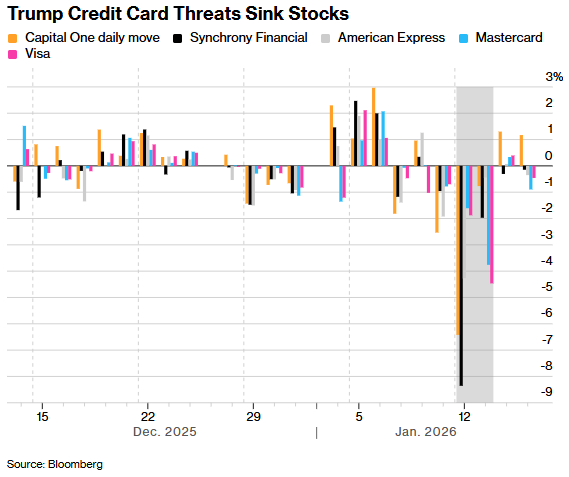
Financial Sector - The financial sector experienced a significant downturn following President Trump's announcement of a one-year cap of 10% on credit card interest rates, effective January 20, 2026, aimed at protecting consumers from high rates averaging around 20% [2][3] - Major financial institutions like JPMorgan Chase, Bank of America, Citigroup, and Wells Fargo saw their stock prices drop significantly, with JPMorgan's shares falling 4.2% to $310.90 despite better-than-expected earnings [3][4] - Consumer finance firms specializing in credit cards faced even steeper declines, with drops between 8% and 11% for companies like Synchrony Financial and Capital One, while Visa and Mastercard also saw declines of over 2% [4] Semiconductor Industry - A trade deal between the U.S. and Taiwan resulted in a reduction of tariffs on Taiwanese goods from 20% to 15%, in exchange for Taiwan's commitment to invest $250 billion in U.S. semiconductor and AI sectors [6][7] - Taiwan Semiconductor Manufacturing Co. reported a 35% year-over-year increase in fourth-quarter profit, leading to a 4.5% surge in its U.S.-listed shares, with trading volume increasing by 159% [7] - Despite a new 25% tariff on specific high-end AI chips, Nvidia's stock rebounded by around 3% due to positive earnings from TSMC and exemptions for companies investing in America [8][9] Healthcare Sector - President Trump introduced "The Great Healthcare Plan" aimed at lowering prescription drug prices and insurance premiums, but the lack of details and the need for Congressional approval left the market skeptical [10] - Some healthcare stocks like UnitedHealth Group and Cigna saw modest gains, but the overall market impact was minimal due to concerns over rising premium costs for millions of Americans [10] Geopolitical Developments - President Trump's announcement of a "Board of Peace" in Gaza and withdrawal from 66 global organizations had little immediate market impact, overshadowed by economic news [11] - Oil prices dropped approximately 5% following Trump's de-escalation of military threats against Iran, indicating a positive market reaction to reduced geopolitical tensions [11] Market Volatility - The week illustrated the unpredictable nature of the market under Trump's administration, characterized by sudden policy announcements and immediate market reactions, creating a challenging environment for investors [12]



Analyst says 'buy the dip' in top bank stock after credit card cap drop
Yahoo Finance· 2026-01-15 23:59
Core Viewpoint - President Trump's proposal to cap credit card interest rates at 10% has led to a significant sell-off in credit card stocks, particularly affecting American Express [1][4]. Group 1: Impact of Interest Rate Cap - A 10% cap on credit card interest would represent a major shift, as the average rate is currently 19.6% [2]. - This cap poses a substantial risk to credit card issuers that depend on interest for revenue and profits [2]. - Despite the sell-off, some analysts believe that American Express is less vulnerable due to its reliance on fees rather than interest income [2][4]. Group 2: American Express's Business Model - American Express focuses on higher-income households willing to pay annual fees for premium card perks, differentiating it from competitors like Synchrony Financial, which relies on no-fee, high-interest cards [5][9]. - The company generates significant revenue from merchant swipe fees, which, combined with card fees, accounted for 65% of its total revenue in the last quarter [10][11]. - American Express's write-offs are lower than those of competitors, indicating a more stable customer base [11]. Group 3: Market Reaction and Analyst Insights - Following the announcement of the interest rate cap, American Express shares fell by 7.3%, including a 4.3% drop on January 12 [3]. - Analysts suggest that the recent decline presents a buying opportunity, as the stock is expected to rebound [3][12]. - The stock price chart indicates a pullback to reliable support levels, with expectations of recovery as earnings are reported on January 30 [7].
Trump's 10% Credit Card Cap Plan Hit AmEx Stock Hard
247Wallst· 2026-01-15 14:51
Core Viewpoint - President Trump's proposed plan to cap credit card rates at 10% has significantly impacted the financial sector, leading to a notable decline in the shares of banks and credit card companies [1] Group 1: Impact on Financial Sector - The proposed cap on credit card rates has caused substantial fluctuations in the stock prices of financial institutions [1] - Banks and credit card companies experienced a sizeable hit in their share values following the announcement of the plan [1]

Bank Execs Say Trump's Credit-Card Interest Rate Idea Is Bad for Consumers—and Business
Investopedia· 2026-01-14 23:00
Core Viewpoint - Major banks oppose President Trump's proposal to cap credit card interest rates at 10%, arguing it could limit consumer access to credit and negatively impact economic growth [1][4]. Group 1: Financial Impact on Banks - Profits in the credit card segment are four times the banking industry average, with lenders earning interest on $1.23 trillion in outstanding U.S. credit card debt at an average annual interest rate of 21% [2]. - Executives from major banks, including JPMorgan Chase and Citigroup, expressed concerns that a cap on interest rates would severely restrict access to credit for consumers, particularly those who need it most, potentially leading to negative consequences for the economy [5]. Group 2: Market Reactions - Shares of major financial service firms declined following the announcement of the proposed interest rate cap, indicating investor concern over the potential impact on profitability [4]. - Some analysts view the drop in share prices as a potential buying opportunity for investors [4]. Group 3: Shift in Consumer Behavior - Experts suggest that if an interest rate cap is enacted, consumers may shift their focus to other financial products, such as personal loans, which could benefit companies like LendingTree [3][5]. - The proposed cap could disrupt the credit card rewards and points system, leading to broader changes in consumer behavior and spending patterns [3].



Wall Street Vs. White House: CEOs Warn Trump's 10% Credit Card Rate Cap Would Freeze Lending
Benzinga· 2026-01-14 22:13
Core Viewpoint - Top executives from major financial institutions warn that President Trump's proposed 10% cap on credit card interest rates could backfire, potentially leading to a significant economic slowdown and reduced access to credit for high-risk borrowers [1][2][3][4][6][9] Group 1: Economic Impact - Citigroup's outgoing CFO Mark Mason stated that the interest rate cap would likely result in a significant slowdown in the economy, despite acknowledging the importance of affordability [3] - JPMorgan Chase's CFO Jeremy Barnum emphasized that the cap would not lower the price of credit but would instead reduce the supply of credit, leading to extensive loss of access for consumers [4][5] - Delta Air Lines' CEO Ed Bastian warned that the cap could disrupt the entire credit card industry, affecting access to credit for lower-end consumers and threatening loyalty programs [6] Group 2: Industry Response - Bank of America CEO Brian Moynihan highlighted the direct correlation between interest rate caps and credit availability, indicating that lower caps would restrict the number of people who can obtain credit cards [7] - Financial leaders collectively expressed a lack of support for the proposed cap, suggesting that it could have severe negative consequences for both consumers and the national economy [4][6][9]

More top Wall Street bankers blast Trump's proposal to cap interest on credit card payments
New York Post· 2026-01-14 21:42
Core Viewpoint - The proposal by President Trump to impose a 10% cap on credit card interest rates has been met with significant opposition from major banking executives, who warn that it could restrict credit access for consumers and negatively impact the economy [1][3][17]. Group 1: Industry Reactions - Bank of America CEO Brian Moynihan expressed concerns that capping interest rates could lead to a credit crunch, limiting credit card availability for consumers [1][2]. - Citigroup's outgoing CFO Mark Mason highlighted the potential "unintended consequences" of the cap, suggesting it could slow down the economy and affect various sectors [4][5]. - Wells Fargo's CFO Mike Santomassimo echoed these sentiments, stating that a cap could hinder economic growth and negatively impact credit availability [8][9]. Group 2: Financial Implications - The average credit card interest rate was reported at 20.97% in November, indicating the high returns banks generate from credit card loans [12]. - Research from Vanderbilt University suggested that a 10% cap could save Americans $100 billion annually, with only a modest impact on rewards and accounts [15]. - JPMorgan CEO Jamie Dimon noted that banks would need to adjust their models to account for the added risk and price controls, indicating that the changes would be significant [15]. Group 3: Market Impact - Following Trump's announcement, banking shares experienced a decline of 5% to 8% as investors assessed the potential impact on financial institutions [3]. - The enforcement of the proposed cap remains uncertain, with questions about whether it would be implemented through executive order, voluntary compliance from banks, or legislative action [17].
These Experts Say Buy Credit Card Stocks Despite Trump's Threats
Investopedia· 2026-01-14 19:55
Core Viewpoint - Credit card stocks are experiencing a decline following President Trump's criticism of the industry regarding high interest rates and fees, alongside his proposal for a cap on credit card interest rates at 10% and support for the Credit Card Competition Act [2][3]. Group 1: Market Reaction - Shares of Visa and American Express have dropped 7% and 5% respectively since the beginning of the week, making them among the worst performers in the Dow Jones Industrial Average, while Mastercard has seen a decline of about 5% [4]. - Analysts from William Blair and Citigroup express confidence that the long-term impact on credit card stocks will be limited, suggesting that historical trends indicate buying during sell-offs related to potential business model changes has been beneficial for investors [5][9]. Group 2: Legislative Context - The Credit Card Competition Act aims to require large banks to enable at least two payment networks for credit cards, with only one being Visa or Mastercard, potentially challenging the dominance of these networks [3]. - The proposed interest rate cap and network reform have raised doubts among experts regarding their implementation by Congress or the Trump administration, but the market has historically overestimated the financial impact of such reforms [5]. Group 3: Historical Performance - Following the enactment of the Durbin Amendment, which capped debit card transaction fees, Visa and Mastercard stocks rose significantly, with respective increases of 1,700% and 2,600% over the past 15 years, outperforming the S&P 500's 550% return during the same period [10]. - Analysts note that despite the requirement for two unaffiliated networks on debit cards, interchange rates did not decrease, suggesting that Visa and Mastercard could similarly adapt if credit card regulations change [8].



BUR vs. AXP: Which Stock Should Value Investors Buy Now?
ZACKS· 2026-01-14 17:41
Core Viewpoint - Burford Capital Limited (BUR) is currently viewed as a superior value opportunity compared to American Express (AXP) based on various financial metrics and Zacks Rank evaluations [1][7]. Valuation Metrics - BUR has a forward P/E ratio of 6.18, significantly lower than AXP's forward P/E of 20.41, indicating BUR may be undervalued [5]. - The PEG ratio for BUR is 0.16, while AXP's PEG ratio stands at 1.50, suggesting BUR has a better growth-to-price ratio [5]. - BUR's P/B ratio is 0.66, compared to AXP's P/B of 7.61, further indicating BUR's market value is more favorable relative to its book value [6]. Zacks Rank and Earnings Outlook - BUR holds a Zacks Rank of 2 (Buy), reflecting an improving earnings outlook, while AXP has a Zacks Rank of 3 (Hold) [3][7]. - The positive revisions in BUR's earnings estimates contribute to its favorable position in the Zacks Rank model [3]. Value Grades - BUR has been assigned a Value grade of A, while AXP has a Value grade of C, highlighting BUR's stronger valuation metrics [6].