
Costco(COST)

Search documents
Holiday Sales Boom: 4 Retail Stocks Ready for 2026 Gains
ZACKS· 2025-12-23 14:16
Core Insights - The holiday shopping season of 2025 highlighted the resilience of consumer demand despite economic concerns, with shoppers prioritizing value and convenience [1][4] - Retailers adapted to changing consumer behaviors by enhancing delivery logistics and utilizing digital and physical channels, leading to innovative shopping experiences [2] - Targeted promotions and loyalty programs were employed to stimulate demand while maintaining profitability, with subscription perks and buy-now-pay-later options appealing to value-conscious consumers [3] Retail Sales Performance - U.S. holiday sales for November and December are projected to exceed $1 trillion for the first time, with year-over-year growth estimated at 3.7%-4.2%, translating to total sales of $1.01-$1.02 trillion [4] - Online spending during Cyber Week increased by 7.7% year-over-year, reaching $44.2 billion, indicating strong digital engagement [4][8] Retailer Strategies and Stock Recommendations - Retailers like Amazon, Ross Stores, Walmart, and Costco are highlighted as strong contenders for growth in 2026, leveraging innovative strategies and consumer engagement [5][8] - Amazon's dominance in e-commerce is supported by its Prime ecosystem and technological innovations, with sales growth estimates of 11.9% for the current year and 11.3% for the next [6][7] - Ross Stores is benefiting from its off-price model and effective merchandising, with sales growth estimates of 6% for the current year and 5.4% for the next [11][12] - Walmart's omnichannel approach and focus on low prices position it well for value shoppers, with sales growth estimates of 4.5% for both the current and next year [15][16] - Costco's membership model drives strong traffic and loyalty, with sales growth estimates of 7.5% for the current year and 7.3% for the next [19][20]



Costco: The Art Of Execution (NASDAQ:COST)
Seeking Alpha· 2025-12-23 12:19
Core Insights - Costco Wholesale Corporation is recognized as one of the best businesses globally due to its subscription-based demand for essential services like grocery shopping and a strong customer-centric approach [1] Group 1: Business Model - The company operates on a recurring subscription model, which provides a steady demand for its services [1] - Costco's focus on customer satisfaction is a key driver of its success, contributing to its reputation as a quality growth investor [1] Group 2: Investment Perspective - The analysis aims to identify the best businesses worldwide to create a long-term portfolio that can outperform the market [1]
Roth Capital’s Bill Kirk points out convenience issues behind Costco’s disappointing year
CNBC Television· 2025-12-22 16:14
Retail App Downloads & Trends - App downloads data is meaningful for assessing retailer convenience and shopper behavior [1] - Last-minute shoppers are increasingly using apps for in-store pickup, highlighting the importance of convenience [2][3] - Target has seen a resurgence in app downloads, reaching the number three spot, indicating improved customer consideration [3] Target Analysis - Roth Capital Partners maintains a neutral rating on Target, viewing any positive holiday performance as tactical [4] - Toys were up about 10% in 3Q [4] - Concerns remain about Target's long-term structural issues, including underinvestment and pricing [5][6] - Increased spending needs in calendar year 2026 pose an earnings risk for Target [6] Costco Analysis - Costco's app download numbers are not as strong [7] - Several metrics are trending negatively for Costco, including renewal rates, new member additions, and traffic [8] - Costco excels in offering value, but consumers are increasingly prioritizing convenience, where Costco is weaker [9][10][11] - Increased assortment overlap between Walmart.com and Costco is emerging [13]

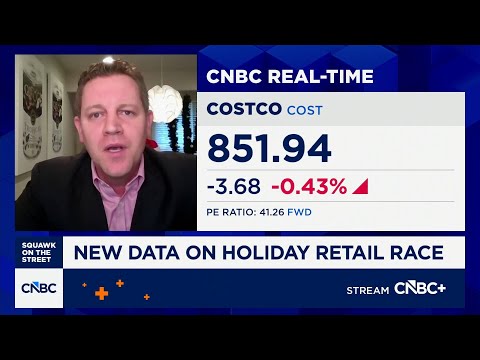
Roth Capital's Bill Kirk points out convenience issues behind Costco's disappointing year
Youtube· 2025-12-22 16:14
Core Insights - The focus is on app downloads as a significant indicator of consumer behavior, particularly for last-minute shoppers who prefer in-store pickup options [2][3] - Walmart continues to perform strongly, while Target has seen a recent surge in app downloads, reaching the third position in total downloads, a notable improvement from earlier in the year [3][4] - Target's recent performance may indicate a positive holiday season, but structural issues related to investment spending and pricing strategies could pose risks in the long term [5][6] Target - Target has experienced a rough couple of years but has shown signs of improvement with a 10% increase in toy sales as of Q3, contributing to strong app download numbers [4][5] - Despite a potentially strong holiday season, Target faces increased spending needs in 2026, which could impact earnings [6] Costco - Costco's app download performance has been weak, and the company is facing challenges with declining renewal rates, slower member growth, and reduced traffic [8][10] - While Costco excels in providing value, it struggles with convenience compared to competitors like Walmart, which is becoming increasingly important as consumer preferences shift [9][10] - The rise of Walmart.com and its extensive assortment poses a competitive threat to Costco, as it overlaps with Costco's offerings [12][13]
美国消费行业策略:是否已至抛售尾声?是否需准备行业轮动?-U.S. Consumer Strategy; have we reached capitulation yet & should we prepare for a sector rotation_ Webinar Transcript
2025-12-22 14:29
Summary of U.S. Consumer Strategy & Quantitative Research Webinar Industry Overview - The focus is on the U.S. Consumer sector, specifically Consumer Discretionary and Consumer Staples, which have underperformed the market by low double-digit percentages year-to-date in 2025 [3][18]. Core Insights and Arguments - **Market Performance**: 2025 has been challenging for the Consumer sector, with both Discretionary and Staples underperforming. Consumer Staples are now seen as attractive due to favorable price-to-forward earnings valuation multiples [3][31]. - **Sector Dynamics**: There is a contrasting performance between Consumer Staples and technology sectors, raising concerns about a potential tech bubble. Economic factors such as cutbacks in healthcare and SNAP benefits for low-income consumers, alongside inflation, could lead to an economic slowdown [4][19]. - **Investment Recommendations**: Focus on Consumer stocks that are: 1. More international 2. Exposed to higher-income consumers 3. Defensive in nature 4. Not facing idiosyncratic pressures that are not fully priced in [3][22]. - **Key Themes**: Tariff volatility, GLP-1 drug uptake, and consumer bifurcation are critical themes to monitor. Lower-income households are pressured by cutbacks, while higher-income households may benefit from upcoming tax breaks [5][20]. Subsector Recommendations - **Consumer Staples**: Emphasis on companies with international exposure in Soft Beverages and Household & Personal Care, as well as defensive Broadline Retailers. Caution is advised around companies negatively impacted by GLP-1 drug uptake [6][22]. - **Consumer Discretionary**: Focus on higher-quality names with reliable earnings performance. Caution is advised for those without a quality bias, although companies catering to higher-income consumers may benefit from tax breaks in 2026 [6][22]. Performance Metrics - **Consumer Discretionary**: - Best performers include Casinos (23.7%), Apparel Retail (22.7%), and Automotive Retail (19.1%). Weakest sectors include Textiles, Apparel, and Luxury Goods (2.1%) [27][28]. - **Consumer Staples**: - Dollar Stores (49.5%) and Tobacco (29.8%) are leading, while Food Producers (-7.3%) and Alcoholic Beverages (-28.6%) are lagging [29][30]. Valuation Insights - **Valuation Multiples**: Discretionary multiples are about 10% cheaper than historical averages, while Staples are in line with historical averages despite underperformance [31][32]. - **Stock Performance Drivers**: In 2025, multiple expansion has driven stock performance more than earnings growth in both sectors [44]. Earnings Revisions - **Sales Expectations**: Remained stable across consumer discretionary sectors, while earnings per share revisions have shown significant dispersion, particularly declining in textiles and luxury goods due to tariff impacts [51][52]. Conclusion - The current environment is characterized by significant sector rotation and stock-picking opportunities. Analysts recommend focusing on high-quality, defensive stocks with international exposure as the market navigates through economic uncertainties and potential sector shifts [21][22].


Before You Buy the Dip on Costco Stock, Here Are 3 Things to Watch in 2026
The Motley Fool· 2025-12-21 23:44
Core Viewpoint - Costco has experienced a disappointing year in 2025, with its stock price down 6% despite strong operational performance [1] Group 1: Same-Store Sales Performance - Costco's same-store sales (SSS) have shown impressive growth, indicating strong productivity at existing locations [4] - In fiscal 2020, during the COVID-19 pandemic, Costco reported positive SSS of 7.7%, followed by 16% in fiscal 2021 and 14.4% in fiscal 2022, with the positive trend continuing [5] - The company is expected to maintain its SSS growth in 2026, driven by increased foot traffic and higher average ticket sizes [6] Group 2: Growth Strategy - Costco currently operates 921 warehouses, with approximately two-thirds located in the U.S., and plans to open 28 net new warehouses in fiscal 2026 [6] - There are significant opportunities for expansion in the U.S. and international markets, particularly in China, which is promising for revenue growth in 2026 and beyond [7] Group 3: Valuation Considerations - Despite a strong operational performance in 2025, with net sales and net income increasing by 8% and 10% year over year, the stock has faced valuation concerns [8] - The current price-to-earnings ratio stands at 46, down from 63 earlier in 2025, indicating a potentially better valuation setup for investors [9]

Jim Cramer Says Victory Against Tariffs Could Finally Pull Costco Stock “From Its Continued, and Endless, and Terrible Tailspin”
Yahoo Finance· 2025-12-21 15:08
Group 1 - Costco Wholesale Corporation (NASDAQ:COST) is involved in a lawsuit against the current administration regarding tariff refunds, which could potentially impact its stock performance positively if successful [1] - The company operates membership warehouses offering a wide range of products and services, including groceries, electronics, and e-commerce options [2] - Recent management changes, including the departure of the CFO Richard Galanti, have raised concerns about the company's performance, particularly in terms of slower monthly signups and membership renewals [2] Group 2 - Despite acknowledging Costco's potential, there are suggestions that certain AI stocks may present greater upside potential and lower downside risk compared to Costco [2]
VDC vs. FSTA: Comparing Two Similar Consumer Staples ETFs
The Motley Fool· 2025-12-21 03:05
Core Insights - The Vanguard Consumer Staples ETF (VDC) has a larger asset base and a longer track record compared to the Fidelity MSCI Consumer Staples Index ETF (FSTA), making it a more established option for investors [1][10]. Cost & Size - FSTA has an expense ratio of 0.08%, while VDC's is slightly higher at 0.09%, indicating that FSTA is marginally more affordable [3][4]. - As of the latest data, FSTA manages $1.3 billion in assets under management (AUM), whereas VDC has $7.4 billion in AUM, highlighting VDC's significant size advantage [3][10]. Performance & Risk - Over the past year, FSTA has returned -2.7% and VDC has returned -2.4%, showing that VDC has performed slightly better [3][15]. - The maximum drawdown over five years for FSTA is -17.08%, while VDC's is -16.54%, indicating that VDC has experienced less volatility [5]. Portfolio Composition - VDC holds 107 stocks primarily focused on consumer defensive companies, with top holdings including Walmart, Costco, and Procter & Gamble [6]. - FSTA has a similar focus, with 98% of its holdings in consumer defensive stocks and also includes Walmart, Costco, and Procter & Gamble among its top holdings [7]. Historical Performance - VDC has been operational for nearly 22 years, while FSTA was launched in 2013, giving VDC a historical performance advantage [10]. - Since FSTA's inception, it has achieved a compound annual growth rate (CAGR) of 8.5%, while VDC has a CAGR of 8.7%, indicating comparable long-term performance [15].

Forget Kraft Heinz: Buy This Unstoppable Consumer Staple Leader Instead
Yahoo Finance· 2025-12-19 22:22
分组1 - Kraft Heinz has been a significant disappointment in the stock market, with a 65% decline over the last decade since its merger in 2015, which was criticized by Warren Buffett as an overpayment [2][3] - The company is planning to split into two entities: North American Grocery Co and Global Taste Elevation Co, but this move has been dismissed by Buffett as ineffective in addressing the underlying business issues [3][7] - Consumer preferences are shifting away from unhealthy, processed foods, which poses a challenge for Kraft Heinz and similar packaged food companies [8] 分组2 - Costco is highlighted as a better investment option in the consumer staples sector, having increased by 440% over the last decade and benefiting from a recession-proof business model primarily based on grocery sales and membership fees [4][9] - Costco reported a 6.4% growth in comparable sales in its most recent quarter, with e-commerce sales growing by 20.5%, indicating successful adaptation to online sales [10] - The stock price of Costco has recently pulled back by 21% from its peak earlier in the year, trading at a price-to-earnings ratio of 45.6, which reflects its strong performance and history of rewarding investors with special dividends [11]

Jim Cramer on TJX: “I Want You to Wait for a Pullback”
Yahoo Finance· 2025-12-19 20:14
Core Viewpoint - The TJX Companies, Inc. is currently experiencing significant momentum, but a pullback is anticipated before making a purchase decision [1]. Company Overview - The TJX Companies, Inc. operates in the off-price retail sector, selling apparel, footwear, accessories, and home goods [1]. - The company offers a diverse range of merchandise, including clothing, beauty items, furniture, decor, kitchenware, and seasonal products [1]. Market Performance - Jim Cramer noted that TJX has shown "tremendous momentum" and is currently at its highest point [1]. - Cramer also compared TJX with Costco, highlighting both as growth retailers with excellent performance metrics [1]. Investment Considerations - While TJX is recognized as a strong investment opportunity, there are suggestions that certain AI stocks may present greater upside potential with less downside risk [1].