
Deutsche Bank AG(DB)

Search documents
外资机构纷纷上调中国GDP增速预期
Zheng Quan Ri Bao· 2025-11-04 16:12
Group 1 - Multiple foreign institutions have raised their expectations for China's annual economic growth, showing optimism towards China's economic outlook driven by technology development and export growth [1] - Goldman Sachs forecasts that China's export volume will grow by 5% to 6% annually over the next few years, contributing to overall economic expansion [1] - Deutsche Bank has revised its GDP growth forecast for China in Q4 2025 to 4.6% (quarter-on-quarter 1.2%) and raised the annual growth expectation to 5.0%, indicating that achieving the annual growth target is feasible [1] Group 2 - Goldman Sachs believes that the internationalization of the RMB has become an important policy direction for the Chinese government and may accelerate significantly in the coming years [2] - The rise of Chinese brands is reshaping global perceptions of "Made in China," particularly in the electric vehicle sector, where local supply chains are fully established [2] - In light of improving fundamentals, Chinese stocks are expected to have further upside potential, with sectors like electronics, industrials, new energy vehicles, AI supply chains, gaming, and e-commerce seeing increasing overseas revenue shares [2]


How a new report convinced Deutsche Bank it’s time to short the 10-year Treasury.
Yahoo Finance· 2025-11-04 12:56
Core Viewpoint - The U.S. economy is growing at a normal pace, with recent data indicating a slight increase in bank willingness to extend consumer loans and a rise in mortgage demand, suggesting stability despite recent pressures on regional banks [3][4]. Economic Performance - Since November 4, 2024, the S&P 500 has increased by 19%, gold has risen by 46%, and bitcoin has surged by 54%, while the U.S. dollar has decreased by 4% [2]. - The 10-year Treasury bond futures have gained 2% in value, which is atypical given the current economic conditions [3]. Interest Rates and Treasury Bonds - Deutsche Bank strategists recommend shorting the 10-year Treasury, targeting a yield of 4.45% with a stop at 3.9%, compared to a recent close of 4.11% [3]. - The Senior Loan Officer Opinion Survey (SLOOS) indicates a rise in bank willingness to extend consumer loans, reaching the highest level since 2022, and an increase in mortgage demand for the first time since 2021 [3][4]. Market Reactions - U.S. stock futures indicate a sharply lower start, with bitcoin prices declining and the dollar slightly increasing [7]. - Key asset performance shows the S&P 500 at 6851.97, down 0.56% for the last day but up 16.50% year-to-date, while gold has increased by 51.69% year-to-date [8].
X @Bloomberg
Bloomberg· 2025-11-04 12:30
Dario Schiraldi, the former Deutsche Bank manager who is suing the lender for allegedly damaging his career, is urging Europe’s top bank watchdog to conduct a supervisory review of the firm as he seeks to increase pressure https://t.co/kA7bM9OgNH ...
How a new report convinced Deutsche Bank it's time to short the 10-year Treasury.
MarketWatch· 2025-11-04 11:48
Core Viewpoint - Deutsche Bank is taking a position against U.S. Treasury bonds based on limited economic data that has emerged, indicating a bearish outlook on the U.S. economy [1] Group 1 - The economic data available has been insufficient, yet it has influenced Deutsche Bank's decision to short U.S. Treasury bonds [1]


金价调整接近尾声?德银:黄金ETF抛售正在减弱,中国税收新政影响不大
美股IPO· 2025-11-04 07:24
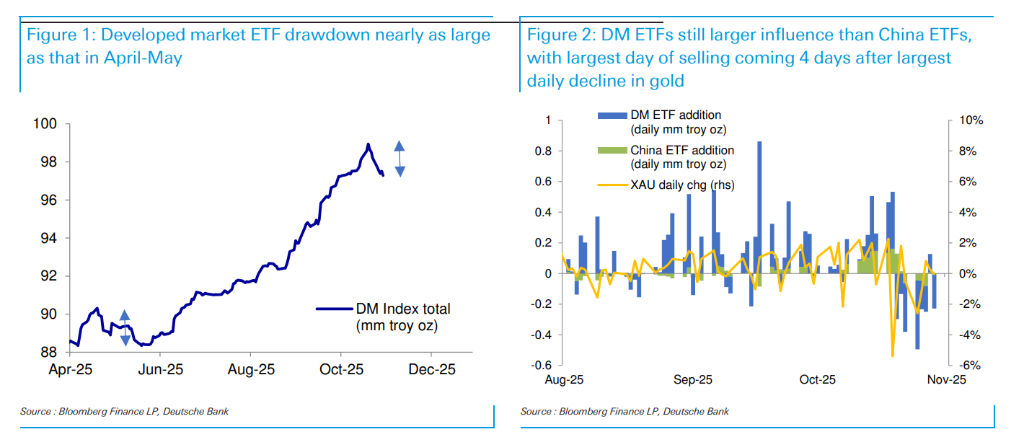
Core Insights - The recent wave of gold ETF sell-offs that has driven down gold prices is showing signs of weakening, indicating that the price correction is nearing its end rather than the beginning of a new decline [1][3][4] - The impact of China's new VAT policy on gold demand and imports is expected to be mild, as the drop in gold prices offsets cost pressures while investment demand remains stable [3][11] Group 1: Gold ETF Sell-Offs - The sell-off of gold ETFs, which has been a major driver of recent price adjustments, is nearing its end, with cumulative sell-offs reaching 86% of the total from the April-May period, suggesting that most selling pressure has been released [4][6] - The most significant sell-off day occurred on October 27, with a reduction of 449,000 troy ounces, happening four days after the largest single-day price drop, indicating that the price decline triggered the ETF outflows rather than the other way around [6][7] Group 2: Market Resilience - Gold prices have shown resilience, remaining above $3,900 per ounce despite hawkish signals from the Federal Reserve regarding interest rates, which typically exert downward pressure on gold [7] - The current market volatility is higher than implied volatility, with a gap of -12.6, the largest since March 2020, suggesting that actual market price fluctuations are more severe than what the options market anticipates [8][10] Group 3: China's VAT Policy Impact - The new VAT policy in China is expected to have a limited impact on gold demand, primarily due to the timing of the policy implementation after a price drop, which mitigates the cost increase for jewelers [11][13] - China's demand for gold is relatively inelastic, as evidenced by continued ETF inflows despite price increases, indicating that consumer behavior is less sensitive to price changes [11][12] - The VAT adjustment mainly affects jewelry sales, while physical gold investments, such as bullion, remain unaffected, allowing for continued tax deductions [13]

金价调整接近尾声?德银:黄金ETF抛售正在减弱,中国税收新政影响不大
Hua Er Jie Jian Wen· 2025-11-04 04:10
Core Insights - The recent report from Deutsche Bank indicates that the large-scale sell-off of gold ETFs, which has driven gold prices down, is showing signs of weakening, suggesting that the current price correction may be nearing its end rather than the beginning of a new decline [1][2] - The anticipated impact of China's new VAT rules on gold demand and imports is expected to be mild and limited, indicating a stable demand outlook for gold [1][9] Group 1: Gold ETF Sell-off - The report highlights that the sell-off of gold ETFs, which has been a key driver of recent price adjustments, is nearing its end, with the cumulative sell-off reaching 86% of the total amount sold during the April-May period [2][4] - On the most significant day of sell-off (October 27), 449,000 troy ounces were liquidated, occurring four days after the largest single-day price drop, suggesting that the price decline triggered the ETF outflows rather than the other way around [4] Group 2: Market Resilience - Despite hawkish signals from the Federal Reserve, gold prices have shown resilience, remaining above $3,900 per ounce, indicating strong support levels [4] - The current market volatility is higher than implied volatility, with a gap of -12.6, the largest since March 2020, suggesting that actual market price fluctuations are more severe than expected [5][8] Group 3: China's VAT Impact - The new VAT rules in China are expected to increase costs for gold jewelry sellers by 7%, but the overall impact on gold demand is anticipated to be limited due to several factors [9][11] - The timing of the policy implementation, the inelastic nature of gold demand in China, and the fact that investment products like gold bars are unaffected by the VAT changes contribute to a stable demand outlook [11][12] - Jewelry sellers may absorb the increased costs to maintain competitiveness, further mitigating the potential negative impact on demand [11]
Deutsche Bank: Private Bank Segment Shows Strength In Q3 2025 Results
Seeking Alpha· 2025-11-01 14:45
Group 1 - The article discusses the author's journey into investing, starting in high school in 2011, focusing on REITs, preferred stocks, and high-yield bonds, indicating a long-standing interest in markets and the economy [1] - The author has recently adopted a strategy that combines long stock positions with covered calls and cash secured puts, emphasizing a fundamental long-term investment approach [1] - The author primarily covers REITs and financials on Seeking Alpha, with occasional articles on ETFs and other stocks influenced by macro trade ideas [1]

CORRECTION -- International companies to host live webcasts at Deutsche Bank’s Depositary Receipts Virtual Investor Conference on November 04, 2025
The Manila Times· 2025-10-31 12:52
Core Points - Deutsche Bank announced the lineup for its Depositary Receipts Virtual Investor Conference (dbVIC) scheduled for November 04, 2025, featuring live presentations from international companies with American Depositary Receipt (ADR) programs in the U.S. [1] - The conference will include representatives from companies based in various countries including Australia, China, Hong Kong, Germany, Spain, Sweden, and the Cayman Islands, aimed at investors and analysts interested in international companies [2] - There is no fee for participants to attend the conference, and pre-registration is suggested [2] Agenda Details - The conference agenda includes presentations from several companies at specific times, starting with HUTCHMED (China) Limited at 8:00 AM and concluding with Repsol S.A at 1:00 PM [6] Company Services - Deutsche Bank specializes in administering cross-border equity structures such as American and Global Depositary Receipts, and provides a range of services including trustee, agency, escrow, and related services to corporates, financial institutions, hedge funds, and supranational agencies [5] - The bank also offers services for complex securitizations, project finance, syndicated loans, debt exchanges, and restructurings [5]


德意志银行将礼来目标价上调至955美元

Ge Long Hui A P P· 2025-10-31 11:17
Core Viewpoint - Deutsche Bank raised the target price for Eli Lilly from $900 to $955 [1] Group 1 - The adjustment in target price reflects a positive outlook on Eli Lilly's performance [1]
Deutsche Bank AG(DB) - 2025 Q3 - Earnings Call Transcript
2025-10-30 15:02
Financial Data and Key Metrics Changes - Record profitability was achieved in the first nine months of 2025, with revenues at EUR 24.4 billion, aligning with the full year goal of around EUR 32 billion before FX effects [3] - Adjusted costs remained consistent with guidance, with a post-tax return on tangible equity of 10.9%, meeting the target of above 10% [3][4] - The cost-income ratio stood at 63%, consistent with the target of below 65% [3] - Pre-provision profit increased to EUR 9 billion, up nearly 50% year on year, or nearly 30% when adjusted for Postbank litigation impacts [3] Business Line Data and Key Metrics Changes - Net commission and fee income rose by 5% year on year, while net interest income across key banking segments remained stable [4] - All four business lines delivered double-digit profit growth and return on tangible equity in the first nine months [6] - The Corporate Bank saw strong fee growth of 5% and was recognized as the best trade finance bank [7] - The Private Bank's profits surged by 71%, and assets under management in Wealth Management grew by EUR 40 billion year to date [7] Market Data and Key Metrics Changes - Loans grew by EUR 3 billion adjusted for FX effects during the third quarter, with strong underlying quality [9] - The deposit book expanded by EUR 10 billion in the third quarter, with significant growth in the Private Bank [10][11] - The liquidity coverage ratio was managed to 140%, demonstrating the strength of the balance sheet [11] Company Strategy and Development Direction - The company is on track to meet or exceed all 2025 strategy goals, with a compound annual revenue growth rate of 6% since 2021 [4][5] - Operational efficiencies of EUR 2.4 billion have been delivered or are expected, nearing the EUR 2.5 billion goal [5] - A second share buyback program of EUR 250 million was launched, bringing cumulative distributions since 2022 to EUR 5.6 billion [5] Management's Comments on Operating Environment and Future Outlook - Management expressed confidence in achieving a return on tangible equity above 10% and a cost-income ratio below 65% for the full year [17] - Despite uncertainties in commercial real estate and the macroeconomic environment, lower provisioning levels are anticipated in the second half of the year [17] - The company remains focused on growing its franchise and expanding market share, particularly in the Corporate Bank [10] Other Important Information - The CET1 ratio increased to 14.5%, with a surplus above regulatory requirements [12][14] - The MREL surplus increased by EUR 2 billion to EUR 26 billion, providing flexibility for future issuance [15][16] Q&A Session Summary Question: Future Return on Tangible Equity - Management indicated that a 10% return on tangible equity could be a reasonable floor for future performance, emphasizing structural profitability improvements [20][21] Question: Private Credit and Commercial Real Estate Exposures - Management noted that private credit is not a concern, while commercial real estate remains a watch item, particularly in California and Washington State [22][23] Question: Receivables Financing Exposure - Management acknowledged some exposure in trade finance and ABS but emphasized it is not significant [28][29] Question: Tier 2 Capital Stack - Management confirmed that Tier 2 instruments remain valuable, but the focus has been on Tier 1 capital needs [32] Question: Sustainability Competitive Disadvantage - Management does not view the sustainability landscape in Europe as a competitive disadvantage, highlighting progress in their sustainability agenda [30][31] Question: Commercial Real Estate Issues - Management detailed that issues are concentrated in West Coast exposures, with ongoing efforts to work with sponsors for value preservation [36][39]