Ford Motor(F)

Search documents
摩根士丹利:全球电动汽车追踪-中国的电动化主导时代
摩根· 2025-06-11 02:16
Investment Rating - Industry View: In-Line [5] Core Insights - Global electric vehicle (EV) sales increased by 38% year-over-year (y/y) in April 2025, with China leading the growth at 51% y/y [1] - Tesla's global sales decreased by 17% y/y, with a notable decline of 15% y/y in the US market [1][8] - The top battery electric vehicle (BEV) manufacturers globally include BYD, Geely, and GM, while Tesla's market share has dropped significantly [7][27] Summary by Sections Global BEV Sales - Total global BEV sales reached 1,079,716 units in April 2025, marking a 38% increase y/y but a decrease of 11% from the previous month [7] - The leading BEV manufacturers in April 2025 were BYD (181k sales), Geely (101k sales), and GM (96k sales) [7][22] - Tesla's market share in the global BEV market fell to 7.9% in April 2025, down from 12.3% the previous month [7][27] Regional Performance - In the US, BEV sales decreased by 4% y/y to 95,427 units in April 2025, with an EV penetration rate of approximately 6.5% [14] - European BEV sales increased by 30% y/y to 214,288 units, with a penetration rate of around 19.9% [14] - China saw a significant increase in BEV sales, up 51% y/y to 662,541 units, with a penetration rate of about 30.2% [14] Top BEV Models - The top-selling BEV models globally in April 2025 included the Tesla Model Y (57k sales), BYD Seagull/Dolphin Mini (38k sales), and Wuling HongGuang Mini (36k sales) [30] - The total sales of the top 20 BEV models accounted for 41% of the total BEV sales in April 2025 [30] Battery Deployment - Total MWh deployed in April 2025 increased by 32% y/y to 66,771 MWh [11] - The top five cell suppliers deployed a combined 49,858 MWh in April 2025, compared to 38,889 MWh the previous year [11] Market Share Dynamics - Tesla's share of the US BEV market decreased from 46.0% last year to 41.0% in April 2025 [8] - The market share of other manufacturers such as BYD and GM has been increasing, indicating a shift in competitive dynamics within the industry [24][27]




Head-to-Head: Here's How Ford and Toyota Stack Up in the Auto Space
ZACKS· 2025-06-10 14:46
Core Insights - Ford and Toyota are major competitors in the global auto industry, with Toyota holding a significant lead in global sales and market capitalization [1][2] - In the U.S. market, Toyota sold 2.33 million vehicles in 2024, a 3.7% increase, while Ford sold 2.07 million vehicles, up 4.2% year over year [1] - On a global scale, Toyota sold 10.8 million vehicles compared to Ford's 4.5 million, with Toyota's market cap at approximately $250 billion versus Ford's $40 billion [2] Ford's Position - Ford remains a key player in the U.S. auto market, with popular models like the F-Series trucks and a strong presence in the SUV and crossover segments [6] - The company's hybrid strategy is gaining traction as full EV adoption slows, appealing to consumers seeking better fuel efficiency [7] - Financially, Ford exited Q1 2025 with $27 billion in cash and $45 billion in liquidity, allowing for investments in digital innovation and electrification [8] - Ford's dividend yield is approximately 6%, significantly higher than the S&P 500 average, with plans to return 40-50% of free cash flow to shareholders [8] - The Ford Pro business, focused on commercial customers, is expected to drive earnings growth due to strong demand and successful product launches [10] - Challenges include declining sales in traditional gas-powered vehicles, significant losses in the EV division, and potential tariff impacts costing up to $2.5 billion [11][12] - The Zacks Consensus Estimate predicts a 7% decline in sales and a 40% decline in EPS for Ford in 2025 [13] Toyota's Position - Toyota is recognized for its reliability and has exceeded earnings expectations, projecting growth in revenues and vehicle volumes for fiscal 2026 [14] - The company anticipates a 21% decline in operating income due to rising material costs, currency headwinds, and potential tariff impacts [15] - Toyota expects to sell 9.8 million vehicles in fiscal 2026, an increase from 9.36 million in fiscal 2025, with a focus on hybrid and plug-in hybrid sales [16] - The hybrid-first strategy is exemplified by the RAV4, which will be sold exclusively as a hybrid or plug-in hybrid starting in 2026 [17] - Toyota raised its annual dividend to 90 yen per share for fiscal 2025 and plans to increase it to 95 yen for fiscal 2026 [18] - The Zacks Consensus Estimate indicates an 8% growth in sales for Toyota in fiscal 2026, while earnings are expected to decline by 21% [18] Capital Efficiency and Valuation - Toyota has a return on invested capital of 4.8%, significantly higher than Ford's 1.77%, indicating better capital efficiency [19] - On a valuation basis, Toyota trades at a more attractive EV/EBITDA multiple compared to Ford, suggesting a more reasonable stock price relative to earnings [21] Conclusion - Both Ford and Toyota are navigating challenges in the evolving auto industry, with Ford having strong brand recognition and a high dividend yield, while Toyota benefits from global scale and a cautious electrification strategy [23][24] - Toyota's stronger capital discipline and strategic positioning provide it with a slight edge over Ford in the current market landscape [25]



金十图示:2025年06月10日(周二)全球汽车制造商市值变化
news flash· 2025-06-10 03:11
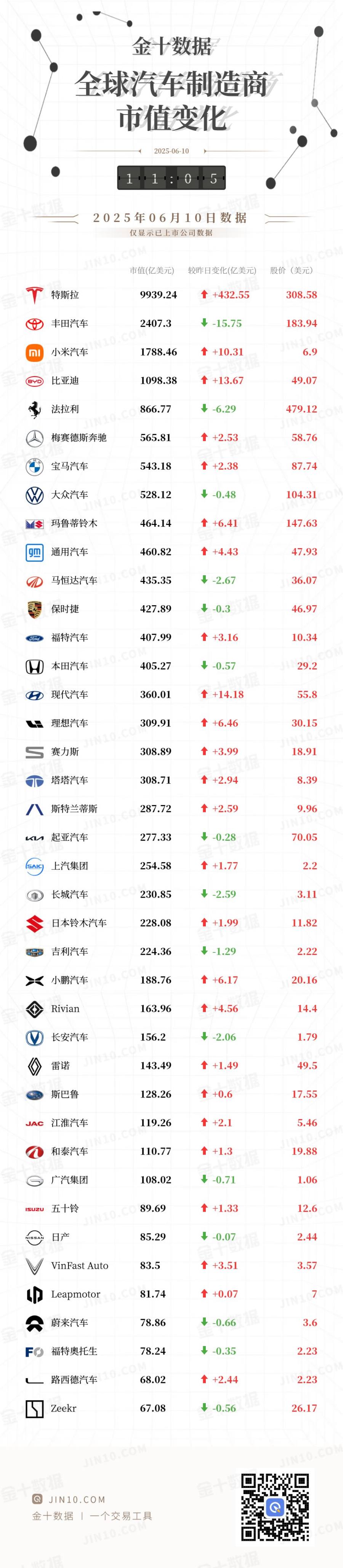
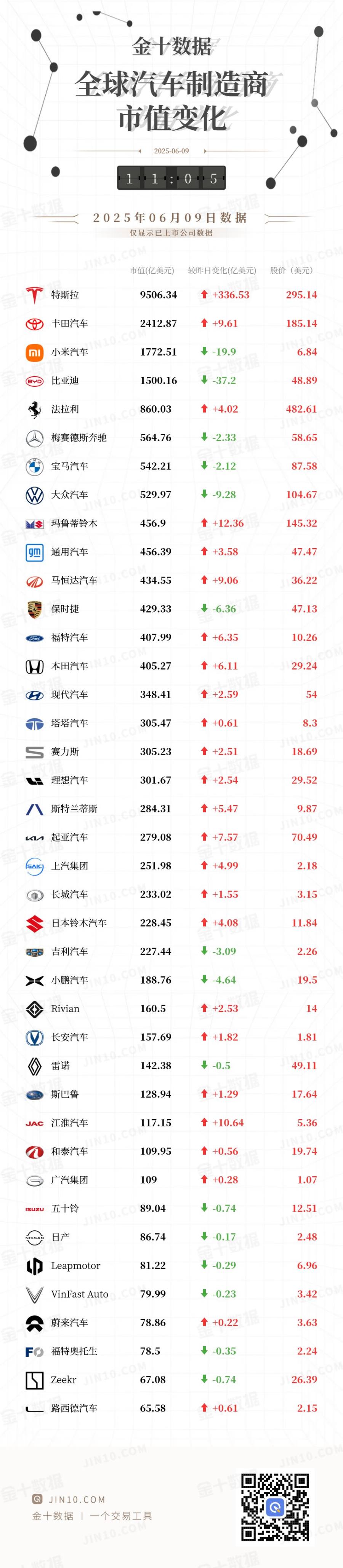
| | 163.96 | +4.56 | 14.4 | | --- | --- | --- | --- | | 长安汽车 | 156.2 | + -2.06 | 1.79 | | 雷诺 | 143.49 | + +1.49 | 49.5 | | 斯巴鲁 | 128.26 | 1 +0.6 | 17.55 | | JAC 江淮汽车 | 119.26 | 1 +2.1 | 5.46 | | 和泰汽车 | 110.77 | + +1.3 | 19.88 | | 广汽集团 | 108.02 | + -0.71 | 1.06 | | ISUZU 五十铃 | 89.69 | + +1.33 | 12.6 | | NISSAN 日产 | 85.29 | -0.07 | 2.44 | | VinFast Auto | 83.5 | +3.51 | 3.57 | | ID | Leapmotor C 81.74 | ↑ +0.07 | | | ● 尉米汽车 | 78.86 | + -0.66 | 3.6 | | FC) 福特奥托生 | 78.24 | + -0.35 | 2.23 | | 1 - 1 - 路西德汽车 | 68. ...

金十图示:2025年06月09日(周一)全球汽车制造商市值变化
news flash· 2025-06-09 03:12
金十图示:2025年06月09日(周一)全球汽车制造商市值变化 | | | 市值(亿美元) 较昨日变化(亿美元) | 股价(美元) | | --- | --- | --- | --- | | 特斯拉 | 9506.34 | + +336.53 | 295.14 | | (4) 丰田汽车 | 2412.87 | 1 +9.61 | 185.14 | | והו 小米汽车 | 1772.51 | + -19.9 | 6.84 | | 比亚迪 | 1500.16 | + -37.2 | 48.89 | | P 法拉利 | 860.03 | ↑ +4.02 | 482.61 | | 梅赛德斯奔驰 | 564.76 | + -2.33 | 58.65 | | 宝马汽车 | 542.21 | + -2.12 | 87.58 | | 入) 大众汽车 | 529.97 | + -9.28 | 104.67 | | --- | --- | --- | --- | | MS 玛鲁蒂铃木 | 456.9 | 1 +12.36 2 | 145.32 | | 通用汽车 gm | 456.39 | + +3.58 | 47.47 | | ...



Baytex Energy: The Importance Of The Eagle Ford
Seeking Alpha· 2025-06-07 11:02
Group 1 - The article discusses the analysis of oil and gas companies, specifically highlighting Baytex Energy and the search for undervalued companies in the sector [1] - The analysis includes a breakdown of essential factors such as balance sheets, competitive positions, and development prospects of these companies [1] - The author emphasizes the cyclical nature of the oil and gas industry, indicating that it requires patience and experience to navigate effectively [2] Group 2 - The author has a beneficial long position in the shares of Baytex Energy, indicating a personal investment interest in the company [3] - The article is presented as an independent analysis, with no compensation received from the companies mentioned, aside from the platform hosting the article [3] - The content is aimed at providing insights to members of the Oil & Gas Value Research service, who receive exclusive analysis not available to the general public [1]


Is Ford's Model e Business Dragging Down its Overall Results?
ZACKS· 2025-06-06 17:01
Core Insights - Ford Motor Company operates a dedicated electric vehicle segment, Model e, which has not yet generated profits despite positive reception of its Mustang Mach-E and F-150 Lightning EVs [1] - The losses in Ford's EV business have widened significantly, with a reported loss of $5.07 billion in 2024, following a $4.7 billion loss in 2023, and an additional loss of $849 million in Q1 2025 [2] Financial Performance - The EV segment's losses are attributed to pricing pressures, increased investments in next-generation EVs, and stiff competition, particularly from companies like BYD in China [2][3] - Ford's stock has declined approximately 10% year to date, contrasting with an 11% growth in the industry [7] Competitive Landscape - Competitors like Toyota and Honda are also cautious about fully electric vehicles, with Toyota reducing its EV production target by 20% and Honda shifting focus towards hybrid models [5][6] - The industry is facing significant pricing pressures and supply chain disruptions, necessitating continuous investment from Ford to remain competitive [3] Strategic Initiatives - Ford is investing in improving charging infrastructure through the Ford Power Promise campaign, which has already provided home chargers to customers [4] - Plans are in place to increase Model e volumes with new product launches in the upcoming quarters [8] Valuation Metrics - Ford trades at a forward price-to-sales ratio of 0.25, which is below the industry average, and carries a Value Score of A [9]
Ford Motor Company (F) Presents at UBS Auto and Auto Tech Conference Transcript
Seeking Alpha· 2025-06-06 13:57
Core Insights - Ford Motor Company is actively participating in the UBS Auto and Auto Tech Conference, highlighting its strategic focus on hybrid and electric vehicle technologies [1]. Group 1: Company Leadership and Strategy - Sherry House, the Chief Financial Officer of Ford, recently celebrated her one-year anniversary with the company, having taken on the CFO role in early February [2][5]. - The company has an advantaged strategy that includes a diverse portfolio in hybrids, electrification, and internal combustion engines (ICE), which provides customers with various choices [7].

金十图示:2025年06月05日(周四)全球汽车制造商市值变化
news flash· 2025-06-05 03:12
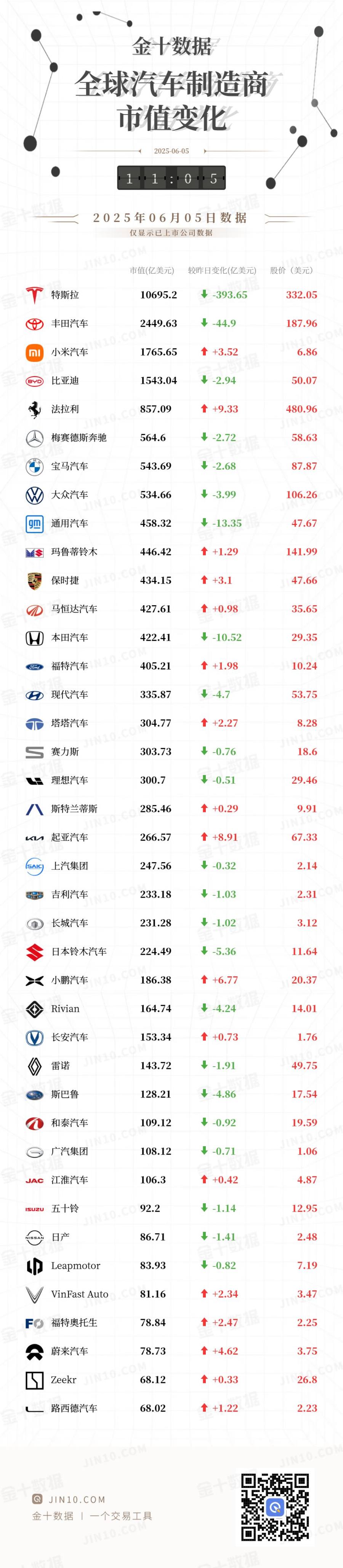
Core Insights - The article presents the market capitalization changes of global automotive manufacturers as of June 5, 2025, highlighting significant fluctuations in values across various companies [1]. Group 1: Market Capitalization Changes - Tesla's market capitalization stands at $10,695.2 million, experiencing a decrease of $393.65 million [3]. - Toyota's market capitalization is $2,449.63 million, with a decline of $44.9 million [3]. - BYD's market capitalization is $1,543.04 million, showing a decrease of $2.94 million [3]. - General Motors has a market capitalization of $458.32 million, down by $13.35 million [4]. - Ford's market capitalization is $405.21 million, with an increase of $1.98 million [5]. Group 2: Notable Increases - Xiaomi Automotive shows a slight increase in market capitalization to $1,765.65 million, up by $3.52 million [3]. - Ferrari's market capitalization increased to $857.09 million, up by $9.33 million [3]. - Kia's market capitalization rose to $266.57 million, with an increase of $8.91 million [5]. - VinFast Auto's market capitalization is $81.16 million, increasing by $2.34 million [5]. Group 3: Other Companies - Mercedes-Benz has a market capitalization of $564.6 million, down by $2.72 million [3]. - Honda's market capitalization is $422.41 million, decreasing by $10.52 million [4]. - NISSAN's market capitalization is $86.71 million, down by $1.41 million [5].
美国钢铝关税涨至50%,汽车和建筑业承压
日经中文网· 2025-06-05 03:01
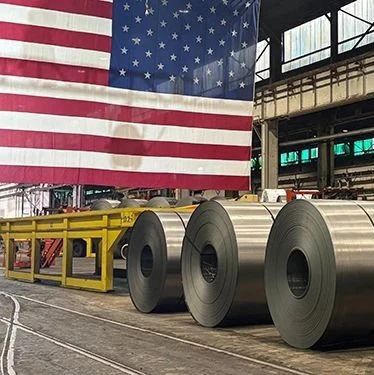
Core Viewpoint - The increase in tariffs on steel and aluminum products by the Trump administration is expected to significantly impact the U.S. steel industry, leading to higher domestic steel prices and potential profit losses for companies reliant on steel imports [1][2]. Group 1: Tariff Impact - The Trump administration raised tariffs on steel and aluminum from 25% to 50%, aiming to protect domestic industries and reduce reliance on imports [1]. - U.S. steel prices have reached twice the global average, with the average price per ton at $901 as of May 26 [2]. - Ford Motor Company anticipates a $1.5 billion profit reduction due to increased costs from tariffs, despite sourcing 85% of its steel domestically [2]. Group 2: Industry Response - The U.S. steel industry is facing challenges with reduced supply and rising fixed costs, leading to deteriorating profits for major companies [3]. - Cleveland-Cliffs announced the suspension of operations at six domestic blast furnaces and mines due to these challenges [3]. - U.S. Steel has reported consecutive quarterly losses, indicating that while rising steel prices are beneficial, decreased demand from sectors like automotive may worsen profitability [3]. Group 3: Supply Chain Concerns - The reliance on global supply chains means that companies dependent on imported specialty steel may face increased burdens due to tariffs [2]. - There are concerns that rising product prices could lead to reduced demand, negatively impacting the performance of large steel companies [2][3].

价格降到“肉疼”、销量腰斩、员工“钱少事多”……合资车企,能否逆风翻盘?
第一财经· 2025-06-05 01:55
Core Viewpoint - The article discusses the significant challenges faced by joint venture automotive companies in China, highlighting the decline in market share and the impact of domestic electric vehicle brands on traditional players [3][20][32]. Group 1: Market Dynamics - As of 2024, joint venture automotive companies' market share in China has dropped to 35%, down from over 60% in 2020, primarily due to the rise of electric vehicles [3][4]. - The shift towards electric vehicles is expected to result in over 50% of new car sales in China being electric by 2024, which has eroded the competitive edge of traditional fuel vehicle brands [3][4]. - The decline in sales and profitability has led to significant operational challenges, including extended payment terms and workforce reductions [4][12]. Group 2: Financial Implications - The financial strain on joint venture companies has resulted in a cascading effect on their supply chains and dealership networks, with many dealers facing bankruptcy [11][12]. - By 2024, most joint venture companies have seen their sales drop by at least 50% compared to their peak years, indicating a collapse of the previous pricing structure [12][14]. Group 3: Internal Challenges - The internal culture within joint venture companies has shifted, with increased pressure on employees and a focus on strict attendance and performance metrics [15][29]. - The decision-making processes in joint ventures have been hampered by the need for consensus between foreign and local partners, which has slowed down responses to market changes [20][21]. Group 4: Strategic Responses - Some companies are beginning to adapt by consolidating operations and reducing production capacity in response to shrinking market demand [28]. - There is a growing recognition among joint venture companies of the need to align more closely with local market preferences, leading to increased local input in product development [29][30]. Group 5: Future Outlook - Despite the challenges, some joint venture companies are exploring partnerships with local electric vehicle manufacturers to enhance their competitive positioning [30][31]. - The survival of joint venture companies will depend on their ability to innovate and adapt to the rapidly changing automotive landscape in China [32].