Alphabet(GOOG)

Search documents
Google Says Spending Could Double This Year Amid Its AI Push. Investors Don't Seem Excited
Investopedia· 2026-02-05 16:07
Core Insights - Alphabet (GOOGL) shares fell over 5% after announcing significant spending plans to enhance its AI infrastructure, forecasting capital expenditures between $175 billion and $185 billion for the year, nearly double the $91.45 billion spent in 2025 [1][5] - The decline in share price resulted in a loss of approximately $170 billion in market value, bringing Alphabet's market capitalization below $4 trillion [2] Investor Implications - The substantial spending plans may indicate investor caution regarding Alphabet's ability to effectively utilize its AI investments, as Big Tech companies are under pressure to demonstrate returns on such expenditures [3] - Despite the drop in share price, some analysts from JPMorgan, Citi, and Wedbush have raised their price targets for Alphabet, citing strong signals of AI demand and positive fourth-quarter results, which included $113.83 billion in revenue and $2.82 earnings per share, with cloud revenue increasing by 48% year-over-year to $17.7 billion [4]



Alphabet Inc. (NASDAQ:GOOG) Sees Optimistic Price Target Amidst Strong Performance
Financial Modeling Prep· 2026-02-05 16:06
Core Viewpoint - Alphabet Inc. is experiencing significant growth in its advertising and cloud sectors, leading to an optimistic price target of $420, representing a 26% increase from its current price of $333.34 [1][6] Financial Performance - The company reported an 18% increase in revenue and a 31% growth in earnings per share for Q4 2025, exceeding market expectations [2][6] - The Cloud segment achieved a remarkable 48% rise in revenues, with margins increasing to 30% [2] Capital Expenditure and Strategic Initiatives - Alphabet announced a substantial increase in its capital expenditure forecast for 2026, estimating between $175 billion and $185 billion, aimed at enhancing its competitive edge in AI technologies [3][6] - CEO Sundar Pichai highlighted the commitment to responsibly scale infrastructure to meet the growing demand for AI [3] Challenges and Investments - Despite strong performance, Alphabet faces near-term challenges such as power, land, and supply chain issues [4] - The company is investing in custom chips, specifically tensor processing units (TPUs), to address the rising demand for AI technologies [4] Stock Performance - The current stock price of GOOG is $333.34, reflecting a decrease of 2.16% or $7.36, with a market capitalization of approximately $4.02 trillion [5]

Alphabet stock sinks after Google parent announces $180 billion spending plan for 2026 in massive AI bet
Yahoo Finance· 2026-02-05 15:54
Core Viewpoint - Alphabet's stock experienced a decline of up to 5% due to its capital expenditure plans for 2026 exceeding forecasts, raising concerns about the sustainability of Big Tech's investments in AI [1] Financial Performance - In its fourth quarter earnings report, Alphabet projected 2026 capital expenditures between $175 billion and $185 billion, significantly higher than the $91.4 billion spent in 2025 and above Wall Street's expectation of around $120 billion for this year [2] - The company's fourth quarter revenue increased by 18% year-over-year to $113.8 billion, surpassing the expected $111.4 billion, while earnings per share rose to $2.82 from $2.15, exceeding the projected $2.65 [5] Segment Performance - Google Cloud revenue surged by 48% year-over-year to $17.7 billion, exceeding analyst expectations of $16.2 billion, driven by demand for AI products [5] - Google Services, which includes ad revenue from Search and YouTube, saw a 14% increase in revenue to $95.9 billion, also above the projected $94.9 billion [6] Investment Strategy - Alphabet's CFO indicated that the increased spending in 2026 would focus on AI computing infrastructure to support the development of advanced AI models and meet demand in its Cloud and Services segments [4] - The company aims to maintain a healthy financial position while making these investments [5] Market Context - Concerns have arisen among investors regarding the return on billions invested in AI by major tech companies, with an estimated $500 billion expected to be spent on AI investments this year by industry leaders including Microsoft, Meta, and Amazon [3] - Despite Alphabet's stock decline, it had previously risen over 20% since its last earnings report, benefiting from AI partnerships, while the broader "Magnificent Seven" group of Big Tech stocks has seen a nearly 5% decline [7]

谷歌母公司大幅上调新财年资本支出 股价震荡下跌
Sou Hu Cai Jing· 2026-02-05 15:46
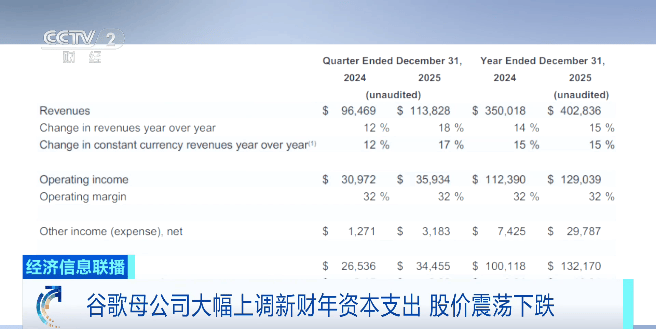
Core Viewpoint - Alphabet, Google's parent company, reported better-than-expected revenue and net profit for the fiscal year 2025, but raised its capital expenditure guidance for 2026 significantly, causing investor concerns and a drop in stock price [1][4]. Financial Performance - For Q4 2025, Alphabet achieved revenue of $113.828 billion, a year-over-year increase of 18%, and a net profit of $34.455 billion, up nearly 30%, exceeding market expectations [2][4]. - For the full year 2025, Alphabet reported revenue of $402.836 billion, a 15% increase year-over-year, and a net profit of $132.17 billion, reflecting a 32% growth [2][4]. Capital Expenditure Guidance - Alphabet raised its capital expenditure guidance for 2026 to a range of $175 billion to $185 billion, significantly above the market expectation of $120 billion [4]. - The increased capital expenditure is primarily aimed at investing in AI infrastructure, including servers and data centers, with the 2026 spending nearly double that of the previous year [4]. Market Reaction - Following the earnings report, Alphabet's stock price initially fell by 7.5% in after-hours trading and subsequently dropped about 3% in pre-market trading the next day [1]. - The market's reaction indicates a mixed sentiment towards AI investments, as the significant increase in capital expenditure has raised concerns among investors [4]. Industry Context - The semiconductor sector, particularly companies like AMD, also faced stock price declines despite strong earnings, reflecting a cautious investor sentiment towards AI-related valuations [6]. - The Nasdaq index experienced a drop of 1.51%, with all gains for the year being erased, indicating a broader sell-off in technology stocks [8].
道指深夜跌超500点,高通跌8%,蔚来涨近9%,白银重挫超16%,比特币跌穿6.8万美元
2 1 Shi Ji Jing Ji Bao Dao· 2026-02-05 15:35
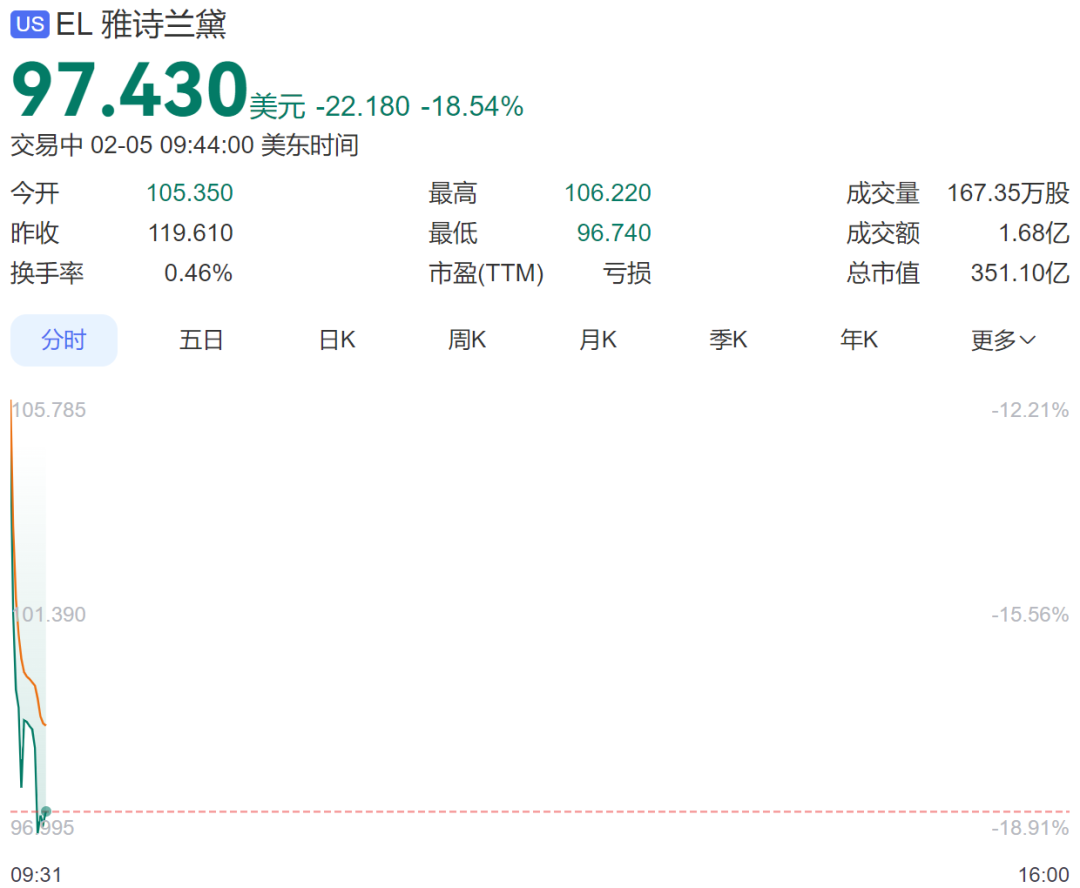
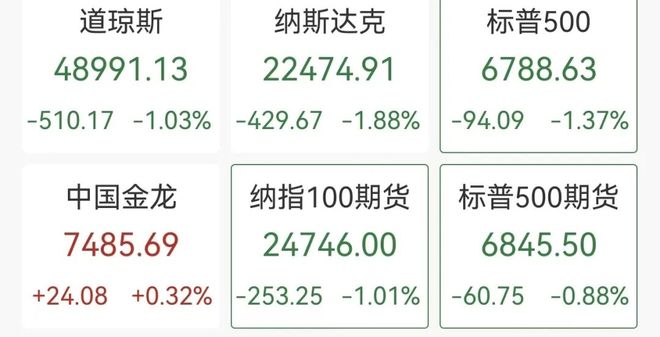
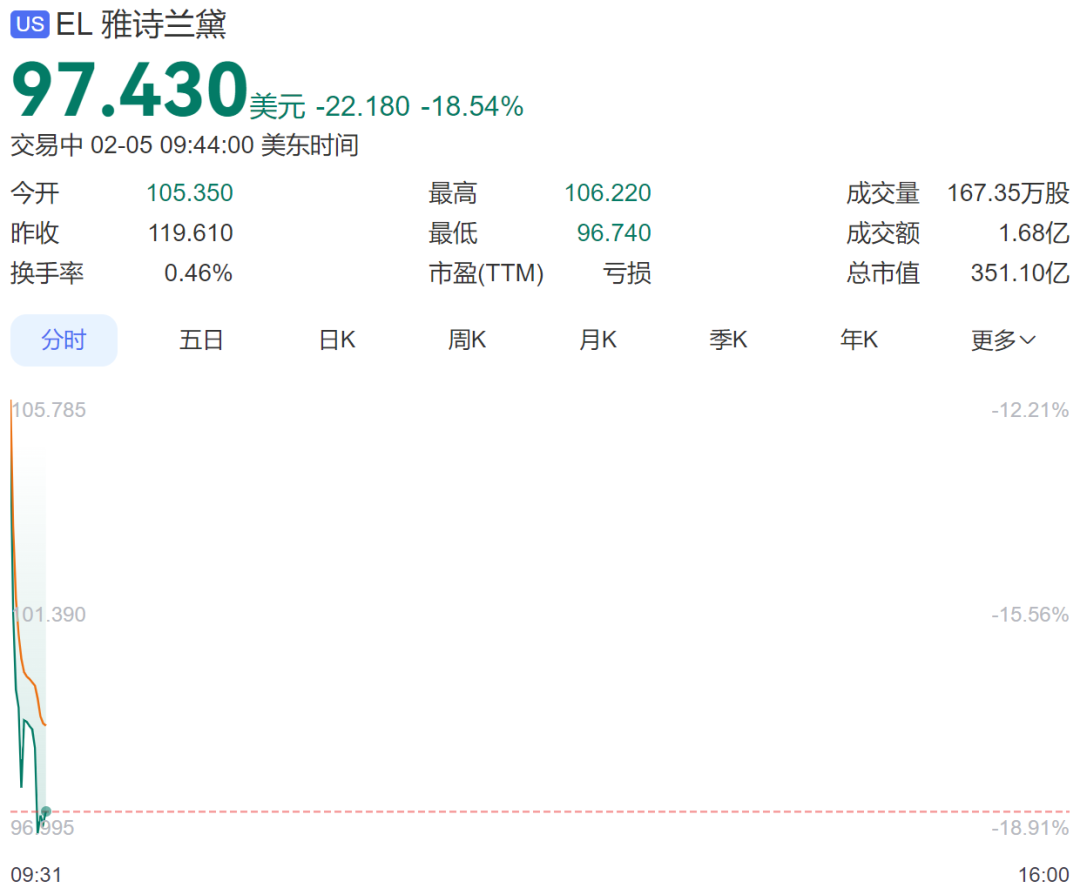
Market Overview - US stock market opened lower with all three major indices down over 1%, with the Dow Jones falling more than 500 points [1] - As of the latest update, Dow Jones at 48,991.13 (-510.17, -1.03%), Nasdaq at 22,474.91 (-429.67, -1.88%), and S&P 500 at 6,788.63 (-94.09, -1.37%) [2] Semiconductor Sector - Qualcomm's stock dropped over 8% due to a global memory supply shortage, with Q2 revenue expected between $10.2 billion and $11 billion, below market expectations [2] - Other semiconductor stocks rebounded after initial declines, with SanDisk and Broadcom up approximately 5%, Intel up over 3%, and TSMC, ASML, AMD, Applied Materials, and NVIDIA all rising over 1% [2] Technology Stocks - Google's parent company Alphabet saw a significant drop of 7.5%, marking its largest intraday decline since May 7, while Amazon fell over 3% ahead of its earnings report [3] - Cryptocurrency-related stocks also declined, with Strategy down over 7% and Coinbase down over 4%, as the cryptocurrency market faced significant losses [3] Consumer Sector - Several consumer stocks experienced sharp declines due to disappointing earnings, with Estée Lauder down 19% and Canada Goose down over 15% [4] - Mixed performance in Chinese concept stocks, with NIO initially rising nearly 9%, while Dingdong Maicai fell over 11% and Canadian Solar dropped over 3% [4] Commodity Market - Spot silver prices fell by 16%, while spot gold dropped over 2%. WTI and Brent crude oil futures also saw declines of 3% [5] - A warning from foreign institutions regarding a potential "speculative frenzy" in gold assets, suggesting that while long-term fundamentals remain strong, short-term volatility may be influenced by retail investor activity [6]


Alphabet Stock Declines 5%
RTTNews· 2026-02-05 15:34
Financial Performance - Alphabet reported fourth-quarter revenue of $113.8 billion, an increase from $96.5 billion a year earlier [2] - Net income rose to $34.5 billion from $26.5 billion year-over-year [2] - Earnings per share increased to $2.82 from $2.15 [2] - For the full year 2025, net income climbed to $132.2 billion, or $10.81 per share, compared to $100.1 billion, or $8.04 per share, in 2024 [2] Stock Performance - The stock price dropped by 4.62 percent or $15.41, trading at $317.93 on Thursday [1] - The stock opened at $313.20 and traded within a range of $306.92 to $326.55 throughout the day on the Nasdaq [1] - Trading volume totaled approximately 15.81 million shares, lower than the average volume of roughly 23.25 million shares [1] - The stock is currently trading within its 52-week range of $142.66 to $350.15 [2]

Broadcom's stock rises on Google's spending plans, but Nvidia's stock extends decline
MarketWatch· 2026-02-05 15:28
Google plans to spend up to $185 billion this year, and analysts say its data-center suppliers stand to benefit. ...


X @Cassandra Unchained
Cassandra Unchained· 2026-02-05 15:27
Alphabet changed risk factor language and useful life methodology language to include "historical asset performance" and "expected technology advancements." https://t.co/6dctquUZvc ...
超3000股下跌 美股三大指数走低!芯片巨头盘中暴跌超10% 谷歌母公司也跌了6%|美股开盘
Mei Ri Jing Ji Xin Wen· 2026-02-05 15:26
Market Overview - On February 5, U.S. stock indices opened lower, with the Nasdaq down 1.58%, the Dow down 0.5%, and the S&P 500 down 1.04%. Over 3,000 individual stocks declined [1] - The Nasdaq China Golden Dragon Index rose by 0.58%, closing at 7504.59 points [4][5] Company-Specific Developments - Google shares fell over 6% due to concerns over high capital expenditure guidance [1] - NIO's stock increased by over 7% as the company reported its first quarterly adjusted operating profit [1] - Qualcomm's shares dropped over 10% following a weak Q2 earnings guidance [1] - Coupang, a South Korean e-commerce giant, saw its stock decline by over 9% after confirming a data breach affecting 165,000 users [1] - Estée Lauder's stock plummeted 18% due to increased marketing costs and lower-than-expected earnings guidance for the year [1] - Cryptocurrency-related stocks also fell, with Strategy down over 7%, Coinbase down over 4%, and Circle down over 2% [4] Commodity Market - Gold prices fell significantly, with spot gold down 3.16% at $4811.27 per ounce, and silver down over 16% at $73.695 per ounce [7] - Morgan Stanley predicts that gold prices could rise to $6300 per ounce by the end of 2026, driven by strong demand from central banks and investors [9] - Brent crude oil prices decreased by 2.97% to $67.40 per barrel, while WTI crude oil fell to $63.17 per barrel, down 3.02% [9] Employment Trends - In January, U.S. companies announced a significant increase in layoffs, with a total of 108,435 job cuts, marking a 118% year-over-year increase and the highest for January since 2009 [11]


超3000股下跌,美股三大指数走低!芯片巨头盘中暴跌超10%,谷歌母公司也跌了6%|美股开盘
Mei Ri Jing Ji Xin Wen· 2026-02-05 15:21
Market Overview - On February 5, US stock indices opened lower, with the Nasdaq down 1.58%, the Dow down 0.5%, and the S&P 500 down 1.04%. Over 3,000 individual stocks declined [1] - The Nasdaq China Golden Dragon Index rose by 0.58%, closing at 7504.59 points [3] Company-Specific Developments - Google shares fell over 6% due to concerns over high capital expenditure guidance [1] - NIO's stock increased by over 7% as the company reported its first quarterly adjusted operating profit [1] - Qualcomm's shares dropped over 10% following a weak Q2 earnings forecast [1] - Coupang, a South Korean e-commerce giant, saw its stock decline by over 9% after confirming a data breach affecting 165,000 users [1] - Estée Lauder's stock plummeted 18% due to increased marketing costs and lower-than-expected earnings guidance for the year [1] Sector Performance - Weight loss drug stocks faced setbacks, with Novo Nordisk down over 4% and Eli Lilly down over 3% [1] - Cryptocurrency-related stocks also fell, with Strategy down over 7%, Coinbase down over 4%, and Circle down over 2% [2] Commodity Market - Gold prices fell significantly, with spot gold down 3.16% to $4811.27 per ounce, and silver down over 16% to $73.695 per ounce [9] - Brent crude oil decreased by 2.97% to $67.40 per barrel, while WTI crude oil fell to $63.17 per barrel, down 3.02% [11]