Infineon(IFNNY)

Search documents
半导体分销商追踪 -库存趋近正常化-Semiconductors_ UBS Evidence Lab inside_ Semis Distributor Tracker - approaching normalised inventories_
UBS· 2025-07-28 01:42
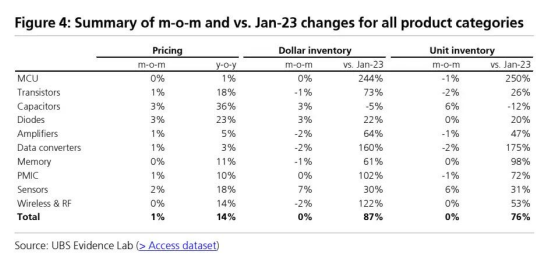
Investment Rating - The report maintains a favorable outlook on the semiconductor industry, particularly favoring companies like Texas Instruments, Renesas, and Infineon [2][3]. Core Insights - The semiconductor inventory levels are showing signs of normalization, with MCU inventories stabilizing after a previous period of understocking [2][3]. - Pricing trends across various semiconductor categories have remained stable, with an average increase of 1% month-over-month and a 14% year-over-year increase [3][9]. - The report highlights a continued digestion of MCU inventories, which had previously been elevated, indicating a positive trend for the industry [3][12]. Summary by Relevant Sections Inventory Trends - MCU inventory has decreased by 1% month-over-month after a 5% decline in the previous month, while overall inventory levels were flat to down 2% across most categories [3][4]. - Capacitors and Sensors saw a month-over-month increase of 6% in inventory, contrasting with declines in other categories [4][15]. Pricing Trends - Pricing for MCUs remained flat month-over-month and increased by 1% year-over-year, while other categories experienced slight increases of 1-3% [4][15]. - The overall pricing environment is deemed manageable, with a year-over-year increase of 3% on a revenue exposure weighted basis [9][12]. Company Observations - The report notes that pricing for transistors increased by 1% month-over-month and 18% year-over-year, driven largely by bipolar transistors [4][15]. - Infineon has seen an increase in MCU inventory to 4% of the total, up from an average of 2.6%, indicating potential overstocking or market share gains [5][19].


半导体行业库存趋于正常化 瑞银首推德州仪器(TXN.US)、瑞萨电子(RNECY.US)与英飞凌(IFNNY.US)
智通财经网· 2025-07-24 07:04
Core Viewpoint - UBS reports a positive trend in the semiconductor industry regarding inventory and pricing, particularly noting the continuous digestion of MCU inventory, which alleviates concerns about supply-demand imbalance [1] Group 1: Inventory Trends - Global semiconductor inventory showed stable adjustments in July, with the exception of capacitors and sensors, which saw a month-on-month increase of 6%. Other categories either remained flat or decreased by 2% [2] - MCU inventory has been consistently decreasing since February, with a month-on-month decline of 1% in July, although this is a slowdown from the previous month's 5% drop [2][4] - Overall, the semiconductor inventory is still high compared to January 2023, but the industry is moving towards supply-demand balance [1][4] Group 2: Pricing Trends - Average pricing across all categories increased by 1% month-on-month and 14% year-on-year, primarily due to product mix adjustments [2] - Transistor prices rose by 1% month-on-month and surged by 18% year-on-year, driven mainly by bipolar transistors [2][4] - Capacitors, diodes, and sensors saw month-on-month price increases of 2%-3%, while other categories remained stable or increased by 1% [2] Group 3: Key Product Dynamics - MCU prices remained stable month-on-month, with a year-on-year increase of 1%, despite high inventory levels compared to January 2023 [4] - Transistor inventory decreased by 2%, with prices increasing by 1% month-on-month and 18% year-on-year [4] - Sensor prices increased by 18% year-on-year and 2% month-on-month, with inventory showing significant fluctuations [4] Group 4: Company Observations - The weighted average pricing across companies increased by 3% year-on-year in July, with stable inventory levels overall [5] - MCU inventory digestion has slowed, previously driven by Microchip Technology and STMicroelectronics, while Infineon’s MCU inventory share has risen from an average of 2.6% to 4%, indicating signs of inventory accumulation [5]

MCU,巨变
半导体行业观察· 2025-07-13 03:25
Core Viewpoint - The article discusses the significant shift in the automotive MCU market with the introduction of new embedded storage technologies like PCM and MRAM, moving away from traditional embedded Flash technology. This transition is seen as a strategic move that will have a profound impact on the MCU ecosystem [1][3]. New Storage Pathways - Major MCU manufacturers such as ST, NXP, and Renesas are launching new automotive MCU products featuring advanced embedded storage technologies, indicating a shift from traditional 40nm processes to more advanced nodes like 22nm and 16nm [2]. - The evolution of MCUs is characterized by increased integration of AI acceleration, security units, and wireless modules, positioning them as central components in automotive applications [2]. Embedded Storage Technology Revolution - The rise of embedded non-volatile memory (eNVM) technologies is crucial for addressing the challenges posed by the complexity of software-defined vehicles (SDVs) and the increasing demands for storage space and read/write performance [3]. - Traditional Flash memory is becoming inadequate in terms of density, speed, power consumption, and durability, making new storage solutions essential for MCU advancement [3]. ST's Adoption of PCM - ST has introduced the Stellar series of automotive MCUs featuring phase change memory (PCM), which offers significant advantages over traditional storage technologies [5][6]. - The Stellar xMemory technology is designed to simplify the development process for automotive manufacturers by reducing the need for multiple memory options and associated costs [7][9]. NXP and Renesas Embrace MRAM - NXP has launched the S32K5 series, the first automotive MCU based on 16nm FinFET technology with integrated MRAM, enhancing the performance and flexibility of ECU programming [10]. - Renesas has also released a new MCU with MRAM, emphasizing high durability, data retention, and low power consumption, further showcasing the advantages of MRAM technology [11]. TSMC's Dual Focus on MRAM and RRAM - TSMC is advancing both MRAM and RRAM technologies, aiming to replace traditional eFlash in more advanced process nodes due to the limitations faced by eFlash technology [15]. - TSMC has achieved mass production of RRAM at various nodes and is actively developing MRAM for automotive applications, indicating a strong commitment to new storage technologies [15][16]. Integration of Storage and Computing - The article highlights a trend towards "storage-computing integration," where new storage technologies like PCM and MRAM are not just replacements but catalysts for MCU architecture transformation [19]. - The merging of storage and computing functions is becoming increasingly important in the context of AI, edge computing, and the growing complexity of computational tasks [21]. Conclusion - The MCU landscape is evolving from a focus on basic control systems to a more integrated approach where storage plays a critical role in computing architecture, driven by advancements in embedded storage technologies [23]. - This transformation presents both challenges and opportunities for domestic MCU manufacturers, who must adapt to the rapidly changing technological landscape [23].

GaN,内卷加剧
半导体芯闻· 2025-07-11 10:29
Core Viewpoint - The GaN market is experiencing significant changes, with TSMC announcing its exit from GaN foundry services within two years, while other companies like Powerchip and Infineon are ramping up their GaN production capabilities. This shift indicates a competitive landscape where GaN is poised for growth, particularly in high-efficiency applications like electric vehicles and fast charging [1][4][15]. Group 1: TSMC's Exit and Market Dynamics - TSMC will gradually phase out its GaN semiconductor foundry business due to profit margin pressures from Chinese competitors, halting the development of 200mm wafer production [1][2]. - Navitas Semiconductor plans to transition its production from TSMC to Powerchip, with expectations to produce GaN products rated from 100V to 650V by mid-2026 [2]. - The exit of TSMC opens opportunities for other players like Powerchip and Infineon to fill the production gap and capture market share [1][4]. Group 2: Competitor Strategies - Infineon is advancing its 12-inch GaN production, with plans to release customer samples by Q4 2025, leveraging its IDM model for scalable production [4]. - Renesas Electronics has shifted focus from SiC to GaN, suspending its SiC projects due to market saturation and is preparing to enhance its GaN capabilities following its acquisition of Transphorm [5][6]. - ROHM is committed to deepening its collaboration with TSMC to address market demands and explore future production frameworks [3]. Group 3: Market Growth and Challenges - The GaN semiconductor market is projected to grow significantly, with a compound annual growth rate (CAGR) of 98.5% from 2024 to 2028, potentially exceeding $6.8 billion by 2028 [15]. - The main drivers for GaN market growth include consumer electronics and electric vehicles, with expectations for GaN applications in fast chargers and adapters to grow at a CAGR of 71.1% [15]. - Transitioning GaN from peripheral applications to core power systems in electric vehicles presents challenges, including reliability and ecosystem maturity [16][17]. Group 4: Strategic Partnerships and Investments - STMicroelectronics has extended its lock-up period for its investment in Innoscience, signaling confidence in the latter's future and the broader GaN market [9][11]. - The partnership between ST and Innoscience aims to leverage each other's manufacturing capabilities to enhance GaN product development and production [12]. - Innoscience has emerged as a key player in the GaN market, achieving significant revenue growth and expanding its wafer production capacity [14].
UMC vs. IFNNY: Which Stock Should Value Investors Buy Now?
ZACKS· 2025-07-10 16:40
Core Insights - Investors in the Electronics - Semiconductors sector should consider United Microelectronics Corporation (UMC) and Infineon Technologies AG (IFNNY) for potential undervalued stock opportunities [1] Valuation Metrics - UMC has a Zacks Rank of 2 (Buy), indicating a stronger earnings outlook compared to IFNNY, which has a Zacks Rank of 3 (Hold) [3] - UMC's forward P/E ratio is 14.53, significantly lower than IFNNY's forward P/E of 28.49, suggesting UMC may be undervalued [5] - UMC's PEG ratio is 1.65, while IFNNY's PEG ratio is 1.93, indicating UMC's expected EPS growth is more favorable [5] - UMC's P/B ratio stands at 1.63, compared to IFNNY's P/B of 3.23, further supporting UMC's valuation advantage [6] - UMC has received a Value grade of A, while IFNNY has a Value grade of C, highlighting UMC's superior valuation metrics [6] Earnings Outlook - UMC is noted for its improving earnings outlook, which enhances its attractiveness as a value investment [7]


英飞凌基于300毫米晶圆的可扩展GaN预计将于25Q4提供 | 投研报告
Zhong Guo Neng Yuan Wang· 2025-07-08 01:26
Investment Highlights - Infineon announced progress in its scalable GaN manufacturing technology based on 300mm wafers, with the first samples expected to be delivered to customers in Q4 2025, aiming to strengthen its position as a market leader in GaN [1][2] - Chipsea Technology has recently completed the tape-out of its first high-performance, high-reliability automotive MCU product, which meets ASIL-D safety standards [2] - Nanfu Technology has secured several million yuan in Pre-A round financing, which will be used to expand its high-frequency, high-speed copper-clad laminate production line and enhance product development in aerospace, communications, automotive, and data center sectors [2] - Xiamen Silan Microelectronics has made significant progress on its 8-inch silicon carbide power device chip manufacturing line, with the first equipment arriving ahead of schedule [2] - China Mobile has announced a procurement project for AI servers, estimating a total of 7,058 units to be purchased for the period of 2025 to 2026 [2] - AGC, a Japanese materials giant, has been forced to suspend the supply of a specific CMP polishing liquid due to new export control policies in Taiwan, which is critical for advanced chip manufacturing [2] - Samsung Electronics has reduced the production of its 12-layer HBM3E memory, originally planned for supply to NVIDIA, due to delays in negotiations and increased uncertainty in demand for the second half of the year [2] Company Announcements - Raytheon Technology announced the establishment of a smart glasses company, holding a 35% stake to enhance competitiveness in the smart glasses market [3] - Fenghua Advanced Technology announced a cash dividend of 1.50 yuan per 10 shares, totaling approximately 172.12 million yuan [3] - Tonglian Precision announced a cash dividend of 1.50 yuan per 10 shares, amounting to approximately 23.51 million yuan [3] - Zhongwei Company announced a cash dividend of 0.30 yuan per share, totaling approximately 187.21 million yuan [3] - Tianwei Vision announced a cash dividend of 0.50 yuan per 10 shares, based on a total share capital of approximately 802.56 million shares [3] - Dashi Intelligent signed a contract for an intelligent project worth 11.88 million yuan, providing IoT and AI-based solutions [3] - Yongxi Electronics announced a share buyback progress, with a total of 2.56 million shares repurchased, representing 0.63% of total shares [3] - Keda Automation plans to acquire 51% of Haituo Technology for 209.10 million yuan in cash [3] - Weichuang Optoelectronics announced a delay in its smart transportation project, now expected to be operational by December 31, 2025 [3] - Jinfeng Technology received an administrative penalty for accounting errors that inflated revenue in previous reports, resulting in a warning and a fine of 4 million yuan [3] - Juquan Technology announced a change in core technical personnel, with Xuming Zhang resigning from multiple positions but continuing as a technical advisor [3]
芯片行业,多起并购
半导体行业观察· 2025-07-02 01:50
Group 1: Tenstorrent Acquires Blue Cheetah - Tenstorrent announced the acquisition of Blue Cheetah Analog Design, a startup focused on custom analog mixed-signal IP [2] - Blue Cheetah has been a key supplier for Tenstorrent, providing advanced interconnect solutions for its chiplet-based products [2][4] - The acquisition aims to enhance Tenstorrent's chiplet roadmap and accelerate the creation of an open chiplet ecosystem [4][6] Group 2: SkyWater Acquires Fab 25 - SkyWater completed the acquisition of Infineon's 200mm semiconductor wafer fab, Fab 25, located in Austin, Texas [7] - The acquisition significantly increases SkyWater's capacity and enhances its advanced technology services [7][8] - Fab 25 will play a crucial role in expanding domestic semiconductor manufacturing capabilities in the U.S. [8][9] Group 3: Nvidia Acquires CentML - Nvidia acquired CentML, a Toronto-based startup focused on machine learning and AI, with undisclosed financial terms [11] - The acquisition brings CentML's co-founders into leadership roles at Nvidia, enhancing its AI software capabilities [11][12] - CentML's operations are set to conclude in July 2025, following Nvidia's earlier investment in the company [11][13] Group 4: Arista Networks Acquires VeloCloud - Arista Networks announced the acquisition of VeloCloud's SD-WAN product portfolio from Broadcom [14][15] - The integration aims to enhance Arista's wired and wireless switching product offerings with VeloCloud's cloud-delivered SD-WAN solutions [16][17] - This acquisition is part of Arista's strategy to bridge the gap between enterprise and cloud WAN access [17] Group 5: Codasip Plans Sale - Codasip, a RISC-V processor developer, is reportedly up for sale under CEO Ron Black's leadership [19][20] - The company has developed tools for producing processor cores using the open RISC-V instruction set and has secured up to €380 million in funding [19][20] - Codasip's board initiated the sale process due to increasing market competition and the company's recent struggles [19][20]


深耕中国30年,英飞凌开启“在中国,为中国”本土化战略
半导体芯闻· 2025-06-30 10:07
Core Viewpoint - Infineon has been deeply integrated into the Chinese semiconductor industry for 30 years, marking its significant role in the industry's evolution and its commitment to local development through the "In China, For China" localization strategy [2][8][24]. Group 1: Historical Context and Achievements - Infineon has witnessed and participated in the growth of the Chinese semiconductor industry, celebrating its 30th anniversary in China with a media day in Shanghai [2][3]. - The company has achieved significant milestones, including leading the global MCU market with a market share of 21.3% and maintaining its position as the top player in automotive semiconductors for five consecutive years, with a global market share of 13.5% in 2024 [5][23]. Group 2: Localization Strategy - The "In China, For China" localization strategy is built on four pillars: operational optimization, technological innovation, production layout, and ecosystem co-construction [9][10]. - Infineon's Wuxi factory, established in 1995, has become a key manufacturing base, supporting local business development and achieving a 34% revenue contribution from the Greater China region in the 2024 fiscal year [7][12][24]. Group 3: Technological Innovations - Infineon has made significant technological advancements, including the launch of the world's first 300mm GaN wafer and the thinnest 20μm silicon power wafer, showcasing its commitment to innovation [5][6]. - The company invests 13% of its revenue in R&D, emphasizing its dedication to continuous innovation and maintaining its industry-leading position [6]. Group 4: Business Segments and Future Plans - Infineon's three core business segments—automotive, industrial and infrastructure, and consumer computing and communications—are driving its localization strategy and enhancing its role in China's industrial upgrade [13][24]. - The company plans to expand its local production capabilities, particularly in the automotive sector, with a focus on meeting the needs of local customers and supporting the growth of the electric vehicle market [15][16][19]. Group 5: Sustainability and Market Impact - Infineon has been recognized for its sustainable practices, being included in the Dow Jones Sustainability Index, which reflects its commitment to responsible business operations [5]. - The company's products are widely used in critical sectors such as renewable energy and transportation, contributing to China's green transformation and energy security goals [19][20].

瑞银:半导体经销商追踪-更多积极指标
瑞银· 2025-06-27 02:04
Investment Rating - The report maintains a positive outlook on the semiconductor industry, highlighting reassuring pricing trends and improving inventory levels [2][3]. Core Insights - The semiconductor market is experiencing a continued digestion of MCU inventory, with a 5% month-over-month decline and a 24% decrease compared to the previous month [3][4]. - Pricing across all product categories has remained stable, with an average increase of 1% month-over-month and 13% year-over-year [3][8]. - The report emphasizes the positive trends in pricing and inventory, particularly for companies like TI, Renesas, and Infineon, while also noting improvements for STM and other industrial MCU names [2][4]. Summary by Relevant Sections Inventory Trends - MCU inventory has decreased by 5% month-over-month, following a 4% decline the previous month, indicating a healthy destocking process [3][4]. - Other categories such as Sensors and Diodes also saw inventory reductions of 5% and 4% respectively, while overall inventory trends are generally stable [3][4]. Pricing Trends - Pricing for MCUs remained flat month-over-month and year-over-year, while transistors saw a 2% increase month-over-month and a 17% increase year-over-year [4][14]. - Capacitors, Diodes, and Sensors experienced price increases of 2-3%, contributing to an overall stable pricing environment [4][14]. Company Observations - Infineon and STM showed varied pricing trends, with Infineon down 4% and STM up 4% in June compared to May, reflecting a mix-driven pricing environment [5][8]. - The report indicates that inventory levels are stable, with significant destocking in MCUs, previously driven by MCHP and now also by STM [5][11].
UMC or IFNNY: Which Is the Better Value Stock Right Now?
ZACKS· 2025-06-24 16:41
Core Insights - The article compares United Microelectronics Corporation (UMC) and Infineon Technologies AG (IFNNY) to determine which stock is more attractive to value investors [1][3] Valuation Metrics - UMC has a forward P/E ratio of 15.32, while IFNNY has a forward P/E of 26.33 [5] - UMC's PEG ratio is 1.74, compared to IFNNY's PEG ratio of 1.78 [5] - UMC's P/B ratio is 1.72, whereas IFNNY has a P/B of 2.92 [6] Analyst Outlook - UMC currently holds a Zacks Rank of 2 (Buy), indicating a more favorable earnings estimate revision activity compared to IFNNY, which has a Zacks Rank of 3 (Hold) [3][7] - UMC's stronger estimate revision activity and more attractive valuation metrics suggest it is the superior option for value investors at this time [7] Value Grades - UMC has a Value grade of A, while IFNNY has a Value grade of C, reflecting UMC's better valuation metrics [6]