Intel(INTC)
Search documents
深夜,全线大涨!中国资产大爆发
Mei Ri Jing Ji Xin Wen· 2025-11-24 16:19
Group 1: Major Tech Stocks Performance - Major tech stocks showed a positive trend, with Tesla rising by 6.36%, Google by 5.49%, Facebook by 3.37%, Amazon by 2.51%, Apple by 0.83%, Microsoft by 0.6%, and Nvidia by 0.2% [2][3] - The Philadelphia Semiconductor Index surged by 3.66%, with Broadcom increasing over 9%, Micron Technology rising by 6.71%, AMD up by 4.05%, and Intel gaining 3.57% [2][5] Group 2: Novo Nordisk's Clinical Trial Results - Novo Nordisk experienced a significant decline of 6.58%, with shares dropping nearly 10% after the company announced that its drug semaglutide did not meet efficacy targets in late-stage trials for Alzheimer's disease [5][6] - The trials aimed to slow cognitive decline in patients by at least 20%, but no significant improvement was observed among thousands of participants [6][7] Group 3: Nasdaq China Golden Dragon Index - The Nasdaq China Golden Dragon Index rose by 2.56%, with notable individual stock performances including Hesai Technology up over 18%, Canadian Solar near 9%, Baidu up 7.84%, and Bilibili rising by 6.96% [9][10] Group 4: Market Outlook and Predictions - Morgan Stanley's chief U.S. equity strategist, Michael Wilson, expressed optimism about the U.S. stock market, suggesting that the recent downturn may soon end and reaffirming a bullish outlook for next year [11][12] - Wilson predicts the S&P 500 index will rebound to 7,800 points in a year, representing an approximate 18% increase from current levels, driven by a potential interest rate cut cycle by the Federal Reserve and an AI-driven efficiency revolution [12][13] - Goldman Sachs anticipates the Federal Reserve will implement a third consecutive rate cut in December, with further cuts expected in 2026, as inflation trends and labor market cooling provide room for policy easing [12][14]
今夜,暴涨!
中国基金报· 2025-11-24 16:14
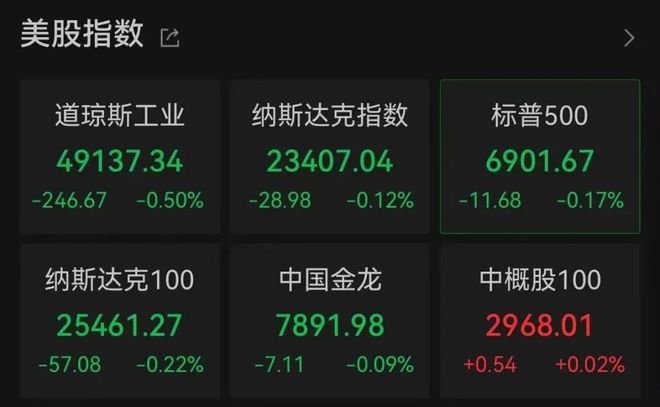
Group 1 - The core viewpoint of the article highlights a significant rise in technology stocks, particularly in the U.S. markets, with the Nasdaq index surging nearly 2% [2][3] - Major semiconductor companies like AMD and Micron, along with tech giants such as Tesla and Alphabet, saw substantial stock price increases, contributing to the overall market rally [3] - The market sentiment is largely influenced by rising expectations for a potential interest rate cut by the Federal Reserve, with the probability of a cut next month reaching nearly 80% [4][5] Group 2 - The article notes that the Boston Fed President Susan Collins does not see an urgent need for rate cuts, while New York Fed President John Williams indicated that there may be reasons for a cut in the near term [5] - Analysts express that the current economic data is subject to various interpretations due to delays in official data releases, complicating the economic outlook [7] - Chinese stocks also performed well, with the China concept stock index rising approximately 2.5%, and Xiaomi's ADR increasing over 4% following a significant share buyback by its founder Lei Jun [7][8]
台积电核心老臣被曝携20箱机密文件投奔英特尔被调查违反商业秘密,英特尔CEO陈立武称谣言
Sou Hu Cai Jing· 2025-11-24 11:44
Core Insights - The recent retirement of TSMC's senior vice president, Luo Wei-ren, and his subsequent move to Intel has raised concerns regarding the potential transfer of confidential documents related to advanced semiconductor processes [2] - Intel's CEO, Pat Gelsinger, publicly denied allegations that Luo brought confidential files with him, asserting that the company respects intellectual property rights [2] - Luo's extensive experience in both TSMC and Intel positions him as a valuable asset for Intel, particularly in managing wafer production and enhancing operational efficiency [3] Group 1 - Luo Wei-ren retired from TSMC in July 2023 and joined Intel as a vice president of R&D, amid rumors of him carrying over 20 boxes of confidential documents related to TSMC's advanced processes [2] - Intel aims to leverage Luo's expertise to improve collaboration with U.S. clients at TSMC's Arizona facility, with expected partnerships including Microsoft and Tesla, and potentially Nvidia and Qualcomm in the future [3] - Luo's career at TSMC included significant advancements in semiconductor technology, leading to over 15,000 patents and establishing TSMC's leadership in 2nm and 1.4nm process technologies [3] Group 2 - This incident is not the first time TSMC has faced allegations related to trade secrets, as the company previously reported cases of employees involved in stealing confidential information about its 2nm chip technology [4] - The ongoing scrutiny surrounding Luo's transition to Intel is heightened by TSMC's recent legal challenges regarding intellectual property theft [4]
人形机器人的落地难题,竟被一顿「九宫格」火锅解开?
机器之心· 2025-11-24 07:27
Core Viewpoint - The article discusses the challenges and advancements in embodied intelligence, emphasizing the need for leading chip companies like Intel to overcome computational architecture barriers for large-scale applications [2][8]. Group 1: Challenges in Embodied Intelligence - Recent demonstrations of humanoid robots, such as Tesla's Optimus and Russia's AI robot "Eidol," have faced criticism for their performance, highlighting the gap between theoretical capabilities and practical applications [3][4][7]. - The primary obstacle for these robots entering production lines is the computational platform, which is identified as a significant barrier to the deployment of embodied intelligence [9][12]. - Current humanoid robots typically use a "brain + cerebellum" architecture, where the "brain" handles complex modeling tasks, while the "cerebellum" manages real-time control, requiring high-frequency operations [9][10]. Group 2: Computational Requirements - The demand for computational power has surged due to the integration of motion generation models and multimodal perception, with many companies struggling to meet the required performance levels [10][11]. - Companies often resort to using multiple systems for different tasks, leading to inefficiencies and delays in communication, which can result in operational failures [10][11]. - The return on investment (ROI) is a critical consideration for manufacturers, necessitating robots that are not only effective but also stable, safe, cost-efficient, and energy-efficient [10][11]. Group 3: Intel's Solutions - Intel proposes a "brain-cerebellum fusion" solution using a single System on Chip (SoC) that integrates CPU, GPU, and NPU, allowing for unified intelligent cognition and real-time control [13][14]. - The Core Ultra processor achieves approximately 100 TOPS of AI computing power while maintaining similar power consumption levels, enabling faster responses and improved privacy [17]. - The integrated GPU provides 77 TOPS of AI computing power, capable of handling large-scale visual and modeling tasks effectively [18]. Group 4: Software and Ecosystem - Intel offers a comprehensive software stack that includes operating systems, drivers, SDKs, and real-time optimizations, facilitating easier development for hardware manufacturers [24][26]. - The oneAPI framework allows developers to write code once and run it across various hardware platforms, promoting interoperability and efficiency [27]. - Intel's open approach to technology enables companies to adapt existing systems without being locked into specific vendors, fostering innovation in the embodied intelligence sector [31].
TMT行业周报(11月第3周):国内外大模型厂商加速抢占C端入口-20251124
Century Securities· 2025-11-24 06:33
Investment Rating - The report does not explicitly state an investment rating for the industry, but it highlights strong performance and growth potential for leading companies in the AI sector, particularly those with established ecosystems like Alibaba and Google [3][4]. Core Insights - Major players in the AI sector, such as Alibaba and Google, are rapidly expanding their consumer-facing applications, indicating a strategic shift towards the C-end market. Alibaba's Qwen3-based Qianwen app and Google's Gemini 3 model are examples of this trend [3][4]. - Nvidia reported exceptional quarterly earnings, with revenues of $57 billion, a year-on-year increase of 62%. This performance alleviates concerns about an "AI bubble" and suggests a robust growth trajectory for AI-related infrastructure [3][4]. - The report emphasizes the increasing concentration of market share among leading AI model providers, predicting that top firms will continue to expand their token shares in the market [3][4]. Weekly Market Review - The TMT sector experienced declines across various sub-industries, with the media sector down by 1.25%, communication by 2.51%, computing by 2.74%, and electronics by 5.89%. Conversely, the marketing agency sub-industry saw a significant increase of 9.60% [3][4]. - Notable declines were observed in the semiconductor equipment and materials sectors, with decreases of 7.19% and 7.08%, respectively [3][4]. Industry News and Key Company Announcements - Alibaba's Qianwen app, launched on November 17, marks a significant move into the consumer AI application space, integrating with various services like maps and shopping [3][4]. - Google's Gemini 3 model has achieved top performance in AI benchmarks, showcasing its advanced multimodal capabilities and integration with Google's existing applications [3][4]. - Nvidia's strong financial results and optimistic future guidance suggest a continued upward trend in AI infrastructure investments, with expectations of reaching $65 billion in Q4 revenue [3][4]. Company-Specific Developments - Nvidia's data center revenue grew by 66% year-on-year, indicating strong demand for AI computing power [3][4]. - Xiaomi has invested heavily in AI, with plans to release multiple AI models and applications, reflecting a broader trend of tech companies enhancing their AI capabilities [3][4]. - OpenAI's collaboration with Target aims to enhance retail experiences through AI, further demonstrating the integration of AI into various sectors [3][4].
US tech majors Apple, Amazon, Cisco, Meta jointly oppose Reliance Jio and VI’s demand on 6 GHz band spectrum
BusinessLine· 2025-11-24 05:34
Core Viewpoint - US tech giants, including Apple, Amazon, Cisco, Meta, HP, and Intel, oppose the allocation of the 6 GHz band for mobile services, advocating instead for its use for Wi-Fi services [1][2]. Group 1: Spectrum Allocation and Auction - The US technology companies argue that the technical and commercial readiness for mobile services in the 6 GHz band is not established [2]. - The government has indicated that 400 MHz of frequencies in the 6 GHz band are available for auction, with 300 MHz expected to be available by 2030 and 500 MHz to be delicensed for low power applications, primarily Wi-Fi [5][6]. - Reliance Jio has requested that the entire 1200 MHz spectrum in the 6 GHz band be included in the upcoming auction, despite the government's decision to delicence 500 MHz for low power applications [5][6]. Group 2: Industry Responses and Concerns - Airtel has also requested a deferment of the 6 GHz band auction due to ecosystem readiness challenges, including device availability and network equipment [7]. - Qualcomm supports the deferment, emphasizing the importance of aligning with global standards and safeguarding India's 6G future [8]. - The Cellular Operators Association of India (COAI) opposes the delicensing of the 6 GHz band, arguing that it undermines quality of service and scalability for digital applications [9][10]. Group 3: Implications of Delicensing - COAI warns that delicensing any part of the 6 GHz band could permanently limit its use for licensed mobile broadband services, affecting India's long-term digital capacity [10]. - Concerns are raised that unlicensed Wi-Fi deployments by global OTT players could disadvantage local telecom operators and reduce government revenues [11].
US vendors Apple, Cisco, Broadcom, HPE jointly oppose Jio, Vodafone Idea on 6GHz band
ETTelecom.com· 2025-11-24 02:34
Core Viewpoint - US technology companies, including Amazon and Qualcomm, oppose the allocation of the upper 6GHz band for International Mobile Telecommunications (IMT) services, advocating instead for the entire 6GHz band to be designated for Wi-Fi services due to concerns over technical and commercial readiness [1][8][10] Group 1: Spectrum Allocation and Auction - The Indian government has stated that 400MHz of airwaves in the 6GHz band are available for auction, with an additional 300MHz expected by 2030, and 500MHz to be delicensed for low-power applications like Wi-Fi [2][10] - Reliance Jio is pushing for the entire 1200MHz spectrum in the 6GHz band to be included in the upcoming auction, despite the government's decision to delicence part of the band for low-power applications [2][10] - Airtel and Qualcomm have called for the deferment of the auction for the 6425-6725 MHz and 7025-7125 MHz bands, citing the need for ecosystem readiness and alignment with global standards [4][10] Group 2: Industry Associations' Stance - The Cellular Operators Association of India (COAI) opposes the delicensing of the 6GHz band, arguing that licensed IMT spectrum is essential for quality service and scalability for future applications like 6G [5][6][10] - COAI warns that delicensing any part of the 6GHz band could permanently limit India's digital capacity and affordable service provision [6][10] - The Manufacturers Association of Information Technology (MAIT) supports the idea of allowing unlicensed access in the lower 6GHz band and suggests extending this to parts of the upper 6GHz for future Wi-Fi generations [7][10]
Wedbush:AI及高性能计算领域内存供应持续紧张
智通财经网· 2025-11-24 02:12
Group 1: Memory Market Insights - High demand for memory, particularly Flash Memory and DRAM, is expected to continue driving prices upward [1] - Memory supply remains tight, with NAND experiencing a sharp price increase similar to DRAM starting in October, often seeing double-digit percentage hikes [1] - Major players in the DRAM market include SK Hynix, Samsung, and Micron Technology, while leading NAND manufacturers are Samsung, SK Hynix, Western Digital, Intel, and Micron Technology [1] Group 2: Quantum Computing and Supercomputing Trends - There is a growing interest in quantum computing within the commercial sector, with companies like IBM, Fujitsu, D-Wave, IonQ, and others being highlighted [2] - The latest list of the world's 500 most powerful supercomputers saw 45 new entrants, but none made it into the top ten, although this is expected to change with new projects from the U.S. Department of Energy [2] - NVIDIA remains the leading supplier for supercomputing systems, occupying 30 GPU slots and 6 CPU slots, while Intel secured 25 CPU slots and AMD obtained 18 slots (14 CPUs and 4 GPUs) [2]
高盛闭门会-电力峰会的关键趋势和洞察,供应链瓶颈和看好公司
Goldman Sachs· 2025-11-24 01:46
Investment Rating - The report indicates a positive outlook for utility companies, with a focus on both high-growth and low-risk investment opportunities [8]. Core Insights - Data center electricity demand is expected to grow at a compound annual growth rate (CAGR) of approximately 2.5%-2.6% over the next decade, with significant potential remaining as many facilities are not yet fully operational [5][6]. - Utility companies are significantly increasing their capital expenditure plans, with Duke Energy forecasting a capital plan of $95 billion to $105 billion from 2026 to 2030, up from a previous plan of $87 billion over five years [6][8]. - The regulatory environment is crucial for the development of utility companies, with strict regulations impacting transmission investments, which typically offer higher returns [7]. Summary by Sections Data Center Demand - The report highlights that data centers are a key growth driver, with actual demand growth aligning with long-term forecasts [5]. - Many large data center facilities are still in the process of being fully operational, indicating further growth potential in the coming years [5]. Utility Companies' Capital Expenditure - Utility companies are optimistic about their capital expenditure outlook, with many raising their capital plans and corresponding earnings growth expectations [6]. - The average expected earnings growth for utility stocks rated as "buy" is projected at 9% over the next five years [6]. Regulatory Environment - The changing regulatory landscape may introduce increased risks and uncertainties for utility companies, particularly with recent shifts in state regulatory commissions [7]. - Customer bills in the PJM regional grid have risen by 15%-20% over the past year, prompting states to consider new procurement processes to manage costs [7]. Investment Strategies - Investors are adopting a "barbell" investment strategy, focusing on both high-growth companies like NextEra and Sempra, and lower-risk companies like Duke Energy, which is expected to see earnings growth of 7-8% [8]. - Companies with exposure to data center opportunities, such as Furtive, Flux, and Jabal, are highlighted as potential investment targets due to their growth potential in the AI data center space [14]. Supercomputing Trends - The report notes a 17% upward revision in performance forecasts for major hyperscale companies by 2026, necessitating substantial infrastructure investments [9]. - Prefabricated power and cooling solutions are being adopted to enhance installation efficiency and address labor shortages [10][11]. Cooling and Power Requirements - The increasing power levels of data center racks, now exceeding 100 kW, are creating new demands for power and cooling solutions [13]. - Companies are exploring liquid cooling technologies and high-voltage power supply options to meet future demands [13].
英特尔新款处理器抢先首测:非满血,但IPC真不低
3 6 Ke· 2025-11-24 00:55
Core Insights - Intel's upcoming Panther Lake processors have been revealed through leaked engineering samples, showcasing advanced specifications and potential performance metrics [5][11][28] - The Panther Lake-H processor features a 10-core configuration with 2 performance cores, 4 efficient cores, and 4 low-power efficient cores, indicating a focus on mobile applications [9][19] - The processor is identified as a low-voltage variant, which may suggest a shift in Intel's design strategy to unify architectures across different power tiers [21][27] Technical Specifications - The Panther Lake development platform includes a CPU with a base speed of 2000 MHz and a maximum TDP of 25W, with configurable TDP levels ranging from 15W to 65W [24][28] - The memory configuration includes LPDDR5X-7467 with a total of 16GB, which is crucial for performance but may also limit the processor's capabilities due to its early engineering sample status [9][28] - The processor's architecture appears to have improved efficiency, potentially allowing it to fit within a 15W power envelope while maintaining performance [27] Performance Metrics - Initial benchmarks indicate that the Panther Lake-ULT processor's single-core performance is comparable to Intel's 10th generation CPUs, primarily due to its lower operating frequency of 3.2 GHz [32][33] - Despite the limitations of the early sample, the new architecture shows a 6% performance improvement over the latest desktop processors at the same frequency [32] - The memory performance tests reveal that the processor struggles to utilize the high-speed memory effectively, indicating a bottleneck in the current configuration [30][35] Market Implications - The unveiling of the Panther Lake processors suggests Intel's commitment to advancing mobile computing technology, with a focus on efficiency and performance [5][27] - As the release date approaches, further information and performance data are expected, which could influence market positioning and competitive dynamics in the semiconductor industry [35]