Microsoft(MSFT)

Search documents
美科技七巨头星光暗淡 彭博:2025多数跑输大盘 主导地位动摇
Feng Huang Wang· 2026-01-12 02:35
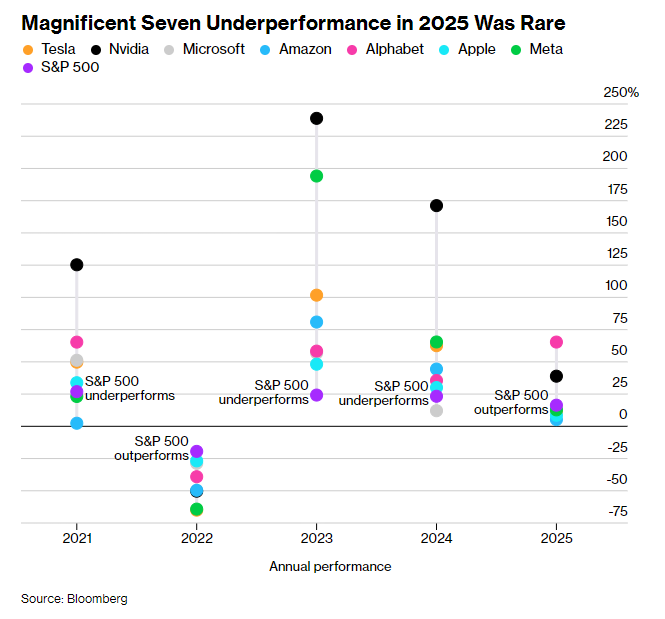
股市对科技七巨头的热情正在降温 市场依旧对科技七巨头保持乐观的一个因素是,他们的估值水平相对适中。科技七巨头指数基于未来12 个月预期盈利的市盈率为29倍,远低于本十年前期的40多倍。目前,标普500指数的预期市盈率为22 倍,纳斯达克100指数为25倍。(作者/箫雨) 自2022年美联储开始加息以来,美国"科技七巨头"(Magnificent 7)首次出现大多数公司表现跑输标普 500 指数的情况。尽管2025年科技七巨头指数上涨25%,跑赢标普500指数的16%涨幅,但这主要是由于谷 歌母公司Alphabet、英伟达的巨大涨幅带动了整体指数上涨。 "市场并非一刀切。如果你只是单纯买入整个组合,表现不佳的股票可能会抵消表现出色股票的收 益。"Natixis投资管理解决方案公司首席投资组合策略师杰克·亚纳西维奇(Jack Janasiewicz)指出,该公 司管理着1.4万亿美元资产。 过去三年,科技巨头引领了美国牛市。自2022年10月牛市行情启动以来,仅英伟达、Alphabet、微软和 苹果四家公司就贡献了标普500超过三分之一的涨幅。然而,随着市场对标普500指数其他成分股的兴趣 升温,投资者对这些科技 ...




微软_维持买入评级至未来 50 年及更长期_仍是科技领域最优质的长期增长标的之一
2026-01-12 02:27
Summary of Microsoft Corp. (MSFT) Conference Call Company Overview - **Company**: Microsoft Corp. (MSFT) - **Industry**: Technology, specifically Software - **Rating**: Buy with a 12-month price target of $655, representing a 37% upside from the previous target of $630 [1] Core Insights and Arguments - **AI Leadership**: Microsoft is positioned to benefit from compounding AI product cycles, leveraging its leadership in AI compute and investments in OpenAI and Anthropic [1][19] - **EPS Growth**: Projected EPS growth to exceed $35 by FY30, indicating over 20% growth compared to peers with median market caps over $1 trillion, which typically see mid-teens growth [1] - **Investment Strategy**: Microsoft is making strategic investments in AI and quantum technologies, which are expected to drive significant product cycles over the next 20 years [13][19] - **Capex Allocation**: Not all capital expenditures (capex) directly translate to Azure revenue growth; Microsoft is focusing on internal AI and first-party applications, which are expected to yield better unit economics [14][41] - **Gross Margin Expectations**: Anticipated gross margins on Azure AI could reach pre-AI highs (from low 30s to high 60s) within 5-7 years, supported by improved demand planning and cost controls [14][63] Financial Projections - **Revenue Growth**: Total revenue is expected to grow from $281.7 billion in FY25 to $464.4 billion by FY28, with a CAGR of approximately 14.9% to 19.2% over the forecast period [9] - **EBITDA and EPS Growth**: EBITDA is projected to grow from $156.5 billion in FY25 to $279.4 billion by FY28, with EPS increasing from $13.77 to $23.46 in the same period [9] - **Free Cash Flow**: Expected to grow from $71.6 billion in FY25 to $109.2 billion by FY28, indicating strong cash generation capabilities [10] Market Position and Competitive Landscape - **Cloud Market Share**: Microsoft holds approximately 20-25% of the cloud computing market, positioning it as a strong competitor against AWS [25] - **Historical Context**: Microsoft has successfully navigated multiple technology adoption cycles over the past 50 years, maintaining relevance and market share through innovation [21][26] Additional Insights - **AI Adoption Cycle**: Microsoft is in the midst of an AI investment cycle, with capex expected to grow significantly, reaching $148 billion in FY26, which is 400% above FY22 levels [40] - **Supply Constraints**: The company anticipates being capacity constrained through FY26, which will impact Azure growth but also indicates strong demand signals [40][55] - **Long-term Vision**: Microsoft is focused on building Azure for the next 50 years, prioritizing workloads that serve a broad customer base rather than niche applications [40] Conclusion Microsoft Corp. is strategically positioned to capitalize on the growing AI market and maintain its leadership in cloud computing. The company's robust financial projections, combined with its historical adaptability and strategic investments, suggest a strong outlook for future growth and profitability.
美洲软件_将软件板块覆盖延伸至智能工作流十年周期_买入 MSFT、ORCL、NOW;卖出 ADBE、DDOGAmericas Technology_ Software_ Assuming Software Sector Coverage into the Decade of Agentic Workflow_ Buy MSFT, ORCL & NOW; Sell ADBE & DDOG
2026-01-12 02:27
Summary of Key Points from the Conference Call Industry Overview - Coverage has been assumed for the Software Sector and 12 additional companies, indicating a constructive outlook on AI adoption as a positive tailwind for the Software Total Addressable Market (TAM) over the next 5-10 years [1][7][8] - The Software TAM is expected to grow significantly, with projections suggesting a TAM of $2.8 trillion by 2037, representing a 30% increase from current estimates [19][21] Core Companies and Recommendations - **Buy Ratings**: Microsoft (MSFT), Oracle (ORCL), Salesforce (CRM), ServiceNow (NOW), Snowflake (SNOW), and Navan (NAVN) are recommended for purchase due to their strong positioning in the evolving software landscape [7][8] - **Sell Ratings**: Adobe (ADBE) and Datadog (DDOG) are recommended for sale due to competitive pressures and growth challenges [7][8] Key Debates in the Software Sector 1. **AI Infrastructure**: The ability of infrastructure software companies to convert initial AI compute shares into sustainable, profitable businesses is crucial. Companies like Microsoft and Oracle are expected to optimize their capital expenditures and improve gross margins from below 40% to over 60% [9][10] 2. **Application Software Disintermediation**: There is a risk that traditional SaaS leaders may be disintermediated by AI-native companies. The competition is expected to heighten as new technology cycles emerge, with a focus on companies that are further along in repurposing their tech stacks [9][10] 3. **Value Accrual in Software Stack**: The orchestration of agents and LLMs across various layers of the software stack is seen as a key area for value capture. Microsoft and ServiceNow are positioned well to leverage their existing IP in this space [10][19] Financial Metrics and Projections - Microsoft is expected to drive significant upside in Azure revenue by 2026, while Oracle is anticipated to show improved visibility into gross profit growth [9][10] - The report suggests that the average software company has increased gross profit per employee by 35% from 2021 to 2025, although there are risks of gross margin compression in the medium term [34] AI Adoption and Market Dynamics - AI adoption is projected to be uneven, creating opportunities for new competition. However, the overall sentiment is that the signals for uptake will be positive by 2026 [8][20] - The report emphasizes that the value unlocked by AI will likely outweigh the impact of increased competition, reversing trends observed in 2025 [20] Additional Insights - The Software TAM is divided into "scaffolding" (2/3) and "agentic" (1/3), with expectations that AI will drive incremental growth tied to enterprise adoption [25][30] - The report highlights the importance of competitive moats, such as ecosystems and network effects, which cannot be easily replicated, thus providing a buffer against competition [34] Conclusion - The Software sector is poised for growth driven by AI adoption, with specific companies positioned to capitalize on this trend. Investors are advised to focus on companies with strong competitive advantages and clear paths to revenue growth in the evolving landscape [30][34]


闭眼买入的时代结束了!美股七巨头抱团策略失灵 华尔街喊话:2026年得“拆开来买”
智通财经网· 2026-01-11 23:21
Core Viewpoint - The strategy of heavily investing in major U.S. tech stocks has underperformed since 2025, with many companies lagging behind the S&P 500 index for the first time since the Fed began raising interest rates in 2022 [1] Group 1: Market Performance - The "Seven Giants" index rose by 25% in 2025, outperforming the S&P 500's 16% increase, but this growth was primarily driven by Google and Nvidia [1] - The Seven Giants index only increased by 0.5% at the beginning of 2026, while the S&P 500 rose by 1.8% [1] - The earnings growth for the Seven Giants is projected to be around 18% in 2026, the slowest since 2022, compared to a 13% expected growth for the other 493 S&P 500 constituents [5] Group 2: Individual Company Insights Nvidia - Nvidia, a leading AI chip manufacturer, faces increased competition and concerns about the sustainability of spending from its largest customers [5] - Despite a 1165% increase since the end of 2022, Nvidia's stock has dropped 11% since reaching an all-time high on October 29, 2025 [5] - Analysts remain optimistic, with 76 out of 82 covering analysts rating it as a "buy," indicating a potential 39% upside in the next 12 months [6] Microsoft - Microsoft is expected to spend nearly $100 billion in capital expenditures for the fiscal year ending June 2026, with projections rising to $116 billion for the next fiscal year [9] - The company has struggled to convince customers to pay for integrated AI features, leading to investor concerns about the return on its significant investments [10] Apple - Apple has taken a conservative approach to AI, resulting in a nearly 20% stock price drop by early August 2025, but later rebounded by 34% by the end of the year [11] - The company is expected to achieve a 9% revenue growth in the fiscal year ending September 2026, the fastest since 2021 [11] Google - Google has emerged as a leader in AI, with its Gemini AI model receiving positive reviews and its self-developed TPU seen as a key revenue growth driver [12] - The stock price increased over 65% in 2025, but analysts predict only a 3.9% increase in 2026 [12] Amazon - Amazon was the worst performer among the Seven Giants in 2025 but has seen a strong rebound in early 2026, driven by its AWS cloud computing business [13] - The company is expected to benefit from efficiency improvements in warehousing and logistics, potentially leading to significant stock price growth [13] Meta - Meta's significant investments in AI have raised investor skepticism, particularly after increasing its capital expenditure forecast to $72 billion for 2025 and expecting a "substantial increase" in 2026 [14] - The stock saw a 35% increase earlier in 2025 but has since declined by 17% [14] Tesla - Tesla's stock price was the lowest among the Seven Giants in the first half of 2025 but surged over 40% in the second half as the focus shifted to autonomous vehicles and robotics [15] - Analysts predict a 12% revenue growth for Tesla in 2026, following a projected 3% decline in 2025 [15]



Billionaire Bill Gates Has 59% of His Foundation's $38 Billion Portfolio Invested in 3 Phenomenal Stocks
Yahoo Finance· 2026-01-11 19:35
分组1: Berkshire Hathaway - Berkshire Hathaway has a strong balance sheet and its core insurance business remains stable despite challenges from California wildfires [1] - Greg Abel took over leadership on January 1, managing $670 billion in investable assets and numerous subsidiaries [2] - The stock price has stagnated since Buffett's retirement announcement, but the company continues to generate strong cash flow and grow its assets [8] 分组2: Gates Foundation - The Gates Foundation receives annual donations from Warren Buffett, including a recent donation of 9.4 million Class B shares of Berkshire Hathaway [4] - The foundation's trust holds a portfolio worth approximately $38 billion, with 59% invested in three major companies [5] - Bill Gates aims to give away nearly all his wealth through the foundation over the next 20 years [6][7] 分组3: WM (Waste Management) - WM operates a solid waste collection and disposal business with a competitive moat due to regulatory barriers for new landfills [10] - The company has shown strong revenue growth and improved operating margins, even amidst challenges in the recycling market [11] - WM trades at an attractive valuation with an enterprise value to EBITDA ratio of less than 14, making it a solid investment option [12] 分组4: Canadian National Railway - Canadian National Railway has a wide competitive moat and geographic advantages, operating tracks from coast to coast in Canada and into the U.S. [13][14] - The company has managed to offset declines in certain freight categories with increases in others, although overall volume growth has been modest [15] - With an enterprise value to EBITDA ratio of less than 12, Canadian National Railway is considered a good long-term value stock [18]


Fiserv (FISV) Announces a Strategic Collaboration with Microsoft
Yahoo Finance· 2026-01-11 18:59
Group 1 - Fiserv, Inc. (NASDAQ:FISV) announced a strategic collaboration with Microsoft to enhance innovation by integrating AI into its development platforms and empowering its global workforce with AI tools [1][2] - The collaboration aims to boost internal productivity and deliver AI-driven solutions that create greater value for clients, including financial institutions, businesses, and consumers [1] - Fiserv is also increasing the use of Microsoft Foundry, an Azure-powered AI platform, to build, customize, deploy, and manage AI applications, thereby bringing intelligent capabilities to market [3] Group 2 - The deployment of Microsoft 365 Copilot throughout Fiserv's global workforce will provide employees with advanced AI tools to improve productivity, accelerate decision-making, and enhance work quality [2] - Fiserv is recognized as a global leader in payments and financial technology, positioning itself to leverage AI advancements for competitive advantage [3]
EXCLUSIVE: Why The AI ETFs Trade Is Entering A More Difficult Phase - Global X Artificial Intelligence & Technology ETF (NASDAQ:AIQ), Amazon.com (NASDAQ:AMZN)
Benzinga· 2026-01-11 16:32
Core Insights - AI-focused exchange-traded funds (ETFs) are facing challenges after two years of strong inflows, with a concentration in a few dominant tech stocks leading to potential risks for investors [1][3][4] Group 1: Market Dynamics - Billions of dollars have flowed into U.S.-listed technology and thematic ETFs, allowing investors to gain exposure to the AI theme without picking individual stocks [3] - Most AI ETFs are heavily weighted towards a small group of mega-cap technology companies, which has driven strong returns during the AI enthusiasm [3][4] - The "Magnificent 7" stocks, including Nvidia, Alphabet, and Microsoft, dominate many AI ETFs, increasing concentration risk [5] Group 2: Investment Strategies - Draco's AI ETF offers a more diversified approach, incorporating major holdings in debt funds and other assets, which has resulted in over 30% growth over the past year [6] - The structure of AI ETFs is crucial as the next phase of AI investing will test their resilience; many simply track AI-related companies without adjusting for market conditions [7][8] - Flexibility in AI ETFs, such as adjusting exposure rather than holding every stock with an AI label, will become increasingly important as market conditions change [8][10] Group 3: Future Outlook - Spending plans from major cloud and technology companies will be a key indicator for the outlook of AI ETFs; continued heavy investment is essential for the broader AI ecosystem [11][12] - The "Magnificent 7" are expected to invest nearly $400 billion into AI infrastructure this year, which will significantly impact market sentiment [12]


This Money Expert Is Sending Warning Signs About the Economy — and How To Protect Yourself
Yahoo Finance· 2026-01-11 15:07
Core Insights - The current economy is not as robust as it appears, with stock market gains concentrated among a few companies, leading to a divergence in performance [1][3][5] - The average American is experiencing a decline in wealth due to rising prices from inflation and a slowing job market influenced by artificial intelligence [1][2] Company Performance - The "Magnificent Seven" companies—Meta, Alphabet, Amazon, Apple, Microsoft, Nvidia, and Tesla—reported a 14.9% earnings growth in Q3 2025, significantly outpacing the S&P 500 average [3][4] - In contrast, the remaining 493 companies in the S&P 500 only achieved a 6.7% earnings growth, indicating a slowdown in broader market performance [4][5] Market Dynamics - The Magnificent Seven account for approximately 33% of the total value of the S&P 500, raising concerns about market stability if any of these companies underperform [6] - J.P. Morgan forecasts a 20% earnings per share (EPS) growth for the Magnificent Seven in 2026, compared to the S&P 500's projected EPS growth of 13% to 15% [6] Risk Assessment - There are concerns about a potential stock market bubble, as the market's performance is heavily reliant on a small number of high-valuation companies [7]

Bill Gates owns 1 of every 4000 acres of US farmland. Why the tech billionaire loves traditional agriculture investing
Yahoo Finance· 2026-01-11 15:00
Core Insights - Bill Gates has transitioned from Microsoft to focus on philanthropy through the Bill & Melinda Gates Foundation, investing billions annually in various projects [1] Group 1: Bill Gates' Investment in Farmland - Bill Gates is the largest private farmland owner in the U.S., owning over 250,000 acres, which constitutes approximately 1/4000 of all U.S. farmland [2][3] - The investment in farmland is seen as a hedge against inflation, with U.S. farmland values reaching a record $4,350 per acre, reflecting a 4.3% year-over-year increase [6] - Despite challenges such as tariff restrictions and the trade war with China, which impacted farmers' market access, farmland values have continued to rise [4][6] Group 2: Challenges in Farmland Investment - Investing in farmland requires significant capital, and financing can be difficult to obtain, especially for those without farming expertise [7]
Market Focus Shifts: Beyond ‘Magnificent 7’ as Geopolitics and Regulation Drive Headlines
Stock Market News· 2026-01-11 14:38
Key TakeawaysThe era of guaranteed success from simply "loading up" on the Magnificent 7 tech stocks is over, making selective stock picking critical for investors seeking to outperform the market.Indonesia and Malaysia have become the first nations to ban Elon Musk's Grok AI system due to its generation of sexual content, highlighting growing concerns over AI content moderation and regulation.The ouster of Venezuelan leader Nicolas Maduro triggered an outsized rally in the country's bonds, though the natio ...