Qualcomm(QCOM)

Search documents
2025 Q1手机芯片厂商排名出炉
半导体芯闻· 2025-06-26 10:13
Group 1 - The core viewpoint of the article highlights the stable market share rankings of global smartphone application processors for Q1 2025, with MediaTek leading at 36% market share, followed by Qualcomm at 28%, and Apple at 17% [1][2] Group 2 - MediaTek's growth in Q1 2025 is driven by increased demand in the entry-level and mainstream markets, despite a decline in the high-end segment. The launch of the Dimensity 8400 chip has strengthened its position in the mid-to-high-end market [1] - Qualcomm's performance remains stable with a market share of 28%, primarily supported by its strong presence in the high-end smartphone processor sector [1] - Apple's market share stands at 17%, with year-over-year growth attributed to the release of the iPhone 16e series featuring the A18 chip, although seasonal factors led to a quarterly decline in shipments [1] - Unisoc ranks fourth, experiencing a seasonal decline in shipments due to reduced LTE chip shipments, but continues to grow its market share in the low-price segment (under $99) [1] - Samsung's Exynos chips saw shipment growth in Q1 2025, with a market share of 5%, driven by new models like Galaxy A56 and Galaxy A16 5G [2] - Huawei's HiSilicon chip shipments increased due to the launch of the nova 13 series and Mate 70 series, with its market share just 1% less than Samsung's [2]


Why Qualcomm's Latest Price Target Can't Be Ignored
MarketBeat· 2025-06-24 20:14
Core Viewpoint - Qualcomm Inc. is experiencing a lack of momentum despite a solid earnings report and a 25% gain since April, failing to match the sustained uptrend of larger peers like NVIDIA and Broadcom [1][2] Financial Performance - Qualcomm's Q2 earnings exceeded analyst expectations across the board, with strong performance in its QCT segment, handsets, automotive, and IoT [4] - The current stock price is $155.71, with a 12-month price target of $186.96, indicating a potential upside of 20.48% [7] Analyst Insights - Bank of America maintains a Buy rating on Qualcomm but has reduced its price target from $245 to $200, suggesting a 30% upside from the current stock price [3] - The updated price target reflects a 15x multiple on the 2026 earnings estimate, positioning Qualcomm as relatively cheap compared to the sector, especially against NVIDIA's P/E of 46 [7][8] Market Challenges - There are signs of stagnation in Qualcomm's sales trends, particularly due to Apple bringing more manufacturing in-house, which may significantly reduce Qualcomm's contribution to headset sales [6] - Despite these challenges, Qualcomm's growth in AI PCs and data centers may help mitigate some negative impacts, although there are no immediate catalysts to drive renewed bullishness [7][8] Technical Analysis - Qualcomm's stock is approaching a critical inflection point, having trended down for the past two weeks, with a bearish crossover in the MACD indicating potential negative momentum [9] - Investors are looking for the stock to rebound towards $160 to avoid setting a lower low and risking a breakdown of the uptrend [10] Long-term Outlook - For investors willing to accept short-term volatility, Qualcomm presents a mix of value and long-term growth potential, particularly in AI [11]


苹果(AAPL.US)、高通(QCOM.US)明年或推出2nm芯片 由台积电(TSM.US)代工
Zhi Tong Cai Jing· 2025-06-24 13:53
Core Insights - Counterpoint Research indicates that Apple, Qualcomm, and MediaTek are expected to launch 2nm system-on-chip (SoC) in the second half of 2026, with TSMC likely as the manufacturer [1] - The adoption of 3nm and 2nm nodes is accelerating due to the integration of more AI features in devices, driven primarily by Apple, which will have over 80% of its product line using 3nm technology this year [1] - The overall cost of SoCs is rising due to increased semiconductor content and wafer price hikes, with one-third of smartphone SoCs projected to adopt 3nm and 2nm technologies by 2026 [1] Company and Industry Analysis - TSMC is expected to begin packaging tests for the 2nm node in the second half of 2025 and achieve mass production by 2026, with Apple, Qualcomm, and MediaTek anticipated to release their flagship SoCs by the end of 2026 [1] - TSMC currently holds approximately two-thirds of the semiconductor foundry market share as of Q4 2024 [1] - TSMC is projected to account for 87% of the total shipment volume of smartphone SoCs at 5nm and below (3nm and 2nm nodes), with this share expected to grow to 89% by the end of 2028 [2] - Major clients like Apple, Qualcomm, and MediaTek rely heavily on TSMC, which may hinder Samsung's foundry competitiveness in advanced nodes due to past yield issues affecting the 3nm process [2]

Qualcomm: From Modems To On-Device Intelligence - Time For Reassessment
Seeking Alpha· 2025-06-23 20:04
Group 1 - Qualcomm is transitioning from being solely a smartphone chipmaker to becoming a key player in embedded intelligence [1] - The company is facing increased competition in mobile connectivity, particularly with Apple's announcement of its proprietary 5G technology [1] Group 2 - Qualcomm's growth strategy includes expanding its presence in various sectors beyond mobile devices [1]

Qualcomm's Dual Model: Disruptive Innovation And Robust Profitability
Seeking Alpha· 2025-06-23 08:07
Group 1 - Qualcomm is undergoing a significant transformation from being a leader in smartphone chips to diversifying into high-growth segments such as smart cars, IoT, and artificial intelligence at the edge [1]

申万宏源 TMT+洞见
2025-06-23 02:09
Summary of Key Points from Conference Call Records Company: Apple Inc. Financial Performance - Apple reported a revenue growth of only 2% in Q2 2025, despite a 15.6% increase in iPhone shipments, indicating a slowdown in revenue growth [1][2] - iPhone revenue for the quarter was $46.8 billion, with Mac and iPad sales exceeding expectations due to a shift in product structure [2] - The company announced a 14% increase in cash dividends to $0.26 per share and a new $100 billion share repurchase plan, reflecting strong cash flow [1][2] AI Strategy - Apple's AI strategy is considered relatively slow, with the release of Apple Intelligence followed by slow updates to features, and the launch of Siri's AI capabilities delayed [1][4] - CEO Tim Cook acknowledged the need for more time to enhance AI functionalities and to navigate regulatory approvals in China [1][4] - Apple plans to build its own data centers and foundational models while collaborating with Alibaba [1][4] Cost and Supply Chain Management - The company anticipates an increase of $900 million in costs for Q2, with a projected gross margin decline of about 1% [1][5] - Most iPhones sold in the U.S. are expected to be produced in India, while other devices will primarily come from Vietnam [1][5] - By 2026, Apple expects to manufacture 80 million iPhones in India, up from 15 million in 2024 [1][5] Regulatory and Antitrust Challenges - Apple faces significant data regulation and antitrust pressures, with service revenue growth rate declining to 11.6% from 13.9% [1][6][7] - The U.S. Department of Justice's antitrust lawsuit against Google may impact Apple's revenue, and a court ruling requiring Apple to loosen its App Store control could lead to increased service subscription pricing or monetization through AI features [1][7] Company: Qualcomm Inc. Financial Performance - Qualcomm's Q2 2025 performance slightly exceeded expectations, with a 15% year-over-year revenue growth and GAAP net profit above expectations [3][10] - The company expects Q3 2025 revenue to be between $9.9 billion and $10.7 billion, which is below market expectations [3][9] Business Segments - The QTL business revenue forecast is lower than expected, while the QCT business is in line with expectations [3][9] - Mobile business is projected to grow by 10% year-over-year, with IoT and automotive businesses expected to grow by 15% and 20%, respectively [3][9] Strategic Acquisitions and Partnerships - Qualcomm has made strategic acquisitions of Edge Impulse and Focus AI to enhance its edge AI capabilities and has partnered with Palantir to integrate AI solutions [3][11] Market Position and Future Outlook - Qualcomm has made significant progress in diversifying its business, particularly in the automotive sector, with 30 new design wins expected to generate $8 billion in revenue by 2029 [3][12] - The company aims to increase its market share in the smartphone and PC sectors, with a target of 12% in the Windows PC market [3][13] Industry Insights - The software industry has shown strong defensive characteristics in the current market environment, outperforming the Nasdaq index [26][27] - The media industry is experiencing a recovery, with a revenue growth rate of 5.6% and a net profit growth rate of 39% driven by key players like Century Huatong and Light Media [17] - The gaming sector is expected to see a 20% revenue growth due to new product launches in the upcoming quarter [17]



Qualcomm: Oversold Status Doesn't Make Sense, Rich Upside Potential Ahead
Seeking Alpha· 2025-06-20 16:15
Core Insights - The article discusses the author's investment portfolio and insights into various stocks, aiming to provide a contrasting view for other investors [1] Group 1 - The author holds long positions in shares of Qualcomm (QCOM), NVIDIA (NVDA), Broadcom (AVGO), and Marvell Technology (MRVL) through stock ownership, options, or other derivatives [2] - The analysis is intended for informational purposes and emphasizes the importance of conducting personal research before making investment decisions [3] - The article clarifies that past performance does not guarantee future results and that the views expressed may not reflect those of Seeking Alpha as a whole [4]

Qualcomm vs. AMD: Which Chipmaker Offers Stronger Growth in 2025?
ZACKS· 2025-06-20 14:56
Core Insights - Qualcomm Technologies Inc. and Advanced Micro Devices, Inc. are leading competitors in the semiconductor industry, focusing on mobile, PC, and data center markets with an emphasis on AI and advanced chip technologies [1][3] - Qualcomm is transitioning from a mobile communications firm to a connected processor company, leveraging its 5G technology and expanding its product offerings in AI PCs [4][5] - Advanced Micro has evolved from a consumer-PC chip provider to an enterprise-focused company, enhancing its portfolio with acquisitions and new product lines aimed at the AI market [2][7] Qualcomm Analysis - Qualcomm is positioned for long-term revenue growth driven by strong 5G adoption and a diversified revenue stream, with recent product launches enhancing its market presence [4][5] - The company faces significant competition from Intel in the AI PC market and from Samsung and MediaTek in the smartphone sector, which may impact its near-term growth [6] - Qualcomm's stock trades at a lower forward P/E ratio of 12.95 compared to AMD's 26.72, indicating a more attractive valuation despite recent performance challenges [8][16] Advanced Micro Analysis - Advanced Micro is expanding its AI market presence with the MI300 series accelerators, which support large language model training and generative AI workloads [7] - The company's projected sales growth for 2025 is 23.1%, significantly outpacing Qualcomm's expected growth of 11.8% [8][12] - AMD's competitive position is bolstered by its 7-nanometer-based processors and strong enterprise adoption, although it faces challenges from Intel and NVIDIA in traditional computing and GPU markets [10][11] Comparative Performance - Over the past year, Qualcomm's stock has declined by 27.7%, while Advanced Micro has lost 21.5%, reflecting broader market challenges [14] - Advanced Micro has demonstrated consistent revenue and EPS growth, with long-term earnings growth expectations of 24.5%, compared to Qualcomm's 8.2% [18] - Both companies are ranked 3 (Hold) by Zacks, but Advanced Micro is viewed as a better investment option due to its stronger growth prospects despite higher valuation [17][18]


美银:高通(QCOM.US)短期承压但长期光明 维持“买入”评级
智通财经网· 2025-06-19 08:44
Core Viewpoint - Bank of America has lowered Qualcomm's target price from $245 to $200, citing short-term challenges due to slowing smartphone market growth, but maintains a "buy" rating due to Qualcomm's long-term growth potential in emerging sectors like IoT, automotive, and AI [1] Smartphone Market Challenges - Qualcomm's core business, smartphone chips, which account for 73% of QCT revenue, is facing growth pressure as the smartphone market nears its peak with a lack of significant growth catalysts [2] - The contribution of Apple to Qualcomm's QCT mobile business is expected to decline from 13% in 2025 to 6% by 2027, creating a difficult gap to fill [2] - Increased competition from Huawei and Xiaomi, along with a rising risk in the Chinese market, is anticipated to impact Qualcomm's smartphone business negatively [2] Growth in IoT and Automotive Electronics - Despite challenges in the smartphone sector, Qualcomm's performance in non-mobile areas is strong, with IoT and automotive electronics emerging as key growth drivers [3][4] - The non-mobile business is projected to have a compound annual growth rate (CAGR) of 20% from 2024 to 2029, with AI PCs expected to significantly contribute to IoT revenue [3] - Qualcomm aims to achieve $8 billion in automotive revenue by fiscal year 2029, with a projected CAGR of 22.5% over the next five years [4] Attractive Valuation and Long-term Strategy - Qualcomm's current price-to-earnings ratio is 12, below the historical average of 15-18, indicating attractive valuation [5] - The company is diversifying its business to reduce reliance on smartphones, actively investing in high-growth areas such as automotive, IoT, AI PCs, and data center connectivity [5]
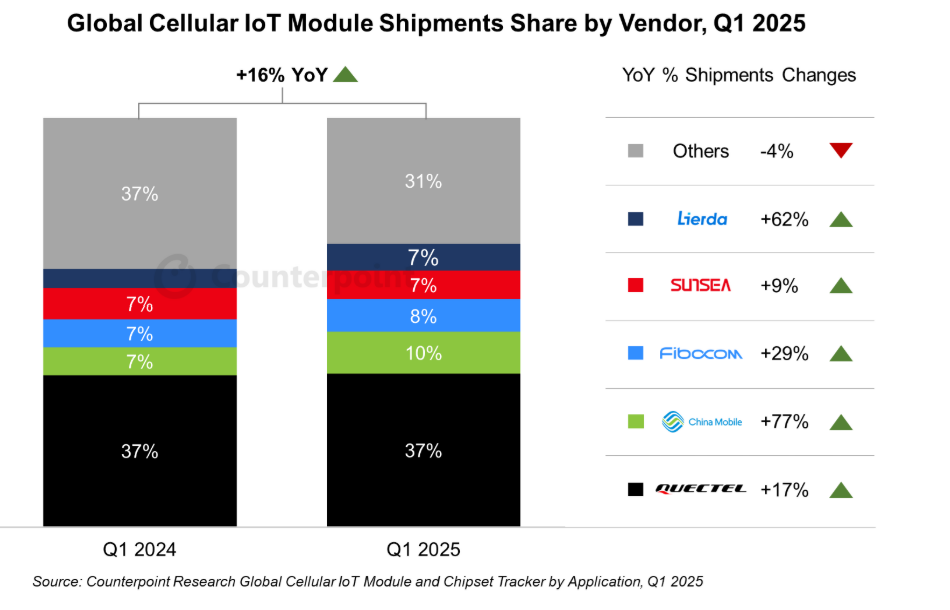
Counterpoint Research:受益新兴市场需求拉动 2025年Q1蜂窝物联网模组出货量同比增长16%
智通财经网· 2025-06-19 03:05
Core Insights - The global cellular IoT module shipments are expected to continue their growth trend, with a year-on-year increase of 16% in Q1 2025, driven by strong demand in India, China, and Latin America for smart meters, POS terminals, and asset tracking [1] - India leads the growth with a remarkable 32% year-on-year increase, while North America and some Asia-Pacific markets experience a decline due to weak demand and macroeconomic headwinds [1] - 5G technology is the fastest-growing segment, with a year-on-year growth of 37%, followed closely by Cat 1 bis technology, which also shows strong growth at 35% [1] Market Dynamics - China maintains its leadership in the global IoT module market with a 19% year-on-year growth, supported by the adoption of 5G and Cat 1 bis technologies in various sectors [1] - The average selling prices of modules and chips are decreasing, leading to increased price pressure from Chinese competitors, prompting companies to seek breakthroughs in higher-margin areas [4] - Qualcomm remains the leader in the chip market, with ASR and UNISOC following in second and third place, respectively [5] Manufacturer Performance - Quectel retains the top position in global cellular IoT module shipments, with China Mobile and Fibocom following closely, collectively accounting for over 50% of global shipments [4] - China Mobile's market share has surpassed double digits due to strong domestic demand for 4G Cat 1 bis modules [4] - u-blox has exited the cellular IoT module business to focus on its core strengths in GNSS and short-range connectivity [4] Future Outlook - The cellular IoT module market is expected to grow steadily in 2025, driven by demand for smart interconnected devices, asset tracking, and automotive applications in emerging markets [6] - Geopolitical tensions, strategic adjustments by manufacturers, and supply chain dynamics may constrain growth [6] - Chinese manufacturers are likely to maintain their global dominance, while Western manufacturers may benefit from demand recovery and easing geopolitical tensions [6]