
Seek .(SKLTY)

Search documents
2025年A股九大财经事件:从DeepSeek到关税风暴、A股总市值突破百万亿元...
Sou Hu Cai Jing· 2025-12-26 08:27
Group 1 - The core investment theme for 2025 is AI, with significant developments such as DeepSeek and Google's Gemini3 model influencing the market, alongside Nvidia's market capitalization reaching $5 trillion [1] - The U.S. tariffs initiated by President Trump in April caused a panic in global markets, leading to substantial declines in major indices, including a 7.34% drop in the Shanghai Composite Index [1] - Central Huijin's announcement of increased holdings in ETFs during the market downturn aimed to stabilize the capital market, with a total investment of approximately 210 billion yuan [1] Group 2 - A comprehensive financial policy package was released in May, including a significant reserve requirement ratio cut by the central bank, which resulted in a rise in the Shanghai Composite Index from around 3,400 to above 3,700 [2] - A-share market capitalization surpassed 100 trillion yuan for the first time on August 18, 2025, with the Shanghai Composite Index reaching a near ten-year high of 3,731 points [2] - A-share trading activity was notably high, with three trading days exceeding 3 trillion yuan in turnover, and the total annual turnover reaching a record 408 trillion yuan, a 58.49% increase from 2024 [2] Group 3 - Gold and silver prices surged throughout the year, with gold reaching $4,530 and a year-to-date increase of over 72%, while silver saw a 160% rise [3] - The Federal Reserve initiated a rate cut cycle in December, providing significant liquidity to the market, which led to a substantial inflow of northbound capital into A-shares [3] - The renminbi strengthened against the dollar, with the offshore rate surpassing 7.0 for the first time since September 2024, reflecting a 6% appreciation since April 2025 [3]

2025年度十大科技突破:DeepSeek带来“Aha Moment”,脑机芯片滑入大脑皮层
Xin Lang Cai Jing· 2025-12-26 06:24
Core Insights - 2025 is designated as the "International Year of Quantum Science and Technology" by UNESCO, marking a pivotal moment in China's "14th Five-Year Plan" and a shift in computational paradigms towards quantum computing and advanced materials [1][22] Quantum Computing Breakthroughs - The DeepSeek-R1 model, released on January 20, 2025, utilizes reinforcement learning to enhance reasoning capabilities and achieves performance comparable to OpenAI's models at a low computational cost [3][24] - The Nobel Prize in Physics awarded in October recognizes the foundational role of superconducting quantum circuits in modern computing, highlighting the work of John Clarke, Michel H. Devoret, and John M. Martinis [5][26] - The Helios quantum computer, launched by Quantinuum, features 98 physical qubits with a fidelity of 99.9975% for single-qubit operations, making it the most precise commercial quantum computer to date [9][30] Advanced Materials and Technologies - The BISC chip, developed by a collaboration between Columbia University and Stanford, integrates 65,536 electrodes into a flexible CMOS chip, enabling unprecedented wireless data transmission rates of up to 100 Mbps [8][29] - A new type of hollow-core optical fiber, reported by the Lumenisity research team, demonstrates a loss of only 0.091 dB/km at a wavelength of 1550 nm, promising advancements in long-distance communication [11][32] - The development of "atomic manufacturing" techniques has pushed metal materials to the Ångström scale, opening pathways for new quantum and electronic devices [13][34] Environmental and Energy Innovations - SSAB's Zero™ steel has become the first product to meet the near-zero emissions threshold set by the International Energy Agency, utilizing hydrogen reduction technology to eliminate carbon emissions [17][38] - The EAST nuclear fusion experiment achieved a world record of 1 billion degrees Celsius for 1066 seconds, demonstrating the feasibility of future fusion reactors [18][39] - Research on the Bennu asteroid samples revealed the presence of essential life-building components, suggesting that the building blocks of life may have been distributed across early Earth and other planets [21][42]

单卡2秒生成一个视频,清华联手生数开源TurboDiffusion,视频DeepSeek时刻来了
3 6 Ke· 2025-12-25 12:12
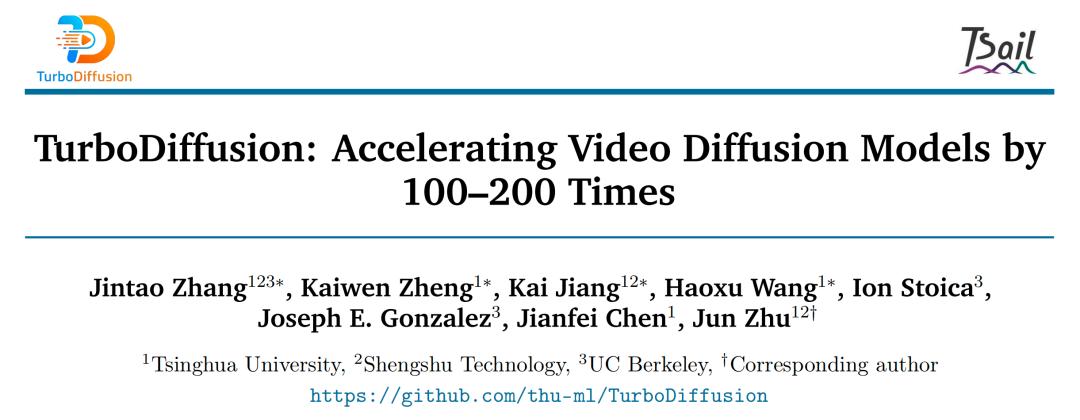
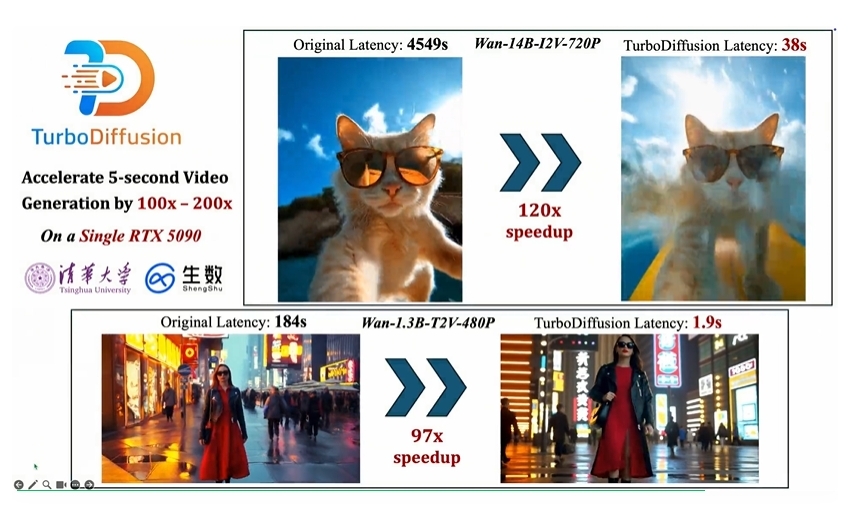
Core Insights - The article discusses the launch of TurboDiffusion, an open-source framework developed by Tsinghua University's TSAIL lab and Shenshu Technology, which significantly accelerates video generation, achieving speed increases of over 200 times while maintaining quality [1][14]. Group 1: Technology and Performance - TurboDiffusion allows for the generation of a 5-second 480P video on a single RTX 5090 GPU in just 1.9 seconds, compared to 184 seconds with the original model, resulting in a 97-fold speed increase [5][6]. - For larger models, such as a 14B video generation model at 720P, the generation time is reduced to 38 seconds, and for a 480P model, it takes only 9.9 seconds [5][6]. - The framework employs four key technologies: SageAttention, Sparse-Linear Attention (SLA), rCM step distillation, and W8A8 quantization, which collectively enhance performance and reduce computational load [9][10][11][12]. Group 2: Industry Impact - TurboDiffusion's advancements enable real-time video generation, making it feasible for individual creators and small businesses to produce high-quality content quickly [14]. - The reduction in inference time by 100 times allows cloud service providers to serve significantly more users with the same computational resources, lowering operational costs [14]. - The technology is compatible with domestic AI chip architectures, promoting self-sufficiency in China's AI infrastructure [14][15]. Group 3: Future Implications - The framework signifies a paradigm shift in video generation, where high-quality AI video can be produced without sacrificing efficiency, thus transforming AI from a post-production tool to a creative partner [16]. - As generation speeds approach human reaction times (under 5 seconds), the potential for real-time interactive video creation becomes a reality, expanding creative possibilities [16].
“韧性”“具身智能”“DeepSeek”入选2025年度“青年十大热词”
Xin Hua Cai Jing· 2025-12-25 07:37
Group 1 - The core viewpoint of the article is that the "Top Ten Youth Buzzwords for 2025" reflect the psychological state and value orientation of contemporary youth, showcasing their unique expressions and social interactions [1][2][3] - The buzzword "resilience" has been redefined by youth to signify their ability to adapt and cope with setbacks, indicating a deeper understanding of personal strength [1] - The term "love yourself" is expressed as "爱你老己," highlighting a trend of self-care and self-dialogue among young people [1] - Other buzzwords like "embodied intelligence" and "DeepSeek" indicate youth's attention to technological advancements, while terms like "emotional consumption" and "'窝囊' tourism" reflect their experiences in work and social interactions [1] Group 2 - The annual youth buzzword list is curated by the Shanghai Youth Research Center's AI laboratory, which analyzes social media data and expert evaluations to create a relevant and meaningful list [3] - Experts believe that youth are the most dynamic thinkers in society, and their language reflects collective mindsets and societal trends [2][3] - The buzzwords serve as a creative response from youth to societal observations, indicating their role in shaping cultural trends [3]
腾讯元宝DeepSeek模式使用量较年初增长超100倍,AI人工智能ETF(512930)冲击5连涨
Xin Lang Cai Jing· 2025-12-25 02:15
Core Insights - The AI sector is experiencing significant growth, with the Zhongzheng AI Theme Index (930713) showing a slight increase of 0.07% as of December 25, 2025, and notable gains in constituent stocks such as Beijing Junzheng (300223) up 6.27% and Zhongke Xingtou (688568) up 2.58% [1] - The AI Artificial Intelligence ETF (512930) has also seen a rise of 0.09%, marking its fifth consecutive increase, with the latest price at 2.17 yuan [1] - The report from Tencent Yuanbao indicates that the user base for DeepSeek has expanded significantly, with usage on December 14 reaching a new high, growing over 100 times since the beginning of the year [1] - According to Chengtong Securities, AI is driving a new structural growth cycle in the global semiconductor market, with projections estimating the market size to reach $772 billion by 2025 and potentially exceed $975 billion by 2026 [1] - Logic chips and memory are expected to be the main growth drivers, with year-on-year growth rates of 37.1% and 27.8% respectively [1] - The Americas and Asia-Pacific regions are anticipated to be the primary growth areas, achieving high growth rates of 29.1% and 24.9% respectively [1] - Key investment directions include high-performance computing, HBM, and edge AI hardware, driven by the demand for AI computing power [1] Industry Overview - The Zhongzheng AI Theme Index tracks 50 listed companies involved in providing foundational resources, technology, and application support for artificial intelligence, reflecting the overall performance of AI-related securities [2] - The top ten weighted stocks in the Zhongzheng AI Theme Index as of November 28, 2025, include companies like Zhongji Xuchuang (300308) and Hikvision (002415), which collectively account for 63.92% of the index [4] - The AI Artificial Intelligence ETF closely follows the Zhongzheng AI Theme Index, with various connection options available for investors [4]

DeepSeek官方点赞元宝,罕见现身互动
Sou Hu Cai Jing· 2025-12-24 18:31
Core Insights - A notable interaction is occurring between DeepSeek and Yuanbao, highlighted by Yuanbao's annual report and DeepSeek's acknowledgment on social media, which has attracted industry attention [2] - Yuanbao's report indicates that since integrating DeepSeek in February, it has consistently updated to the latest DeepSeek model, resulting in a user base that has grown over 100 times since the beginning of the year, achieving a new usage peak on December 14 [2] User Engagement - DeepSeek is utilized in Yuanbao not merely as a Q&A tool but as an interactive thinking partner, with over one-third of conversations involving deep follow-up questions on the same topic [4] - The ratio of deep thinking to quick thinking among users is reported to be 3:7, indicating varied engagement levels [4] - Yuanbao's usage patterns show that DeepSeek acts as a personal assistant throughout the day, with increased activity on the app during evenings for relaxation and conversation [4] Technological Integration - Yuanbao employs a "DeepSeek+" strategy, integrating the latest DeepSeek and Hunyuan models while enhancing capabilities with its proprietary Tencent Hunyuan model [4] - DeepSeek in Yuanbao is described as an "enhanced version," offering additional features such as image generation, photo editing, and understanding of 38 document types, alongside access to exclusive content from Tencent's ecosystem [4] - More than half of the responses in Yuanbao are presented in a multimedia format, allowing seamless transitions to reading, watching, or listening within Tencent's ecosystem [4] Product Ecosystem - Yuanbao has integrated more Tencent products, allowing users to interact with Yuanbao while engaging with other content like public accounts, videos, and music without switching apps [5] - This integration facilitates a natural incorporation of AI into daily activities, enhancing user experience [5] Technical Optimization - The team has optimized model responses to handle millions of users and high concurrency scenarios, ensuring stable and smooth usage of DeepSeek within Yuanbao [6] - The interaction between the model and application signifies a "mutual pursuit," promoting the daily use of AI in more people's work and life [6]

DeepSeek 官方点赞元宝,罕见现身互动
Xin Lang Cai Jing· 2025-12-24 10:15
Core Insights - A notable interaction is occurring between DeepSeek and Yuanbao, highlighting a collaborative effort in AI application development [2][3][4] User Engagement - Since integrating DeepSeek in February, Yuanbao has seen a user growth of over 100 times, reaching a new usage peak on December 14 [3][8] - DeepSeek is utilized as a conversational partner rather than a simple Q&A tool, with over one-third of interactions involving deep follow-up questions [3][8] - The ratio of deep thinking to quick thinking among users is 3:7, indicating varied engagement levels [3][8] Product Features - Yuanbao employs a 'DeepSeek+' strategy, enhancing DeepSeek's capabilities with additional features such as image processing, voice calls, and understanding 38 types of documents [4][9] - More than half of the responses in Yuanbao are presented in a multimedia format, integrating content from over 100 authoritative sources [4][9] - Users can interact with Yuanbao seamlessly across various Tencent products without needing to switch applications [4][9] Technical Optimization - The team has optimized the model's response efficiency and speed to ensure a stable and smooth user experience for DeepSeek within Yuanbao [4][9] - This interaction showcases the mutual advancement between AI models and applications, promoting AI's integration into daily life [4][9]
PriceSeek提醒:江苏太仓玖龙废纸收购价上调
Xin Lang Cai Jing· 2025-12-24 09:52
Group 1 - The core point of the news is that the waste paper purchase price has been increased by 30 yuan/ton, resulting in a new price of 1680 yuan/ton, indicating strong market demand likely driven by increased production needs in the paper products sector [1][4]. - The increase in waste paper prices is expected to directly boost the spot market trading prices and stimulate supply-side activity [2][5]. - The pricing model used by the company is based on big data and a pricing model, which serves as a trading guide price, known as the "Shengyi Price" [2][5]. Group 2 - The pricing formula for determining transaction settlement prices includes an adjustment coefficient (K) that accounts for factors such as account period costs [2][5]. - The additional costs (C) in the pricing formula include logistics costs, brand price differences, and regional price differences [3][6].
清华系DeepSeek时刻来了,硅谷沸腾,单卡200倍加速,视频进入秒级时代
3 6 Ke· 2025-12-23 10:46
Core Insights - The launch of TurboDiffusion by Tsinghua University and Shengshu Technology marks a significant advancement in AI video generation, reducing generation time from minutes to seconds while maintaining high quality [1][3][7]. Group 1: TurboDiffusion Overview - TurboDiffusion is an open-source video generation acceleration framework designed specifically for diffusion models, achieving speed improvements of 100-200 times on consumer-grade GPUs like the RTX 5090 [8][24]. - The framework allows for efficient video generation from both image-to-video (I2V) and text-to-video (T2V) inputs, maintaining impressive performance even for high-resolution and long-duration videos [8][14]. Group 2: Performance Metrics - In practical tests, TurboDiffusion demonstrated a speed increase of approximately 97 times, generating a 5-second video in just 1.9 seconds compared to the standard implementation which took 184 seconds [10]. - For a 14B model generating a 5-second 720P video, TurboDiffusion reduced the generation time from over 4549 seconds to just 38 seconds, achieving a speedup of about 120 times [14][17]. Group 3: Core Technologies - TurboDiffusion employs four key technologies: 1. SageAttention for low-bit quantization of attention mechanisms, enhancing GPU performance [24]. 2. Sparse-Linear Attention (SLA) to reduce redundant calculations in sparse computing, further accelerating inference [24]. 3. rCM step distillation to minimize the number of diffusion steps required without sacrificing quality [24]. 4. W8A8 INT8 quantization for linear layers, optimizing speed and reducing memory usage [24][26]. Group 4: Industry Impact - The introduction of TurboDiffusion is seen as a pivotal moment in the AI video generation industry, transitioning from a niche, time-consuming process to a more accessible and rapid content creation tool [29]. - The technology has already been integrated into various leading tech companies' products, showcasing its potential for significant economic benefits [26].
QuestMobile:豆包、DeepSeek、元宝周活跃用户位居前三
Feng Huang Wang· 2025-12-23 05:17
Group 1 - The active user rankings for AI-native apps have changed significantly, with Doubao, DeepSeek, and Yuanbao leading the list with weekly active users of 155 million, 81.56 million, and 20.84 million respectively [1] - The second tier includes Antifufu, Qianwen, and Doubao Aixue, with weekly active users of 10.25 million, 8.72 million, and 7.22 million respectively [1] - From July to November 2025, the industry chain completed 186 financing events, amounting to 33.67 billion yuan, a 20.8% increase compared to the first half of the year [1] Group 2 - Over 200 AI applications were launched from July to November 2025, with AI application plugins, PC web versions, and AI-native apps accounting for 81.5%, 10.7%, and 7.8% respectively [2] - Vertical applications that deeply understand user personalization needs and pain points have become breakthroughs, with AI image processing, AI professional consulting, AI efficiency office, AI social interaction, and AI copywriting accounting for 24.9%, 18.5%, 6.8%, 5.9%, and 5.9% respectively [2] - As of November 2025, eight major manufacturers have launched a total of 409 large models, with single-modal, multi-modal, and full-modal models accounting for 61.4%, 36.7%, and 1.9% respectively [1]