Sony Group(SONY)

Search documents
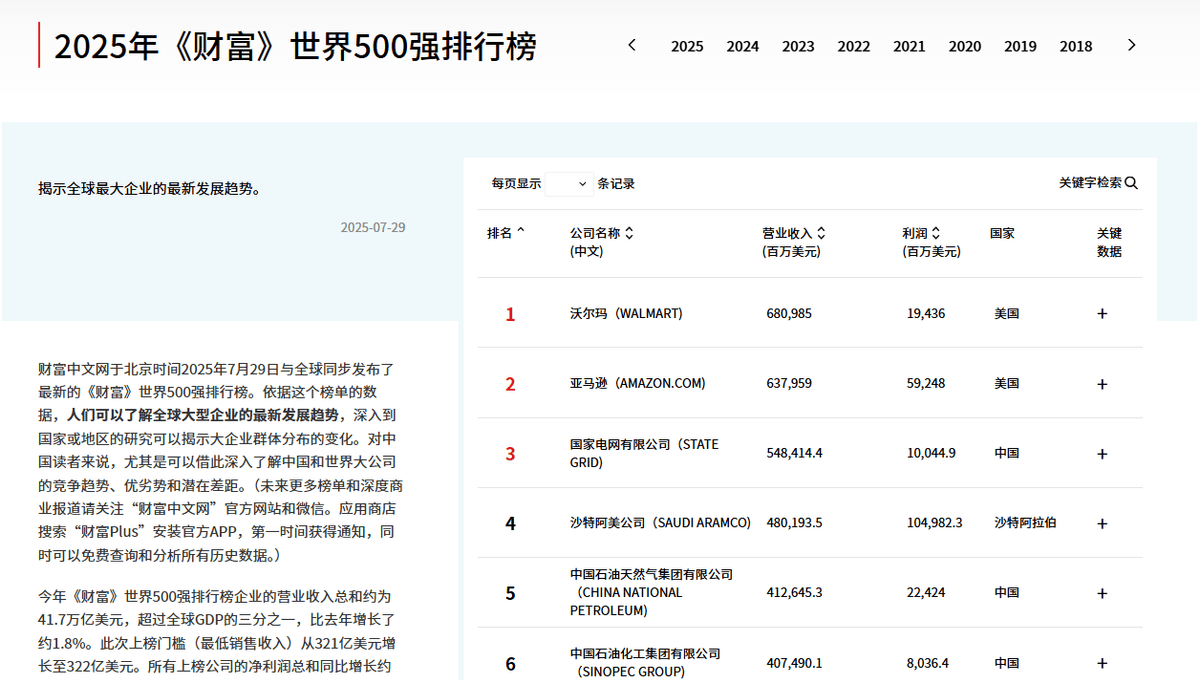
2025年最新世界500强公布,美国独占138家,日本跌至38家,中国呢
Sou Hu Cai Jing· 2025-08-23 05:37
Group 1 - The latest Fortune Global 500 list reveals the economic strength of various countries, with a total revenue of approximately $41.7 trillion, accounting for over one-third of global GDP, and a year-on-year growth of about 1.8% [2][11] - Walmart leads the list with revenues of $680.985 billion and profits of $19.436 billion, followed by Amazon with $637.959 billion in revenue and $59.248 billion in profit [2] - The threshold for inclusion in the list increased from $32.1 billion to $32.2 billion in sales revenue [2] Group 2 - American companies dominate the list, accounting for 44% of the total, with an average sales figure of $121.7 billion and net profits of $31 billion, reflecting a year-on-year increase of 19% and 31% respectively [8][11] - In contrast, Chinese companies, totaling 130, generated $10.7 trillion in revenue but had an average net profit of only $4.2 billion, less than half of their American counterparts [11][18] - Japanese companies have seen a significant decline, dropping from 149 to 38 on the list, with an average net profit of only $3.13 billion, highlighting a stagnation in their business models [20][22] Group 3 - High-tech companies are showing strong performance, with 34 global high-tech firms averaging $96.7 billion in revenue and $18.1 billion in net profit, marking increases of 9.6% and 24% year-on-year [5][11] - Notable examples include Nvidia, which boasts a 55% net profit margin, and other tech giants like Microsoft and Google, which have established significant revenue streams through advanced technologies [8][10] - The rise of companies like BYD and Chery illustrates China's shift from scale to efficiency, with BYD surpassing Tesla and Chery achieving significant export growth [13][14][15] Group 4 - Pinduoduo's revenue reached $54.736 billion with a profit of $15.626 billion, showcasing a remarkable efficiency in its operations, particularly in agricultural product sales [17] - The contrasting business models of the U.S., China, and Japan highlight different paths to economic success, with the U.S. focusing on technology, China on efficiency, and Japan struggling with outdated practices [24]





美股异动|索尼股价劲升3.55%全球市场策略奏效股民信心回暖
Xin Lang Cai Jing· 2025-08-23 00:04
Core Insights - Sony's stock price increased by 3.55% on August 22, driven by positive developments across multiple business sectors and changes in the macroeconomic environment, boosting investor confidence [1][2] Group 1: Business Developments - Sony has reintroduced the Xperia 1 VII smartphone in the European market after addressing previous circuit board issues, which included optimizing production processes, offering replacement services, and enhancing customer communication, restoring market confidence in product quality [1] - The upcoming resumption of Xperia 1 VII sales in the Taiwan market further strengthens market expectations [1] - The gaming division remains a focal point for investors, with ongoing interest in the next-generation PS6 console, particularly rumors about the game "GT8" potentially being a launch title, which has sparked widespread discussion [1] Group 2: Pricing Strategy and Market Response - Sony's pricing strategy for the PS5 has elicited mixed reactions, as the company has raised prices in the U.S. while offering promotional discounts in China, reflecting a flexible approach to global market conditions [2] - The anticipated recovery of Xperia 1 VII sales in more markets is expected to continue driving stock price increases [2] - The development of the PS6 and its potential market performance are critical areas of focus for long-term investors [2]

Sony: Focusing On Core Products, Faces Tariff Risk
Seeking Alpha· 2025-08-22 20:24
Group 1 - Sony Group Corporation plans to reposition the organization following the spin-off of its Financial Services business, scheduled for September 2025, which will free up capital for reinvestment in core entertainment and imaging sensor businesses for improved growth [1] - The spin-off is expected to enhance the company's focus on its primary sectors, potentially leading to better financial performance and strategic alignment [1]

斑马原CFO公开吐槽老东家上市圈钱:离开是不看好业务;传阴阳师事业部负责人金韬已离职创业;极氪优化直营体系,转手部分门店
雷峰网· 2025-08-22 00:35
Key Points - The article discusses various developments in the tech and automotive industries, highlighting significant corporate actions, product launches, and market strategies. Group 1: Corporate Developments - Former CFO of Zhibo Network publicly criticized the company's upcoming IPO, stating that he left due to a lack of confidence in the business and accused certain executives of being opportunistic [4][6]. - Alibaba announced the spin-off of Zhibo Network for an independent listing on the Hong Kong Stock Exchange, with plans to retain over 30% ownership post-IPO [6]. - Alibaba's Lingxi Entertainment has shifted its reporting structure to report directly to CFO Xu Hong, indicating potential changes in business strategy [12][13]. Group 2: Product Launches and Innovations - NIO unveiled the new ES8 model, with a starting pre-sale price of 416,800 yuan, featuring significant upgrades in size and technology [19]. - Vivo introduced the Vision Exploration Edition, the lightest MR headset in the industry, weighing only 398g, designed for enhanced user experience [30]. - DeepSeek released version 3.1, which includes significant upgrades and price adjustments for its API services, reflecting a shift towards next-generation domestic chips [11]. Group 3: Market Strategies - Alibaba's local services division is launching a new group-buying feature called "Flash Group," aimed at price-sensitive consumers, to compete with Meituan's similar offerings [18]. - Multiple ride-hailing platforms, including Didi and T3, have announced reductions in commission rates to support driver income and expand platform capacity [24][25]. - Zero Run Auto reported a cumulative delivery of over 900,000 vehicles, achieving profitability in the first half of the year and adjusting its annual sales target upwards [26][27]. Group 4: Financial Performance - Kuaishou reported a revenue of 35.05 billion yuan for Q2 2025, with a net profit increase of 20.1%, and announced a special dividend for shareholders [39]. - Bilibili's Q2 revenue reached 7.34 billion yuan, with significant growth in advertising and gaming revenue, and a record high in user engagement metrics [40]. Group 5: Competitive Landscape - Samsung's HBM4 samples have passed initial testing with Nvidia and are set to enter pre-production, potentially challenging SK Hynix's dominance in the AI memory chip market [44][45]. - Intel is negotiating with large investors to replicate a previous financing deal with SoftBank, aiming to bolster its capital structure [46]. Group 6: Privacy and Regulatory Issues - Meta is facing allegations of circumventing Apple's privacy restrictions to enhance ad revenue, with claims of misleading advertisers about the performance of its Shop Ads [51][52]. - xAI's Grok platform experienced a significant privacy breach, exposing over 370,000 user chat records due to design flaws in its sharing functionality [46][47].





Sony Hikes PlayStation Prices Amid ‘Challenging' Climate
PYMNTS.com· 2025-08-21 15:21
Core Insights - Sony has announced a price increase for its PlayStation 5 consoles in the U.S., effective August 21, with hikes of $50 for all three versions [2] - The new prices are set at $549.99 for the standard PlayStation 5, $499.99 for the Digital Edition, and $749.99 for the PlayStation 5 Pro [2] - Sony is the last major video game company to raise prices, following Microsoft and Nintendo, which have already implemented price increases [3] Economic Context - The price hikes are attributed to a challenging economic environment, including increased costs from tariffs imposed by the U.S. government, which have raised shipping, manufacturing, and assembly costs [4] - Consumer confidence has declined, leading to reduced spending and lower forecasts from retailers [4] - Retailers like Target and Home Depot are adopting cautious approaches due to economic uncertainties, while Lowe's is facing challenges from high mortgage rates and consumer caution [5] Consumer Behavior - Consumers are actively seeking ways to reduce retail spending, such as opting for private label goods over branded items and delaying appliance replacements [6] - Tariffs are described as a "silent tax" that ultimately impacts households and businesses, leading to increased costs at checkout and a shift in spending towards essentials, thereby shrinking discretionary spending [7]

再次暂停实施24%关税90天:中美关税博弈背后的“重复囚徒困境”
3 6 Ke· 2025-08-21 03:43
Group 1 - In the late 1980s, Nintendo dominated the gaming industry with a 95% market share in Japan and 83% in North America, but this changed dramatically by the mid-1990s due to Sony's entry into the market [1][2] - The introduction of CD-ROM technology by Sony allowed for larger game sizes and lower costs, prompting Nintendo to consider upgrading from cartridge-based systems [2] - A partnership was formed between Nintendo and Sony to leverage Sony's technology while Nintendo maintained strict control over third-party licensing, but this partnership soon faced significant challenges [2][3] Group 2 - The partnership between Nintendo and Sony collapsed when Nintendo discovered a control rights loophole in their agreement, leading to Nintendo secretly negotiating with Philips [3][4] - At the 1991 CES, Sony was blindsided by Nintendo's announcement of a partnership with Philips, prompting Sony to launch the PlayStation independently, which became a major success [3][4] - The PlayStation sold approximately 100 million units, while Nintendo's subsequent console, the Nintendo 64, struggled due to its reliance on cartridges and high costs [3][4] Group 3 - The conflict between Nintendo and Sony exemplifies a "prisoner's dilemma," where both companies prioritized individual gains over collaboration, leading to suboptimal outcomes for both [4] - The dynamics of repeated interactions in trade negotiations, such as the U.S.-China tariff disputes, reflect similar patterns of behavior seen in the gaming industry rivalry [4][6] - The strategies employed in these repeated games highlight the importance of cooperation and the potential pitfalls of short-sighted tactics [4][6]


X @TechCrunch
TechCrunch· 2025-08-20 18:04
Sony is hiking the price of PlayStation 5 consoles in the U.S. this week, citing a "challenging economic environment." https://t.co/yi0pmF9P9U ...
Sony is increasing the price of the PlayStation 5 as new tariffs take hold
TechCrunch· 2025-08-20 18:02
Core Viewpoint - Sony is raising the prices of PlayStation 5 consoles by approximately $50 due to a challenging economic environment, which is linked to tariffs imposed by the U.S. government [2][3]. Price Changes - The new prices for the PlayStation 5 will be $549.99, $499.99 for the Digital Edition, and $749.99 for the Pro version, effective August 21 [2]. - Sony has previously raised prices for PlayStation consoles in Europe, Australia, and New Zealand in April, citing similar economic challenges [3]. Market Context - Other companies in the gaming industry are also adjusting their prices in response to the tariffs. Microsoft announced price increases of $80 to $100 for its consoles and some games [4]. - Nintendo has raised prices for certain accessories related to the new Nintendo Switch 2 but has not increased the console price itself [4].