TSMC(TSM)

Search documents
台积电年初至今已上涨8% 分析师密集上调目标价
Xin Lang Cai Jing· 2026-01-07 02:30
Core Viewpoint - Analysts are increasingly optimistic about TSMC, raising their stock price targets following a historic surge, indicating strong market sentiment towards the company [1] Group 1: Stock Price Target Adjustments - At least six brokerages have raised their forecasts for TSMC's stock since the beginning of the year [1] - JPMorgan increased its target price by 24% to NT$2100, citing expectations of strong revenue growth and improved profitability [1] Group 2: Stock Performance - TSMC's stock has risen by 8% in 2026, following a more than twofold increase over the past three years due to sustained investor interest [1] - The strong performance of TSMC has contributed to record highs in the benchmark stock index, with TSMC accounting for nearly 45% of the index [1] Group 3: Growth Expectations - The demand for TSMC's advanced process technologies and pricing increases are expected to drive another strong growth year in 2026, with anticipated improvements in gross margins [1]
台积电2nm量产在即:性能跃升成本翻倍,旗舰芯片迎分水岭
Xin Lang Cai Jing· 2026-01-07 01:45
Core Viewpoint - TSMC's 2nm process technology (N2) is set to enter mass production in Q4 2025, marking a significant advancement in semiconductor manufacturing technology [1][4] Group 1: Technology Advancements - The N2 process offers a performance improvement of 10% to 15% while maintaining the same power consumption levels compared to the previous N3E process [1][4] - Power consumption can be reduced by 25% to 30% at the same frequency, showcasing significant energy efficiency improvements [1][4] Group 2: Market Impact - Qualcomm's next-generation flagship mobile platform, Snapdragon 8 Elite Gen6, and MediaTek's Dimensity 9600 series will utilize TSMC's 2nm process [3][4] - The manufacturing cost for 2nm wafers is expected to exceed $30,000, nearly doubling the cost of 4nm products, which will directly affect the cost of end hardware [3][4][5] Group 3: Product Strategy - The rise in wafer prices will lead to structural adjustments in flagship smartphone product lines set to launch in the second half of 2026 [5] - Manufacturers are likely to implement differentiated strategies, with standard versions using existing 3nm platforms to control costs, while higher-end Pro and Ultra versions will adopt 2nm chips to create a performance gap [3][5] - This strategy will result in clearer tier distinctions for consumers, with standard versions offering mainstream performance at controlled prices, while high-end versions will leverage the latest technology for superior performance [4][5]

Taiwan Semiconductor: The Ultimate AI Infrastructure Play, A $358 Target And +18% Upside
Seeking Alpha· 2026-01-06 20:42
Core Insights - Taiwan Semiconductor Manufacturing Company Limited (TSM) is currently priced at approximately $325, while fundamental analysis suggests a fair price of $358, indicating a potential mispricing in the market [1] Group 1: Company Overview - TSM is a leading semiconductor manufacturer, and its valuation is influenced by key inflection points that the market may not be fully recognizing [1] Group 2: Analyst Background - Sandeep Gupta, a technology investment analyst, specializes in semiconductor companies and AI infrastructure, bringing a strategic perspective to technology investments [1] - Gupta has extensive experience in technology consulting, having worked with major firms like Ernst & Young and Accenture, advising Fortune 500 companies on technology strategy and operational efficiency [1] Group 3: Investment Philosophy - The investment philosophy focuses on fundamental analysis that combines technical product evaluation, competitive positioning, financial metrics, and market dynamics [1] - The emphasis is on identifying companies with sustainable competitive advantages and significant growth potential in high-value markets, rather than pursuing short-term momentum [1] Group 4: Analysis Approach - The analysis aims to provide in-depth insights into technology companies, examining product roadmaps, competitive dynamics, and industry trends to aid investors in making informed decisions [1] - The goal is to bridge the gap between complex technology developments and investment implications, making sophisticated analysis accessible to individual investors [1]

Taiwan Semiconductor: The Ultimate AI Infrastructure Play With A $358 Target And +18% Upside
Seeking Alpha· 2026-01-06 20:42
Taiwan Semiconductor Manufacturing Company Limited ( TSM ) is currently priced at around $325, but fundamental analysis indicates a fair price of $358 since markets are consistently mispricing three key inflection points: First, theSandeep Gupta is a technology investment analyst and writer specializing in semiconductor companies, AI infrastructure providers, and enterprise technology markets, bringing a strategic business perspective to evaluating technology investments and market opportunities with an MBA ...
扩产不能停!花旗:三星、台积电、英特尔三巨头资本开支将有积极指引
美股IPO· 2026-01-06 16:04
Core Viewpoint - Citigroup anticipates that TSMC will set its 2026 capital expenditure guidance in the range of $46 billion to $48 billion, while Intel's capital expenditure is expected to stabilize, and Samsung may increase its investment following Micron's expansion plans. The combined capital expenditures of these three companies account for approximately 59% of Citigroup's 2026 global WFE spending model, indicating their capital expenditure trends serve as a bellwether for the entire semiconductor equipment industry [1][3]. Group 1: TSMC - TSMC is expected to announce its 2026 capital expenditure guidance between $46 billion and $48 billion, with potential for upward adjustments throughout the year [5]. - Citigroup's model predicts TSMC's capital expenditure for 2026 to be $47 billion, with additional upward potential [5]. - Market expectations for TSMC's 2026 capital expenditure are around $50 billion, reflecting optimism regarding TSMC's expansion efforts [5]. Group 2: Intel - Citigroup forecasts Intel's 2026 capital expenditure to stabilize, benefiting from improvements in its backend customer pipeline, with projected expenditures of $18 billion in 2025 and $15 billion in 2026 [6]. - Intel is expected to maintain its 2025 capital expenditure guidance at $18 billion and project approximately $16 billion for 2026 [6]. - Despite a decrease in capital expenditure for 2026 compared to 2025, Intel's capital spending is expected to stabilize due to growth in its backend packaging business [6]. Group 3: Samsung - Citigroup believes Samsung's 2026 capital expenditure has room for upward adjustment, influenced by Micron's significant increase in capital expenditure guidance [7]. - Samsung's management has indicated a flexible approach to 2026 capital expenditure, planning to increase investments based on the growth in AI demand [7]. - Micron's recent announcement to raise its 2026 net capital expenditure from $18 billion to $20 billion, a 45% increase, may prompt Samsung to take similar actions to maintain its market position [8].

AI 算力破局关键!52 页先进封装报告逐页拆解(含隐藏机遇)
材料汇· 2026-01-06 16:00
Core Insights - The article discusses the rising costs associated with advanced semiconductor processes, highlighting that the transition from planar FET to FinFET and Nanosheet technologies has led to exponential increases in design and manufacturing costs, making it difficult for small and medium enterprises to invest in advanced processes [8][9]. - The industry is shifting towards higher concentration among leading foundries, while advanced packaging technologies allow smaller companies to participate in high-end chip design without relying on advanced processes [9][11]. - The article emphasizes the importance of heterogeneous integration and the need for tailored architectures based on application scenarios, indicating a trend towards dynamic adjustments in advanced packaging strategies [25][56]. Cost Trends - Design costs have surged from $28 million for 65nm processes to $725 million for 2nm processes, with manufacturing investments also increasing significantly [9]. - The investment required for a 5nm factory is five times that of a 20nm factory, indicating a substantial financial barrier for smaller players in the industry [8]. Architectural Comparisons - The article compares four architectures, noting that smaller systems (like mobile chips) benefit from a "large chip + 3D stacking" approach, while larger systems (like AI servers) favor a "chiplet + 3D stacking" strategy to balance performance and cost [16][24]. - As system complexity increases, the advantages of chiplet-based designs become more pronounced, particularly in terms of cost efficiency [17][23]. Advanced Packaging Technologies - Advanced packaging is evolving to meet the demands of AI and high-performance computing, with technologies like 2.5D and 3D packaging becoming standard for high-end chips [36][72]. - The integration of HBM (High Bandwidth Memory) with 2.5D packaging has become a standard, driven by the need for high memory bandwidth in AI applications [29][36]. Interconnect Technologies - The article highlights the critical role of interconnect technologies in enhancing I/O density, with projections showing a significant increase in interconnect density from 1960s levels of 2/mm² to future levels of 131072/mm² [38]. - Advanced packaging is shifting from being a secondary process to a core component of performance enhancement, with interconnect-related technologies expected to yield higher profit margins than traditional packaging [39][42]. Market Dynamics - The article notes that the demand for advanced packaging is driven by the need for high bandwidth, miniaturization, and low power consumption, particularly in edge AI applications [49][50]. - The automotive sector's transition from distributed ECUs to centralized computing is pushing for higher integration levels, which in turn drives advancements in packaging technologies [53][56]. Technology Evolution - The evolution of packaging technologies is characterized by a shift from single technology optimization to system-level engineering design, necessitating cross-domain integration capabilities [68][70]. - The article outlines a clear roadmap for the evolution of interconnect technologies, indicating that the industry is entering a phase of rapid technological iteration driven by market demands [154][165]. Cost Structure - The cost structure for 2.5D packaging is primarily driven by the interposer (Si/mold/silicon bridge) and packaging substrate, while for 3D packaging, the key cost factor is the bonding process [168][169]. - The differences in cost structures dictate the profitability models for companies, with 2.5D packaging firms needing to manage interposer and substrate costs, while 3D packaging firms focus on optimizing bonding yields and efficiency [169].




美股三大指数开盘涨跌不一 芯片股普涨
Zheng Quan Shi Bao Wang· 2026-01-06 14:51
转自:证券时报 转自:证券时报 人民财讯1月6日电,美股三大指数开盘涨跌不一,道琼斯指数跌0.09%,标普500指数涨0.10%,纳斯达 克综合指数涨0.30%。芯片股普涨,恩智浦、台积电涨超2%。 人民财讯1月6日电,美股三大指数开盘涨跌不一,道琼斯指数跌0.09%,标普500指数涨0.10%,纳斯达 克综合指数涨0.30%。芯片股普涨,恩智浦、台积电涨超2%。 ...

Top 2 Tech Stocks That Could Sink Your Portfolio In Q1
Benzinga· 2026-01-06 13:20
Group 1: Market Overview - As of January 6, 2026, two stocks in the information technology sector are signaling potential warnings for momentum-focused investors [1] - The Relative Strength Index (RSI) is a key momentum indicator, with values above 70 indicating that a stock may be overbought [2] Group 2: Company Analysis - Taiwan Semiconductor Manufacturing Co Ltd (TSMC) - TSMC secured a one-year U.S. export license to import chipmaking equipment into its China operations [6] - The stock gained approximately 7% over the past five days, reaching a 52-week high of $331.25 [6] - TSMC's RSI value is reported at 72.1, with shares closing at $322.25 on Monday [6] - The company has an Edge Stock Rating of 88.80 for momentum and 33.75 for value [6] Group 3: Company Analysis - Micron Technology Inc - Micron reported first-quarter revenue of $13.64 billion, exceeding analyst estimates of $12.83 billion [6] - The company posted adjusted earnings of $4.78 per share, surpassing analyst expectations of $3.95 per share [6] - Micron's stock increased by around 26% over the past month, achieving a 52-week high of $325.53 [6] - The RSI value for Micron is 71.1, with shares closing at $312.15 on Monday [6]


Top 2 Tech Stocks That Could Sink Your Portfolio In Q1 - Abercrombie & Fitch (NYSE:ANF), Micron Technology (NASDAQ:MU)
Benzinga· 2026-01-06 13:20
分组1 - As of January 6, 2026, two stocks in the information technology sector are identified as potentially overbought, signaling caution for momentum-focused investors [1] - The Relative Strength Index (RSI) is highlighted as a key momentum indicator, with a value above 70 indicating that a stock may be overbought [2] 分组2 - Taiwan Semiconductor Manufacturing Company (TSMC) has secured a one-year U.S. export license for importing chipmaking equipment into its China operations, resulting in a stock gain of approximately 7% over the past five days and a current RSI value of 72.1 [6] - TSMC's stock closed at $322.25, with a 52-week high of $331.25 and an Edge Stock Rating momentum score of 88.80 [6] - Micron Technology reported first-quarter revenue of $13.64 billion, exceeding analyst estimates, and posted adjusted earnings of $4.78 per share, also above expectations [6] - Micron's stock has increased by around 26% over the past month, with a 52-week high of $325.53 and an RSI value of 71.1 [6] - Micron's shares closed at $312.15 after a decline of 1% [6]
台积电美国扩张遇冷?毛利率62%跌至8%,折旧黑洞成利润杀手
Sou Hu Cai Jing· 2026-01-06 12:12
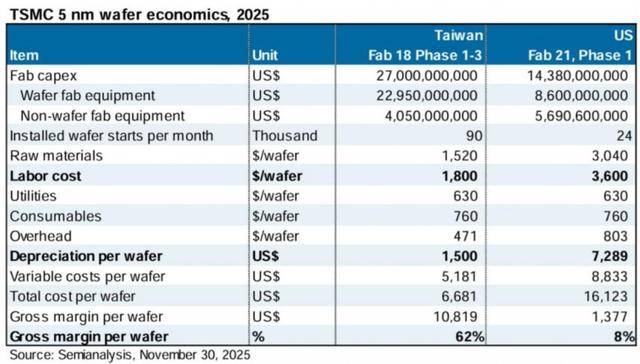
Core Viewpoint - TSMC's U.S. factory is projected to achieve profitability in the second half of 2025, but recent data reveals significant cost disparities compared to its Taiwan operations, raising concerns about the sustainability of this investment [2][4]. Cost Analysis - TSMC's Fab 18 in Taiwan has a capital expenditure of $27 billion, while Fab 21 in the U.S. has a capital expenditure of $14.38 billion [3]. - The total cost per wafer in Taiwan is $6,681, yielding a gross margin of 62%, whereas in the U.S., the total cost per wafer is $16,123, resulting in a gross margin of only 8% [3][24]. - Depreciation costs per wafer are significantly higher in the U.S. at $10,200 compared to $2,100 in Taiwan, primarily due to lower capacity utilization in the U.S. factory [6][24]. Labor Costs - Labor costs per wafer in the U.S. are $3,600, double that of Taiwan's $1,800, exacerbated by cultural differences affecting operational efficiency [8][10]. - U.S. labor regulations limit overtime, impacting productivity, with U.S. factories experiencing an average of 40 minutes more downtime per day compared to Taiwan [10][12]. Strategic Decisions - TSMC's decision to build in the U.S. is influenced by a $52 billion government subsidy, which comes with conditions that restrict expansion in other countries and mandate R&D spending in the U.S. [14][24]. - Major clients like Apple and Nvidia are pushing for supply chain diversification, with Apple already committing to using U.S.-produced wafers despite higher costs [16][18]. Long-term Outlook - TSMC's U.S. expansion is viewed as a strategic gamble, with potential long-term benefits as the global semiconductor industry undergoes significant geopolitical restructuring [20][24]. - By 2027, TSMC aims to increase local supply chain integration to 60%, and analysts predict that overall gross margins could exceed 60% by 2026, although U.S. operations may drag margins down by 2% to 3% [22][24]. - The shift towards regional supply chains is seen as a necessary evolution in the semiconductor industry, balancing efficiency with resilience [24][26].