TSMC(TSM)

Search documents
2nm芯片制程战火升级!高通(QCOM.US)重返三星 从单押台积电转向双代工链
智通财经网· 2026-01-07 12:48
智通财经APP获悉,有媒体援引美国高通公司首席执行官克里斯蒂亚诺·阿蒙(Cristiano Amon)的话报道 称,高通(QCOM.US)很可能将使用三星电子的2nm级别芯片代工工艺来制造其下一代移动应用处理器。 高通过去几年在领先制程上"几乎完全依赖台积电",而此次若把下一代移动AP的一部分先进节点订单 转向三星2nm,意味着高通在"最核心、最量大的手机SoC"上启动双供应链策略或者分散化,会在份额 与议价权层面对台积电形成轻微压力,但是对于台积电基本面增长前景无任何重大扰动。 台积电与英特尔的先进芯片制程布局 该媒体援引阿蒙在采访中透露的消息表示,这家智能手机与PC端芯片领军者正在与包括三星电子在内 的多家晶圆代工厂就采用最前沿的2nm芯片制造品工艺进行合同代工制造展开磋商;阿蒙表示,高通面 向OC、智能手机甚至数据中心的绝大多数新一代核心芯片设计工作已经完成,以便在不久的将来实现 大规模代工以及全面商业化。 有着"全球芯片代工之王"称号的台积电方面同样全面聚焦于2nm及以下这一最先进芯片制程产能,该公 司在其官网制程介绍中明确写到:2nm(N2)"已于2025年第四季度(4Q25)按计划开始量产",并强 ...


If I Could Only Buy and Hold a Single Stock in 2026, This Would Be It
Yahoo Finance· 2026-01-07 11:50
Key Points Taiwan Semiconductor is launching a new technology in 2026. TSMC's revenue is greater than its competition combined. However, Taiwan Semiconductor isn't a risk-free investment. 10 stocks we like better than Taiwan Semiconductor Manufacturing › Finding a single stock to buy and hold isn't an easy task. The stock needs to cover a wide range of outcomes, and failure isn't an option. While this stock may not provide the highest returns in your portfolio, it is also the most likely to beat ...
TSMC: Why an Nvidia Chip Could Supercharge the Next Rally
Investing· 2026-01-07 08:50
Market Analysis by covering: NVIDIA Corporation, Taiwan Semiconductor Manufacturing. Read 's Market Analysis on Investing.com ...


台积电(TSM.US)股价迭创新高 华尔街争相上调目标价
智通财经网· 2026-01-07 03:58
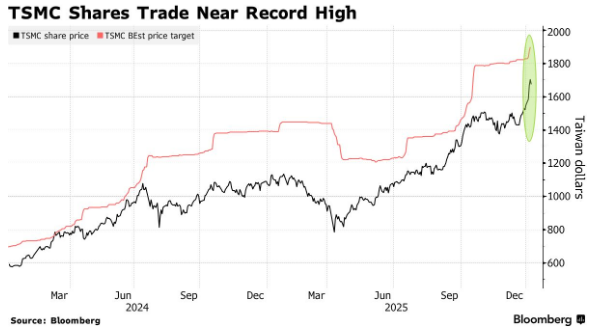
台积电将于下周公布去年12月季度业绩。根据分析师预期,其销售额将同比增长18%,营业利润率将提 升至三年高位,超过50%。 该股周三一度下跌2.4%,在连续四日上涨推动其市值达到创纪录的1.4万亿美元后出现温和回调。 摩根大通分析师戈库尔·哈里哈兰在报告中写道:"我们预计2026年将是台积电又一个强劲增长年",原 因是对该公司最先进芯片制造技术的需求扩大以及定价提升。"毛利率亦有望上行。" 智通财经APP获悉,随着台积电(TSM.US)股价创纪录飙升,研究分析师正争相上调这家芯片制造巨头 的目标价,显示出市场对其持续的看涨情绪。 自今年初以来,至少六家券商(包括高盛集团和麦格理集团)已上调了对台股上市的台积电的目标价。摩 根大通在周三的报告中将其目标价上调24%至新台币2100元,理由是预期营收强劲增长且盈利能力改 善。 台积电股价在2026年迄今已上涨8%,过去三年更因投资者对这家人工智能热潮关键驱动力之一的需求 持续旺盛而上涨逾两倍。其涨势推动台湾基准股指连创新高,台积电在该指数中的权重占比已近45%。 ...
AI 供应链:CES 展会影响、ASIC 芯片生产、中国 AI 芯片-Asia-Pacific Technology-AI Supply Chain CES implications, ASIC production, China AI chips
2026-01-07 03:05
Summary of Key Points from the Conference Call Industry Overview - The focus is on the **AI semiconductor industry**, particularly the dynamics surrounding **AI GPUs** and **AI ASICs**. The demand for these components is expected to be strong in 2026, driven by supply factors such as memory availability and TSMC's 3nm technology [1][4][42]. Core Insights - **Nvidia's Production**: Nvidia's management reported that the **Rubin** compute board is in "full production," with assembly time significantly reduced from approximately **2 hours** for Blackwell to about **5 minutes** for Rubin. The launch is anticipated in the **second half of 2026** [2][54]. - **China's AI Chip Demand**: There is a forecast of around **2 million units** of H200 chips demanded by Chinese customers, with ongoing licensing processes. Companies like **ByteDance** are actively developing AI server racks compatible with both Nvidia and local chips [4][84]. - **Market Size Projections**: The total AI chip market is projected to reach **US$550 billion** by **2029**, which includes both AI GPUs and ASICs. This reflects a significant growth trajectory for the sector [5][42]. Capacity and Production Dynamics - **TSMC's CoWoS Capacity**: TSMC is expected to expand its CoWoS capacity by **20-30%** in 2026, with a revised forecast of **125kwpm** by the end of the year, marking a **79% increase** from previous estimates [12][43]. - **ASE/SPIL and Amkor**: Both ASE/SPIL and Amkor are also expanding their CoWoS capacities to meet rising demand from key customers like Nvidia, AMD, and AWS [13][14]. - **Google TPU Production**: Google is accelerating the production of its next-generation **TPU** chips, moving the timeline from **4Q26** to **3Q26**. Broadcom has also booked **30k** of CoWoS-S capacity to meet TPU demand [26][28]. Financial Outlook - **Revenue Growth**: TSMC is projected to generate **US$107 billion** from AI chip foundry services by 2029, which would account for about **43%** of its total revenue [44]. - **Cloud Capex Spending**: Estimated cloud capital expenditure for 2026 is projected to reach **US$632 billion**, indicating robust investment in AI infrastructure [45]. Risks and Considerations - **Supply Chain Risks**: The primary concerns for 2026 are expected to be shortages in memory, T-Glass, and TSMC's 3nm wafers, rather than CoWoS capacity itself [43][42]. - **China's Localization Efforts**: China is expected to increase its local chip production to support AI development, which may create additional demand for both local and foreign chips [81][82]. Additional Insights - **ByteDance's AI Server Racks**: At a recent conference, ByteDance showcased its **256-node AI server racks**, which are designed to work with both Nvidia and local AI chips, highlighting the competitive landscape in China's AI market [84]. - **Market Dynamics**: The AI semiconductor market is characterized by rapid growth and evolving dynamics, with significant implications for companies involved in chip production and supply chain management [42][43]. This summary encapsulates the key points discussed in the conference call, providing insights into the current state and future outlook of the AI semiconductor industry.



2026年电子行业年度投资策略
2026-01-07 03:05
Summary of Key Points from the Conference Call Industry Overview - The conference call focuses on the **electronic industry** and its investment strategies for 2026, highlighting the growth of major cloud service providers and advancements in semiconductor technology [1][2][3]. Core Insights and Arguments Cloud Service Providers (CSPs) - North America's four major cloud service providers (Microsoft, Google, Amazon, and Meta) are expected to see their capital expenditures reach **$600 billion** in 2026, driven by profit growth and robust revenue increases [1][3][4]. - CSPs are experiencing strong cash flow growth, which supports their ongoing capital investments in AI and related technologies [3][25]. PCB Sector - The PCB sector is deemed to have reasonable valuations, with technological innovations and performance growth driving above-average industry growth. The transition from standard servers to advanced models (GB200/GB300) is expected to continue supporting profit growth through 2026 [1][5][9]. - The PCB industry is projected to see a **180% growth** in global demand by 2025, with new technologies enhancing both usage and value [1][9]. Domestic Semiconductor Developments - Domestic computing chips (e.g., Cambricon, Huawei Ascend, Baidu Kunlun) are gaining traction in cloud scenarios, aligning with domestic AI models. The expansion of storage capacity is a significant catalyst, with DDR4/DDR5/Flash prices rising substantially [1][6]. - The semiconductor equipment market is expected to benefit from increased production rates and demand for advanced process equipment, with domestic companies showing significant revenue and profit growth [3][14]. Storage Market Dynamics - The storage market is entering a "super cycle," driven by AI demand, with DRAM contract prices expected to rise by **50-60%** quarter-over-quarter and Flash prices by **30-40%** [1][7]. - Despite domestic manufacturers expanding production, overseas companies (e.g., SK Hynix, Samsung, Micron) maintain a dominant market position, leading to ongoing price increases and shortages in the short term [7]. AI Hardware and End-User Applications - The AI hardware sector is viewed positively, with significant investment opportunities in computing infrastructure, domestic breakthroughs, and the storage super cycle. Specific segments like edge AI and AI AR glasses are also highlighted as promising [2][8]. - The development of AI products, particularly AI smartphones and AR glasses, is expected to drive growth in the consumer electronics sector, with major companies like Apple planning new product launches [20][21]. Additional Important Insights - Concerns regarding the potential downgrading of specifications for certain products (e.g., Rubin) are deemed unfounded, with expectations for continued high demand and innovation in the PCB sector [10][11]. - The semiconductor equipment market is anticipated to experience significant growth, with domestic companies like North Huachuang and Zhongwei showing strong revenue increases [14][19]. - The overall investment landscape for the electronic industry in 2026 is expected to focus on AI-driven innovations and the expansion of domestic semiconductor capabilities [2][18]. Conclusion - The electronic industry is poised for substantial growth driven by advancements in AI, cloud computing, and semiconductor technologies. Key players in the PCB and semiconductor equipment sectors are expected to benefit significantly from these trends, making them attractive investment opportunities for the coming years [1][3][34].

台积电年初至今已上涨8% 分析师密集上调目标价
Xin Lang Cai Jing· 2026-01-07 02:30
Core Viewpoint - Analysts are increasingly optimistic about TSMC, raising their stock price targets following a historic surge, indicating strong market sentiment towards the company [1] Group 1: Stock Price Target Adjustments - At least six brokerages have raised their forecasts for TSMC's stock since the beginning of the year [1] - JPMorgan increased its target price by 24% to NT$2100, citing expectations of strong revenue growth and improved profitability [1] Group 2: Stock Performance - TSMC's stock has risen by 8% in 2026, following a more than twofold increase over the past three years due to sustained investor interest [1] - The strong performance of TSMC has contributed to record highs in the benchmark stock index, with TSMC accounting for nearly 45% of the index [1] Group 3: Growth Expectations - The demand for TSMC's advanced process technologies and pricing increases are expected to drive another strong growth year in 2026, with anticipated improvements in gross margins [1]
台积电2nm量产在即:性能跃升成本翻倍,旗舰芯片迎分水岭
Xin Lang Cai Jing· 2026-01-07 01:45
Core Viewpoint - TSMC's 2nm process technology (N2) is set to enter mass production in Q4 2025, marking a significant advancement in semiconductor manufacturing technology [1][4] Group 1: Technology Advancements - The N2 process offers a performance improvement of 10% to 15% while maintaining the same power consumption levels compared to the previous N3E process [1][4] - Power consumption can be reduced by 25% to 30% at the same frequency, showcasing significant energy efficiency improvements [1][4] Group 2: Market Impact - Qualcomm's next-generation flagship mobile platform, Snapdragon 8 Elite Gen6, and MediaTek's Dimensity 9600 series will utilize TSMC's 2nm process [3][4] - The manufacturing cost for 2nm wafers is expected to exceed $30,000, nearly doubling the cost of 4nm products, which will directly affect the cost of end hardware [3][4][5] Group 3: Product Strategy - The rise in wafer prices will lead to structural adjustments in flagship smartphone product lines set to launch in the second half of 2026 [5] - Manufacturers are likely to implement differentiated strategies, with standard versions using existing 3nm platforms to control costs, while higher-end Pro and Ultra versions will adopt 2nm chips to create a performance gap [3][5] - This strategy will result in clearer tier distinctions for consumers, with standard versions offering mainstream performance at controlled prices, while high-end versions will leverage the latest technology for superior performance [4][5]
Taiwan Semiconductor: The Ultimate AI Infrastructure Play, A $358 Target And +18% Upside
Seeking Alpha· 2026-01-06 20:42
Core Insights - Taiwan Semiconductor Manufacturing Company Limited (TSM) is currently priced at approximately $325, while fundamental analysis suggests a fair price of $358, indicating a potential mispricing in the market [1] Group 1: Company Overview - TSM is a leading semiconductor manufacturer, and its valuation is influenced by key inflection points that the market may not be fully recognizing [1] Group 2: Analyst Background - Sandeep Gupta, a technology investment analyst, specializes in semiconductor companies and AI infrastructure, bringing a strategic perspective to technology investments [1] - Gupta has extensive experience in technology consulting, having worked with major firms like Ernst & Young and Accenture, advising Fortune 500 companies on technology strategy and operational efficiency [1] Group 3: Investment Philosophy - The investment philosophy focuses on fundamental analysis that combines technical product evaluation, competitive positioning, financial metrics, and market dynamics [1] - The emphasis is on identifying companies with sustainable competitive advantages and significant growth potential in high-value markets, rather than pursuing short-term momentum [1] Group 4: Analysis Approach - The analysis aims to provide in-depth insights into technology companies, examining product roadmaps, competitive dynamics, and industry trends to aid investors in making informed decisions [1] - The goal is to bridge the gap between complex technology developments and investment implications, making sophisticated analysis accessible to individual investors [1]
Taiwan Semiconductor: The Ultimate AI Infrastructure Play With A $358 Target And +18% Upside
Seeking Alpha· 2026-01-06 20:42
Taiwan Semiconductor Manufacturing Company Limited ( TSM ) is currently priced at around $325, but fundamental analysis indicates a fair price of $358 since markets are consistently mispricing three key inflection points: First, theSandeep Gupta is a technology investment analyst and writer specializing in semiconductor companies, AI infrastructure providers, and enterprise technology markets, bringing a strategic business perspective to evaluating technology investments and market opportunities with an MBA ...