
TSMC(TSM)

Search documents
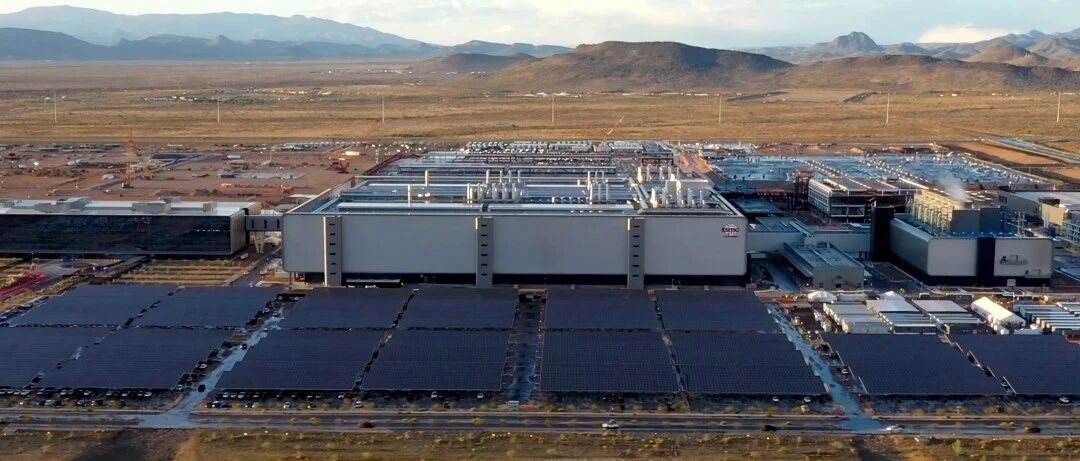
台积电美国厂断电!数千晶圆报废!
国芯网· 2025-11-25 10:54
Group 1 - TSMC's third-quarter profit from its U.S. factory plummeted by 99% due to a power outage incident that occurred in mid-September, leading to the scrapping of thousands of wafers being produced for clients like Apple, Nvidia, and AMD [2][4] - The outage was caused by a power system failure from Linde Group, a UK industrial gas and engineering giant, which interrupted production for several hours [4] - Despite the setback, TSMC's Arizona plant turned from loss to profit in the first quarter of this year, indicating its ability to expand capacity and generate revenue even in a high-cost environment [4] Group 2 - TSMC acknowledged that while the Arizona plant has started generating positive revenue, its net profit is still affected by multiple factors, and long-term observation is needed to assess the situation [4] - The financial losses from the incident may be compensated through insurance, and the overall impact on the supply chain is expected to be limited due to the low capacity of Fab21 and prior completion of many chip products in Taiwan [4] - Historically, revenue and production gaps caused by similar incidents tend to be recovered in the following quarter [4]


英特尔封装或抢单台积电!
国芯网· 2025-11-25 10:54
Core Insights - The semiconductor industry is increasingly seeking alternative solutions due to the ongoing tight capacity for advanced packaging at TSMC, with Marvell and MediaTek evaluating the integration of Intel's EMIB technology into their ASIC chip designs [2][4]. Group 1: Industry Challenges - TSMC faces dual challenges: the inability to rapidly expand its advanced packaging capacity in the short term and the demand from U.S. clients for localizing the entire supply chain, which TSMC's U.S. backend capacity is not yet fully equipped to meet [4]. Group 2: Technological Developments - Intel's EMIB technology, which utilizes a 2.5D packaging architecture, is gaining attention for its unique advantages in heterogeneous chip integration [4]. - Recent job postings from leading companies like Apple, Qualcomm, and Broadcom explicitly mention EMIB-related positions, indicating a proactive approach to talent acquisition in the advanced packaging sector [4]. - Intel's newly launched 3.5D packaging technology achieves higher chip interconnect density through more precise silicon vias, further enhancing its competitive edge [4]. Group 3: Market Dynamics - The embedded bridge solution used in EMIB offers advantages in cost control and yield improvement compared to traditional intermediary layer designs, making it a key focus as advanced process evolution slows down [4]. - The shift of multiple companies towards the EMIB solution not only reflects current supply chain adaptation strategies but may also reshape the competitive landscape of the semiconductor packaging industry [4].


X @Bloomberg
Bloomberg· 2025-11-25 10:03
Taiwanese newspapers reported last week that Lo Wen-jen was alleged to have taken proprietary knowledge from TSMC just before his departure https://t.co/TQw1gH3hSe ...
TSMC files lawsuit against former executive on security concerns
Reuters· 2025-11-25 10:02
Taiwan Semiconductor Manufacturing Co said on Tuesday it had filed a lawsuit in the Intellectual Property and Commercial Court against its former Senior Vice President Wei-Jen Lo, who recently joined ... ...

美股异动|英特尔盘前跌逾1% 台积电据称已对罗唯仁提起诉讼
Xin Lang Cai Jing· 2025-11-25 10:00
Core Viewpoint - Intel's stock price dropped by 1.23% to $35.35 in pre-market trading following a lawsuit filed by TSMC against former senior vice president Luo Wei-ren, who is accused of potentially leaking TSMC's trade secrets to Intel [1]. Group 1: Company Performance - Intel's closing price on November 24 was $35.79, reflecting an increase of 3.74% [1]. - The pre-market price on November 25 was $35.35, indicating a decrease of $0.44 [1]. - The stock reached a high of $36.155 and a low of $34.685 during the trading session [1]. - The trading volume was 104 million shares, with a total transaction value of $3.709 billion [1]. - Intel's market capitalization stands at $170.718 billion [1]. Group 2: Financial Metrics - The price-to-earnings (P/E) ratio is reported at 596.50, indicating a loss [1]. - The price-to-book (P/B) ratio is 1.604 [1]. - The stock has a 52-week high of $42.480 and a low of $17.665 [1].

台积电拟增建三座2nm晶圆厂,半导体产业ETF(159582)盘中一度涨超1.5%
Xin Lang Cai Jing· 2025-11-25 06:53
Group 1 - The semiconductor industry index rose by 0.23% as of November 25, 2025, with notable increases in individual stocks such as ShenGong Co. (up 13.18%) and ChangChuan Technology (up 3.55%) [1] - The semiconductor industry ETF (159582) increased by 0.15%, with a latest price of 2.01 yuan, and has seen a cumulative rise of 11.85% over the past three months [1] - TSMC plans to build three additional 2nm fabs in Taiwan to meet the surging demand for AI chips, with an estimated total investment of 900 billion NTD [1] Group 2 - Tianfeng Securities highlights that edge AI chips are evolving towards "high energy efficiency architecture + scenario-based customization + global ecosystem," with advancements in in-memory computing and software toolchains [2] - The semiconductor industry ETF closely tracks the CSI Semiconductor Industry Index, which includes up to 40 companies involved in semiconductor materials, equipment, and applications [2] - As of October 31, 2025, the top ten weighted stocks in the CSI Semiconductor Industry Index accounted for 78.04% of the index, including companies like Zhongwei Company and North Huachuang [2]
TrendForce集邦咨询:AI催生超大封装需求 ASICs有望从CoWoS转向EMIB技术
智通财经网· 2025-11-25 05:47
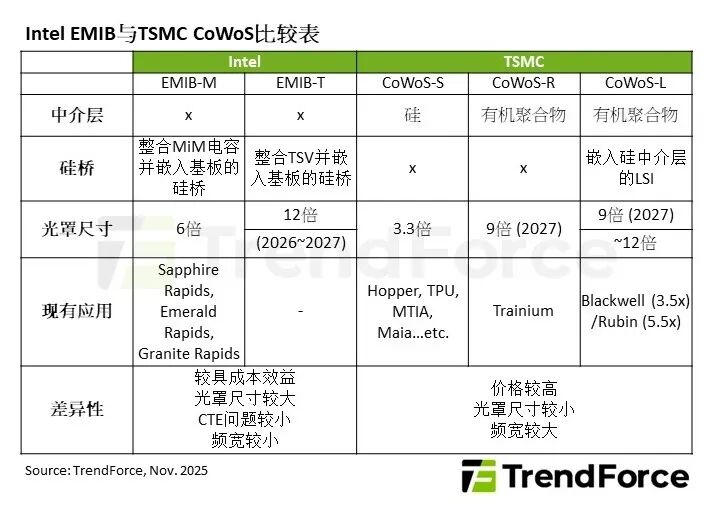
Core Insights - The demand for AI HPC (High-Performance Computing) is driving the need for advanced packaging solutions, particularly TSMC's CoWoS technology, but some cloud service providers (CSPs) are considering Intel's EMIB technology due to increasing chip integration requirements and packaging area demands [1][2]. Group 1: Technology Comparison - TSMC's CoWoS solution connects different functional chips using an interposer, while Intel's EMIB simplifies the structure by embedding silicon bridges directly into the substrate, resulting in higher yield rates [3][7]. - EMIB technology has advantages over CoWoS in terms of thermal expansion coefficient (CTE) issues, as it has a lower silicon ratio and fewer contact areas, reducing the risk of warping and reliability challenges [3][7]. Group 2: Market Dynamics - The current market for advanced packaging is facing capacity shortages and high costs associated with CoWoS, leading companies like Google and Meta to explore Intel's EMIB solutions [2][8]. - Intel's EMIB technology is expected to support larger die sizes and provide cost-effective solutions by eliminating the expensive interposer layer, making it attractive for AI customers [7][8]. Group 3: Future Prospects - EMIB is projected to achieve significant advancements in mask size, with EMIB-M already providing 6x mask size and expected to reach up to 12x by 2027, while CoWoS technologies are limited to lower mask sizes [4][7]. - Intel's Foundry Services (IFS) has been developing EMIB technology since 2021, and with major clients like Google and Meta showing interest, this could lead to substantial growth for IFS [8].

研报 | AI催生超大封装需求,ASICs有望从CoWoS转向EMIB技术
TrendForce集邦· 2025-11-25 05:01
Core Insights - The article discusses the increasing demand for AI HPC (High-Performance Computing) and the shift from TSMC's CoWoS solution to Intel's EMIB technology by cloud service providers (CSPs) due to capacity shortages and cost considerations [2][3][4]. Group 1: Technology Comparison - TSMC's CoWoS solution connects different functional chips using an interposer, while Intel's EMIB simplifies the structure by embedding silicon bridges directly into the substrate, leading to higher yield rates [4][6]. - EMIB technology has advantages such as a lower coefficient of thermal expansion (CTE) issue, which reduces the risk of warping and reliability challenges compared to CoWoS [4][6]. - EMIB can achieve larger die sizes, with EMIB-M supporting up to 6 times the mask size, while CoWoS-L is expected to reach 9 times by 2027 [6]. Group 2: Market Dynamics - The demand for CoWoS is facing challenges such as capacity shortages and high costs, leading CSPs like Google and Meta to explore Intel's EMIB solutions [3][7]. - Intel's EMIB technology is being adopted in its server CPU platforms, and companies like Google and Meta are considering it for their products, indicating a potential shift in market dynamics [7][8]. - NVIDIA and AMD, which require high bandwidth and low latency, are likely to continue using CoWoS as their primary packaging solution [7].


台积电CEO:先进制程产能“不够、不够、还是不够”,现有产能还差3倍!
美股IPO· 2025-11-25 03:40
Core Viewpoint - TSMC's CEO, C.C. Wei, indicated that the current production capacity is approximately three times short of demand based on major clients' product plans and growth expectations, highlighting the strong demand for wafers that is difficult to meet [1][5]. Group 1: Demand and Capacity - The demand for advanced process technology driven by AI is rapidly increasing, with Wei stating that the advanced process capacity is "not enough, not enough, still not enough" [3]. - TSMC's current production capacity is about three times less than what is needed according to the product planning and growth expectations of major clients [5]. - Wei humorously mentioned wanting to wear a "No more wafer" T-shirt, emphasizing the overwhelming wafer demand [5]. Group 2: Recognition and Achievements - Wei and former chairman Liu Deyin received the Robert Noyce Award from the American Semiconductor Industry Association, marking the second time TSMC leaders have been honored since founder Morris Chang in 2008 [3][4]. - The award signifies global recognition of TSMC's long-term contributions to advanced processes, advanced packaging, and manufacturing ecosystems [5]. - TSMC has successfully transitioned through multiple technology nodes, from 7nm to the upcoming 2nm, and is accelerating factory construction in the U.S., Japan, and Europe, establishing a foundation for the AI era [5]. Group 3: Industry Impact - The award ceremony, attended by key figures in the semiconductor industry, underscored TSMC's critical role in the AI chip supply chain [4]. - U.S. Commerce Secretary Howard Lutnick acknowledged TSMC's leadership as transformative for global technology advancement [4].
台积电CEO:先进制程产能“不够、不够、还是不够”,现有产能还差3倍!
Hua Er Jie Jian Wen· 2025-11-25 01:37
Core Insights - TSMC's CEO, C.C. Wei, stated that the demand for advanced process capacity is "not enough, not enough, still not enough," indicating that current capacity is approximately three times short of what is needed based on major clients' product plans and growth expectations [1][2] - TSMC has been recognized with the Robert Noyce Award, highlighting its significant contributions to advanced processes, packaging, and manufacturing ecosystems over the years [2] Group 1 - The demand for AI-driven advanced processes has exceeded expectations, with TSMC's current capacity falling short by about three times according to major clients' forecasts [2] - TSMC has successfully transitioned through multiple technology nodes, including 7nm, 5nm, 3nm, and is set to begin mass production of 2nm, establishing a robust global manufacturing footprint essential for the AI era [2] - The award received by TSMC's leadership symbolizes the company's pivotal role in the global supply chain amid rising AI computing demands [1][2]