Vale(VALE)

Search documents
Still Bearish On Iron Ore, But Vale Looks Too Cheap To Ignore
Seeking Alpha· 2025-06-29 09:26
Core Viewpoint - The analysis expresses skepticism towards Vale (VALE) due to its heavy reliance on iron ore, which may pose risks to its financial stability and growth potential [1]. Group 1: Company Analysis - Vale's excessive dependence on iron ore is highlighted as a significant concern, suggesting that this reliance could limit diversification and expose the company to market volatility [1]. - The analyst identifies a need for Vale to explore growth opportunities beyond iron ore to enhance its investment appeal [1]. Group 2: Investment Perspective - The analysis is framed from a value investing standpoint, focusing on identifying undervalued stocks with potential for growth, indicating that Vale may not currently fit this criterion [1].


主要铁矿石企业季度运营情况跟踪:主流矿山产运受扰,Q1供给增速不及预期
Guo Tai Jun An Qi Huo· 2025-06-27 13:49
Report Industry Investment Rating No relevant content provided. Core Viewpoints of the Report - In Q1 2025, the production and transportation of mainstream iron ore mines were disrupted, with the growth rate of supply falling short of expectations. The combined production/transportation volume of the four major mines in Q1 was 245 million tons, a year-on-year decrease of 3.3%. Although most of the eight non-mainstream mines tracked achieved a year-on-year output increase of 6.8%, their performance may not be representative of the overall overseas non-mainstream mines. - The trend of "increasing mainstream supply and decreasing non-mainstream supply" may become the main theme of overseas iron ore supply from Q2 to Q4. The dominance of Australian and Brazilian mainstream mines in global seaborne iron ore may be further strengthened this year. - The reduction in non-mainstream mine supply is not enough to fully offset the increase in the four major mines. Therefore, the report holds a relatively optimistic view on the overall annual supply [1][2][58]. Summary by Directory 1. Overview of the Operation of Major Mines in Q1 2025 - **Mainstream Four Major Mines**: The combined production/transportation volume in Q1 was 245.307 million tons, a year-on-year decrease of 3.3% and a quarter-on-quarter decrease of 14.6%. Vale and Rio Tinto maintained their annual production and transportation volume guidance ranges. BHP and Fortescue had completed over 75% of the lower limit of their full fiscal - year guidance ranges by Q1 and are expected to meet their annual targets [7][8]. - **Non - Mainstream Mines**: Most of the eight non - mainstream mines tracked showed a seasonal quarter - on - quarter decline in production in Q1 but achieved an overall year - on - year output increase of 6.8%. Mineral Resources and Champion Iron had significant year - on - year increases [9]. 2. Key Points Interpretation of the Quarterly Reports of the Four Major Mines 2.1 Vale (Vale) - Weather Factors Affected, Q1 Production and Sales Diverged - **Overall Situation**: In Q1, iron ore production was 67.664 million tons, a year - on - year decrease of 4.5%. Sales were 66.141 million tons, a year - on - year increase of 3.6%. The company is confident in achieving its annual production targets of 325 - 335 million tons in 2025 and 340 - 360 million tons in 2026. The C1 cash cost in Q1 was 21.0 US dollars/wet ton, a year - on - year decrease of 10.6% [11][13]. - **Operation Details**: The northern system was affected by weather and license restrictions, but the S11D mine's output reached a new high. The southeastern system's output decreased due to factory maintenance. The southern system focused on high - quality ore production, resulting in a decline in output. Ball pellet production also decreased due to weather [15][17][20]. 2.2 Rio Tinto (Rio Tinto) - Extreme Weather Affected, Production and Transportation Increases Were Hindered - **Overall Situation**: In Q1, affected by multiple hurricanes, the shipment was about 13 million tons behind schedule, and about 6.5 million tons are expected to be made up later. The output of the Pilbara mining area was 69.771 million tons, a year - on - year decrease of 10.5%, and the shipment was 70.74 million tons, a year - on - year decrease of 9.3%. The company may achieve the lower limit of its annual shipment guidance range [23]. - **Operation Details**: The Western Range project achieved its first production in Q1, and the Brockman Syncline 1 project's investment was approved. The Simandou project in Guinea is progressing as planned and is expected to have its first shipment in November [26][27]. 2.3 BHP (BHP) - Supply Chain Optimization Resisted Some Weather Risks, and Production Stabilized - **Overall Situation**: In Q1, the equity output was 61.772 million tons, a year - on - year increase of 0.5%, and the sales volume was 60.679 million tons, a year - on - year decrease of 3.9%. The company maintained its production guidance ranges for the 2025 fiscal year [33]. - **Operation Details**: The PDP - 1 project continued to improve efficiency. The second concentrator of the Samarco mine in Brazil was put into operation ahead of schedule, and the capacity ramp - up is expected to be completed by mid - year [35]. 2.4 Fortescue (Fortescue) - Low - Base Background, Q1 Output Increased Year - on - Year - **Overall Situation**: In Q1, the total iron ore shipment was 46.1 million tons, a year - on - year increase of 6.5%. The C1 cost of Pilbara hematite was 17.53 US dollars/wet ton, a quarter - on - quarter decrease of 4% and a year - on - year decrease of 7% [36]. - **Operation Details**: The Iron Bridge project was affected by a tropical cyclone. The company expects the total shipment of the Iron Bridge project to reach 10 - 12 million tons in FY26, 16 - 20 million tons/year in the first half of 2027, and full production of 22 million tons/year in FY28. The company completed the acquisition of Red Hawk in March [38][39]. 3. Review of the Quarterly Operation of Major Non - Mainstream Iron Ore Producers 3.1 Anglo American - Kumba's Logistics Continued to Improve, Minas - Rio's Output Reached a New High - **Kumba Iron Ore**: In Q1, the output was 8.99 million tons, a year - on - year decrease of 3.1%, and the shipment was 8.939 million tons, a year - on - year increase of 6.6%. The iron grade remained stable at 64.2%. - **Minas - Rio Mine**: The output in Q1 was 6.455 million tons, a year - on - year increase of 10.0%, and the shipment was 5.625 million tons, a year - on - year increase of 21.9%. The iron grade averaged 67%. The company's annual production guidance range is 57 - 61 million tons, and it will continue to invest in logistics and infrastructure [41][43][44]. 3.2 ArcelorMittal - The Second - Phase Expansion of AML Is Nearly Completed, and Full Production Rate Will Be Reached by the End of the Year - In Q1, the total output was 11.8 million tons, and the output of the Liberian mines AML and AMMC for external sales was 8.4 million tons, a year - on - year increase of 29.2%. The company is expanding its mines in Liberia and acquiring new mineral resources in India. The second - phase expansion of the Liberian iron mine aims to increase the annual capacity from 15 million tons to 20 million tons and is expected to reach full production by the end of the year [45][47]. 3.3 India NMDC - Current Production Is Stable, and Long - Term Ambitious Goals Remain Unchanged - In Q1, the iron ore output was 13.27 million tons, a year - on - year decrease of 0.4%, and the sales volume was 12.67 million tons, a year - on - year increase of 1.3%. The company aims to exceed 50 million tons in the 2024 - 2025 fiscal year and reach 100 million tons by 2030 [48][49]. 3.4 Brazil CSN - The Construction of the P15 Mining Area Continues to Advance - In Q1, the output was 10.21 million tons, a year - on - year increase of 11.8%, and the sales volume was 9.64 million tons, a year - on - year increase of 5.4%. The construction of the P15 mining area started earthwork excavation in Q1 and is expected to enter the equipment installation and commissioning stage in the second half of the year. The annual output target range remains at 42 - 43.5 million tons [50][52]. 3.5 Mineral Resources (MinRes) - The Shipment Growth Rate of Onslow Continued to Increase - In Q1, the output of Onslow Iron decreased by 22.9% quarter - on - quarter due to logistics and weather. The company adjusted its annual output target to 8.5 - 8.7 million wet tons and expects Onslow to reach full production in the third quarter of this year [53]. 3.6 Champion Iron - Bloom Lake's Sales Reached a Record High, and Shipments in Canada Increased Again - In Q1, the output of the Bloom Lake mining area was 3.167 million wet tons, a quarter - on - quarter decrease of 12.5% and a year - on - year decrease of 3.3%. The sales volume was 3.495 million dry tons, a year - on - year increase of 17.7%. The inventory decreased from 2.94 million wet tons to 2.6 million wet tons [55][56][57]. 4. Summary and Future Outlook - In Q1, the supply of mainstream mines was disrupted by weather, but the shipment improved in Q2. The report is confident in the annual supply increase of mainstream mines. - In Q1, the shipment of non - mainstream mines decreased significantly compared to last year. It is expected that the production and shipment volume of non - mainstream mines will be difficult to reach last year's level in the remaining time of this year. The trend of "increasing mainstream supply and decreasing non - mainstream supply" may dominate the overseas iron ore supply from Q2 to Q4, and the overall annual supply is expected to be relatively loose [58][59][62].


铁矿石半年度报告:供需维持宽松,矿价宽幅震荡
Yin He Qi Huo· 2025-06-27 09:50
1. Report Industry Investment Rating No relevant information provided. 2. Core Viewpoints of the Report - The supply of iron ore in China decreased while demand increased in the first half of 2025. The consumption of iron ore reached a record high, supporting the high valuation of iron ore among the black commodities. [2][93] - In the second half of the year, the global iron ore supply is expected to increase slightly, with a total increment of about 13 million tons from the Big Four mines and non - Australia and Brazil regions. The supply pressure is not significant. [2][93] - The demand for construction steel in China is expected to continue to decline, while the demand for manufacturing steel is expected to remain resilient. Overseas demand, especially from India, is expected to contribute more than 10 million tons of incremental demand throughout the year. [2][93] - The trading logic in the second half of the year mainly involves the Fed's interest - rate cuts and global tariff policies. The fundamentals of iron ore supply and demand will remain neutral, and the Platts iron ore price will fluctuate widely between $90 - $105. [3][94] - The trading strategy suggests speculatively buying at the bottom of the iron ore price and for spot enterprises to hedge at high prices. [5][95] 3. Summary by Relevant Catalogs 3.1 Iron Ore Supply and Demand Analysis 3.1.1 Production and Sales of the Big Four Mines in H1 2025 - The total production of the Big Four mines in the first half of the year was estimated at 545 million tons, a year - on - year decrease of 0.3% (2 million tons), and the total shipment was 544 million tons, a year - on - year decrease of 0.1% (0.6 million tons). The overall production and sales were lower than market expectations. [12] - In the second half of the year, the production may accelerate, with the increment mainly from Rio Tinto and BHP, but the overall increment may be only about 7 million tons. [12] 3.1.2 Domestic Iron Ore Imports - From January to May 2025, China's cumulative imports of iron ore and its concentrates were 513 million tons, a year - on - year decrease of 5% (26 million tons). Imports from Australia, Brazil, and non - Australia and Brazil all declined. [13] 3.1.3 Non - Australia and Brazil Global Shipments - The current non - Australia and Brazil global shipments depend on the remaining gap in global total demand after subtracting the shipments of the Big Four mines. The marginal cost of non - mainstream mine shipments may be above $90. [29][30] - Australia and Brazil's non - mainstream mines are unlikely to see large increments. Non - Australia and Brazil global shipments are likely to decline. [33][37] 3.1.4 Domestic Iron Concentrate Production and Scrap Steel Consumption - From January to May 2025, domestic iron concentrate production decreased by 5.4% year - on - year (6 million tons). In 2025, it is expected to continue to contribute to the reduction. [49] - In 2025, domestic scrap steel consumption is unlikely to see a significant increase due to the continuous decline in real estate investment. [49] 3.1.5 Terminal Steel Demand - The real estate market is still at the bottom, and the infrastructure may contribute a small reduction. The manufacturing investment remains at a relatively high level, and the demand for manufacturing steel is expected to maintain its resilience. [56][61] - Overseas iron element consumption has been at a high level. India's steel demand is expected to contribute more than 10 million tons of incremental demand throughout the year. [73][74] 3.1.6 Imported Iron Ore Port Inventory - The total inventory of imported iron ore ports is relatively high, but the low total iron element inventory and the resilience of overseas demand support the iron ore price. The port iron ore inventory is expected to remain balanced in the third quarter. [80][83] 3.2 Iron Ore Market Outlook - The supply of iron ore in China decreased while demand increased in the first half of 2025. In the second half of the year, the supply is expected to increase slightly, and the demand is expected to maintain a certain level. [93] - The trading logic in the second half of the year mainly involves the Fed's interest - rate cuts and global tariff policies. The fundamentals of iron ore supply and demand will remain neutral, and the Platts iron ore price will fluctuate between $90 - $105. [94] - The trading strategy suggests speculatively buying at the bottom of the iron ore price and for spot enterprises to hedge at high prices. [95]
VALE S.A. (VALE) Sees a More Significant Dip Than Broader Market: Some Facts to Know
ZACKS· 2025-06-17 23:01
Company Performance - VALE S.A. experienced a decline of 4.79% in its stock price, closing at $9.35, which was a larger drop compared to the S&P 500's loss of 0.84% [1] - Over the past month, VALE's shares gained 0.2%, outperforming the Basic Materials sector, which remained flat, but lagging behind the S&P 500's gain of 1.44% [1] Upcoming Earnings - The upcoming earnings disclosure for VALE S.A. is anticipated to report an EPS of $0.44, reflecting a 2.33% increase from the same quarter last year [2] - Revenue is expected to reach $10 billion, indicating a 0.78% increase compared to the previous year [2] Full Year Projections - For the full year, Zacks Consensus Estimates project earnings of $1.78 per share and revenue of $39.39 billion, representing a decrease of 2.2% in earnings and an increase of 3.5% in revenue from the prior year [3] Analyst Estimates - Recent adjustments to analyst estimates for VALE S.A. are important as they reflect changes in short-term business dynamics, with upward revisions indicating positive sentiment towards the company's operations [4] - The Zacks Rank system, which incorporates these estimate changes, currently ranks VALE S.A. at 3 (Hold) [6] Valuation Metrics - VALE S.A. has a Forward P/E ratio of 5.52, which is in line with the industry average [7] - The company also has a PEG ratio of 0.32, matching the average for the Mining - Iron industry, which is part of the Basic Materials sector [8] Industry Ranking - The Mining - Iron industry holds a Zacks Industry Rank of 93, placing it in the top 38% of over 250 industries [8] - Research indicates that industries in the top 50% outperform those in the bottom half by a factor of 2 to 1 [9]
Is It Worth Investing in VALE (VALE) Based on Wall Street's Bullish Views?
ZACKS· 2025-06-17 14:31
Core Viewpoint - The average brokerage recommendation (ABR) for VALE S.A. is 2.00, indicating a "Buy" rating based on recommendations from 14 brokerage firms, with 50% of these being "Strong Buy" [2][5]. Brokerage Recommendation Trends - The ABR of 2.00 suggests a positive outlook for VALE, but reliance solely on this metric may not be advisable due to studies showing limited success of brokerage recommendations in predicting stock price increases [5][10]. - Brokerage analysts tend to exhibit a strong positive bias in their ratings, with five "Strong Buy" recommendations for every "Strong Sell" [6][10]. Zacks Rank vs. ABR - The Zacks Rank, which is a proprietary stock rating tool, is based on earnings estimate revisions and is considered a more reliable indicator of near-term price performance compared to the ABR [8][11]. - The Zacks Rank is displayed in whole numbers (1 to 5) and is updated more frequently than the ABR, which may not always reflect the most current information [9][12]. Earnings Estimates for VALE - The Zacks Consensus Estimate for VALE's earnings for the current year remains unchanged at $1.78, indicating steady analyst views on the company's earnings prospects [13]. - Due to the unchanged consensus estimate and other factors, VALE holds a Zacks Rank of 3 (Hold), suggesting caution despite the Buy-equivalent ABR [14].
对话淡水河谷中国区总裁:从巴西到中国,如何以创新技术重塑全球低碳钢铁产业链?
Xin Lang Cai Jing· 2025-06-04 01:14
Core Viewpoint - Multinational companies, particularly Vale, are focusing on sustainable development and adapting their strategies to the Chinese market to create positive social, economic, and environmental impacts [1][4]. Group 1: Sustainable Development Strategy - Vale integrates sustainability into its business practices, aligning its ESG goals with the United Nations' 2030 Sustainable Development Goals (SDGs) [4][5]. - The company has set specific targets to reduce its carbon emissions, including a 33% reduction in absolute emissions by 2030 and achieving net-zero emissions by 2050 for Scope 1 and Scope 2 emissions [6][20]. - Vale is the first mining company to establish quantified reduction targets for Scope 3 emissions, which account for approximately 98% of its total emissions, primarily from steel production [6][10]. Group 2: Technological Innovations - Vale is deploying AI technologies to optimize resource management, carbon reduction, and supply chain efficiency, including projects like "smart mining" to reduce truck fuel consumption and greenhouse gas emissions [2][14]. - The company has invested in AI since 2016, deploying around 40 AI products and 1500 models across 80 projects to enhance operational efficiency and safety [14][15]. Group 3: Future Plans in China - China is Vale's largest market, with 187 million tons of iron ore exported in the previous year, accounting for over 60% of its total iron ore sales [17][19]. - Vale plans to invest 70 billion Brazilian Reais in the "New Carajás" project over the next five years to increase iron ore and copper production [17]. - The company is collaborating with Chinese partners to build a mineral processing plant in Oman, expected to process 18 million tons of iron ore annually by mid-2027 [19].

四大矿山为何仅微调指导产量?
Qi Huo Ri Bao Wang· 2025-06-03 22:30
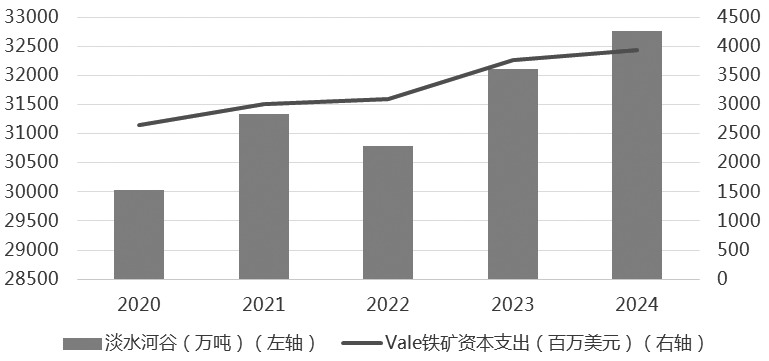
Group 1: Production Capacity and Guidance - In 2024, Vale and Rio Tinto's combined actual production is 65.565 million tons, with a slight increase in guidance for 2025 to 66.050 million tons, reflecting a cautious approach despite significant planned capacity increases of 40.05 million tons [1] - BHP and FMG's combined production for FY2024 is 45.376 million tons, with a downward adjustment in guidance for FY2025 to 45 million tons, indicating a divergence between planned capacity increases and production guidance [1] - Vale's capital expenditure for iron ore projects in 2024 is $3.943 billion, showing ongoing investment in capacity expansion [2] Group 2: Specific Projects and Their Impact - The Serra Sul+20 project aims to increase annual capacity to 12 million tons, with a total investment of approximately $2.844 billion, expected to contribute 500,000 tons of new capacity in 2025 [5] - The VGR1 plant renovation project is designed to restore wet processing capacity, with an annual capacity of 1.7 million tons and an investment of $67 million, expected to contribute 560,000 tons in 2025 [6] - The Capanema capacity maximization project aims to add 1.5 million tons of capacity by 2026, with a total investment of $913 million, contributing 495,000 tons in 2025 [7] Group 3: Production Management and Challenges - Vale maintains a production guidance range of 32.5 to 33.5 million tons for 2025, despite a significant planned capacity increase, reflecting careful management of resource depletion and production rates [11] - BHP's production guidance for FY2025 is adjusted to 25 million to 26 million tons, primarily due to ongoing capacity ramp-up and resource depletion management [14] - FMG's production guidance for FY2025 is set at 19 million to 20 million tons, with a focus on the Iron Bridge magnetite project, which is expected to contribute 700,000 tons of new capacity [19] Group 4: Overall Industry Trends - The overall trend shows a significant mismatch between new capacity additions and production guidance across the four major mining companies, primarily driven by resource depletion and declining ore grades [21] - The combined depletion rate for the four major mines is estimated at 3.9%, leading to substantial reductions in expected production despite planned capacity increases [21]
3小时,与施耐德电气、博世、村田、康宁等20+大企业“闭门谈生意”!手慢无
创业邦· 2025-06-03 03:21
Core Viewpoint - The article emphasizes the ongoing transformation in the economy, highlighting the integration of new technologies with traditional industries, and the role of the Banglink closed-door meetings in facilitating collaboration between large enterprises and innovative companies [1]. Summary by Sections DEMO WORLD Conference - The DEMO WORLD conference was launched in 2021 to become a significant platform for open innovation in China, connecting government, industry clusters, and entrepreneurs [1]. - The Banglink closed-door meetings have successfully facilitated strategic partnerships between over a thousand innovative companies and industry giants across various dimensions, including technology development and capital injection [1]. Upcoming Banglink Event - The 2025 Banglink closed-door meeting is scheduled for July 4, 2025, in Songjiang, Shanghai, featuring 20 global enterprises and 30 active investment institutions for 1-on-1 discussions [2]. - Notable participating companies include Murata Manufacturing, Corning Display, and BYD Investment, among others, with a focus on real collaboration opportunities [2][4]. Collaboration Needs - The latest collaboration needs focus on low-carbon and sustainable development, including hydrogen technology and carbon recycling [5][8]. - There are over 200 collaboration demands across six core areas, targeting a trillion-dollar market with 20 industry giants [7]. Key Areas of Focus - Key areas include sustainable carbon source technologies, advanced manufacturing, intelligent terminals, and biotechnology [9][10][12][14]. - Specific technologies mentioned include clean energy materials, robotics, and advanced food packaging technologies [12][16]. Event Process - The event process includes a registration deadline on June 20, followed by online matching from June 25-26, and the on-site meeting on July 4 [15][19].




VALE S.A. (VALE) Outperforms Broader Market: What You Need to Know
ZACKS· 2025-06-02 23:01
Company Performance - VALE S.A. closed at $9.27, reflecting a +1.53% change from the previous trading day's close, outperforming the S&P 500's gain of 0.41% [1] - Over the past month, VALE's shares have decreased by 2.56%, underperforming the Basic Materials sector's gain of 2.3% and the S&P 500's gain of 6.13% [1] Earnings Expectations - The upcoming earnings report is expected to show an EPS of $0.44, a 2.33% increase compared to the same quarter last year, with quarterly revenue anticipated at $10 billion, up 0.78% from the previous year [2] - For the full year, analysts expect earnings of $1.78 per share and revenue of $39.39 billion, representing changes of -2.2% and +3.5% respectively from last year [3] Analyst Estimates - Recent changes to analyst estimates for VALE S.A. indicate shifting business dynamics, with positive revisions suggesting analyst optimism regarding the company's profitability [4] - The Zacks Rank system, which evaluates estimate changes, currently ranks VALE S.A. at 3 (Hold), with a 1.55% decline in the Zacks Consensus EPS estimate over the past month [6] Valuation Metrics - VALE S.A. has a Forward P/E ratio of 5.14, which is in line with the industry average [7] - The company also has a PEG ratio of 0.29, matching the average PEG ratio for the Mining - Iron industry [8] Industry Context - The Mining - Iron industry, part of the Basic Materials sector, holds a Zacks Industry Rank of 92, placing it in the top 38% of over 250 industries [9]
Vale: Betting On Buybacks And Relevant Upside
Seeking Alpha· 2025-05-31 13:58
Core Insights - The article emphasizes the importance of in-depth research and insights for informed investment decisions in the Latin American equity market [1] Group 1 - The company has over 5 years of experience in equity analysis specifically focused on Latin America [1] - The research provided aims to assist clients in making informed investment decisions [1]