XIAOMI(XIACY)

Search documents
中证港股通TMT主题指数报4601.65点,前十大权重包含小米集团-W等
Jin Rong Jie· 2025-08-01 12:24
Core Viewpoint - The China Securities TMT Index has shown significant growth, with a year-to-date increase of 35.09%, reflecting strong performance in the TMT sector [1]. Group 1: Index Performance - The China Securities TMT Index has increased by 5.12% over the past month and 15.24% over the last three months [1]. - The index was established on November 14, 2014, with a base point of 3000.0 [1]. Group 2: Index Composition - The index comprises 50 listed companies in the TMT sector from the Hong Kong Stock Connect, with Tencent Holdings, Xiaomi Group-W, and China Mobile being the top three holdings [1]. - The top ten weightings in the index are as follows: Tencent Holdings (14.42%), Xiaomi Group-W (13.77%), China Mobile (13.69%), SMIC (8.44%), Kuaishou-W (7.88%), CK Hutchison (4.76%), Lenovo Group (3.01%), China Telecom (2.99%), Kingdee International (2.24%), and China Unicom (2.07%) [1]. Group 3: Market and Sector Breakdown - The index is exclusively composed of stocks listed on the Hong Kong Stock Exchange, with a 100% allocation [2]. - In terms of industry distribution, communication services account for 55.81% and information technology for 44.19% of the index [3]. Group 4: Index Adjustment Mechanism - The index samples are adjusted biannually, with changes implemented on the next trading day following the second Friday of June and December [3]. - Special adjustments may occur under certain circumstances, such as delisting or significant corporate actions [3].





招银国际:料AI眼镜热潮利好科技供应链 推荐买入小米集团-W等
Zhi Tong Cai Jing· 2025-08-01 07:48
Core Viewpoint - The report from CMB International expresses a strong optimism for the growth of the AI glasses industry, highlighting significant growth in sales and the expansion of product lines and ecosystems [1] Industry Summary - The global smart glasses market is expected to achieve a year-on-year growth of 43%, while the Chinese market is projected to grow by 121% this year [1] - The entry of more tech companies into the AI glasses market, along with cost optimization and the expansion of generative AI applications, is anticipated to drive demand in the coming years [1] Company Summary - Ray-Ban Meta glasses experienced a strong growth of over 200% in the first half of the year [1] - Xiaomi aims for a shipment target of 500,000 AI glasses [1] - Major tech brands such as Xiaomi Group (01810) have a target price of HKD 65.91, while optical component manufacturer Cowell (01478) has a target price of HKD 13.21, and speaker and microphone component company AAC Technologies (02018) has a target price of HKD 63.54, all rated as "buy" [1]
招银国际:料AI眼镜热潮利好科技供应链 推荐买入小米集团-W(01810)等
Zhi Tong Cai Jing· 2025-08-01 07:48
Group 1 - The report from 招银国际 highlights the strong growth potential of the AI glasses industry, with Ray-Ban Meta glasses experiencing over 200% growth in the first half of the year and Xiaomi targeting a shipment goal of 500,000 AI glasses [1] - The global smart glasses market is expected to achieve a year-on-year growth of 43%, while the Chinese market is projected to grow by 121% this year [1] - Major technology brands, including Xiaomi Group-W (01810), are recommended for investment, with a target price of HKD 65.91, alongside optical component manufacturers like 丘钛科技 (01478) with a target price of HKD 13.21, and speaker and microphone component company 瑞声科技 (02018) with a target price of HKD 63.54, all receiving "buy" ratings [1] Group 2 - The expansion of the ecosystem and applications of artificial intelligence will continue to drive demand for AI glasses in the coming years, benefiting the technology supply chain [1] - The entry of more tech companies into the AI glasses market, along with cost optimization and the expansion of generative AI applications, is expected to sustain demand growth [1]

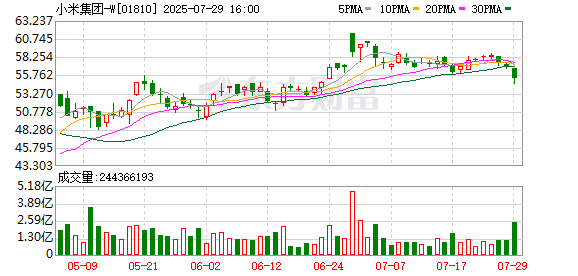
小米集团-W(01810)下跌2.01%,报53.65元/股
Jin Rong Jie· 2025-07-31 02:19
Core Viewpoint - Xiaomi Group is experiencing a decline in stock price, reflecting market volatility and investor sentiment towards the company's performance and upcoming financial disclosures [1]. Group 1: Company Overview - Xiaomi Group is primarily an internet company focused on smartphones, smart hardware, and IoT platforms, with a product range that includes smartphones, IoT and lifestyle consumer products, and internet services [1]. - The company's business model is built on three interrelated pillars: innovative and high-quality hardware, efficient new retail, and a rich array of internet services, aimed at reducing operational costs and enhancing efficiency [1]. Group 2: Financial Performance - As of the first quarter of 2025, Xiaomi Group reported total revenue of 111.29 billion yuan and a net profit of 10.92 billion yuan [1]. - The company is set to disclose its mid-year financial report for the fiscal year 2025 on August 19 [1].
南向资金今日净买入127.20亿港元,小米集团-W净买入16.59亿港元
Zheng Quan Shi Bao Wang· 2025-07-29 12:00
今日上榜个股中,小米集团-W、腾讯控股、阿里巴巴-W等8只股同时上榜港股通(深)、港股通(沪)成交活跃股, 小米集团-W合计成交额 83.68亿港元,成交净买入16.59亿港元,腾讯控股合计成交额45.43亿港元,成交净买入8.33亿港元。泡泡玛特合计成交额23.37亿港元,成交净卖 出3.51亿港元,美团-W合计成交额37.51亿港元,成交净卖出2.88亿港元。 从连续性进行统计, 有4只股获南向资金连续3天以上净买入,连续净买入天数较多的有腾讯控股、中芯国际、阿里巴巴-W,连续净买入天数分 别为4天、3天、3天。以其间净买入金额统计,净买入金额最多的是小米集团-W,合计净买入为24.46亿港元,其次是腾讯控股合计净买入为20.89 亿港元,中芯国际合计净买入为13.03亿港元。(数据宝) | 7月29日南向资金成交活跃股 | | --- | | 代码 简称 | 成交金额 成交净买入 | 今日涨跌幅(%) | | --- | --- | --- | | | (万港元) (万港元) | | | 01810 小米集团-W | 836751.42 165918.68 -2.64 | | | 00700 腾讯控股 ...



南向资金追踪|净流入逾127亿港元 买入小米集团流出美团和泡泡玛特
Xin Lang Cai Jing· 2025-07-29 11:52
智通财经7月29日讯(编辑 冯轶)据Wind数据显示,南向资金今日成交约1554.92亿港元,短线交投连续收缩后重新放量,约为今日恒指成交总额的 58.23%,占比也较前几日明显抬升。 个股方面,交易所数据显示,今日南向资金 大幅净买入:小米集团-W(01810.HK)16.59亿港元;腾讯控股(0700.HK)8.33亿港元;阿里巴巴-W(09988.HK)7.53亿港元;石药集团(01093.HK)6.52 亿港元;信达生物(01801.HK)5.14亿港元;国泰君安国际(01788.HK)4.31亿港元;中芯国际(00981.HK)3.67亿港元; 大幅净流出:泡泡玛特(09992.HK)3.51亿港元;美团-W(03690.HK)2.88亿港元。 恒指今日弱势震荡,午后有所走强。全天南向资金净流入约127.20亿港元,其中沪港股通净流入约58.78亿港元,深港股通净流入约68.42亿港元。 | 令日 | 58.78 | 68.42 | 127.20 | | --- | --- | --- | --- | | 近一月 | 573.94 | 534.16 | 1108.10 | 投资要点 小米集团-W今日 ...

北水成交净买入127.2亿 北水再度加仓创新药概念 全天买入小米(01810)超16亿港元
Zhi Tong Cai Jing· 2025-07-29 11:07
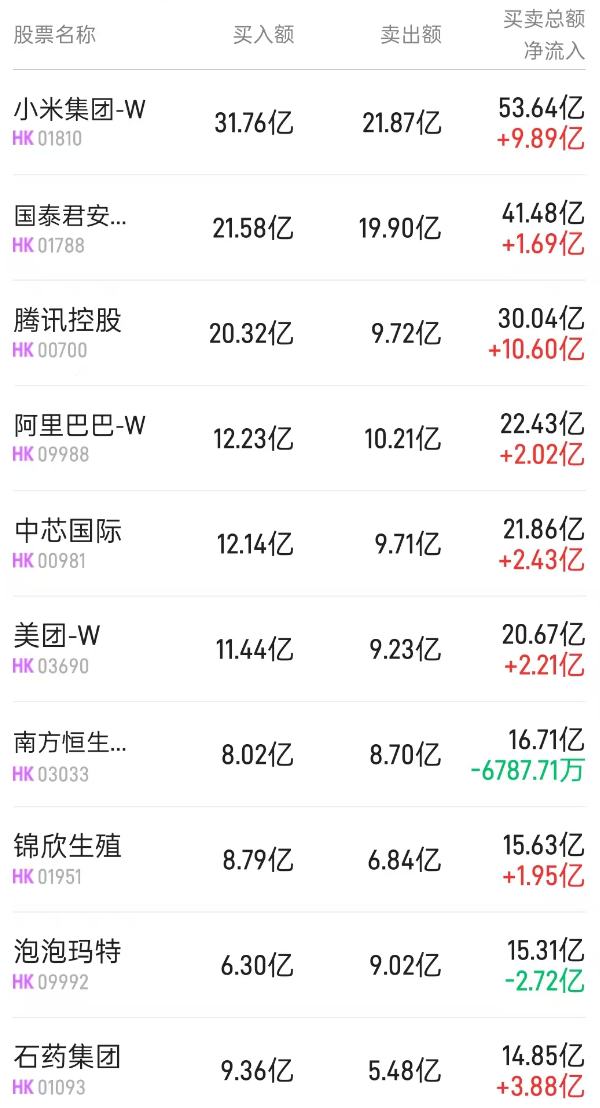
| 中芯国际 | 6.421Z | 5.18 亿 | 11.60亿 | | --- | --- | --- | --- | | HK 00981 | | | +1.24 亿 | | 快手-W | 4.62亿 | 4.71亿 | 9.33亿 | | HK 01024 | | | -850.31万 | | 石药集团 | 5.88亿 | 3.24亿 | 9.11亿 | | HK 01093 | | | +2.64 乙 | | 信达生物 | 6.77 亿 | 1.62亿 | 8.39亿 | | HK 01801 | | | +5.141Z | | 泡泡玛特 | 3.63亿 | 4.43亿 | 8.06亿 | | HK 09992 | | | -7973.47万 | 港股通(深)活跃成交股 | 股票名称 | 买入额 | 卖出额 | 买卖总额 | | --- | --- | --- | --- | | | | | 净流入 | | 小米集团-W HK 01810 | 31.76亿 | 21.87 亿 | 53.64亿 | | | | | +9.89 亿 | | 国泰君安 ... | 21.58亿 | 19.90亿 | 41 ...
南向资金今日净买入127.2亿港元 小米集团-W获净买入额居前
Jin Rong Jie· 2025-07-29 10:02
南向资金今日净买入127.2亿港元。小米集团-W、腾讯控股、阿里巴巴-W分别获净买入16.59亿港元、 8.33亿港元、7.53亿港元;泡泡玛特净卖出额居首,金额为3.51亿港元。 本文源自:金融界AI电报 ...
北水动向|北水成交净买入127.2亿 北水再度加仓创新药概念 全天买入小米(01810)超16亿港元
智通财经网· 2025-07-29 09:56
智通财经APP获悉,7月29日港股市场,北水成交净买入127.2亿港元,其中港股通(沪)成交净买入58.78 亿港元,港股通(深)成交净买入68.42亿港元。 | 石药集团 HK 01093 | 5.88亿 | 3.24亿 | 9.11亿 +2.64亿 | | --- | --- | --- | --- | | 信达生物 | 6.77亿 | 1.62亿 | 8.39亿 | | HK 01801 | | | +5.14亿 | | 泡泡玛特 | 3.63亿 | 4.43亿 | 8.06亿 | | HK 09992 | | | -7973.47万 | 港股通(深)活跃成交股 北水净买入最多的个股是小米集团-W(01810)、腾讯(00700)、阿里巴巴-W(09988)。北水净卖出最多的 个股是南方恒生科技(03033)。 | 股票名称 | 买入额 | 卖出额 | 买卖总额 净流入 | | --- | --- | --- | --- | | 小米集团-W HK 01810 | 31.76亿 | 21.87 乙 | 53.64亿 +9.89亿 | | 国泰君安 ... | 21.58 乙 | 19.90亿 | 41. ...