
XIAOMI(XIACY)

Search documents
南向资金今日净买入逾127亿港元 小米集团获净买入居前
news flash· 2025-07-29 09:45
智通财经7月29日电,南向资金今日净买入约127.20亿港元。其中,小米集团-W、腾讯控股分别获净买 入约16.59亿港元、8.33亿港元;泡泡玛特遭净卖出约3.51亿港元。 南向资金今日净买入逾127亿港元 小米集团获净买入居前 ...



2025年《财富》世界500强小米集团排名第297位,提高100位,雷军:向着 “全球新一代硬核科技引领者” 挺进!
Sou Hu Cai Jing· 2025-07-29 09:20
7月29日,2025年《财富》世界500强发布。小米集团排名第297位,较上一年提高100位,创下2019年上 榜以来的最大增幅。2024年小米集团总收入3659亿元,收获史上最强业绩。 来源:新浪网 对此,小米集团创始人、董事长兼CEO雷军发微博表示,今年是小米创业第十五周年,小米"人车家全 生态" 战略正式闭环,手机、汽车、大家电三大增长曲线齐头并进,开启新一轮增长。 小米将始终以技 术为本,向着 "全球新一代硬核科技引领者" 挺进! ...

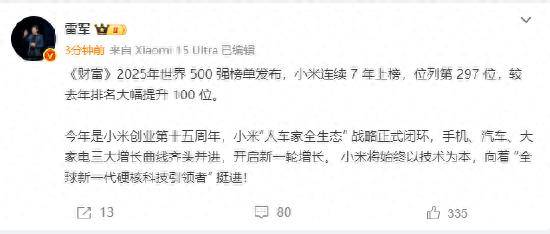
2025年《财富》世界500强小米集团排名第297位,较上一年提高100位,雷军:向着 “全球新一代硬核科技引领者” 挺进!
Sou Hu Cai Jing· 2025-07-29 09:20
【免责声明】本文仅代表作者本人观点,与和讯网无关。和讯网站对文中陈述、观点判断保持中立,不 对所包含内容的准确性、可靠性或完整性提供任何明示或暗示的保证。请读者仅作参考,并请自行承担 全部责任。邮箱:news_center@staff.hexun.com 对此,小米集团创始人、董事长兼CEO雷军发微博表示,今年是小米创业第十五周年,小米"人车家全 生态" 战略正式闭环,手机、汽车、大三大增长曲线齐头并进,开启新一轮增长。 小米将始终以技术为 本,向着 "全球新一代硬核引领者" 挺进! 7月29日,2025年《财富》世界500强发布。小米集团排名第297位,较上一年提高100位,创下2019年上 榜以来的最大增幅。2024年小米集团总收入3659亿元,收获史上最强业绩。 ...
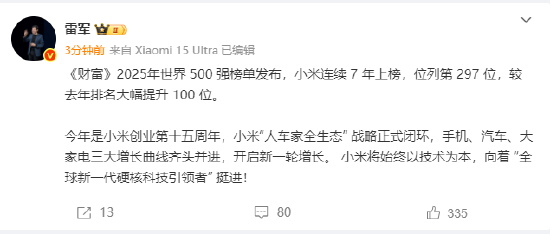
小米集团-W(1810.HK):志揽星河 初绽华彩
Ge Long Hui· 2025-07-29 02:24
Core Viewpoint - Xiaomi's home appliance business has become a crucial strategic component, achieving significant growth with a projected CAGR of 48.8% from 2020 to 2024 in the smart home appliance sector [1] Group 1: External Factors - The cautious consumer environment and the shift in leading companies towards profitability have facilitated Xiaomi's rapid market share expansion [1] - The preference for high cost-performance products among consumers has allowed Xiaomi to enhance its market position [1] Group 2: Internal Factors - Xiaomi's competitive edge is bolstered by its ecosystem model, which enables rapid product category expansion and enhances user loyalty through AIoT integration [1] - The company's "explosive product" strategy provides cost advantages compared to similarly sized competitors, benefiting consumers [1] - Strong marketing and user operation capabilities allow Xiaomi to quickly capture user demands, supported by its high brand recognition [1] Group 3: Growth Potential - The home appliance sector shows significant growth potential, particularly in categories like air conditioning, dishwashers, and electric ovens, with strong market share and structural opportunities [2] - The optimization of offline channel systems and the globalization of major appliance products are expected to support long-term growth in Xiaomi's home appliance business [2] Group 4: Investment Outlook - Xiaomi's comprehensive "smart home" platform and the steady growth of its IoT business position the company favorably in a cautious consumer environment [2] - The ongoing high growth in Xiaomi's smartphone and IoT segments, along with the rapid expansion of new automotive business, is projected to drive substantial profit increases by 2025-2027 [2]
小米集团-W(01810):家电篇:志揽星河,初绽华彩
Changjiang Securities· 2025-07-27 02:11
Investment Rating - The report maintains a "Buy" rating for the company [15]. Core Viewpoints - The company's home appliance business has shown significant growth, evolving from a supplementary role in the IoT ecosystem to a crucial component of the "human-vehicle-home" strategy. The company has established a competitive advantage through its ecosystem model, popular product strategy, and effective marketing capabilities. With the development of its automotive business, the company is expected to optimize its offline channel system and actively promote its large appliance export plans, enhancing the long-term growth potential of the home appliance segment [3][9][39]. Summary by Sections Home Appliance Business: Strategic Upgrade and Scale Breakthrough - The company has built a comprehensive "human-vehicle-home" ecosystem over more than a decade, with home appliances as a core business. The smart home appliance business is projected to achieve a CAGR of 48.8% from 2020 to 2024. The company has achieved full category coverage in home appliances, primarily developing white and black goods in-house while utilizing an ecosystem model for other categories [9][20][26]. External Factors: Differentiated Positioning and Market Trends - The company has rapidly gained market share in a mature domestic home appliance industry due to two main external factors: a cautious consumer environment leading to a preference for high cost-performance products and a shift in leading companies focusing more on profitability, which has created favorable conditions for the company [10][40]. Internal Factors: Ecosystem Support and Innovation - The company's competitive edge in home appliances is attributed to three main aspects: rapid category expansion through its ecosystem model, a successful product strategy that allows for cost advantages, and strong marketing and user operation capabilities that enable quick capture of consumer demand [11][39]. Growth Potential: Initial Foundation and Promising Outlook - The home appliance segment has significant growth potential, with high penetration rates in certain categories and room for expansion in others. The company is expected to see strong growth in online markets for air conditioners, dishwashers, and electric ovens, supported by the optimization of offline channels and global expansion of large appliances [12][39]. Investment Recommendation: Seizing Multi-Dimensional Development Potential - The company has established a leading global platform for smart terminals, with steady growth in its IoT business. The cautious consumer environment and the industry's focus on profitability provide a favorable backdrop for the company's development. The home appliance business is expected to deliver strong growth momentum in the long term, supported by the anticipated high growth of its smartphone and IoT business, as well as rapid expansion in the automotive sector. The projected net profits for 2025-2027 are estimated at 42.39 billion, 55.75 billion, and 70.08 billion respectively, with corresponding PE ratios of 32.6, 24.8, and 19.7 [13][39].
中华港股通优选50指数上涨0.58%,前十大权重包含小米集团-W等
Jin Rong Jie· 2025-07-24 14:29
Group 1 - The core viewpoint of the article highlights the performance of the Chinse Hong Kong Stock Connect Preferred 50 Index, which has shown significant growth over various time frames, including a 5.68% increase in the past month, a 15.89% increase in the past three months, and a 27.65% increase year-to-date [1] - The index is compiled by the China Securities Index Co., Ltd. and aims to reflect the overall performance of the top 50 blue-chip securities listed on the Hong Kong Stock Exchange under the "Hong Kong Stock Connect" program [1] - The index's base date is December 30, 2011, with a base point of 2000.0 [1] Group 2 - The top ten holdings of the index include HSBC Holdings (10.29%), Tencent Holdings (10.16%), Alibaba-W (9.68%), Xiaomi Group-W (6.8%), China Construction Bank (6.48%), Meituan-W (5.26%), AIA Group (4.85%), Hong Kong Exchanges and Clearing (3.64%), China Mobile (3.46%), and Industrial and Commercial Bank of China (3.42%) [1] - The index's holdings are entirely composed of stocks from the Hong Kong Stock Exchange, with the financial sector representing 39.55%, consumer discretionary 24.18%, communication services 16.35%, information technology 8.91%, energy 3.91%, real estate 3.28%, utilities 1.63%, consumer staples 0.96%, industrials 0.83%, and healthcare 0.40% [2]
深夜,暴涨近600%!中国资产也爆发
天天基金网· 2025-07-24 03:30
Core Viewpoint - The article highlights the strong performance of Chinese concept stocks and the overall positive sentiment in the market, driven by various factors including economic stability and policy support [2][8]. Group 1: Chinese Concept Stocks Performance - The Nasdaq Golden Dragon China Index rose nearly 1.4%, with notable gains in stocks such as Manulife and Brain Rejuvenation, which surged over 100% and 30% respectively [2]. - Major Chinese tech stocks showed significant increases, with Pinduoduo up over 4%, Tencent Holdings ADR up over 3%, and Meituan ADR up over 2% [6][7]. - The Shanghai Composite Index broke the 3600-point mark, while the Hang Seng Index and Hang Seng Tech Index approached four-year highs, indicating strong market momentum [7]. Group 2: International Investment Sentiment - Several foreign institutions have raised their forecasts for China's economic growth in 2025, citing stable economic performance and improving corporate earnings outlook [8]. - A report from Citi highlighted that despite macroeconomic fluctuations, Asian markets, particularly China and South Korea, are expected to outperform global peers, leading to upgraded ratings for these markets [8]. - Approximately 60% of Middle Eastern sovereign wealth funds plan to increase their allocation to Chinese assets over the next five years, reflecting a growing interest in China's digital technology, renewable energy, and advanced manufacturing sectors [8]. Group 3: Abivax Stock Surge - French biotechnology company Abivax saw its stock surge by nearly 600% after reporting strong results from its oral drug for ulcerative colitis in late-stage trials, demonstrating significant clinical efficacy and safety [11][13]. - Abivax plans to submit a new drug application to the FDA next year, contingent on further positive data [13]. Group 4: Meme Stocks Rally - The article discusses a resurgence of "meme stocks" in the U.S. market, with companies like Krispy Kreme and GoPro experiencing significant price increases, driven by retail investor enthusiasm [15][17]. - Krispy Kreme's stock rose nearly 40%, while GoPro surged over 70%, as these stocks were heavily shorted and gained traction on social media platforms [15][17]. - Analysts noted that the current rally in speculative stocks could indicate a potential market bubble, as these stocks outperformed those with consistent earnings [17].





全线收涨,中国大涨!
中国基金报· 2025-07-24 01:02
Core Viewpoint - The U.S. stock market saw significant gains, with the S&P 500 and Nasdaq reaching record closing highs, while major Chinese tech stocks experienced substantial increases [2][3][4]. Group 1: U.S. Stock Market Performance - The three major U.S. stock indices all closed higher, with the Dow Jones up 1.14% to 45010.29 points, the S&P 500 rising 0.78% to 6358.91 points, and the Nasdaq increasing 0.61% to 21020.02 points, marking new closing highs for both the S&P 500 and Nasdaq [4][6]. - Notable gainers included Merck, which rose nearly 3%, and UnitedHealth Group, which increased over 2%, leading the Dow [4]. Group 2: Chinese Tech Stocks - Chinese tech stocks saw a majority increase, with the Nasdaq Golden Dragon China Index rising 0.75% and the Wind Chinese Tech Leaders Index up 1.86% [17]. - Key performers included Tencent, which rose 3.93%, Pinduoduo up 2.97%, and Meituan increasing by 1.90%, leading the Wind Chinese Tech Leaders Index [20]. Group 3: Corporate Earnings Reports - Alphabet (Google) reported strong Q2 earnings, with revenue of $96.428 billion, exceeding expectations of $93.94 billion, and an EPS of $2.31, surpassing the forecast of $2.17. The stock rose 3% in after-hours trading following the announcement [23][24]. - Tesla reported a Q2 adjusted EPS of $0.40, a 23% year-over-year decline, with revenue of $22.5 billion, down 12% from the previous year. The stock fell over 2% in after-hours trading [25][26].



深夜,暴涨近600%!中国资产也爆发
证券时报· 2025-07-23 15:10
Core Viewpoint - Chinese concept stocks continue to show strong performance, with the Nasdaq Golden Dragon China Index rising approximately 1.4% [4][6]. Group 1: Market Performance - On July 23, U.S. stock indices opened higher, with the Dow Jones Industrial Average up 0.5%, Nasdaq up 0.07%, and S&P 500 up 0.27% [1][2]. - Individual stocks like Abivax surged nearly 600% after reporting strong results for its ulcerative colitis treatment [2][10]. - The Nasdaq Golden Dragon China Index saw a rise of about 1%, with notable increases in stocks such as Pinduoduo (up over 4%), Tencent Holdings ADR (up over 3%), and Meituan ADR (up over 2%) [4][6]. Group 2: Investment Sentiment - Several foreign institutions have raised their forecasts for China's economic growth in 2025, citing stable economic performance and improving corporate earnings [8]. - A significant portion of sovereign wealth funds globally is increasing their allocation to Chinese assets, with about 60% of Middle Eastern funds planning to invest more in China over the next five years [8]. Group 3: Meme Stocks Activity - The U.S. market has seen a resurgence of "meme stocks," with companies like Krispy Kreme and GoPro experiencing significant price increases, driven by retail investor enthusiasm [14][17]. - Krispy Kreme's stock was shorted at 28%, while GoPro had a short ratio of about 10%, indicating high speculative interest [17].


中证港股通TMT主题指数报4552.41点,前十大权重包含小米集团-W等
Jin Rong Jie· 2025-07-21 12:02
Core Points - The China Securities TMT Index has shown significant growth, with a 33.64% increase year-to-date, 20.88% over the last three months, and 8.48% in the past month [1] - The index comprises 50 listed companies in the TMT sector from the Hong Kong Stock Connect, reflecting the overall performance of these companies [1] - The top ten holdings of the index include major companies such as Xiaomi Group (14.86%), Tencent Holdings (14.03%), and China Mobile (13.81%) [1] Index Composition - The index is fully composed of stocks listed on the Hong Kong Stock Exchange, with a 100% allocation [1] - The industry breakdown shows that communication services account for 55.47% and information technology for 44.53% of the index [1] Index Adjustment Mechanism - The index samples are adjusted biannually, specifically on the second Friday of June and December, with weight factors fixed until the next adjustment [2] - In special circumstances, the index may undergo temporary adjustments, such as removing delisted companies or adding new TMT firms that rank in the top ten by market capitalization [2]

