
一汽

Search documents
汽车稳增长方案带来利好,汽车产业链股、港股整车股走强
Xin Jing Bao· 2025-09-15 14:46
Core Viewpoint - The Ministry of Industry and Information Technology (MIIT) has emphasized the importance of stabilizing growth in the automotive industry and regulating competition, leading to a significant rise in automotive stocks on September 15, 2023 [1][2]. Group 1: Policy Initiatives - The "Automotive Industry Stabilization Growth Work Plan (2025-2026)" was officially released on September 13, outlining 15 initiatives and 3 guarantee measures across four dimensions: expanding domestic consumption, improving supply quality, optimizing the development environment, and deepening open cooperation [2]. - The plan aims for approximately 32.3 million vehicle sales in 2025, a year-on-year increase of about 3%, with new energy vehicle sales targeted at around 15.5 million, reflecting a 20% growth [2]. Group 2: Industry Response - Following the MIIT's initiatives, the China Association of Automobile Manufacturers (CAAM) issued a payment standard for automotive suppliers, advocating for a 60-day payment term to stabilize the supply chain and reduce systemic risks [3]. - Major automotive companies, including FAW, Dongfeng, Changan, SAIC, and BYD, have committed to actively implementing the payment standards proposed by CAAM [2]. Group 3: Market Reaction - On September 15, automotive stocks surged, with notable increases in companies such as Jianghuai Automobile (up 6.68%) and BYD (up 2.63%), reflecting positive market sentiment towards the government's initiatives [1]. - Hong Kong-listed automotive stocks also experienced gains, with Li Auto rising by 4.56% and NIO by 3.53%, indicating a broader market response to the regulatory changes [1].




17家车企集体表态!
Guo Ji Jin Rong Bao· 2025-09-15 12:21
Core Viewpoint - The China Automotive Industry Association (CAAM) has launched an initiative to standardize payment practices between automotive manufacturers and suppliers, aiming to foster a collaborative ecosystem and promote high-quality development in the automotive industry [1][2][8]. Group 1: Initiative Principles - The initiative emphasizes not exploiting the advantages of large enterprises to harm suppliers' interests, promoting a win-win collaboration between vehicle manufacturers and parts suppliers [2]. - In the order confirmation phase, both parties should agree on order details, and any changes to existing orders must be mutually negotiated [2]. - Payment terms stipulate that the maximum payment period should not exceed 60 calendar days from the date of delivery and acceptance [2]. Group 2: Contract Duration - The initiative encourages establishing long-term cooperative relationships, with each contract having a minimum validity period of one year [3]. Group 3: Industry Response - As of the report, 17 automotive manufacturers have committed to implementing the initiative, including Chery Group, which aims to standardize contract terms and comply with the "Regulations on Payment for Small and Medium Enterprises" [4]. - Companies like Seres and Changan Automobile have expressed their commitment to industry self-discipline and adherence to the 60-day payment term [4][5]. - Other major players such as Dongfeng, BYD, and Great Wall have also pledged to support the initiative and ensure supplier rights are protected [5]. Group 4: Policy Context - This initiative is part of a broader governmental effort to regulate the automotive industry, following the implementation of the revised "Regulations on Payment for Small and Medium Enterprises" which established a legal basis for the 60-day payment term [9]. - The CAAM's initiative details operational standards across four key areas: order confirmation, delivery acceptance, payment settlement, and contract duration [9]. Group 5: Industry Challenges - Despite the industry's growth, challenges persist, including rising debt levels among manufacturers due to increased R&D investments and structural adjustments for electric vehicle production [10]. - The average payment cycle for ten major domestic automakers was reported to be 182 days in the first half of the year, significantly exceeding the 60-day requirement [11].

17家车企集体响应中汽协账款支付倡议
Jing Ji Guan Cha Wang· 2025-09-15 10:40
9月15日,中国汽车工业协会发布《汽车整车企业供应商账款支付规范倡议》,要求整车企业支付账期自供应商交货并通过验收合格之日起计算,最长不超 过60个自然日,且货物验收时间原则上不超过3个工作日。倡议发布后,17家重点车企集体响应,包括东风、上汽、长安、赛力斯、理想、比亚迪、奇瑞、 广汽、蔚来、小鹏、小米、吉利、长城、零跑、北汽、江汽和一汽均表态落实倡议,推动供应链账款支付规范化。 工信部明确支持该倡议,认为其细化了货物交付验收、账期起计、对账结算等执行要求,有助于解决此前各车企因流程差异导致的"尺度不一"问题,对促进 汽车行业规范发展具有重要意义。多家车企已推出具体措施:长安汽车通过"按交付日起算+十日归集支付"方案全面兑现60天账期承诺;上汽集团明确不采 用商业承兑汇票等增加供应商资金压力的结算方式;广汽集团表示已严格执行"不超过60天账期"支付原则28年;奇瑞集团通过"账期规范化、执行全链化、 审批数字化、预付款机制化"组合拳缩短平均支付账期。 经观汽车 ...
一汽、比亚迪、小米等17家车企集体表态:积极落实账款支付倡议
Xin Lang Cai Jing· 2025-09-15 09:52
Group 1 - The China Automotive Industry Association (CAAM) issued an initiative on September 15, 2023, regarding payment norms for suppliers, emphasizing the importance of timely payments in the automotive industry [1] - A total of 17 automotive companies, including major players like SAIC, Geely, BYD, and NIO, have publicly supported the initiative and committed to adhering to the payment norms [1][4] - The initiative encourages the use of cash or bank acceptance bills for payments, particularly for small and medium-sized enterprises (SMEs) [2] Group 2 - SAIC Group and Geely have explicitly stated they will not use commercial acceptance bills, which could increase financial pressure on suppliers, and will standardize payment terms to within 60 days [2] - Several companies, including Li Auto, Xiaomi, and Changan, have reiterated their commitment to a 60-day payment period and are working on optimizing their payment processes [3][4] - The Ministry of Industry and Information Technology (MIIT) has established a platform for SMEs to report issues regarding the adherence to payment commitments by key automotive companies [4][5]


比亚迪、上汽、小米等车企集体表态
Xin Lang Cai Jing· 2025-09-15 08:23
Group 1 - The China Automotive Industry Association (CAAM) released the "Supplier Payment Norms Initiative" on September 15, prompting several automakers to respond positively [2][4] - BYD expressed its commitment to the initiative, focusing on key aspects such as order confirmation, delivery and acceptance, payment and settlement, and contract duration to foster a collaborative ecosystem for high-quality development in the automotive industry [2][4] - Xiaomi Auto fully supports the initiative and commits to maintaining a payment period of within 60 days, emphasizing the importance of supplier rights and enhancing supply chain resilience [6] Group 2 - Other automakers, including Dongfeng Motor, Changan Automobile, BAIC Group, Chery Group, Seres, and Li Auto, also responded positively to the CAAM initiative [7] - In June, 17 major automakers, including FAW and Dongfeng, pledged to keep supplier payment periods within 60 days, aligning with the newly released initiative [7] - The initiative outlines specific requirements for goods delivery acceptance, payment periods, and encourages stable cooperation between suppliers and automakers, which is crucial for the regulated development of the automotive industry [7]

国泰海通|新能源:再读固态电池投资机会——固态电池行情复盘与展望
国泰海通证券研究· 2025-09-12 08:52
Core Viewpoint - Solid-state batteries are identified as the next generation of high-performance batteries, with increasing demand for oxide semi-solid batteries and the potential for sulfide all-solid-state batteries to demonstrate vehicle integration, indicating a strengthening trend in the solid-state battery market [1][2]. Investment Recommendations - Solid-state batteries are expected to become a key development direction for high-performance batteries due to their advantages in safety and energy density, with significant market potential in consumer batteries, new energy vehicles, and low-altitude applications. Companies that are proactively investing in solid-state batteries and key materials and equipment are viewed positively [2]. - The safety and performance improvements of solid-state batteries are driven by both policy and demand. Compared to mainstream liquid lithium batteries, solid-state batteries utilize non-flammable solid electrolytes, reducing the need for flammable organic electrolyte solvents, and can be paired with higher activity materials, significantly enhancing energy density. The Chinese government plans to invest approximately 6 billion yuan in solid-state battery research and development, involving major companies like CATL and BYD [2][3]. Market Dynamics - The solid-state battery market has transitioned from being demand-driven to technology-driven. Before 2024, the focus was on semi-solid batteries, which faced challenges due to high costs and limited market acceptance. However, the demand for aviation-grade lithium batteries in the low-altitude economy is expected to drive the semi-solid battery market's growth [3]. - In November 2024, significant advancements in sulfide technology patents and increased R&D investments in all-solid-state batteries by major companies like CATL have garnered market attention, leading to a systematic rise in the new energy lithium battery sector [3]. Future Outlook - The solid-state battery industry is expected to see an upward trend in market conditions, with the gradual release of semi-solid demand and the potential for all-solid-state products to demonstrate vehicle integration. The oxide solid electrolyte is currently the most mature technology, and the commercial viability of semi-solid batteries is being realized with competitive pricing [4]. - The urgency for R&D in all-solid-state batteries is highlighted by the production planning timelines set by various automotive and battery companies for 2027, indicating a strong push towards commercialization [4].
首次双超2000万辆
Shang Hai Zheng Quan Bao· 2025-09-11 13:21
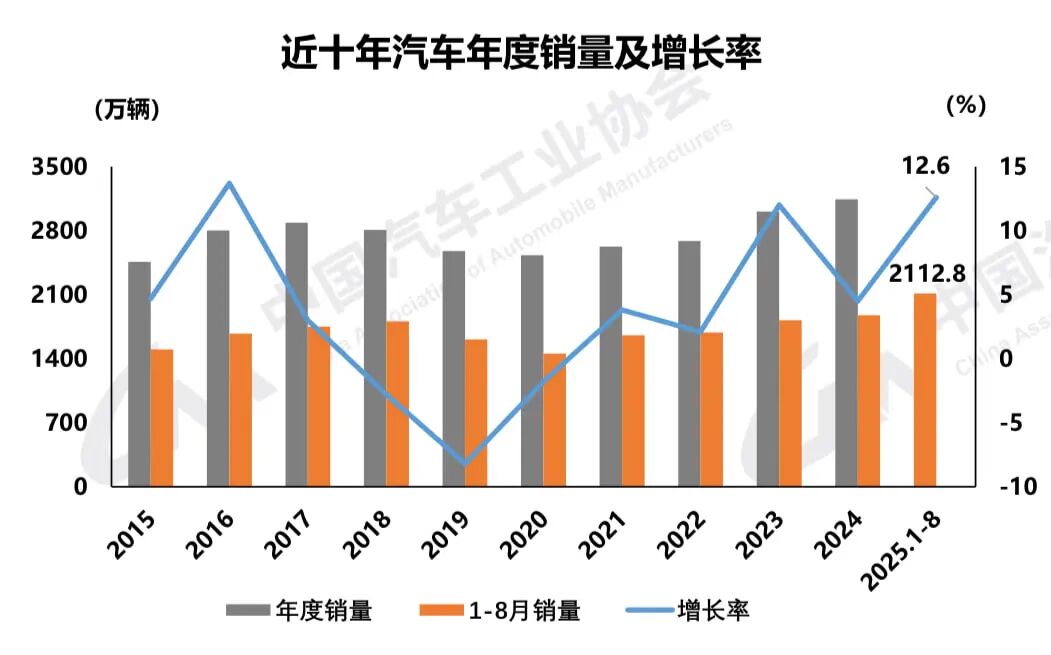
中国汽车行业传来喜报。9月11日,中国汽车工业协会(简称"中汽协")召开沟通会披露数据显示,2025年1至8月份,中国汽车产销量分别完成2105.1万 辆和2112.8万辆,同比分别增长12.7%和12.6%。这也是中国汽车产销量首次在1至8月期间内双超2000万辆。 中汽协有关负责人在沟通会表示,8月,我国宏观经济景气水平总体继续保持扩张,当月汽车产销同比保持10%以上增长。"两新"政策持续发力,个人消 费贷款财政贴息等政策及时出台,企业新车型投放热情较高,行业综合整治"内卷"工作继续显效,汽车行业总体运行平稳。 中汽协数据显示,2025年8月,中国汽车产销分别完成281.5万辆和285.7万辆,环比分别增长8.7%和10.1%,同比分别增长13.0%和16.4%。1-8月,汽车产 销累计完成2105.1万辆和2112.8万辆,同比分别增长12.7%和12.6%,对比1-7月增速,产量保持持平,销量扩大了0.6个百分点。 从不同车型大类来看,8月,中国乘用车产销分别完成250万辆和254万辆,环比分别增长9.0%和11.1%,同比分别增长12.5%和16.5%。1-8月,乘用车产销 累计完成1833.8万辆 ...
阿尔特:小鹏是公司客户之一
Zheng Quan Ri Bao Wang· 2025-09-10 11:45
Core Viewpoint - The company, Altec (300825), is focused on the full-process research and development of complete vehicles and platforms, as well as the development and manufacturing of core components, with a diverse client base including major automotive manufacturers and new energy vehicle companies [1] Company Overview - Altec's main business includes the R&D of complete vehicles and platforms, development of new energy intelligent platforms, and manufacturing of core components [1] - The company serves a variety of clients such as Honda, Nissan, Toyota, FAW, Dongfeng, BAIC, JMC, Chery, and several new energy vehicle companies, including Xpeng [1] Industry Engagement - Altec is closely monitoring innovations in the low-altitude economy and is actively communicating with leading companies in the industry [1] - Currently, Altec has not participated in the supply chain support for clients' flying cars [1]

阿尔特(300825.SZ):目前暂未参与客户飞行汽车的供应链配套
Ge Long Hui A P P· 2025-09-10 06:40
Core Viewpoint - The company, Altec (300825.SZ), focuses on the full-process research and development of complete vehicles and platforms, as well as the development and manufacturing of core components for new energy intelligent platforms, serving notable clients including Honda, Nissan, Toyota, and several emerging enterprises like Xiaopeng [1] Group 1 - The company's main business includes the R&D of complete vehicles and platforms, new energy intelligent platform development, and core component manufacturing [1] - Key clients of the company include major automotive manufacturers such as Honda, Nissan, Toyota, FAW, Dongfeng, BAIC, Jiangling, Chery, and various new energy vehicle companies [1] - The company is closely monitoring innovations in the low-altitude economy sector and actively engages with leading enterprises in the industry [1] Group 2 - Currently, the company has not participated in the supply chain support for clients' flying cars [1]
车企的账期承诺兑现情况如何?实际操作中仍然存在诸多卡点
Hua Er Jie Jian Wen· 2025-09-06 01:57
Core Viewpoint - The article discusses the challenges faced by the automotive industry in implementing a 60-day payment term commitment made by 17 car manufacturers to alleviate pressure on suppliers, highlighting the need for systemic changes to ensure compliance and transparency [1][5][6]. Group 1: Payment Terms and Industry Practices - The average payment cycle for automotive parts suppliers is around 9 months, with some manufacturers publicly committing to 60-day payments but facing operational hurdles [2][3]. - Many car manufacturers delay payments until parts are installed and sold, creating a "pay after use" model that exacerbates cash flow issues for suppliers [2][3]. - The lack of standardized acceptance criteria and hidden clauses in contracts complicates the payment process, leading to further delays [2][4]. Group 2: Supplier Challenges and Market Dynamics - Suppliers often prioritize maintaining relationships with major car manufacturers over negotiating payment terms, even accepting price cuts of up to 20% [3][4]. - The competitive pressure within the supply chain leads to practices such as cash rebates to secure contracts, further straining supplier finances [3][4]. - The financial health of car manufacturers directly impacts payment speed, with good sales correlating to faster payments [4]. Group 3: Recommendations and Regulatory Actions - Industry experts suggest optimizing payment processes and reducing reliance on supply chain financing to alleviate supplier cash flow issues [5][6]. - There is a call for regulatory bodies to establish a breach compensation mechanism and to publicly disclose payment compliance data to enforce accountability [5][6]. - The Ministry of Industry and Information Technology plans to guide the development of standardized payment norms and contracts to reduce disputes and promote sustainable industry growth [6][7]. Group 4: Industry Outlook - Experts believe that addressing payment term issues, optimizing capacity, and regulating competition will help the automotive industry move towards a more efficient and resilient development phase [7].