千禾味业

Search documents
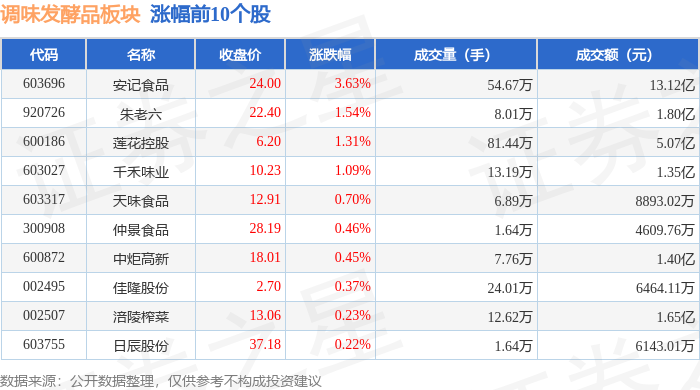
调味发酵品板块1月9日跌0.17%,ST加加领跌,主力资金净流出1.25亿元
Zheng Xing Xing Ye Ri Bao· 2026-01-09 08:54
Market Overview - The seasoning and fermentation sector experienced a decline of 0.17% on January 9, with ST Jiajia leading the drop [1] - The Shanghai Composite Index closed at 4120.43, up 0.92%, while the Shenzhen Component Index closed at 14120.15, up 1.15% [1] Stock Performance - Notable gainers in the seasoning and fermentation sector included: - Anji Food (603696) with a closing price of 24.00, up 3.63% and a trading volume of 546,700 shares, totaling 1.312 billion yuan [1] - Zhu Laoliu (920726) closed at 22.40, up 1.54% with a trading volume of 80,100 shares, totaling 180 million yuan [1] - Lianhua Holdings (600186) closed at 6.20, up 1.31% with a trading volume of 814,400 shares, totaling 507 million yuan [1] Capital Flow - The seasoning and fermentation sector saw a net outflow of 125 million yuan from institutional investors, while retail investors had a net inflow of 146 million yuan [2] - The capital flow for individual stocks showed: - Qianhe Flavor (603027) had a net inflow of 5.1857 million yuan from institutional investors [3] - ST Jiajia (002650) experienced a net outflow of 4.5464 million yuan from institutional investors [3] - Zhu Laoliu (920726) had a net inflow of 4.4530 million yuan from institutional investors [3]


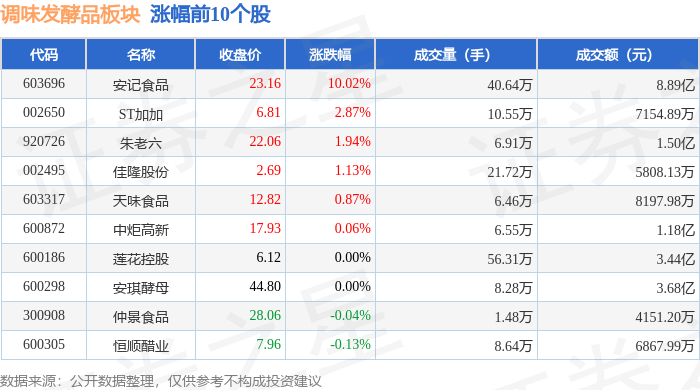
调味发酵品板块1月8日跌0.14%,日辰股份领跌,主力资金净流入4060.52万元
Zheng Xing Xing Ye Ri Bao· 2026-01-08 08:51
Market Overview - The seasoning and fermentation sector experienced a slight decline of 0.14% on January 8, with Day Chen Co. leading the drop [1] - The Shanghai Composite Index closed at 4082.98, down 0.07%, while the Shenzhen Component Index closed at 13959.48, down 0.51% [1] Stock Performance - Anji Food (603696) saw a significant increase of 10.02%, closing at 23.16 with a trading volume of 406,400 shares and a transaction value of 889 million [1] - Other notable performers included ST Jiajia (002650) with a rise of 2.87% and Zhu Laoliu (920726) with an increase of 1.94% [1] - Conversely, Day Chen Co. (603755) led the decline with a drop of 1.62%, closing at 37.10 [2] Capital Flow - The seasoning and fermentation sector had a net inflow of 40.61 million from institutional investors, while retail investors saw a net inflow of 8.55 million [2] - However, speculative funds experienced a net outflow of 49.16 million [2] Individual Stock Capital Flow - Anji Food (603696) had a net inflow of 109 million from institutional investors, but a net outflow of 49.45 million from speculative funds [3] - ST Jiajia (002650) reported a net inflow of 7.21 million from institutional investors, while experiencing a net outflow of 4.04 million from speculative funds [3] - Other stocks like Fuling Pickles (002507) and Tianwei Food (603317) also showed varied capital flows, with Fuling Pickles having a net inflow of 5.12 million from institutional investors [3]

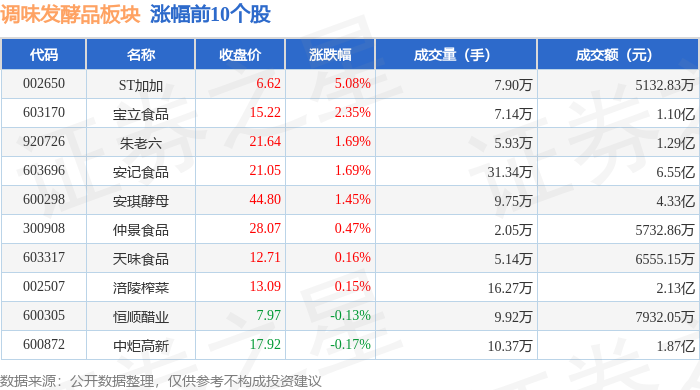
调味发酵品板块1月7日跌0.07%,日辰股份领跌,主力资金净流出6839.03万元
Zheng Xing Xing Ye Ri Bao· 2026-01-07 08:58
Market Overview - The seasoning and fermentation sector experienced a slight decline of 0.07% on January 7, with Day Chen Co. leading the drop [1] - The Shanghai Composite Index closed at 4085.77, up 0.05%, while the Shenzhen Component Index closed at 14030.56, up 0.06% [1] Stock Performance - Notable gainers in the seasoning and fermentation sector included: - ST Jiajia (002650) with a closing price of 6.62, up 5.08% on a trading volume of 79,000 shares and a turnover of 51.33 million yuan [1] - Baoli Food (603170) closed at 15.22, up 2.35% with a trading volume of 71,400 shares and a turnover of 110 million yuan [1] - Zhu Laoliu (920726) closed at 21.64, up 1.69% with a trading volume of 59,300 shares and a turnover of 129 million yuan [1] - Decliners included: - Day Chen Co. (603755) closed at 37.71, down 2.05% with a trading volume of 13,600 shares and a turnover of 51.77 million yuan [2] - Jialong Co. (002495) closed at 2.66, down 1.85% with a trading volume of 262,500 shares and a turnover of 70.03 million yuan [2] Capital Flow - The seasoning and fermentation sector saw a net outflow of 68.39 million yuan from institutional investors, while retail investors contributed a net inflow of 76.92 million yuan [2] - The capital flow for key stocks showed: - ST Jiajia had a net inflow of 7.70 million yuan from institutional investors, but a net outflow of 4.71 million yuan from speculative funds [3] - Hai Tian Flavor Industry (603288) had a net inflow of 7.52 million yuan from institutional investors, with a significant outflow of 38.87 million yuan from speculative funds [3]

调味发酵品板块1月6日涨1.04%,宝立食品领涨,主力资金净流入4758.38万元



Zheng Xing Xing Ye Ri Bao· 2026-01-06 08:56
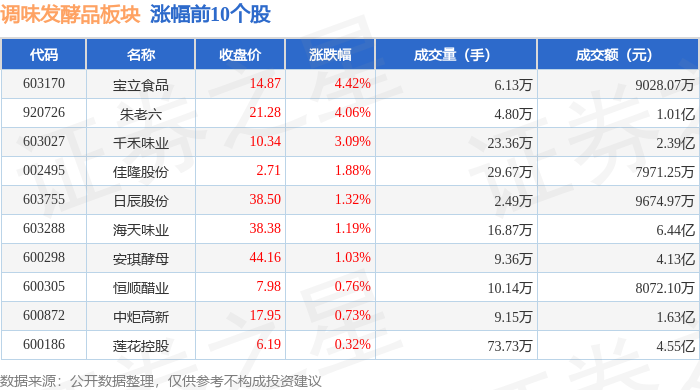
Market Performance - The seasoning and fermentation sector increased by 1.04% on January 6, with Baoli Food leading the gains [1] - The Shanghai Composite Index closed at 4083.67, up by 1.5%, while the Shenzhen Component Index closed at 14022.55, up by 1.4% [1] Individual Stock Performance - Baoli Food (603170) closed at 14.87, rising by 4.42% with a trading volume of 61,300 shares and a transaction value of 90.28 million yuan [1] - Zhuolaoliu (920726) closed at 21.28, up by 4.06% with a trading volume of 48,000 shares and a transaction value of 101 million yuan [1] - Qianhe Flavor (603027) closed at 10.34, increasing by 3.09% with a trading volume of 233,600 shares and a transaction value of 23.9 million yuan [1] - Other notable stocks include Jialong Co. (002495) up by 1.88%, and Haitian Flavor (603288) up by 1.19% [1] Capital Flow Analysis - The seasoning and fermentation sector saw a net inflow of 47.58 million yuan from main funds, while retail funds experienced a net outflow of 39.52 million yuan [2] - Main funds showed significant inflow into Haitian Flavor (603288) with 88.14 million yuan, while retail funds had a net outflow of 46.84 million yuan [3] - Qianhe Flavor (603027) also attracted main fund inflow of 26.18 million yuan, but retail funds saw a net outflow of 46.51 million yuan [3]
2025年1-11月全国其他制造业出口货值为593.5亿元,累计增长4%
Chan Ye Xin Xi Wang· 2026-01-06 03:29
根据国家统计局数据可知:2025年11月全国其他制造业出口货值为57.1亿元,同比下降4.3%;2025年1- 11月全国其他制造业累计出口货值为593.5亿元,累计同比增长4%。 2019年-2025年1-11月全国其他制造业出口货值统计图 上市公司:华纺股份(600448),凤竹纺织(600493),江南高纤(600527),浙文影业(601599), 千禾味业(603027),广州酒家(603043),台华新材(603055),百合股份(603102),养元饮品 (603156),一鸣食品(605179),华生科技(605180),富春染织(605189),安德利(605198), 佳禾食品(605300) 相关报告:智研咨询发布的《2026-2032年中国制造业市场竞争格局分析及投资发展研究报告》 数据来源:国家统计局,智研咨询整理 知前沿,问智研。智研咨询是中国一流产业咨询机构,十数年持续深耕产业研究领域,提供深度产业研 究报告、商业计划书、可行性研究报告及定制服务等一站式产业咨询服务。专业的角度、品质化的服 务、敏锐的市场洞察力,专注于提供完善的产业解决方案,为您的投资决策赋能。 ...

调味发酵品板块1月5日涨1.88%,日辰股份领涨,主力资金净流入1.47亿元
Zheng Xing Xing Ye Ri Bao· 2026-01-05 08:59
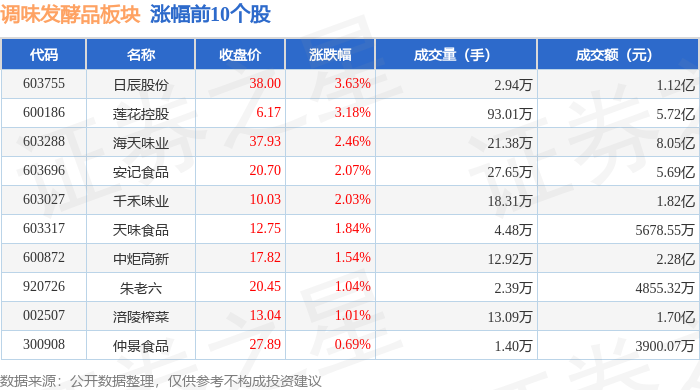
Core Viewpoint - The seasoning and fermentation sector experienced a rise of 1.88% on January 5, with Richen Co., Ltd. leading the gains. The Shanghai Composite Index closed at 4023.42, up 1.38%, while the Shenzhen Component Index closed at 13828.63, up 2.24% [1]. Group 1: Stock Performance - Richen Co., Ltd. (603755) closed at 38.00, with an increase of 3.63% and a trading volume of 29,400 shares, amounting to 112 million yuan [1]. - Lianhua Holdings (600186) closed at 6.17, up 3.18%, with a trading volume of 930,100 shares and a transaction value of 572 million yuan [1]. - Haitian Flavoring and Food Co., Ltd. (603288) closed at 37.93, increasing by 2.46%, with a trading volume of 213,800 shares and a transaction value of 805 million yuan [1]. - Anji Food (603696) closed at 20.70, up 2.07%, with a trading volume of 276,500 shares and a transaction value of 569 million yuan [1]. - Qianhe Flavoring (603027) closed at 10.03, increasing by 2.03%, with a trading volume of 183,100 shares and a transaction value of 182 million yuan [1]. Group 2: Capital Flow - The seasoning and fermentation sector saw a net inflow of 147 million yuan from institutional investors, while retail investors experienced a net outflow of 27.03 million yuan [2]. - The main capital flow for Haitian Flavoring and Food Co., Ltd. (603288) showed a net outflow of 57.51 million yuan from institutional investors, with a retail net inflow of 1.72 million yuan [3]. - Lianhua Holdings (600186) had a net inflow of 50.97 million yuan from institutional investors, while retail investors saw a net outflow of 2.34 million yuan [3].


食品饮料行业周报:茅台调整线上渠道,落实市场化转型-20260104
Shenwan Hongyuan Securities· 2026-01-04 15:13
Investment Rating - The report maintains a positive outlook on the food and beverage industry, particularly on the liquor sector, with a focus on high-quality companies for long-term investment [3][7]. Core Insights - The report emphasizes the importance of domestic demand, which has been highlighted by authoritative media and government officials since mid-December 2025. It notes that the high-end liquor prices have recently declined, indicating a market shift towards finding a balance between volume and price [3][7]. - For 2026, the report anticipates a double-digit decline in sales volume in Q1, with a potential stabilization in Q2 and a turning point in fundamentals by Q3. If the fundamentals recover as expected, a dual boost in valuation and performance is anticipated towards the end of 2026 and into 2027 [3][7]. - The report recommends several key liquor companies, including Luzhou Laojiao, Shanxi Fenjiu, Guizhou Moutai, and Wuliangye, while also suggesting attention to other brands like Yingjia Gongjiu and Jinhuijiu [3][7]. - In the consumer goods sector, the report highlights opportunities in the supply chain related to condiments, frozen foods, and dairy products, recommending companies such as Anjijia, Yili, and Qianhe Flavoring [3][10]. Summary by Sections 1. Food and Beverage Weekly Insights - The food and beverage sector experienced a decline of 2.26% last week, with liquor down 2.79%, underperforming the broader market [6][33]. - The report notes that the liquor sector's performance is closely tied to the upcoming Spring Festival, with expectations of improved market conditions compared to the previous months [11]. 2. Market Performance of Food and Beverage Sectors - The report indicates that the food and beverage industry underperformed the Shenwan A index by 1.95 percentage points, with the liquor sector lagging behind by 2.48 percentage points [33][34]. 3. Key Company Updates - Guizhou Moutai announced a significant adjustment to its online sales strategy, which is expected to have a profound impact on both the company and the industry. The adjustment includes a new product matrix aimed at better consumer engagement and market pricing [8][11]. - The report also mentions that Moutai's product prices have seen a decline, with the retail price for its flagship product dropping to 1490 yuan per bottle, reflecting a broader trend in the high-end liquor market [8][19].






食品饮料2026年年度策略汇报
2025-12-31 16:02
Summary of Key Points from the Conference Call on the Food and Beverage Industry Industry Overview - The food and beverage industry is currently facing pressure in cyclical demand, with performance uncertainty among leading companies in various segments, suggesting a cautious approach to investment [1][2] - The investment strategy for 2026 is divided into two main areas: segments with lower correlation to domestic demand and high-growth leading companies with overseas expansion or strong dividend capabilities, and cyclical sectors with high domestic demand [2] Key Recommendations - **Retail and Brand Companies**: Focus on retail channel companies like Wancheng and Mingming Hen Mang, and brand companies such as Yanjin and Weilong, which maintain their channel expansion logic [3] - **Beverage Sector**: Monitor opportunities for Dongpeng Special Drink, which is expected to benefit from long-term penetration rate improvements [3] - **High Dividend and Operational Improvement**: Recommend Qianhe Flavor and Yihai International, with Qianhe expected to have significant elasticity in 2026 and Yihai offering a 6% dividend yield at a 15x P/E ratio [5][12] Cyclical Sector Insights - The cyclical sectors, including liquor, beer, and restaurant supply chains, are currently at historical lows with pessimistic market sentiment. Investment in Moutai and Yanjing Beer is suggested for Q1 to Q2 2026 [6] - The liquor market is expected to remain stable during the Mid-Autumn Festival and National Day in 2026, with a cautious approach recommended due to the current market dynamics [20][21] Consumer Goods Sector - The consumer goods sector is recommended to focus on high-growth segments such as snack retail stores and functional beverages like Dongpeng Special Drink, which are expected to see increased penetration rates [7][8] - Dongpeng's performance in shelf management and freezer coverage is noted as strong, with significant revenue growth potential [9] Profitability and Cost Structure - Dongpeng is expected to benefit from cost reductions in P, E, and T, with a projected sales increase from 30 billion to 40-50 billion in 2026, improving gross margins [10] - The yeast and health product sectors are anticipated to grow significantly in overseas markets, particularly in regions with rising populations and increasing staple food consumption [11] Investment Strategy for Liquor Sector - The liquor sector is influenced by policy and economic cycles, with a recommendation to invest in Moutai and other leading brands during low sentiment periods [22][24] - The expected EPS for the liquor sector in 2026 is projected to stabilize, with a valuation range of 20 to 25 times [27] Conclusion - The overall investment strategy for the food and beverage sector in 2026 emphasizes identifying companies with strong growth potential, reasonable valuations, and competitive advantages in branding, distribution, and product differentiation [29]
弱复苏低通胀强补贴下的内需主线
2025-12-31 16:02
Summary of Key Points from Conference Call Records Industry Overview - The focus is on the domestic consumption sector, with policies aimed at boosting consumer spending through increased household income, including minimum wage hikes and corporate salary increases [1][4][5] - The service consumption sector is expected to benefit from reforms in pricing mechanisms, particularly in healthcare, transportation, and public utilities [1][6] - The retail sector, especially offline retail, is seen as a crucial driver for domestic demand, supported by policies for updating commercial facilities [1][12] Core Insights and Arguments - **Consumer Policy Effectiveness**: The effectiveness of consumer promotion policies is anticipated to exceed market expectations, with significant increases in minimum wage across provinces, averaging over 8% [4][5] - **Service Sector Reforms**: Reforms in service pricing, particularly in healthcare, are expected to enhance the income of service providers while controlling costs for consumers [6] - **Product Innovation**: In the goods consumption sector, companies that excel in innovation and new supply offerings are likely to thrive, moving away from traditional consumer upgrade logic [7] - **Tourism and Local Policies**: Local government competition is expected to stimulate tourism, benefiting cultural and agricultural sectors [1][7] Important but Overlooked Content - **Retail Performance**: The first quarter of 2026 is projected to be crucial for leading regional retail companies, with expectations of strong performance during the extended Spring Festival [12] - **Cross-Border E-commerce**: Currency fluctuations have a limited impact on leading cross-border e-commerce companies, with exchange rate losses being a minor portion of profits [13] - **Household Appliances and Smart Hardware**: The government has initiated a subsidy plan for key household appliance categories, with a total subsidy of approximately 250 billion for 2026, focusing on six core categories [19][20] - **Food and Beverage Sector**: The food and beverage sector is expected to hit a performance bottom in Q1 2026, with a gradual recovery anticipated in Q2 [22] Future Outlook - **Economic Rebalancing**: The macroeconomic narrative is shifting towards economic rebalancing, with a cautious optimism for 2026 as supply-demand dynamics are expected to improve [8][9] - **Investment Opportunities**: Key investment opportunities are identified in sectors benefiting from government support, particularly in smart home and wearable technology, with a focus on companies like Midea, Haier, and TCL [20][21] - **Pork Market Expectations**: The pork market is showing signs of recovery, with prices expected to stabilize and improve, leading to a more optimistic outlook for the industry [16] This summary encapsulates the essential insights and projections from the conference call records, highlighting the key themes and potential investment opportunities across various sectors.
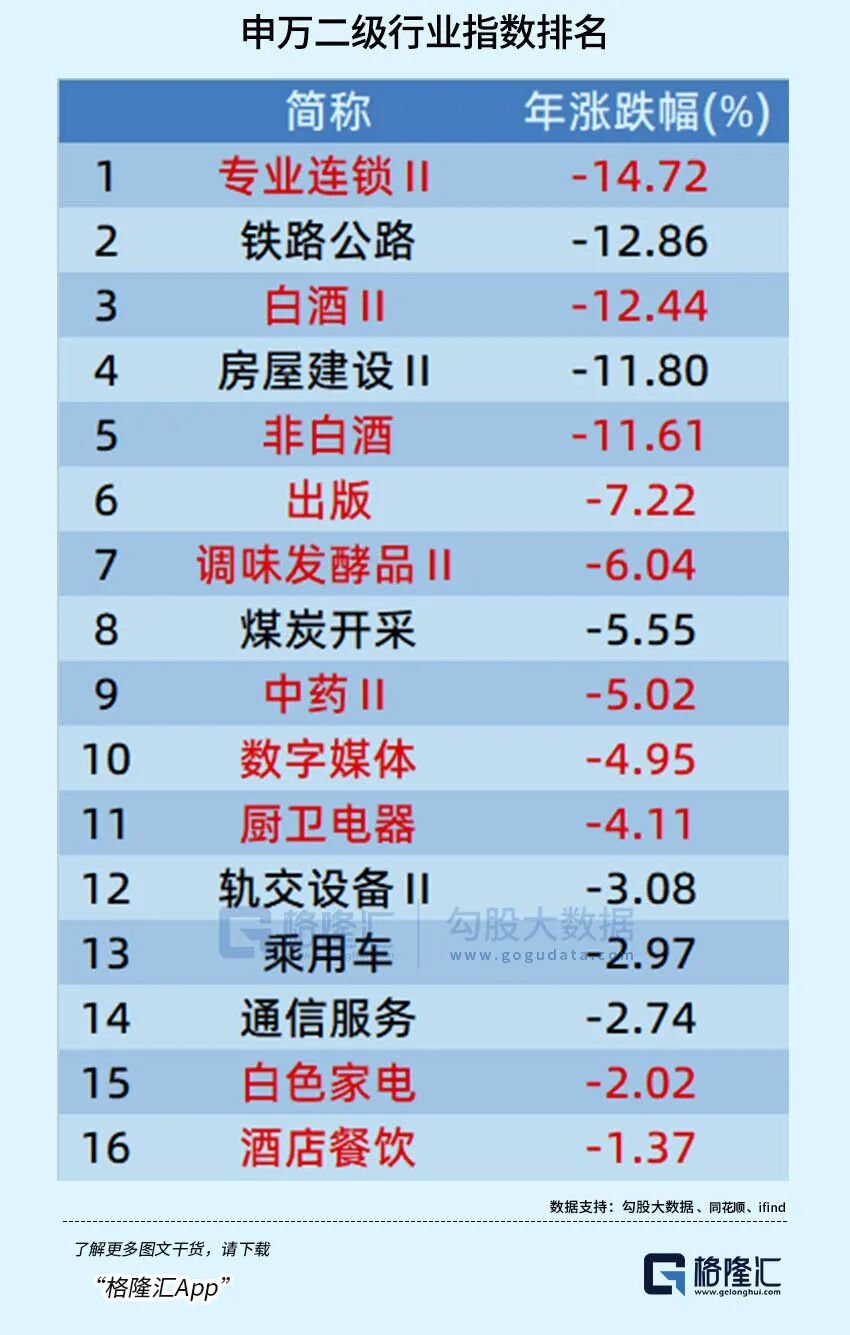
今年十大最惨板块,跌麻了
3 6 Ke· 2025-12-30 12:11
Core Viewpoint - The consumer sector has faced significant challenges in the past year, with many industries within this sector experiencing declines despite overall market growth. The focus on domestic demand and consumption has not translated into positive performance for many consumer-related industries [1]. Group 1: Consumer Sector Performance - In the first half of the year, 10 out of 16 industries that saw declines were from the consumer sector, indicating a troubling trend for consumer-related stocks [1]. - The white liquor sector, a key component of the consumer market, has seen a year-to-date decline of 12.44%, with major brands like Wuliangye experiencing significant drops in revenue and profit [5][8]. - The professional chain sector has been particularly hard hit, with a year-to-date decline of 14.72%, as traditional retail models struggle to adapt to changing consumer behaviors [13][14]. Group 2: White Liquor Industry - The white liquor industry is facing its eighth consecutive year of production decline, with both volume and price dropping, leading to increased inventory pressure and cash flow issues for many companies [9]. - Wuliangye reported a 10.26% decline in revenue and a 13.72% drop in net profit for the first three quarters, marking its first negative growth in nearly a decade [8]. - The changing consumer landscape, with a shift towards lower-alcohol and healthier options, is forcing white liquor companies to adapt or risk further declines [12]. Group 3: Professional Chain Sector - The professional chain sector is experiencing a crisis, with many traditional stores closing and business models failing to adapt to the digital age [14][19]. - The decline of major players like Renrenle, which has seen its market value plummet and faced continuous losses, exemplifies the struggles within this sector [18]. - The shift towards online shopping and personalized consumer experiences is reshaping the retail landscape, leaving traditional large-format stores at a disadvantage [20]. Group 4: Non-White Liquor Sector - The non-white liquor sector, including beer and wine, has also faced challenges, with a year-to-date decline of 11.61% [22]. - Budweiser APAC reported an 8.2% drop in domestic sales and a 24.4% decline in net profit, reflecting broader issues within the beer industry [25]. - The rise of cross-industry competition, with liquor companies diversifying into other beverage categories, indicates a shift in market dynamics [27]. Group 5: Publishing Industry - The publishing industry has seen a decline in the overall market, with a 10.4% drop in the domestic paper book market, yet some companies have managed to increase profits through cost control [35][38]. - Chinese Media, a leading player in the sector, has faced significant revenue and profit declines, highlighting the challenges of adapting to changing educational policies [36][38]. Group 6: Seasoning Industry - The seasoning industry has experienced a 6.04% decline, with companies like Qianhe Flavor struggling due to a drop in sales across key product lines [43][47]. - The industry is facing increased competition and changing consumer preferences, necessitating a shift in strategy for many companies [52]. Group 7: Traditional Chinese Medicine - The traditional Chinese medicine sector has seen a 5.02% decline, with companies like Pian Zai Huang facing significant revenue and profit drops due to rising costs and regulatory pressures [53][56]. - The industry is undergoing a transformation as companies seek to innovate and diversify their product offerings in response to market challenges [62]. Group 8: Digital Media - The digital media sector has faced a 4.95% decline, with traditional advertising models struggling to keep pace with new digital trends [67]. - Companies like Mango TV have reported significant revenue declines, indicating the need for adaptation in a rapidly changing media landscape [66]. Group 9: Kitchen and Bathroom Appliances - The kitchen and bathroom appliance sector has seen a 4.11% decline, largely due to a slowdown in new housing demand and increased competition [69][70]. - Companies like Boss Appliances are experiencing revenue declines for the first time in years, reflecting broader industry challenges [69]. Group 10: White Goods - The white goods sector has faced a 2.02% decline, with major players like Gree Electric experiencing significant revenue and profit drops due to increased competition and market saturation [76][80]. - The industry is shifting towards a focus on product quality and operational efficiency as traditional growth drivers diminish [80]. Group 11: Hotel and Catering - The hotel and catering sector has seen a 1.37% decline, with many businesses struggling to convert increased travel demand into profits due to high commission fees from online platforms [84][85]. - The industry is witnessing a shift towards more refined operational models as companies seek to adapt to changing consumer behaviors and market conditions [86].