华宝证券

Search documents
湖南证监局披露3则警示函 2家券商被罚
Xin Lang Cai Jing· 2025-09-19 04:42
Regulatory Actions - Hunan Securities Regulatory Bureau disclosed three regulatory penalties on September 17 [1] - Huabao Securities' Changsha Chazi Road branch received a warning letter for non-compliant account solicitation and refusal to cooperate with inspections, with the responsible person Chen Yeli being held accountable [1] - Former investment advisor of Northeast Securities Hunan branch, Deng Zhimei, also received a warning letter for her actions during her tenure [1] Investment Activities - Deng Zhimei invested in two external companies while serving as an investment advisor at Northeast Securities Hunan branch [1] - She introduced personal investors to conduct off-market individual stock options business through these companies to generate profits [1]

华宝证券一营业部及负责人遭警示
Zhong Guo Ji Jin Bao· 2025-09-19 02:24
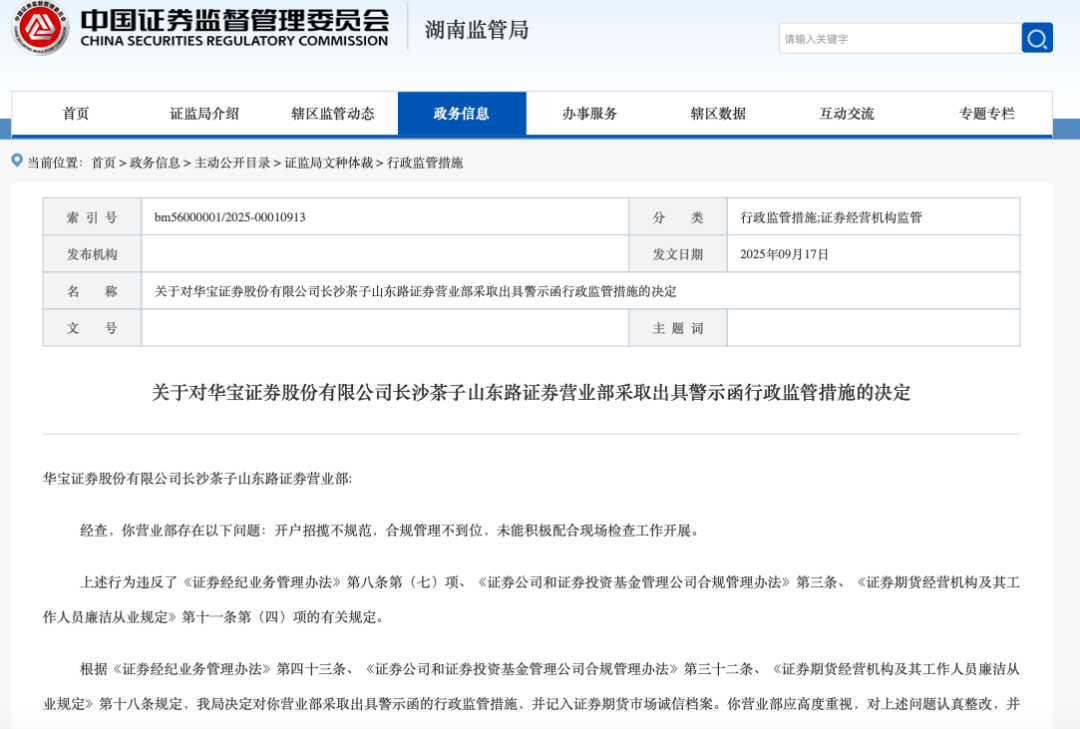
湖南证监局决定,对该营业部采取出具警示函的行政监管措施,并记入证券期货市场诚信档案。上述营 业部应高度重视,对上述问题认真整改,并于收到决定书之日起一个月内提交书面整改报告,湖南证监 局将在日常监管中持续关注整改情况。 作为营业部负责人亦"难辞其咎"。湖南证监局指出,陈叶丽作为华宝证券长沙茶子山东路证券营业部负 责人,对营业部的违规行为负有主要责任。湖南证监局决定对陈叶丽采取出具警示函的行政监管措施, 并记入证券期货市场诚信档案。 【导读】华宝证券一营业部及负责人遭警示 中国基金报记者 孙越 券商"违规揽客"再遭罚!9月17日,湖南证监局披露,华宝证券长沙茶子山东路证券营业部及相关负责 人,被采取出具警示函行政监管措施。 今年以来,A股市场交投热度持续攀升,市场整体投资氛围日益浓厚,展现出较强的市场活力。但在此 背景下,部分证券公司分支机构及所属从业人员为争夺市场份额、扩大业务规模,忽视合规经营底线, 各类违规操作现象呈现多发态势。 华宝证券一营业部及负责人遭警示 9月17日,湖南证监局披露,华宝证券长沙茶子山东路证券营业部存在开户招揽不规范,合规管理不到 位,未能积极配合现场检查工作开展等问题。 "违规揽客 ...


券商“拉客乱象”再曝光
Zhong Guo Ji Jin Bao· 2025-09-19 02:22
【导读】华宝证券一营业部及负责人遭警示 券商"违规揽客"再遭罚!9月17日,湖南证监局披露,华宝证券长沙茶子山东路证券营业部及相关负责人,被采取出具警示函行政监管措施。 今年以来,A股市场交投热度持续攀升,市场整体投资氛围日益浓厚,展现出较强的市场活力。但在此背景下,部分证券公司分支机构及所属从业人员为 争夺市场份额、扩大业务规模,忽视合规经营底线,各类违规操作现象呈现多发态势。 华宝证券一营业部及负责人遭警示 9月17日,湖南证监局披露,华宝证券长沙茶子山东路证券营业部存在开户招揽不规范,合规管理不到位,未能积极配合现场检查工作开展等问题。 湖南证监局决定,对该营业部采取出具警示函的行政监管措施,并记入证券期货市场诚信档案。上述营业部应高度重视,对上述问题认真整改,并于收到 决定书之日起一个月内提交书面整改报告,湖南证监局将在日常监管中持续关注整改情况。 作为营业部负责人亦"难辞其咎"。湖南证监局指出,陈叶丽作为华宝证券长沙茶子山东路证券营业部负责人,对营业部的违规行为负有主要责任。湖南证 监局决定对陈叶丽采取出具警示函的行政监管措施,并记入证券期货市场诚信档案。 | 中国正秀监督管理委员会 CHINA S ...
从“人海战术”走向“人机协同” AI升级券商财富管理业务价值链
Zheng Quan Shi Bao· 2025-09-18 21:48
Core Insights - The integration of artificial intelligence (AI) in the wealth management sector of brokerage firms is transforming operations from traditional human-driven methods to intelligent, data-driven approaches [1][7][8] - AI applications are being deployed across various functions, including customer engagement, investment advisory, trading execution, and operational management, leading to enhanced efficiency and competitive advantages [1][4][7] Group 1: AI Product Development - Brokerage firms are continuously launching new AI products, enhancing their wealth management services with features like AI-driven investment assistants and trading tools [2][3] - Notable examples include Guangfa Securities' AI-native upgrade of its "Yitaojin APP" and the introduction of comprehensive AI services by firms like Guotai Junan and Dongxing Securities [2][3] Group 2: Operational Efficiency - AI is being utilized to streamline operations, such as automating customer service and improving response times through intelligent platforms [5][6] - A central brokerage firm reported a 60% reduction in operational time for institutional account openings by implementing AI-driven processes [4][6] Group 3: Market Transformation - The industry is shifting from a "people-intensive" model to one that emphasizes "human-machine collaboration," with AI playing a crucial role in decision-making and risk management [1][7] - The competitive landscape is evolving, focusing on data-driven insights and personalized financial services to meet the diverse needs of clients [7][8] Group 4: Challenges and Future Outlook - Despite the advancements, challenges remain in aligning AI capabilities with real business needs, as well as resource constraints for some brokerage firms [8] - The future of AI in the industry is expected to involve a complete restructuring of business and technology platforms, emphasizing the importance of data as a core asset [8]
A股开户热潮持续升温 又有券商营业部开户招揽不规范
Mei Ri Jing Ji Xin Wen· 2025-09-18 13:49
Core Insights - The recent warning letter from Hunan Securities Regulatory Bureau highlights compliance loopholes in the account opening process of brokerage firms, specifically citing Huabao Securities' Changsha branch for irregularities in client solicitation [1] - The surge in A-share account openings since the "9.24" market rally has led to a rise in violations, with 2.6503 million new accounts opened in August 2025, a month-on-month increase of approximately 35%, and a total of 17.2117 million new accounts in the first eight months of this year, representing a year-on-year growth of about 48% [1] Group 1: Compliance Issues in Account Opening - The most prominent issue in the account opening process this year is the superficial nature of investor suitability assessments, with some brokerage branches failing to diligently verify the necessary materials for account opening and permissions [2] - There are instances where brokerage staff assist or induce investors to bypass compliance requirements, prioritizing performance over regulatory adherence [2][3] Group 2: Misleading Practices and Violations - Typical violations include providing clients with standardized answers for account opening or investment knowledge tests and requiring clients to submit false information, undermining the authenticity and compliance of the account opening process [3] - Several brokerage firms have been found to have compliance issues not only in the account opening phase but also in client solicitation and product sales, with problems categorized as "qualification mismatches" and "role overstepping" [4] Group 3: Broader Regulatory Concerns - Non-compliant practices include unqualified personnel participating in fund sales and improper solicitation methods, such as using unauthorized third parties for client acquisition [4] - Misleading information, promises of returns, and unauthorized sales practices have been reported in the product promotion and sales phase, raising significant regulatory concerns [4][5]
【公募基金】A股市场短暂回调,重回上行趋势创年内新高——公募基金量化遴选类策略指数跟踪周报(2025.09.14)
华宝财富魔方· 2025-09-16 10:08
Core Viewpoint - The A-share equity market has experienced a brief adjustment after approaching the high point of August 2025, but has rebounded and reached a new high for the year, indicating a strong upward trend despite short-term resistance [3][4]. Market Performance - The Shanghai Composite Index has shown strong performance since June 2025, quickly breaking through multiple hundred-point levels after short-term fluctuations. The market remains active with strong capital inflow intentions after corrections, suggesting limited downside potential [3][4]. - The market is currently at a critical resistance point, and strategies should focus on gradually accumulating positions during dips, anticipating a potential upward trend after consolidation [4]. Quantitative Strategy Allocation - The preferred strategy allocation is as follows: Equity Enhancement Strategy > Overseas Equity Strategy > Evergreen Low Volatility Strategy [4]. - The Evergreen Low Volatility Fund Strategy has shown stable performance, with a return of 1.387% this week, and has maintained a low volatility characteristic, outperforming the benchmark [10][11]. - The Equity Enhancement Fund Strategy recorded a return of 1.955% this week, with potential for alpha generation as market conditions improve [6][12]. Overseas Market Insights - The U.S. stock market has been buoyed by easing tariff expectations and strong earnings reports from tech companies, with a potential new interest rate cut cycle expected to provide further momentum [5][7]. - The Overseas Equity Allocation Fund Strategy has also performed well, with a return of 0.982% this week, indicating a recovery in the U.S. market following tariff negotiations [7][10]. Fund Performance Tracking - The Evergreen Low Volatility Fund has consistently outperformed the benchmark with a year-to-date return of 13.385% [10][11]. - The Cash Enhancement Fund Strategy has achieved a return of 0.027% this week, outperforming the benchmark index [10][14]. - The Overseas Equity Allocation Fund has accumulated significant excess returns since its inception, benefiting from global technology growth [17][21].

2025年8月基金投顾投端跟踪报告:主动权益基金仓位抬升,多维弹性品种获增持
Ping An Securities· 2025-09-10 11:55
Group 1 - The total number of fund advisory portfolios on the Tian Tian Fund APP reached 454 as of the end of August 2025, an increase of 4 from the previous month, with new portfolios in consumption, pharmaceuticals, dividends, and overseas strategies [9][10][11] - The performance of the fund advisory portfolios showed that the median return of the equity-debt balanced portfolios lagged behind similar FOF products over the past year, with all types of equity-debt balanced portfolios underperforming their benchmarks in the month [17][18] - The active equity funds saw significant increases in holdings, particularly in quantitative strategies, industry rotation strategies, and growth styles, indicating a shift towards more dynamic investment approaches [41][42] Group 2 - The performance of sector-specific portfolios indicated that all sector portfolios had positive median returns over the past year, with pharmaceuticals, new energy, consumption, dividends, and state-owned enterprises outperforming their benchmarks [23][27] - The regional portfolios, particularly those focused on Hong Kong stocks, outperformed their benchmarks over the past year, while overseas strategy portfolios underperformed in the same period [22][23] - The top-performing sector portfolios this year were concentrated in pharmaceuticals and technology, with the highest returns coming from the "Pharmaceutical Hamburger" and "China's Hard Technology" portfolios [25][27] Group 3 - The tracking of fund positions revealed that the conservative advisory portfolios reduced their holdings in index funds while increasing their allocation to mixed funds, reflecting a strategic shift in asset allocation [30][32] - The balanced advisory portfolios decreased their bond fund holdings and increased their mixed fund allocations, indicating a preference for more flexible investment strategies [32][35] - The aggressive advisory portfolios also reduced their stock fund holdings while increasing their allocations to active equity funds, suggesting a trend towards more active management in pursuit of higher returns [32][35]
A股回暖 券商组团涨薪!经纪业务提成激增,人均薪酬涨30%
2 1 Shi Ji Jing Ji Bao Dao· 2025-09-04 14:28
Group 1 - The average salary of securities firms in the first half of 2025 exceeded 300,000 yuan, representing a nearly 30% increase from 237,400 yuan in the same period last year, marking the second highest level in nearly a decade, only behind 2021 [1] - Among the firms with outstanding salary performance this year, the proportion of leading securities firms is low, with smaller firms showing better compensation due to significant performance improvements [1] - Only two leading firms, Guotai Junan (422,200 yuan) and CITIC Securities (420,800 yuan), had average salaries exceeding 400,000 yuan, while other firms like Huabao Securities (506,900 yuan), Guokai Securities (413,400 yuan), and Ping An Securities (403,800 yuan) also performed well [1] Group 2 - The increase in securities firm salaries is primarily driven by a market recovery that has led to a surge in brokerage business commissions, with brokerage income nearly doubling year-on-year in the first half of the year [2] - Approximately half of the total workforce in securities firms consists of brokerage personnel, whose high elastic commission structure (with some smaller firms offering commission rates of 35%-40%) significantly boosts the average salary in the industry [2] - However, industry insiders believe that this salary fluctuation is highly cyclical and has limited sustainability [2]


券商大厂领衔涨薪!经纪业务提成激增,人均同比增30%
2 1 Shi Ji Jing Ji Bao Dao· 2025-09-04 06:43
Core Viewpoint - The securities industry is experiencing a new cycle of salary fluctuations, with average compensation for brokers significantly increasing in the first half of 2025 compared to the previous year, marking a break from the salary reduction trend since 2022 [1][2][3] Summary by Sections Salary Trends - As of September 3, 2025, the average salary for brokers reached 308,500 yuan, a nearly 30% increase from 237,400 yuan in the same period last year, the second highest level in the past decade, only behind 2021 [1][3] - The increase in salaries is particularly notable among small and medium-sized brokerages, with Guolian Minsheng leading at 972,300 yuan, while major firms like CITIC Securities and Guotai Junan maintained salaries above 400,000 yuan [2][4] Market Dynamics - The surge in broker salaries is primarily driven by a recovery in the market, leading to a significant increase in brokerage business commissions, which nearly doubled year-on-year [2][8] - Brokerage personnel constitute about half of the total workforce in many firms, meaning their income increases have a substantial impact on overall average salaries [8][10] Salary Distribution - In the first half of 2025, six brokerages reported average salaries exceeding 400,000 yuan, with only two being major firms [4][5] - A total of 20 brokerages had average salaries above 300,000 yuan, a significant increase from previous years [5] Individual Brokerage Performance - Notably, Guolian Minsheng's average salary of 972,300 yuan is a significant rise from its previous lower rankings, indicating a shift in performance and compensation structure [3][4] - Other firms like Huabao Securities and Guokai Securities also reported substantial increases in average salaries, reflecting improved performance [4][9] Future Outlook - Despite the impressive short-term salary data, the salary increases are viewed as cyclical and may not be sustainable in the long term due to ongoing salary cap policies being implemented by state-owned brokerages [2][10] - The current salary management trend in the securities industry remains cautious and prudent, with a focus on maintaining stability [2][10]
【公募基金】市场高位小幅回调整固,不改上行趋势——公募基金量化遴选类策略指数跟踪周报(2025.08.31)
华宝财富魔方· 2025-09-02 09:22
Core Viewpoint - The A-share equity market is experiencing high-level fluctuations, with the Shanghai Composite Index showing a 0.84% increase this week, indicating a resilient market despite short-term adjustments [3][4]. Group 1: Market Performance - The A-share market remains strong, with the Shanghai Composite Index quickly rebounding after a brief correction near the 3900-point mark [3]. - The domestic equity fund strategy index also recorded gains this week, with low-volatility strategies underperforming in terms of excess returns [3][4]. Group 2: Fund Strategy Insights - The preferred fund strategies are ranked as follows: stock-enhanced strategies > overseas equity strategies > evergreen low-volatility strategies [4]. - The stock-enhanced fund strategy achieved a return of 1.389% this week, while the evergreen low-volatility strategy recorded a return of 1.249% [5]. - The cash-enhanced fund strategy outperformed the benchmark with a return of 0.027%, accumulating a total excess return of 0.481% since its inception [5]. Group 3: Overseas Market Dynamics - The overseas equity allocation fund strategy recorded a return of 0.329% this week, with a focus on the recovery of the U.S. stock market following tariff negotiations and strong earnings reports from tech companies [6]. - The U.S. economy shows no significant signs of recession, and the ongoing technological advancements are expected to drive future growth in the U.S. stock market [6]. Group 4: Fund Composition and Strategy - The evergreen low-volatility fund strategy has demonstrated strong stability and lower volatility compared to the benchmark, making it suitable for risk-averse investors [9]. - The stock-enhanced fund strategy aims to identify funds with strong alpha generation capabilities, which may yield excess returns as market conditions improve [10][21]. - The cash-enhanced fund strategy focuses on selecting high-yield money market funds to optimize short-term cash management [12][22]. - The overseas equity allocation fund strategy utilizes momentum and reversal indicators to select international equity indices for investment, enhancing global diversification [15][23].