
基金投顾组合

Search documents
节前最后一周,你需要知道的五件大事
表舅是养基大户· 2026-02-08 13:33
Group 1 - The article discusses the significant rebound in global markets, particularly in precious metals like gold and silver, and cryptocurrencies such as Bitcoin, following a liquidity shock caused by the announcement of the new Federal Reserve chairperson [5][14]. - Silver has shown extreme volatility, with two instances of over 20% single-day declines in the past six trading days, followed by a rebound of over 21% from its low point [5][10]. - The article emphasizes the importance of long-term value in asset allocation, particularly highlighting gold as a stable investment choice for ordinary investors due to its clearer underlying logic and lower volatility [10][12]. Group 2 - The article notes a significant rebound in U.S. and Chinese stocks, with major indices like the Nasdaq and S&P 500 rising around 2%, and the Dow Jones reaching a historical high [15][16]. - Concerns remain regarding the capital expenditures of major tech companies, which have been a source of market anxiety, particularly in relation to their ability to generate sufficient returns [21][29]. - The article highlights the competitive landscape among internet giants in Hong Kong, with Alibaba and Tencent engaging in aggressive promotional activities, raising concerns about their spending and market positioning [25][26]. Group 3 - The article suggests that the upcoming Chinese New Year may lead to a surge in tourism, indicating potential investment opportunities in the service consumption sector [39][46]. - It mentions the increasing popularity of certain travel destinations during the holiday season, emphasizing the need for investors to focus on structural opportunities within the consumption sector [46][47]. - The article advises investors to monitor the recovery of consumer spending relative to pre-pandemic levels, particularly in terms of average transaction values [46].


2025年12月基金投顾投端跟踪报告:投顾组合调仓频率抬升,黄金和有色金属ETF受青睐
Ping An Securities· 2026-01-15 09:32
Group 1 - The total number of fund advisory portfolios on the Tian Tian Fund APP reached 476 by the end of December 2025, an increase of 7 from the previous month, including new balanced, aggressive, and conservative portfolios, as well as thematic portfolios focused on technology and dividends [2][8] - The distribution of fund advisory portfolios includes 417 in the stock-bond central type, 38 in the track type, and 21 in the regional type, with stock-bond central type portfolios being the most dominant [8][12] - The performance of the stock-bond central type portfolios showed that the median return of aggressive portfolios outperformed similar FOF products over the past year, while balanced and conservative portfolios underperformed [18][19] Group 2 - The performance of track type portfolios indicated that all track portfolios had positive median returns over the past year, with military, smart manufacturing, medical, consumer, dividend, and central state-owned enterprise portfolios outperforming their benchmarks [25][29] - The regional type portfolios showed that the Hong Kong strategy portfolio outperformed its benchmark over the past year, while overseas strategy portfolios underperformed [25][29] - The aggressive type portfolio with the highest return since 2025 was "Anxin Jijin 90" from Guolian Securities, achieving a return of 52.50% [22][29] Group 3 - The tracking of fund positions revealed that the conservative portfolio reduced its allocation to index funds while increasing its allocation to QDII funds, with QDII fund average positions rising by 0.67% [34][37] - The balanced portfolio decreased its allocation to mixed funds and increased its allocation to index funds, with index fund average positions increasing by 1.58% [34][37] - The aggressive portfolio reduced its allocation to equity funds and increased its allocation to mixed funds, with mixed fund average positions rising by 0.68% [34][37] Group 4 - The most favored active equity funds by the advisory portfolios included those managed by Chen Yunzong (growth style), Lan Xiaokang (dividend strategy), and Wu Guoqing (cyclical theme), which saw significant increases in holdings [43][48] - The most favored QDII funds included "Southern Asian Dollar Bond A RMB" and "E Fund Global Quality Enterprise A," which received notable increases in allocations [44][48] - The most favored passive index funds included "Oriental Red CSI Oriental Red Dividend Low Volatility A" and "Southern CSI Shenwan Nonferrous Metals ETF," which were also significantly increased in holdings [49][50]
2025年11月基金投顾投端跟踪报告:平衡型、进取型组合调减QDII仓位,周期产品获增持
Ping An Securities· 2025-12-16 08:57
Report Industry Investment Rating No relevant information provided. Report Core View - As of the end of November 2025, there were 469 fund investment advisor portfolios on the Tiantian Fund APP, an increase of 4 from the end of the previous month. Among them, there were 2 new balanced, 1 new aggressive, and 1 new consumer-themed portfolio [2][8]. - In terms of performance, over the past year, the median returns of aggressive and balanced portfolios outperformed similar FOF products, while the median return of the stable portfolio underperformed. In November, the median returns of aggressive, balanced, and stable portfolios outperformed both similar FOF products and their benchmarks. Among the track-type portfolios, only the gold track had a positive median return in November. For the regional portfolios, both the Hong Kong stock strategy and overseas strategy portfolios had median returns that underperformed their benchmarks in November [2][17][24]. - Regarding position changes, stable portfolios reduced bond funds and increased QDII funds; balanced portfolios reduced bond funds and increased money market funds; aggressive portfolios reduced hybrid funds and increased QDII funds. In terms of individual fund positions, consumer-themed, small-cap strategy, and real estate-themed funds were significantly increased [2][33][42]. - In November 2025, there were 91 portfolio adjustments, an increase of 1 from the previous month. Stable portfolios increased commodity funds and reduced active bond funds; balanced portfolios increased fixed-income + funds and reduced QDII funds; aggressive portfolios increased passive equity funds and reduced QDII funds [2][65]. Summary by Directory Fund Investment Advisor Portfolio Overall Situation - **Portfolio Structure**: As of the end of November 2025, there were 412 stock-bond central, 36 track-type, and 21 regional investment advisor portfolios. The number of stock-bond central portfolios dominated, with the aggressive type being the most numerous among them. Track-type portfolios were concentrated in growth industries, and regional portfolios mainly targeted global overseas markets including Hong Kong and US stocks [8]. - **Investment Advisor Institution Distribution**: Institutions such as Huabao Securities, Guolian Securities, Southern Fund, and Zhongou Fortune had a relatively large number of portfolios on the platform. The top ten institutions accounted for 66% of the total. Most of the portfolios were established between February and May 2022, with 2 new portfolios launched in November 2025 [12]. Investment Advisor Portfolio Performance Tracking - **Stock-Bond Central Investment Advisor Portfolio Performance**: Over the past year, the median returns of aggressive and balanced portfolios outperformed similar FOF products, while the stable portfolio underperformed. In November, all three types outperformed similar FOF products. Compared with the benchmark, the median returns of aggressive portfolios underperformed the benchmark over the past year, while the other three types outperformed. In November, all three types outperformed the benchmark. The Anxin Aggressive 90 of Guolian Securities, Taoli Buyan of Guolian Securities, and Shendu Stable of Shenwan Hongyuan Fund had the highest returns this year. The Huaxia All-Weather Multi-Aggressive Allocation of Huaxia Fortune, Zhongou Multi-All-Weather of Zhongou Fortune, and China Merchants Spare Money Best of China Merchants Fund had the highest Sharpe ratios this year [16][17][21]. - **Track-Type and Regional Investment Advisor Portfolio Performance**: Over the past year, all track-type portfolios had positive median returns, with most outperforming the benchmark except for the intelligent manufacturing and gold tracks. In November, only the gold track had a positive median return, and several tracks outperformed the benchmark. For regional portfolios, the Hong Kong stock strategy portfolio outperformed the benchmark over the past year, while both the Hong Kong stock strategy and overseas strategy portfolios underperformed in November. The top-performing track-type portfolios this year were mainly in the medical and technology sectors, and the top-performing regional portfolios were mainly in the Hong Kong stock strategy, with some overseas strategy portfolios also performing well [23][24][28]. Investment Advisor Portfolio Position Adjustment Tracking - **Holding Fund Position Change Tracking**: When analyzing the position changes of 449 portfolios, stable portfolios decreased bond funds and increased QDII funds; balanced portfolios decreased bond funds and increased money market funds; aggressive portfolios decreased hybrid funds and increased QDII funds. Among the 77 portfolios that disclosed individual fund positions, stable portfolios decreased active bond funds and increased fixed-income + funds; balanced portfolios decreased active bond funds and increased money market funds; aggressive portfolios decreased quantitative funds and increased passive equity funds [33][36]. - **Investment Advisor Portfolio Individual Fund Holding Tracking**: - **Active Equity Funds**: Value-style, quantitative strategy, dividend strategy, and technology-themed fund managers were favored. Consumer-themed, small-cap strategy, and real estate-themed funds were significantly increased [38][42]. - **QDII Funds**: Products such as Southern Asia US Dollar Bond A RMB, Huaxia Hang Seng Technology ETF Link A, and Tianhong S&P 500 A were favored. Global allocation products like Huatai-PineBridge Global Medical RMB and China Merchants Pusu Global Allocation A, as well as products tracking the Hang Seng Technology Index in the Hong Kong market, were significantly increased [43][47]. - **Passive Index Funds**: Dividend low-volatility strategy index funds and industry index funds such as Hong Kong Stock Connect Internet, gold stocks, liquor, and chemicals were favored. Industry-themed index products such as banks, coal, and gold stocks were significantly increased [49][52]. - **Fixed-Income + Funds**: Products such as Invesco Great Wall Jingyi Double Dividend, Zhongou Jintong, and Yongying Stable Enhancement were favored. Products such as China Merchants Anben Zengli and Huatai-PineBridge Zunli were significantly increased [54][57]. - **Active Bond Funds**: Products managed by fund managers such as Wang Xiaochen, Wang Shuai, Fang Chang, Song Qianqian, and Ji Lingyun were favored. Products such as Zhongou Pure Bond and Fullgoal Short Bond were significantly increased [59][62]. - **Fund Investment Advisor Position Adjustment Situation Tracking**: In November 2025, there were 91 portfolio adjustments, mainly in aggressive and stable portfolios. Stable portfolios increased commodity funds and reduced active bond funds; balanced portfolios increased fixed-income + funds and reduced QDII funds; aggressive portfolios increased passive equity funds and reduced QDII funds. A total of 13 funds had a net increase of 5 or more investment advisor portfolios, including 3 active equity funds, 4 passive equity funds, 2 active bond funds, 3 QDII funds, and 1 commodity fund [65][70].

提升A股配置 基金“专业买手”布局跨年行情
Shang Hai Zheng Quan Bao· 2025-12-10 17:57
Group 1 - The core viewpoint is that despite increased volatility in the A-share market in November, fund advisors are increasing their allocation to A-share assets, indicating a preparation for the year-end market rally [1] - In November, 131 fund advisor portfolios adjusted their allocations, with A-share assets receiving the largest increase compared to other asset types, as many fund managers begin to position for the year-end market trend [1] - The "year-end market rally" typically occurs from November to March, driven by positive expectations for policies, economy, and earnings for the following year, with historical data suggesting a high probability of such rallies [1] Group 2 - The Yingmi Fund's strategy for December indicates that the market is preparing for a spring rally in 2026, with a neutral short-term allocation value for domestic stocks but a potential for medium to long-term recovery [2] - Industry consensus suggests that despite short-term volatility in A-shares, declines present better buying opportunities, with optimism regarding overseas risk appetite and domestic liquidity expectations [2] Group 3 - Fund advisors are accelerating their adjustment pace, with cyclical industries such as coal, electric equipment, basic chemicals, and food and beverage receiving increased allocations in November, while some technology assets saw reduced allocations [3] - In December, fund advisors are refocusing on technology growth assets, anticipating early market speculation on improving economic conditions for the coming year [3] - Specific fund portfolios, such as Wanji Fund's "Wanji Extraordinary New Quality Drive," increased their mixed fund allocation from 54.6% to 64.1%, optimizing holdings in AI computing and innovative pharmaceuticals [3] Group 4 - Recent positive signals in the broader technology sector include improvements in lithium battery supply and sustained high demand in the optical module industry, which are areas of mid-term focus [4] - However, short-term trading in popular areas like AI computing chips and energy storage remains crowded, requiring time for market digestion, while lower-crowded areas like AI applications and robotics lack incremental funding and fundamental catalysts [4]
大跌之后的几条建议
表舅是养基大户· 2025-11-18 13:33
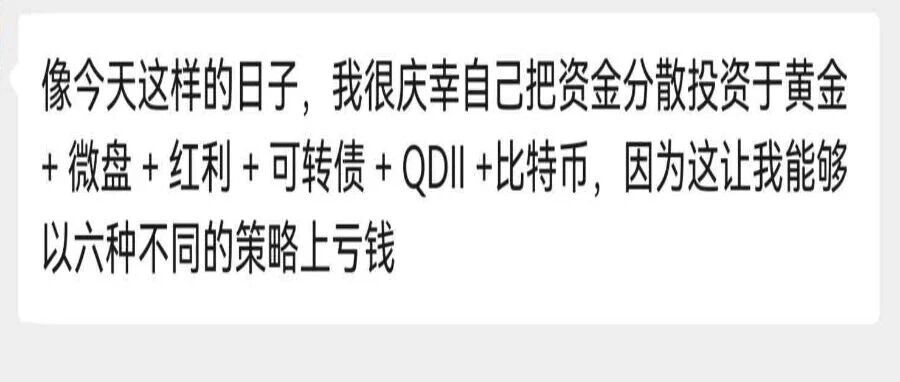
Group 1 - The article discusses the recent global market downturn, highlighting a liquidity shock that has led to a collective decline in various asset classes, including global stocks, cryptocurrencies, and gold, with the Asia-Pacific region experiencing the largest drop of over 3% in Japan and South Korea [4][8]. - It emphasizes the importance of maintaining core positions in quality equity investments, particularly in a low-interest-rate environment, and suggests that the main investment themes remain unchanged despite market fluctuations [7][10]. - The article advises investors to lower their expectations and set realistic benchmarks for returns, suggesting that the focus should be on long-term investment in quality companies rather than short-term gains [13][15]. Group 2 - The article highlights the need for investors to avoid crowded trades and to be cautious about entering popular sectors unless they have a deep understanding of industry trends, using examples from the lithium battery sector and the banking sector to illustrate the risks of chasing hot stocks [17][22]. - It advocates for dynamic portfolio balancing and the acquisition of undervalued assets, suggesting that investors should assess their holdings and consider diversifying across different sectors and regions to mitigate risks [24][27]. - The article mentions the performance of the Hong Kong stock market, noting the impact of significant capital raises on valuations and the mixed results from companies like Xiaomi, which reported a 20% year-on-year revenue increase but faces concerns about sustaining growth in its automotive business [34].
基金产品类型及优劣分析
Sou Hu Cai Jing· 2025-11-16 15:47
Group 1 - The article discusses the phenomenon of "fund nesting," particularly focusing on FOF (Fund of Funds) and advisory fund combinations, both of which invest in a basket of funds often managed by the same team [1] - The author expresses a preference for advisory fund combinations over FOFs, noting that both have peculiar developmental forms at present, with FOFs relying on a single channel and advisory combinations depending on traffic, resulting in poor performance for both [1] - The article highlights that ETF-linked funds are a special type of FOF, primarily targeting ETFs, and suggests that on-exchange ETFs have advantages due to higher positions, better trading efficiency, and lower costs [1] Group 2 - The article mentions a product called "拼好基," which combines equity and fixed-income fund managers to create "fixed income +" funds, but practical experience shows that simply combining excellent managers' holdings does not guarantee success, as volatility and drawdown control must also be considered [1]

广发基金投顾团队:四季度美元流动性有望保持宽松,建议以多元配置把握全球机遇
Zhong Zheng Wang· 2025-11-11 03:25
Group 1 - The core viewpoint is that the liquidity environment in the US is expected to remain loose, with the Federal Reserve's recent rate cuts being more preventive than indicative of an economic downturn [1] - The team holds a cautiously optimistic view on US stocks, noting that while liquidity is favorable, current valuations are relatively high [1] - The performance of US stocks in the first three quarters of the year has been strong, driven by optimism around corporate earnings, particularly in the context of the AI wave [1] Group 2 - In emerging markets, a weak dollar combined with ample liquidity typically benefits asset performance, making these markets more attractive to global investors [2] - The team has begun to focus on the value of emerging market allocations since April 2025, increasing related investments in various advisory portfolios [2] - A diversified asset allocation strategy is recommended for investors preferring a more stable approach, as many assets are entering overvalued territory [2]
4000点拉锯战 广发基金投顾团队:市场资金结构呈现新变化
Zhong Zheng Wang· 2025-10-31 11:24
Group 1 - The A-share market has reached a significant milestone with the Shanghai Composite Index closing above 4000 points, marking the highest level since August 18, 2015 [1] - The market rally since September 24 has been primarily driven by several types of funds, including broad-based ETFs and margin financing, with active equity public funds and non-broad-based ETFs focusing on industry sectors playing a key role since July [1] - Institutional investors show a preference for cyclical and large financial sectors, while individual investors are more focused on the consumer sector; both groups are interested in gold and chips, with institutions also favoring military and dividend-related sectors, while individuals lean towards pharmaceuticals and securities [1] Group 2 - The current growth rate of household deposits has not significantly declined, indicating that while there is an emerging willingness among residents to invest, large-scale market entry has not yet commenced, suggesting that the entry of residents is still in the early stages [2] - There has been a notable shift in foreign capital flows since July, with a slowdown in active foreign capital outflows and a significant net inflow of passive foreign capital, driven by the attractiveness of China's emerging industries and competitive valuations in the global market [2] - The market is characterized by a steady allocation from institutional investors, gradual participation from individual investors, and improved inflow dynamics from overseas investors, highlighting the importance of monitoring individual investor participation, domestic policy implementation, and foreign capital flows for potential structural investment opportunities [2]
本土优势成胜势!红塔证券打造普惠金融特色范式
券商中国· 2025-10-17 01:14
Core Viewpoint - The article emphasizes the role of the securities industry in promoting inclusive finance, particularly in reaching new citizens and minority regions, showcasing the innovative practices of Hongta Securities in this regard [2][3][7]. Group 1: Service to New Citizens - The expansion of the "new citizen" demographic, particularly in regions like Yunnan, presents a significant opportunity for financial institutions to enhance their service capabilities [3]. - Hongta Securities identifies the approximately 300 million farmers transitioning to urban life as a key growth area, shifting its focus from high-net-worth clients to middle-class, working-class, and new citizen demographics [3]. - The firm is transitioning from a "sell-side" to a "buy-side advisory" model, prioritizing client interests over product sales, with performance metrics now centered on client asset size and satisfaction [3][4]. Group 2: Financial Education Initiatives - Hongta Securities addresses the challenges of financial literacy in minority regions by providing education in local languages, thereby breaking down barriers to understanding financial concepts [5][6]. - The company has developed bilingual educational materials, such as a dual-language picture book on securities law, to cater to the needs of local populations [6]. - The focus on practical financial education aims to empower local communities and mitigate risks associated with financial fraud [5][6]. Group 3: Local Advantages and Trust Building - Hongta Securities leverages its local knowledge and understanding of the economic context to create tailored financial products and services for regional investors [7]. - The firm emphasizes a "teach to fish" approach to build trust and enhance financial literacy among investors in Yunnan, where traditional sales methods have proven ineffective [8]. - By integrating local data and experiences into its service offerings, Hongta Securities fosters a positive feedback loop that benefits both its investment and wealth management divisions [7].


淬炼四大本土优势成胜势 红塔证券打造普惠金融特色范式
Zheng Quan Shi Bao· 2025-10-16 18:39
Core Viewpoint - The article discusses how Hongta Securities is exploring inclusive financial practices tailored to the characteristics of border areas, focusing on serving "new citizens" and ethnic minority regions through various innovative strategies [1][2]. Group 1: Service Transformation - Hongta Securities views the approximately 300 million farmers transitioning to urban citizens as a significant growth opportunity, shifting its wealth management services from high-net-worth clients to a broader demographic including middle-class, working-class, and new citizens [2][3]. - The company is transitioning its business model from a "sell-side" approach to a "buy-side advisory" model, centering on client interests rather than product sales, with performance metrics now focusing on client asset size (AUM), retention rates, and satisfaction [2][3]. Group 2: Product Accessibility - Hongta Securities offers low-threshold investment products, such as fund advisory combinations starting from 1,000 yuan and stable strategy products, designed to lower the barriers for investor participation and enhance financial service accessibility [3]. Group 3: Investor Education - The company addresses the challenges of financial literacy in ethnic minority regions by providing education in local languages, recognizing the barriers posed by language and cultural differences [4][5]. - Hongta Securities has created bilingual educational materials, such as the first bilingual investment education picture book in Chinese and Dai, to cater to the needs of local populations [5][6]. Group 4: Local Advantages - The company's success in implementing inclusive finance is attributed to four key advantages: a deep understanding of the local economic context, a trust-building education system, enhanced local data application, and the digitization and productization of regional experiences [7][8]. - Hongta Securities leverages its geographical advantages and extensive involvement in local economic development to gain insights into local industry dynamics, funding needs, and risk characteristics, which informs its wealth management strategies [7].
