
强脑科技

Search documents
岩山科技(002195.SZ):公司未与强脑科技展开合作
Ge Long Hui· 2026-01-14 07:23
格隆汇1月14日丨岩山科技(002195.SZ)在投资者互动平台表示,公司未与强脑科技展开合作。 ...

国产脑机接口有望跃升发展,挖掘机行业温和复苏
Tebon Securities· 2026-01-14 07:10
Group 1: Healthcare Sector - The domestic brain-computer interface (BCI) market is expected to maintain double-digit growth, with a projected market size of 3.83 billion yuan in 2025, reflecting a 20% year-on-year increase [3][11] - The global BCI market is anticipated to reach 2.93 billion USD in 2025, marking a 12% year-on-year growth [3][11] - The Chinese government has introduced several significant policies since 2025 to support the development of BCIs in the medical field, including the inclusion of BCIs in medical insurance [11][12] - As of December 2025, there have been 24 financing rounds in the domestic BCI sector, totaling over 5 billion yuan, with a record single financing of 350 million yuan in February 2025 [3][15] Group 2: High-end Manufacturing Sector - The excavator market in China showed a mild recovery, with total sales of 23,095 units in December 2025, representing a 19.2% year-on-year increase [22][23] - For the entire year of 2025, excavator sales reached 235,257 units, up 17% from the previous year, with domestic sales increasing by 17.9% and exports by 16.1% [22][24] - The adjustment of export tax rebates for photovoltaic products is expected to accelerate industry clearing and benefit product price recovery [27][28] Group 3: Market Overview - The A-share market experienced a general increase, with the Shanghai Composite Index rising by 3.82% during the week of January 5-9, 2026 [29][30] - The average daily trading volume in the market was 2.85 trillion yuan, showing an increase compared to the previous week [29][30] - The performance of various sectors was mixed, with growth and cyclical sectors leading the gains, while some sectors like banking and transportation lagged behind [30][36]
强脑科技冲刺港股IPO!医疗设备ETF(159873)标的指数昨日逆市收涨超1%,创新药ETF天弘(517380)连续6日“吸金”2.64亿元
Xin Lang Cai Jing· 2026-01-14 02:03
Core Insights - The medical device ETF (159873) has shown strong trading activity with a turnover of 26.84% and a transaction volume of 36.34 million yuan, while the underlying index, the CSI All Share Healthcare Equipment and Services Index (H30178), increased by 1.09% [1] - The innovative drug ETF Tianhong (517380) also performed well, with a turnover of 5.36% and a transaction volume of 95.97 million yuan, tracking the Hang Seng Shanghai-Shenzhen-Hong Kong Innovative Drug Select 50 Index (HSSSHID), which rose by 2.21% [1] - Both ETFs reached new highs in terms of scale and shares as of January 13, 2026, with the medical device ETF achieving a record scale and share, while the innovative drug ETF reached a scale of 1.807 billion yuan and 2.162 billion shares [2][3] Fund Flows - The medical device ETF (159873) has seen a net inflow of 26.50 million yuan over the past four days [1] - The innovative drug ETF Tianhong (517380) experienced a net inflow of 264 million yuan over the last six days [3] Product Highlights - The medical device ETF (159873) has a high concentration in brain-computer interface technology, accounting for over 19%, with nearly 80% of its components from the Sci-Tech Innovation Board and the Growth Enterprise Market [4] - The innovative drug ETF Tianhong (517380) targets opportunities in the innovative drug sector, benefiting from the concentration of top component stocks like WuXi AppTec and Hengrui Medicine, alongside the growth in BD transactions and breakthroughs in AI drug development [4] Industry Events - Qiangnao Technology, a brain-computer interface company, has submitted a confidential IPO application for listing on the Hong Kong Stock Exchange, potentially becoming the first listed company in China's brain-computer interface sector [4] - The company has completed approximately 2 billion yuan in financing, marking the second-largest financing event globally in the brain-computer interface field, excluding Neuralink [4][5] Institutional Perspectives - Analysts from Changcheng Guorui Securities view brain-computer interfaces as a forward-looking direction under the 14th Five-Year Plan, with several recommended industry standards being established to promote technological standardization and clinical registration processes [5]

早参|AI医疗应用延续强势!医疗器械ETF(562600)四连阳,迪安诊断大涨11.9%
Sou Hu Cai Jing· 2026-01-14 01:53
Group 1 - The A-share market experienced overall fluctuations on January 13, with the medical device ETF (562600) rising by 1.05%, marking its fourth consecutive day of gains [1] - AI medical applications continued to show strength, with notable stock increases: Tianzhihang up 16.62%, Dian Diagnostics up 11.9%, Berry Genomics up 9.97%, and Jiukang Bio up 9.41% [1] - The trading volume of the medical device ETF (562600) reached 66.1453 million yuan, indicating a significant increase in trading activity [1] Group 2 - The brain-computer interface industry in China is emerging as a trillion-yuan ecosystem, with the medical device ETF (562600) tracking the CSI Medical Device Index, which has a 23.8% allocation to brain-computer interfaces, the highest among listed ETFs [2] - The medical device sector constitutes 89.2% of the ETF, highlighting its concentrated focus and ability to capture growth opportunities in niche markets [2] - Investors can also consider the Huaxia CSI Medical Device ETF Initiated Link A (021250) and Huaxia CSI Medical Device ETF Initiated Link C (021251) for convenient investment options [2]

融资狂揽20亿元后 强脑科技冲击港股IPO
Mei Ri Shang Bao· 2026-01-13 22:20
Group 1 - Zhejiang Qiangnao Technology Co., Ltd. has secretly submitted an IPO application in Hong Kong, aiming to raise several hundred million dollars [1][2] - The company recently completed a financing round of approximately 2 billion RMB, making it the second-largest single financing in the global brain-computer interface sector, following Neuralink [1][2] - The financing attracted participation from notable investors including IDG, Huaden International, and leading manufacturing companies, indicating strong market expectations for the commercialization of non-invasive brain-computer interfaces [1][2] Group 2 - Qiangnao Technology aims to help 1 million physically disabled individuals regain daily life through neural-controlled prosthetics within the next five to ten years [2] - The company plans to use the funds raised from the IPO to accelerate core technology research and development, engineering breakthroughs, and product scaling [1][2] - The involvement of major manufacturing and technology firms in the financing round suggests a collaborative effort to enhance hardware production capabilities and core component synergies [2][3] Group 3 - The brain-computer interface sector is experiencing significant growth, with a projected global market size of $12.4 billion by 2034 and a Chinese market size of 6.14 billion RMB by 2028 [6] - Recent positive developments in the sector, including the establishment of industry standards and participation in major medical investment conferences, have energized the market [4] - Brain-computer interface concept stocks have shown strong performance, with several companies experiencing significant stock price increases [4][5]
强脑科技递表 脑机接口量产在即?
Bei Jing Shang Bao· 2026-01-13 15:45
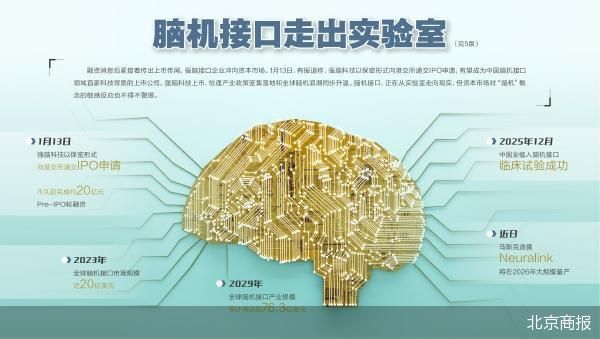
Core Insights - Strong Brain Technology has reportedly submitted a confidential IPO application to the Hong Kong Stock Exchange, positioning itself as the first technology-based public company in China's brain-computer interface (BCI) sector [1][3] - The company recently completed approximately 2 billion yuan in Pre-IPO financing, achieving a post-investment valuation exceeding 1.3 billion USD [1][3] - The global brain-computer interface market is projected to grow from 1.2 billion USD in 2019 to nearly 2 billion USD in 2023, with a compound annual growth rate (CAGR) exceeding 13% [6] Company Developments - Strong Brain Technology aims to assist 1 million physically disabled individuals by providing neural-controlled prosthetics and improve the lives of 10 million patients suffering from brain-related disorders over the next five to ten years [3] - The company is focused on non-invasive solutions, developing super sensors to detect human neural signals, differentiating itself from competitors like Neuralink [3] - In 2025, the company plans to accelerate its technology innovation and industrialization processes, launching a new generation of bionic dexterous hands for smart manufacturing applications [4] Market Trends - The brain-computer interface sector has been included in China's "14th Five-Year Plan" as one of the six future industries, indicating its transition from laboratory research to a national strategic focus [6] - Following the announcement of BCI-related developments, several companies in the sector, such as Innovation Medical and Rock Mountain Technology, experienced significant stock price movements, highlighting market sensitivity to BCI concepts [6][7] - The capital market's reaction has been mixed, with some companies facing scrutiny from regulatory bodies regarding their BCI-related announcements [6][7]
脑机接口走出实验室,强脑科技递表港交所
Bei Jing Shang Bao· 2026-01-13 12:15
Group 1 - Strong Brain Technology has submitted a confidential IPO application to the Hong Kong Stock Exchange, with expectations that its listing is only a matter of time [2] - The company recently completed approximately 2 billion yuan in Pre-IPO financing, achieving a post-investment valuation of over 1.3 billion USD [2] - The global brain-computer interface (BCI) market is experiencing significant growth, with a compound annual growth rate (CAGR) of over 13% from 2019 to 2023, and is projected to reach 7.63 billion USD by 2029 [4] Group 2 - The funds raised from the recent financing will be used to accelerate core technology research and development, extreme engineering breakthroughs, and product scaling [3] - Strong Brain Technology aims to help 1 million physically disabled individuals regain daily life through neural-controlled prosthetics and improve the conditions of 10 million patients suffering from brain-related disorders [3] - The company differentiates itself from competitors like Neuralink by focusing on non-invasive solutions and developing super sensors to detect human neural signals [4] Group 3 - The Chinese government has included brain-computer interfaces in its national strategic planning, indicating a shift from laboratory research to a national priority [4] - The stock market has reacted to the BCI concept, with companies like Innovation Medical and Rock Mountain Technology experiencing consecutive trading gains [4] - Recent inquiries from the Shanghai Stock Exchange regarding partnerships in the BCI space highlight the regulatory scrutiny and market interest surrounding this technology [5]
杭州六小龙,排队IPO
混沌学园· 2026-01-13 12:01
Core Viewpoint - The article discusses the current status and future prospects of the "Hangzhou Six Little Dragons," a group of six technology companies that have gained significant attention and are now preparing for IPOs amidst intense competition and market pressures [2][3][4]. Group 1: Company Status and IPO Progress - Four out of the six companies are preparing for IPOs: Yushu Technology, Qunhe Technology, Yundong Technology, and Qiangnao Technology [2][8]. - Yushu Technology has achieved annual revenue exceeding 1 billion yuan and has been profitable for five consecutive years, with a significant order volume [13][14]. - Qiangnao Technology recently completed a financing round of approximately 2 billion yuan, positioning itself as a leading player in the brain-computer interface sector [10][11]. - Yundong Technology has seen its revenue double in 2024 and is also preparing for an IPO [16][17]. - Qunhe Technology has established itself as a leader in the space design software market, with a significant market share and a stable revenue model [18][38]. Group 2: Financial Performance and Market Position - Game Science has generated over 9 billion yuan in revenue from its flagship game, demonstrating strong cash flow and market demand [19][20]. - DeepSeek, the parent company of DeepSeek, reported a revenue of 5 billion yuan, showcasing its financial strength and market potential [22]. - Yushu Technology's competitive pricing strategy has contributed to its leading market share in the quadruped robot segment, with over 60% of the global market [45][46]. - Qiangnao Technology aims to make advanced prosthetics affordable, significantly reducing the price of its products compared to imported alternatives [56]. Group 3: Innovations and Product Developments - Game Science is expanding its IP commercialization efforts, launching new products and establishing a flagship store to enhance brand presence [20][27]. - DeepSeek has introduced innovative models that improve efficiency in AI training and inference, positioning itself as a cost-effective solution in the AI landscape [29][33]. - Qunhe Technology has developed spatial language models that enable direct generation of interactive 3D designs, marking a significant advancement in spatial intelligence [38][40]. - Yushu Technology has launched new robotic products, including the Unitree H2 humanoid robot, showcasing advancements in robotics technology [44][45]. Group 4: Industry Challenges and Competitive Landscape - The technology sector is experiencing intense competition, particularly in the fields of robotics and AI, with numerous new entrants emerging [58][61]. - The article highlights the need for companies to innovate continuously and adapt to market pressures to survive in a rapidly evolving industry [65]. - The competition is not only about technology but also about the ability to create sustainable business models and long-term value [65][73].

强脑科技或已秘密递交香港上市申请,与中金、瑞银合作,有望成“杭州六小龙”首家上市公司
机器人圈· 2026-01-13 09:41
Core Viewpoint - Strong Brain Technology is preparing for an IPO in Hong Kong, potentially raising hundreds of millions of dollars, collaborating with China International Capital Corporation and UBS for the issuance [1][3]. Group 1: Company Overview - Strong Brain Technology is expected to be the first company listed among the "Six Little Dragons of Hangzhou" [2]. - The company recently completed approximately 2 billion yuan in financing, marking the second-largest funding round globally in the brain-computer interface sector, following Neuralink [2]. - The investor lineup includes prominent institutions such as IDG, Huaden International, and major companies like Lens Technology and Lingyi iTech [2]. Group 2: Product and Technology - Strong Brain Technology focuses on breakthroughs in brain-computer interface technology, aiming to establish communication pathways between the brain and external devices to assist individuals with disabilities [3][5]. - The company has received FDA and CE certifications, making it one of the largest investors in brain-computer interface R&D globally [2]. - Its core product, a super sensor, can detect weak signals from the brain without invasive procedures, enabling the development of neuro-controlled prosthetics for individuals with limb disabilities [5]. Group 3: Future Prospects - The company plans to continue its focus on non-invasive brain-computer interfaces, targeting solutions for conditions such as depression and Alzheimer's disease [6]. - Strong Brain Technology aims to help 1 million individuals with limb disabilities regain mobility and assist 10 million patients suffering from brain-related conditions like Alzheimer's and autism over the next 5 to 10 years [5].

哈佛学霸创办的杭州六小龙,要IPO了
Xin Lang Cai Jing· 2026-01-13 09:38
Core Viewpoint - Qiangnao Technology is reportedly preparing for an IPO in Hong Kong, aiming to raise a significant amount of capital, following a recent financing round that set a record in the brain-computer interface sector, second only to Neuralink [1][10]. Company Overview - Qiangnao Technology is recognized as China's first unicorn in the brain-computer interface space, focusing on enabling users to control machines through thought [11][12]. - The company adopts a non-invasive approach, contrasting with Neuralink's invasive method, which involves surgical implantation of chips in the brain [12][22]. Financial Projections - Following a recent financing round, Qiangnao's valuation exceeded $1.3 billion (approximately 9.2 billion RMB), with analysts estimating a potential market capitalization of 100 billion RMB upon IPO, and possibly reaching 200-300 billion RMB under high demand [3][13]. - Revenue projections for 2025 suggest Qiangnao could surpass 800 million RMB, with a net profit of approximately 120 million RMB, indicating a year-on-year growth rate exceeding 100% [3][13]. Founder Background - The founder, Han Bicheng, is a 1987-born entrepreneur from Heilongjiang, who studied at the Korea Advanced Institute of Science and Technology and later pursued a PhD at Harvard University [14][17]. - Han's early experiences in a medical research center influenced his vision of redefining human interaction with technology through brain-computer interfaces [15][18]. Market Position and Competition - Qiangnao Technology and Neuralink are the two highest-funded companies in the global brain-computer interface sector, representing distinct technological paths and commercialization strategies [9][22]. - The company is positioned to potentially become the first among the "Hangzhou Six" to go public, leveraging a shorter review process in Hong Kong compared to A-share listings [21][22]. Vision and Future Outlook - Qiangnao has articulated a vision for brain-computer interface technology to become as transformative as electricity in the modern era, suggesting it could revolutionize various industries once fully developed [22].
