
桃李面包

Search documents
全国最“硬核”的饼干,一年3万吨,卖到上市
东京烘焙职业人· 2025-11-23 08:33
Core Viewpoint - The article discusses the success of Shandong Qingshi, a company that has dominated the calcium milk biscuit market in Shandong for over 70 years, achieving significant revenue and profit growth while maintaining a strong regional presence [3][5][6]. Company Overview - Shandong Qingshi was established in 2016, focusing on new consumption and retail sectors [2]. - The company has become a regional giant with its calcium milk biscuits, which have been a staple for three generations in Shandong [4][6]. Market Position - Qingshi holds over 80% market share in Shandong's calcium milk biscuit market, selling 31,000 tons last year, generating revenue of 526 million yuan and nearly 100 million yuan in net profit [5][11]. - The company’s revenue grew by 7.47% year-on-year, while net profit increased by 13.20%, marking a five-year high [7][11]. Product Significance - Calcium milk biscuits are considered essential nutrition for children in Shandong, comparable to milk powder, and were included in "planned supply" during their early years [8][11]. - The product has a strong cultural significance in Shandong, contributing to its widespread acceptance and consumption [10][12]. Regional Focus and Challenges - Qingshi's market penetration is nearly universal in Shandong, but it has limited presence outside the province, with less than 5% market share nationally [11]. - The company faces challenges in expanding beyond Shandong due to weak distribution networks and high brand education costs in other regions [11][12]. Competitive Landscape - The national biscuit market is dominated by larger players like Dali Foods, which reported over 20 billion yuan in revenue, significantly overshadowing Qingshi [12]. - New consumer brands are capturing younger demographics through online marketing, posing additional challenges for Qingshi in terms of brand influence and product innovation [12].

一周上新!菽麦谷屋、方炉面包、Puddingpapa...海内外新品资讯抢先看 | 全球职人情报站
东京烘焙职业人· 2025-11-23 08:33
Group 1 - The article highlights the emergence of new bakery products and trends in the industry, showcasing various innovative items from different brands [2][3][4][5][6][8] - Notable new products include Olé's purple sweet potato and taro two-color toast, and the unique "cleaning cloth cake" from Peach Li Bakery [2][3][13] - The article emphasizes the growing competition among bakery chains and the introduction of healthier options, such as low-sugar and low-calorie products [6][7][8] Group 2 - Starbucks has launched a new cheese latte series, featuring flavors like pandan and sea salt caramel, indicating a trend towards gourmet coffee experiences [6][114] - The introduction of new products by various brands, such as the "can drink golden barley wave" from Guozi Shule and the collaboration between Luckin Coffee and "Zootopia 2," reflects the industry's focus on seasonal and themed offerings [6][115][117] - The article discusses the strategic moves of companies like Manner Coffee, which is considering an IPO, and CPE Yuanfeng's investment in Burger King China, highlighting significant financial developments in the sector [7][119][121]



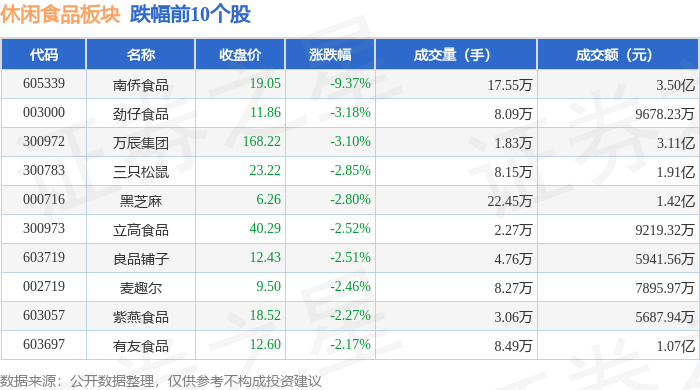
休闲食品板块11月20日跌2.33%,南侨食品领跌,主力资金净流出1.78亿元
Zheng Xing Xing Ye Ri Bao· 2025-11-20 09:09
Market Overview - The leisure food sector experienced a decline of 2.33% on November 20, with Nanjiao Food leading the drop [1] - The Shanghai Composite Index closed at 3931.05, down 0.4%, while the Shenzhen Component Index closed at 12980.82, down 0.76% [1] Individual Stock Performance - Nanjiao Food (605339) closed at 19.05, down 9.37% with a trading volume of 175,500 shares [1] - Jin Zai Food (003000) closed at 11.86, down 3.18% with a trading volume of 80,900 shares [1] - Wanchen Group (300972) closed at 168.22, down 3.10% with a trading volume of 18,300 shares [1] - Three Squirrels (300783) closed at 23.22, down 2.85% with a trading volume of 81,500 shares [1] - Black Sesame (000716) closed at 6.26, down 2.80% with a trading volume of 224,500 shares [1] - Other notable declines include Lihai Food (300973) down 2.52% and Liangpinpuzi (603719) down 2.51% [1] Capital Flow Analysis - The leisure food sector saw a net outflow of 178 million yuan from main funds, while retail investors contributed a net inflow of 118 million yuan [1] - Speculative funds recorded a net inflow of 60.43 million yuan [1] Detailed Capital Flow for Selected Stocks - Lihai Food (300973) had a main fund net inflow of 5.90 million yuan, but a retail net outflow of 13.17 million yuan [2] - Ziyan Food (603057) experienced a main fund net inflow of 42,400 yuan, with a retail net outflow of 1.79 million yuan [2] - Maquur (002719) had a negligible main fund net inflow of 4,364 yuan, with a retail net outflow of 127,690 yuan [2] - Other stocks like Guangzhou Restaurant (603043) and Huangshanghuang (002695) also reported net outflows from main funds [2]




福建女首富正式接班,能否重振“乡镇之王”达利食品?
Guan Cha Zhe Wang· 2025-11-19 08:05
Core Insights - Dali Food Group announced that Xu Yangyang, daughter of founder Xu Shihui, officially took over as president in November 2025, leading the company during a challenging period of declining performance and industry transformation [1][9] Company History and Development - Xu Shihui's entrepreneurial journey began in 1989 when he invested his entire savings to buy a second-hand biscuit production line, establishing the precursor to Dali Food [2] - Dali Food was officially founded in 1992, but faced significant competition from brands like Wangwang and Lays as they entered the Chinese market [2] Business Strategy - Dali Food adopted a unique "Dali Model" to compete against foreign brands, focusing on low-priced products, celebrity endorsements, and deep channel penetration [3][5] - The company has historically leveraged aggressive marketing strategies, utilizing popular celebrities for endorsements and maintaining a pricing strategy that undercuts competitors by 30% to 50% [6][8] Financial Performance - Dali Food's revenue peaked at 222.94 billion yuan in 2021 but fell to 199.57 billion yuan in 2022, marking the beginning of a downward trend [10][12] - The company initiated a privatization process in 2023 due to its stock price being undervalued, but subsequent revenue figures for 2023 and 2024 showed continued decline [12][13] Market Challenges - Dali Food has struggled to adapt to new market dynamics, including the rise of e-commerce and competition from direct-to-consumer models, which have eroded its traditional channel advantages [14][16] - The company's reliance on a "pressuring inventory" model has led to issues with distributor relationships and inventory management, further complicating its market position [14] Leadership Transition and Future Strategy - Xu Yangyang aims to transition Dali Food from a "follower" to an "innovator," focusing on brand rejuvenation and product innovation to meet evolving consumer demands [16][17] - The company is pursuing an international expansion strategy, targeting Southeast Asia, with plans to establish production bases in Indonesia, Thailand, Vietnam, and Saudi Arabia [19][20]
从“哈基米”梗到10万+销量:九阳的“玩梗营销”,接住了年轻人的情绪吗?
3 6 Ke· 2025-11-16 21:53
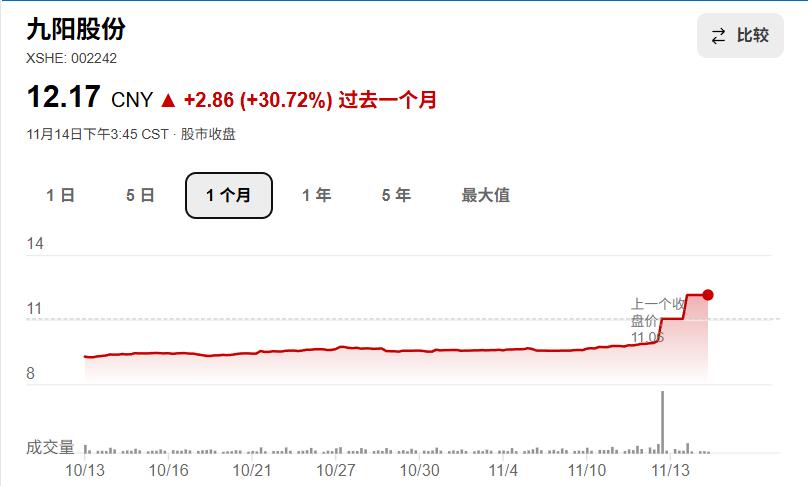
Core Viewpoint - The launch of "Hachimi North-South Mung Bean Milk" by Joyoung has become a viral marketing success, driven by its unique packaging and naming, leading to significant sales and a surge in stock prices for Joyoung despite the product being unrelated to its core business of kitchen appliances [1][13][21]. Product Launch and Sales Performance - Joyoung's new product features a creative packaging design and is priced affordably at 29.9 yuan for 15 bags, resulting in over 10,000 orders within two hours and more than 100,000 units sold on Douyin, leading to a 45-day pre-sale period [1][13]. - The stock price of Joyoung surged to 11.06 yuan, hitting the daily limit, prompting the company to clarify that it does not produce food or beverage products [1][13]. Marketing Strategy and Consumer Engagement - The product's success is attributed to its emotional and symbolic value rather than its functional benefits, reflecting a trend where younger consumers are motivated by emotional resonance and cultural identity [13][21]. - The marketing strategy effectively tapped into the "Hachimi" meme culture, which has become a symbol of absurdity and rebellion, resonating with the target demographic [12][21]. Cultural Context and Meme Evolution - The term "Hachimi" originated from a Japanese anime and evolved into a meme associated with cats, leading to a wave of user-generated content and music that became popular on social media platforms [3][4][10]. - The combination of the "Hachimi" meme and the viral orange cat character created a new cultural phenomenon, further enhancing the product's appeal [10][12]. Consumer Behavior Insights - The phenomenon illustrates a shift in consumer behavior where individuals purchase products not solely for their utility but to express identity and engage with cultural trends [13][21]. - Joyoung's approach demonstrates the importance of aligning marketing strategies with the values and interests of younger consumers, fostering a sense of community and shared experience [15][21]. Conclusion - The success of "Hachimi North-South Mung Bean Milk" highlights the effectiveness of playful and culturally relevant marketing in capturing the attention of younger consumers, suggesting that brands can achieve unexpected success by embracing contemporary cultural narratives [21][22].

休闲食品板块11月12日跌0.01%,桂发祥领跌,主力资金净流出1.71亿元
Zheng Xing Xing Ye Ri Bao· 2025-11-12 08:42
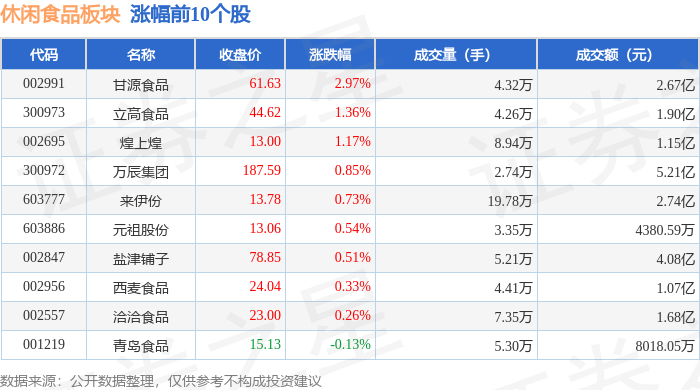
Market Overview - The leisure food sector experienced a slight decline of 0.01% on November 12, with Gui Faxiang leading the drop [1] - The Shanghai Composite Index closed at 4000.14, down 0.07%, while the Shenzhen Component Index closed at 13240.62, down 0.36% [1] Stock Performance - Notable gainers in the leisure food sector included: - Ganyuan Food: closed at 61.63, up 2.97% with a trading volume of 43,200 lots and a transaction value of 267 million [1] - Lihai Food: closed at 44.62, up 1.36% with a trading volume of 42,600 lots and a transaction value of 206.1 million [1] - Major decliners included: - Gui Faxiang: closed at 14.30, down 2.26% with a trading volume of 273,100 lots and a transaction value of 394 million [2] - Ziyan Food: closed at 19.27, down 2.18% with a trading volume of 29,900 lots and a transaction value of 58.19 million [2] Capital Flow - The leisure food sector saw a net outflow of 171 million from institutional investors, while retail investors contributed a net inflow of 249 million [2] - Specific stock capital flows included: - Ganyuan Food: net inflow of 17.70 million from institutional investors, with a net outflow of 12.58 million from speculative funds [3] - Lihai Food: net inflow of 10.29 million from institutional investors, with a net outflow of 7.30 million from speculative funds [3]


桃李面包:公司一直以“让更多人爱上面包”为使命
Zheng Quan Ri Bao Zhi Sheng· 2025-11-11 14:12
Core Viewpoint - The company aims to enhance its market position in the bread industry by focusing on high cost-performance and health safety, while continuously optimizing its national market layout through various strategies [1] Group 1 - The company’s mission is to "make more people love bread" [1] - The company is committed to high cost-performance and health safety as its core values [1] - The company is implementing multi-dimensional strategies such as capacity expansion, channel optimization, and strong R&D to solidify its industry position [1]
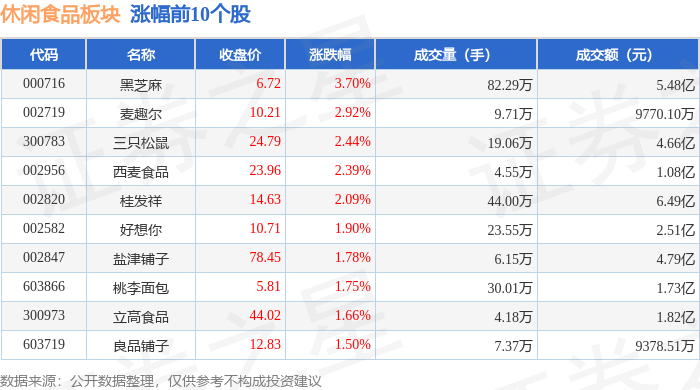
休闲食品板块11月11日涨0.93%,黑芝麻领涨,主力资金净流入3460.97万元
Zheng Xing Xing Ye Ri Bao· 2025-11-11 08:37
Market Overview - The leisure food sector increased by 0.93% on November 11, with Hei Zhima leading the gains [1] - The Shanghai Composite Index closed at 4002.76, down 0.39%, while the Shenzhen Component Index closed at 13289.0, down 1.03% [1] Stock Performance - Hei Zhima (000716) closed at 6.72, up 3.70% with a trading volume of 822,900 shares and a transaction value of 548 million [1] - Other notable performers include: - Mai Jiao Er (002719) at 10.21, up 2.92% [1] - San Zhi Song Shu (300783) at 24.79, up 2.44% [1] - Xi Mai Food (002956) at 23.96, up 2.39% [1] - Gui You Xiang (002820) at 14.63, up 2.09% [1] Capital Flow - The leisure food sector saw a net inflow of 34.61 million from main funds, while retail funds experienced a net outflow of 25.13 million [2] - The main funds' net inflow for Hei Zhima was 39.29 million, representing 7.17% of its total trading volume [3] - San Zhi Song Shu had a main fund net inflow of 30.52 million, accounting for 6.55% of its trading volume [3] Individual Stock Analysis - Hei Zhima experienced a significant net outflow from retail investors of 42.06 million, indicating a divergence in investor sentiment [3] - San Zhi Song Shu also faced a retail net outflow of 26.17 million, suggesting potential concerns among smaller investors [3] - Other stocks like Yan Jin Pu Zi (002847) and Xi Mai Food (002956) showed mixed capital flows, with Yan Jin Pu Zi having a net inflow from main funds of 13.91 million [3]

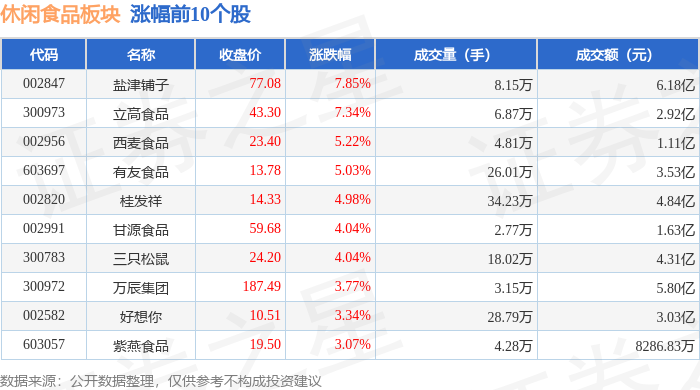
休闲食品板块11月10日涨3.63%,盐津铺子领涨,主力资金净流入1.99亿元
Zheng Xing Xing Ye Ri Bao· 2025-11-10 08:48
Core Insights - The leisure food sector experienced a significant increase of 3.63% on November 10, with Yanjinpuzi leading the gains [1] - The Shanghai Composite Index closed at 4018.6, up 0.53%, while the Shenzhen Component Index closed at 13427.61, up 0.18% [1] Sector Performance - Yanjinpuzi (002847) saw a closing price of 77.08, with a rise of 7.85% and a trading volume of 81,500 shares, amounting to a transaction value of 618 million yuan [1] - Ligao Food (300973) closed at 43.30, increasing by 7.34% with a trading volume of 68,700 shares, totaling 292 million yuan [1] - Ximai Food (002956) closed at 23.40, up 5.22%, with a trading volume of 48,100 shares and a transaction value of 111 million yuan [1] - Youyou Food (603697) closed at 13.78, increasing by 5.03% with a trading volume of 126,010 shares, amounting to 353 million yuan [1] - Guifaxiang (002820) closed at 14.33, up 4.98%, with a trading volume of 342,300 shares and a transaction value of 484 million yuan [1] Capital Flow - The leisure food sector saw a net inflow of 199 million yuan from main funds, while retail investors experienced a net outflow of 213 million yuan [1] - Youyou Food (603697) had a main fund net inflow of 39.92 million yuan, but retail investors had a net outflow of 37.03 million yuan [2] - Guifaxiang (002820) recorded a main fund net inflow of 34.32 million yuan, with retail investors seeing a net outflow of 51.87 million yuan [2] - Sanzi Songshu (300783) had a main fund net inflow of 30.50 million yuan, while retail investors faced a net outflow of 36.72 million yuan [2]

品牌工程指数 上周收报2021.77点
Zhong Guo Zheng Quan Bao· 2025-11-09 22:51
Market Performance - The market experienced a volatile upward trend last week, with the Shanghai Composite Index rising by 1.08%, the Shenzhen Component Index by 0.19%, and the ChiNext Index by 0.65% [2] - The China Securities Index reported a decrease of 0.40%, closing at 2021.77 points [2] Strong Stock Performances - Notable strong performers included Zhongwei Company, which increased by 10.66%, and Darentang, which rose by 8.80% [2] - Other significant gainers were Yangguang Electric Power and Yiwei Lithium Energy, with increases of 5.90% and 5.04% respectively [2] Year-to-Date Stock Gains - Since the beginning of the second half of the year, Zhongji Xuchuang has surged by 236.32%, leading the gains [3] - Yangguang Electric Power follows with a rise of 198.52%, while Yiwei Lithium Energy, Zhaoyi Innovation, and Zhongwei Company have increased by 91.34%, 75.11%, and 69.86% respectively [3] Market Outlook - Short-term market sentiment is expected to remain volatile, with basic economic factors potentially having a reduced impact on stock structure [4] - Long-term perspectives suggest that the current market risk premium is at a historical median level, with equity asset valuations remaining reasonable [4] - The market is anticipated to shift from valuation-driven growth to fundamental-driven growth as domestic economic stability improves [4] Investment Focus - Investment strategies should focus on sectors with structural growth potential, particularly in emerging growth areas such as AI technology innovation, energy infrastructure, and semiconductors [4] - Additionally, attention should be given to cyclical sectors that may benefit from "anti-involution" policies and leading companies actively expanding into overseas markets [4]



