
AI科技创新

Search documents
2026年投资机会在哪?权益/固收/商品/海外
Xin Lang Cai Jing· 2026-01-19 03:25
Core Viewpoint - The macroeconomic environment in 2026 is expected to be characterized by a "loose external and stable internal" pattern, with China and the U.S. likely maintaining a "competitive yet non-destructive" relationship, which will continue to influence investment strategies and opportunities [16]. Investment Opportunities - Three main investment directions are highlighted: 1. AI technology innovation, particularly in domestic computing power, edge hardware, and semiconductor supply chains [3][5]. 2. Repricing of resources and manufacturing sectors, focusing on non-ferrous metals (like copper), chemicals, and aviation due to supply-demand gaps [3]. 3. Companies expanding overseas, leveraging China's manufacturing advantages in sectors such as construction machinery, power equipment, and innovative pharmaceuticals [3][5]. Sector-Specific Insights - The technology sector is expected to benefit from inflationary pressures, with upstream price increases in components like optical chips and PCBs showing greater elasticity [7]. - Investment opportunities in the semiconductor sector are anticipated, especially in storage chips (DRAM/SSD) driven by AI demand, and in domestic semiconductor equipment and materials [7][14]. - The robotics industry is seen as a significant area for investment, with leading global companies poised for breakthroughs in design and production [11][12]. Consumer Sector Trends - The consumer sector is entering a "post-consumption era," with opportunities arising from the restructuring of traditional consumer goods and retail channels, focusing on new consumer behaviors and preferences [19]. - Key areas of investment include innovative retail formats, smart product iterations, and emerging consumer categories driven by younger generations [19]. Healthcare Sector Focus - The pharmaceutical industry is expected to see significant developments, particularly in innovative drugs, with a focus on supply, demand, and payment dynamics [21]. - The recovery of the innovative drug supply chain is anticipated, with many companies nearing operational turning points that could lead to earnings surprises and valuation recoveries [21]. Fixed Income and Asset Allocation - The fixed income market is projected to maintain a low interest rate environment, with opportunities for bond trading and a focus on credit quality [28][33]. - A multi-asset allocation strategy is recommended, emphasizing a balance between equity and fixed income investments, with a focus on sectors that can provide stable returns amid economic fluctuations [35][38].

均衡配置 寻找确定性 年底私募投资“关键词”出炉
Zhong Guo Zheng Quan Bao· 2025-11-25 20:29
Core Viewpoint - The recent adjustment in the A-share market is attributed to a combination of internal and external factors, leading to a collective risk-averse behavior among investors [1][2]. Group 1: Market Adjustment Factors - The adjustment is seen as a result of multiple factors, including concerns over the economic fundamentals and a complex external environment, alongside fluctuations in liquidity expectations for December [2]. - The tightening of overseas liquidity, particularly following the Federal Reserve's hawkish stance, has led to a net outflow of foreign capital, putting pressure on high-valuation technology stocks in the A-share market [2]. - Defensive behaviors, such as profit-taking by institutional investors as the year-end approaches, have contributed to short-term market volatility [2][4]. Group 2: Private Equity Strategies - Private equity firms are responding to the high market positions with varied strategies, including maintaining high positions, using derivatives for risk hedging, and actively adjusting portfolios for future market conditions [1][4]. - As of November 14, the average stock position of private equity firms reached 81.13%, with large firms holding an even higher average of 87.07%, indicating a high level of market engagement [4]. - Some firms, like Dushuquan, are employing precise risk hedging techniques, such as purchasing out-of-the-money put options to protect against extreme drawdowns [5]. Group 3: Long-term Market Outlook - Despite short-term challenges, private equity firms maintain confidence in the long-term market, actively seeking new investment opportunities during the adjustment [7]. - Dushuquan emphasizes that the current market adjustment is a "healthy correction" within a long-term upward trend, which can help optimize market leverage levels and trading structures [8]. - Firms are focusing on sectors with structural growth potential that do not rely on overall economic recovery, particularly in emerging growth areas like AI technology, semiconductor, and new consumption trends [7].
年底私募投资“关键词”出炉
Zhong Guo Zheng Quan Bao· 2025-11-25 20:27
Core Viewpoint - The recent adjustment in the A-share market is attributed to a combination of internal and external factors, leading to a collective risk-averse behavior among funds [1][2]. Group 1: Market Adjustment Factors - The market adjustment is seen as a result of multiple factors, including concerns over the economic fundamentals and a complex external environment, alongside fluctuations in liquidity expectations for December [2]. - The tightening of overseas liquidity, particularly following the Federal Reserve's hawkish stance, has led to a net outflow of foreign capital, putting pressure on high-valuation technology sectors in A-shares [2]. - Defensive behaviors, such as institutions cashing in on floating profits as the year-end approaches, have contributed to short-term market volatility [2]. Group 2: Private Equity Strategies - Private equity firms have adopted varied strategies in response to the high market positions, with an average stock position of 81.13% among private equity firms, reaching a 112-week high [3]. - Some firms, like Zhiyu Zhi Shan, utilize risk hedging techniques, such as purchasing out-of-the-money put options to protect against extreme drawdowns [4]. - Others, like Yongjin Investment, have adjusted their portfolios to include cyclical stocks while maintaining a balanced approach to technology sectors [4]. Group 3: Long-term Market Outlook - Despite short-term challenges, private equity firms maintain confidence in the long-term market, actively seeking new investment opportunities during the adjustment [4][5]. - Firms like Dushuquan emphasize that the current market does not exhibit systemic bubbles, focusing on sectors with structural growth potential that can sustain performance without relying on overall economic recovery [5]. - The adjustment is viewed as a healthy correction within a long-term upward trend, helping to manage leverage levels and optimize market trading structures [5].
品牌工程指数 上周收报2021.77点
Zhong Guo Zheng Quan Bao· 2025-11-09 22:51
Market Performance - The market experienced a volatile upward trend last week, with the Shanghai Composite Index rising by 1.08%, the Shenzhen Component Index by 0.19%, and the ChiNext Index by 0.65% [2] - The China Securities Index reported a decrease of 0.40%, closing at 2021.77 points [2] Strong Stock Performances - Notable strong performers included Zhongwei Company, which increased by 10.66%, and Darentang, which rose by 8.80% [2] - Other significant gainers were Yangguang Electric Power and Yiwei Lithium Energy, with increases of 5.90% and 5.04% respectively [2] Year-to-Date Stock Gains - Since the beginning of the second half of the year, Zhongji Xuchuang has surged by 236.32%, leading the gains [3] - Yangguang Electric Power follows with a rise of 198.52%, while Yiwei Lithium Energy, Zhaoyi Innovation, and Zhongwei Company have increased by 91.34%, 75.11%, and 69.86% respectively [3] Market Outlook - Short-term market sentiment is expected to remain volatile, with basic economic factors potentially having a reduced impact on stock structure [4] - Long-term perspectives suggest that the current market risk premium is at a historical median level, with equity asset valuations remaining reasonable [4] - The market is anticipated to shift from valuation-driven growth to fundamental-driven growth as domestic economic stability improves [4] Investment Focus - Investment strategies should focus on sectors with structural growth potential, particularly in emerging growth areas such as AI technology innovation, energy infrastructure, and semiconductors [4] - Additionally, attention should be given to cyclical sectors that may benefit from "anti-involution" policies and leading companies actively expanding into overseas markets [4]



品牌工程指数上周收报2021.77点
Zhong Guo Zheng Quan Bao· 2025-11-09 20:15
Market Performance - The market experienced a volatile upward trend last week, with the CSI Xinhua National Brand Engineering Index closing at 2021.77 points, down 0.40% [1] - The Shanghai Composite Index rose by 1.08%, the Shenzhen Component Index by 0.19%, the ChiNext Index by 0.65%, and the CSI 300 Index by 0.82% [1] Strong Stock Performances - Notable strong performers included Zhongwei Company, which increased by 10.66%, and Darentang, which rose by 8.80% [1] - Other significant gainers included Yangguang Electric Power (5.90%), Yiwei Lithium Energy (5.04%), and several stocks that rose over 4% such as Yiling Pharmaceutical and Guangyuyuan [1] Long-term Market Outlook - Institutions believe that while the market may maintain volatility in the short term, the long-term outlook for equity assets remains reasonable, with potential for further upward movement as policies stabilize the domestic economy [1][2] - Starstone Investment indicates that the current market risk premium is at a historical median level, and corporate earnings have likely reached a bottom, suggesting a shift from valuation-driven to fundamentals-driven market growth [2] Sector Focus - Freshwater Spring Investment suggests that while A-shares and Hong Kong stocks have seen some recovery in valuations, there is no systemic bubble, and the likelihood of systemic risk remains low [3] - The focus should be on sectors with structural growth potential, particularly in emerging growth areas such as AI technology innovation, energy infrastructure, and semiconductors, as well as cyclical sectors benefiting from "anti-involution" policies [3]



建信保险资管杨雪梅:发挥保险资金优势,持续加大科技创新投资力度
券商中国· 2025-11-09 06:21
Core Viewpoint - The article emphasizes the importance of insurance asset management companies, like Jianxin Insurance Asset Management, in supporting the development of technology finance and innovation in China, aligning with the national strategy of becoming a technology powerhouse [2][5]. Investment Strategies - Jianxin Insurance Asset Management is focusing on emerging fields such as artificial intelligence, robotics, intelligent driving, large models, and biomedicine, increasing its investment scale in these areas [2][3]. - The company employs a top-down asset allocation strategy for equity investments, aiming to increase the proportion of investments in technology innovation companies while ensuring return rates and asset volatility constraints [3][4]. - From the second half of 2024, the company plans to intensify research in AI technology, new energy technologies, and innovative pharmaceuticals, including overseas computing power construction and domestic semiconductor independence [3][4]. Investment Scale - As of July 2025, Jianxin Insurance Asset Management's total investment in technology innovation amounts to 22.9 billion, with 6.204 billion in technology innovation stocks, 6.171 billion in technology innovation bonds, and 5.145 billion in technology equity investment funds [4]. Risk Management - The company recognizes the challenges of balancing risk and return in technology innovation investments, which are characterized by rapid technological changes and significant asset price volatility [6][8]. - Four key measures are implemented to manage risks: enhancing research capabilities, optimizing investment strategies to diversify across various technology sectors, focusing on safety margins during investment, and improving post-investment management [7][8]. Challenges and Solutions - Challenges include the high barriers to researching and investing in technology innovation companies, significant stock price volatility, and the long investment cycles associated with equity investments [8][9]. - Solutions involve leveraging the parent company's resources for comprehensive research and enhancing the evaluation system for equity investments to align with long-term investment logic [9].

双重底层逻辑支撑 私募认为A股将走向新阶段
Zheng Quan Ri Bao Wang· 2025-11-05 11:12
Core Viewpoint - The A-share market is expected to enter a new phase supported by dual underlying logic: the increasing importance of capital markets in wealth allocation and a shift in market pricing logic from valuation-driven to fundamental-driven [1][2] Group 1: Market Outlook - The A-share market has seen a rise in valuations, but there is no systemic bubble present [1] - Capital markets may experience temporary disturbances but are unlikely to cool down significantly [1] - The focus will shift from sector effects to individual stock effects in the future [1] Group 2: Investment Focus - The company will concentrate on sectors with structural growth potential that can maintain profitability without relying on overall economic recovery [1] - Key areas of interest include emerging growth sectors such as AI technology innovation and energy infrastructure [1] - The semiconductor industry is expected to enter a critical breakthrough period as domestic technology, capacity, and supply chains improve [1] - Changes in global young consumer behavior are anticipated to create sustained growth opportunities in service-oriented and emotional value-driven consumption [1] Group 3: Cyclical Sector Opportunities - The "anti-involution" policy is expected to bring structural opportunities, shifting industry growth logic from disorderly expansion to quality improvement [2] - Leading companies with competitive advantages are likely to benefit from industry policy guidance and market clearing [2] - Expanding into overseas markets has become a necessary strategy for many leading companies, opening new growth avenues [2]
聚势而行启新局、进而有为筑未来 “2025中金财富1018发布会”圆满结束
Zheng Quan Ri Bao Zhi Sheng· 2025-10-19 10:15
Core Insights - The event "2025 CICC Wealth 1018 Conference" focused on macro research, buy-side advisory, global allocation, fintech, and inclusive finance, highlighting the unique attractiveness of the Chinese market driven by technological breakthroughs and resilient manufacturing upgrades [1] - The wealth management industry is transitioning from a "product-selling" model to a "service-oriented" model, with CICC Wealth leading the buy-side advisory transformation, achieving over 120 billion yuan in assets under management by July 2023, and recently surpassing 120 billion yuan [1][2] Group 1: Buy-Side Advisory Transformation - CICC Wealth has developed a buy-side advisory service system, including "China 50" and "Micro 50," focusing on long-term value and detailed customer needs [1] - The company has constructed over 11,000 different strategy lines across equity assets, alternative assets, and global assets to address clients' asset allocation challenges in a low-interest-rate environment [2] - CICC Wealth is innovating its trading business model to be more client-centric, integrating research, multi-product trading, and exclusive execution services [2] Group 2: AI and Global Investment Opportunities - The introduction of cross-border investment channels like Stock Connect and Wealth Management Connect has expanded product choices and investment tools for investors [3] - CICC Wealth aims to provide a comprehensive service framework for global asset allocation, leveraging its global network and deep research capabilities [3] - The application of AI technology is accelerating the transformation of the wealth management industry, with discussions on how AI can enhance client experience in wealth management [3]
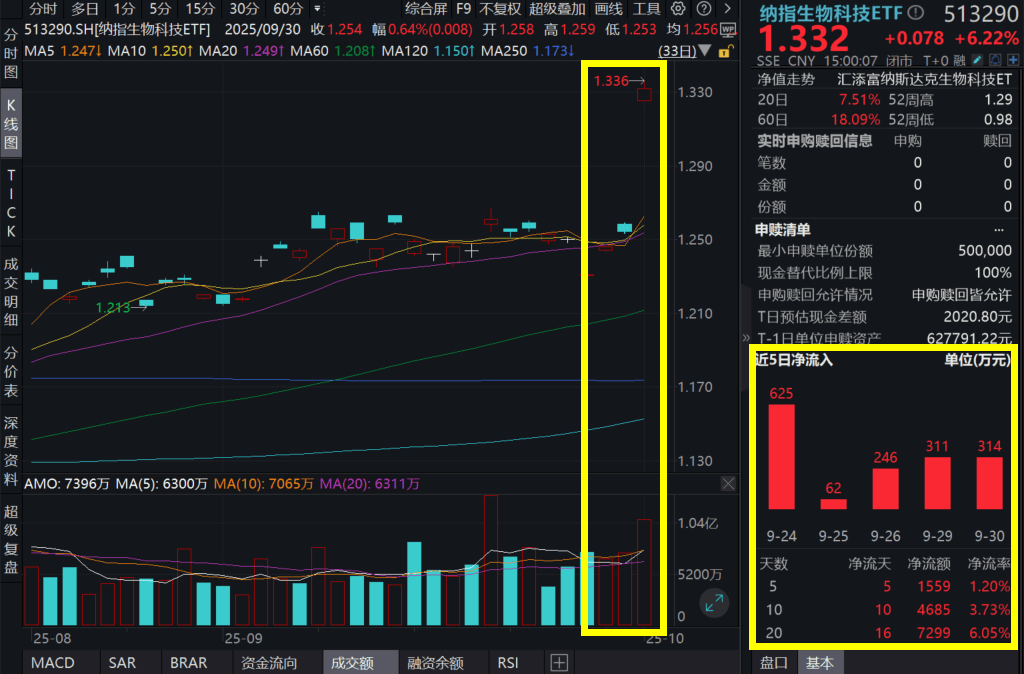
美联储降息再迎大消息,纳指生科创年内新高,纳指生物科技ETF(513290)强势收涨6.22%,连续16日获资金加仓,“吸金”近7300万元
Sou Hu Cai Jing· 2025-10-09 10:05
Group 1 - The core viewpoint of the articles highlights the mixed performance of the U.S. stock market, with the Nasdaq and S&P 500 reaching new closing highs, while the Dow remained flat [1] - The Nasdaq Biotechnology Index saw a rise of 0.89%, with several component stocks experiencing significant gains, such as KYTX up over 32% and NTLA up over 19% [2][3] - The Nasdaq Biotechnology ETF (513290) experienced a substantial increase of 6.22%, with strong net inflows for 16 consecutive days [1][2] Group 2 - The Federal Reserve's recent meeting minutes indicate that more than half of the participating officials expect at least two more rate cuts this year, while some anticipate only one or no cuts in 2025 [4][5] - Pfizer announced a voluntary price reduction of up to 85% on many of its foundational and specialty drugs, which has positively impacted its stock price and those of other pharmaceutical companies [5] - The Nasdaq Biotechnology Index (NBI) serves as a key indicator for global innovative pharmaceuticals, combining top U.S. biotech leaders and international innovators, with the top ten weighted stocks accounting for nearly 50% of the index [6][7] Group 3 - The Nasdaq Biotechnology ETF (513290) is the only ETF that focuses on global innovative pharmaceuticals, with a low entry point of around 100 yuan, making it accessible for investors [7] - The minimum subscription unit for the Nasdaq Biotechnology ETF has been reduced from 1 million to 500,000 units, lowering the barrier for entry for larger investors [7]
美团:将扩大“到店自提专属优惠” 覆盖,引导堂食消费
Xin Lang Ke Ji· 2025-08-05 09:55
Core Viewpoint - Meituan has launched a support plan for small and medium-sized restaurants to promote healthy industry development amid intensified competition and price wars in the restaurant sector [1][2] Group 1: Support Measures for Small and Medium-sized Restaurants - Meituan will provide cash assistance to small and medium-sized restaurants, with a maximum of 50,000 yuan per store, aiming to cover over 100,000 restaurants by the end of the year [1] - The company plans to help 200,000 small stores complete infrastructure upgrades by reserving half of the space in its "Raccoon Canteen" for all restaurant businesses to enter and receive support funds [1] - Meituan will expand the coverage of "in-store self-pickup exclusive discounts" to encourage dine-in consumption and reduce the visibility of low-price promotions, promoting healthy competition based on quality [1] Group 2: Technological Support - Meituan has launched AI management tools that will be offered for free to all businesses in the industry, including features for store location selection, menu development, smart decoration, customer service, and operational analysis [2] - The initiative aims to enhance operational efficiency for small and medium-sized merchants, lower the digital operation threshold, and alleviate the workload of business owners [2]
