
SpaceX

Search documents
X @Starlink
Starlink· 2026-03-11 20:36
Starlink and Roam service plans keep you connected on the go 🛰️🚐OffRoadCampingBoys (@OffRoadCampBoys):@elonmusk Starlink is amazing!Took our mini with overlanding Big Island, Hawaiʻi https://t.co/F8x93tSPNa ...
Billionaires and businesses fuel growing exodus from blue states
Fox Business· 2026-03-11 20:26
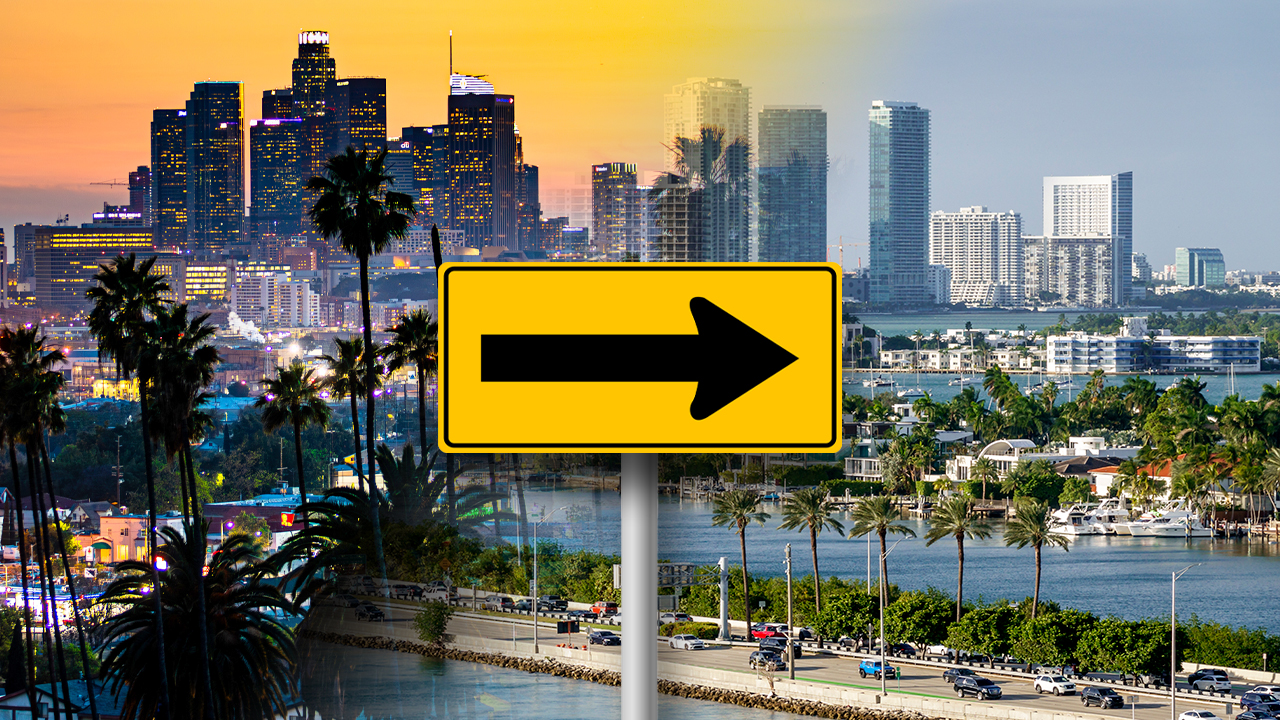
Core Insights - A significant trend is emerging where billionaires, CEOs, and major corporations are relocating from blue states to red states due to lower taxes, fewer regulations, and a more favorable business environment [1] Company Relocations - Palantir Technologies moved its headquarters from Denver to Miami in February [3] - ExxonMobil announced its relocation from New Jersey to Texas, citing a pro-business legal environment [4] - Public Storage is moving its corporate headquarters from Glendale, California, to Frisco, Texas [5] - Yamaha Motor Co. is relocating its U.S. headquarters from California to Georgia [8] - SpaceX and X moved their headquarters from California to Texas, with Elon Musk citing policy concerns [9] - Tesla officially moved its corporate headquarters from Palo Alto, California, to Texas in December 2021 [12] - Chevron plans to relocate its headquarters from San Ramon, California, to Houston, Texas [13] - Playboy Enterprises is moving its Los Angeles headquarters to Miami Beach [14] - Oracle announced its headquarters move to Nashville, Tennessee, after previously relocating from California to Texas [17] High-Profile Individual Moves - Howard Schultz, former CEO of Starbucks, moved to Florida from Washington state [20] - Jeff Bezos announced his move from Seattle to Miami in 2023 [21] - Ken Griffin relocated Citadel's headquarters from Chicago to Miami in 2022 [22] - Peter Thiel established a new office for Thiel Capital in Miami [25] - Stephen Ross moved from New York to Florida [26] - Mark Zuckerberg and Priscilla Chan purchased a property in the Miami area for under $200 million [27] - Sergey Brin reportedly acquired a $51 million property in northern Miami Beach [28] - Elon Musk moved to Texas in 2020 [31] Economic Implications - Florida, with no state income tax, is becoming increasingly attractive to wealthy individuals [32] - California lawmakers are considering new taxes targeting ultra-wealthy individuals, which may further drive wealth migration [32]

X @Tesla Owners Silicon Valley
Tesla Owners Silicon Valley· 2026-03-11 20:00
2014 footage of Elon Musk teaching first principles thinking to kids at Ad Astra — the groundbreaking school he founded at SpaceX HQ.“A first principles foundational approach would be to say, let’s look at the physics and economics of a rocket…”This is the exact mindset that built reusable rockets and changed the world: break problems down to the most fundamental truths instead of reasoning by analogy. Pure genius being passed to the next generation. 🚀🧠 ...
X @Tesla Owners Silicon Valley
Tesla Owners Silicon Valley· 2026-03-11 17:56
RT Tesla Owners Silicon Valley (@teslaownersSV)Hey @grok, how many SpaceX launches are planned for 2026? https://t.co/rvD4fGXEJn ...

X @SpaceX
SpaceX· 2026-03-11 17:35
It worked! DART successfully shifted the orbit of not one, but two asteroids around the Sun after Falcon 9 launched the spacecraft in 2021 → https://t.co/XRqXZumZBk https://t.co/G1kBkx5EQ3SpaceX (@SpaceX):@NASA Congratulations on successfully crashing a spacecraft into an asteroid! ...
FCC chair criticizes slow pace of Amazon satellite launches
Reuters· 2026-03-11 17:23
Group 1 - The FCC Chair Brendan Carr criticized Amazon for focusing on SpaceX's satellite plans instead of advancing its own satellite launches and constellation [1] - Amazon's satellite unit, Amazon Leo, expressed concerns about SpaceX's plan to launch a constellation of up to 1 million satellites [1]


Elon Musk's Plan To 'Simulate Microsoft' Crumbles—And Tesla Is Picking Up The Pieces - Tesla (NASDAQ:TSLA)
Benzinga· 2026-03-11 17:20
Core Insights - The Macrohard project by xAI, initially pitched as a potential competitor to Microsoft, is now reportedly stalled and lacks leadership [1][2][3] Group 1: Project Status - Macrohard has faced significant setbacks, including leadership departures, a hiring freeze, and the suspension of a major data project that employed 600 contractors [2] - Over 20 engineers have left Macrohard, and the project currently has no leader or job postings, indicating a lack of momentum [3] Group 2: Company Dynamics - xAI has lost six of its 12 original co-founders, with former staff describing the company as being in a "catch-up" phase against competitors like OpenAI and Anthropic [3] - Tesla is reportedly reallocating resources from Macrohard to its own AI initiatives, such as "Digital Optimus," which aims to operate computers autonomously [4] Group 3: Financial Implications - Tesla disclosed a $2 billion investment in xAI as part of its Master Plan Part IV, which now represents a stake in the merged SpaceX-xAI entity [5] - The future trajectory of Digital Optimus remains uncertain, especially with recent leadership losses in Tesla's AI teams [5] Group 4: Market Predictions - Prediction markets indicate a low probability of xAI's Grok model shipping by the end of March, with only 4% odds, and a mere 8% chance of it being the best AI model by the end of June [6] - Traders assign only 33% odds for the Cybercab to sell for under $30,000 this year, and just 18% for Optimus to reach consumers by year-end [7]
Musk unveils Tesla-xAI project ‘Macrohard' to emulate software companies
Invezz· 2026-03-11 17:13
Group 1: Project Overview - The project "Macrohard" is a joint initiative between Tesla and xAI, aimed at emulating the functions of software companies using artificial intelligence [1][2] - The system combines xAI's Grok model with a Tesla-developed AI agent, designed to autonomously perform software tasks by processing real-time screen video and inputs [1][2] - Musk described the project as capable of emulating entire companies, referencing Microsoft in a tongue-in-cheek manner [1][2] Group 2: Industry Context - The unveiling of Macrohard comes amid rising concerns in the software industry regarding agentic AI systems that can autonomously execute digital tasks, potentially disrupting traditional business models [1][2] - The launch of competing AI systems, such as Anthropic's Claude Cowork, has already unsettled software investors [1][2] Group 3: Technological Infrastructure - The Macrohard system will utilize Tesla's in-house AI4 chip along with Nvidia-based server hardware from xAI, which Musk claims is a cost-competitive setup [1][2] - xAI filed a trademark application for "Macrohard" in August 2025, indicating a formal commitment to the project [1][2] Group 4: Corporate Strategy - Tesla's investment of approximately $2 billion in xAI reflects a deepening collaboration on AI systems [1][2] - SpaceX's acquisition of xAI, valued at $250 billion, signifies a strategic expansion into AI infrastructure, with Musk emphasizing the importance of orbital data centers for future AI ecosystems [1][2] Group 5: Energy Demand - The rapid growth of AI technologies is increasing energy demands, prompting Tesla and other companies to form a lobbying group called Utilize to address rising electricity costs [1][2] - Electricity prices have surged by 44% since the pandemic began, with AI data centers contributing significantly to this demand [1][2]
X @Forbes
Forbes· 2026-03-11 17:07
At the top of the world’s richest is Elon Musk—and he keeps setting new records.His fortune soared past $800 billion in February after he merged rocket maker SpaceX with his artificial intelligence and social media company xAI in a deal valuing the combined firm at $1.25 trillion.A successful IPO of the merged company later this year could make Musk the world’s first trillionaire.Read more about the leader of our 2026 #ForbesBillionaires list: https://t.co/6xLkVMj1ZU ...
X @Bloomberg
Bloomberg· 2026-03-11 16:42
The head of the Federal Communications Commission chastised Amazon for filing a petition critical of rival satellite operator SpaceX while Amazon itself is behind on meeting deployment obligations https://t.co/VJcFGknJCH ...